At the Liberty Fund conference on "Liberty and Violence," one of the participants was a primatologist who studies bonobos in Africa. At one point in our discussion of Steven Pinker's Better Angels of Our Nature, she complained about how Pinker unfairly dismisses the evidence for peaceful cooperation among bonobos, in contrast to the violence of chimpanzees. She noted that Pinker relies on primatologists who study chimps or who have only studied bonobos in zoos, and who want to make bonobos look like chimps in their tendency to violence.
She explained that in the wild bonobo females serve a policing function, in that they intervene in fights to moderate conflicts through impartial mediation, because they benefit from living in a stable social order that is not disrupted by violence.
She also observed that bonobos--like all primates--show a range of personality types, so that some individuals have more violent temperaments than others, and consequently the occurrence of violence can depend on the contingency of whether there are such violent individuals in the group. She said that many of the deaths of the males comes from "testosterone poisoning"--young males vigorously displaying their virility in the forest canopy can kill themselves by slamming into a tree.
She also said that if dominant males are grouped together in zoos without females who can moderate their male conflicts, then nasty fighting is likely to break out. She explained then that what the females are doing in the wild groups in pacifying conflicts is "niche construction"--behavior that creates a social environment in which stable and peaceful cooperation is adaptive.
Here she was appealing to an idea developed by F. John Odling-Smee, Kevin Laland, and Marcus Feldman in Niche Construction: The Neglected Process in Evolution (Princeton University Press, 2003). In most of evolutionary theory, we think of organisms as carrying genes, and the inheritance of these genes by the next generation depends on organisms surviving and reproducing according to chance and natural selection in their environments. But there is another process of evolution that arises from organisms changing their environments, which modifies the natural selection pressures in their environments. This is evolutionary niche construction. Among many animals, evolutionary niche construction includes the transmission of culturally learned traditions. And among human beings, it includes the transmission of culturally learned symbolic systems such as art, science, religion, and philosophy.
In response to this discussant's comment about social niche construction among bonobos, I suggested that the history of classical liberalism is evolutionary niche construction, and that this is a big part of Pinker's argument: the history of classical liberal philosophy has created a cultural moral environment of liberalism in which peaceful cooperation and declining violence are adaptive. (This is what Deirdre McCloskey would identify as the work of rhetorical entrepreneurs in the marketplace of ideas who have used moral persuasion to create a liberal culture that honors the bourgeois virtues.)
As Pinker argues, human nature is a mixture of Inner Demons and Better Angels. Human beings are innately predisposed to violence by their Inner Demons, but the expression of those predispositions is not "hydraulic"--that is, a drive that must necessarily be satisfied--but "strategic"--that is, a propensity that is responsive to environmental triggers. Classical liberalism constructs a cultural niche of social institutions, mental attitudes, and moral traditions that tend to elicit the Better Angels to motivate voluntary cooperation and nonviolent relationships.
In this way, human nature constrains but does not determine human culture and individual judgment. Within the constraints of human nature as a mixture of Inner Demons and Better Angels, classical liberalism can foster those cultural traditions and individual judgments that limit the Inner Demons and channel the Better Angels towards a system of liberty and voluntarism.
A few of the people at this Liberty Fund conference were such fervent critics of the Pinker argument that they resolutely rejected this claim that there has been a historical trend towards declining violence as fostered by classical liberal culture. But by the end of our discussions, I had a strong impression that many--and maybe most--of the people there found the Pinker argument persuasive, even if one could dispute some of Pinker's evidence and argumentation.
Nevertheless, even those of us who were persuaded by Pinker were left with the unsettling conclusion that while the general historical trend of declining violence and increasing liberty was encouraging, the contingencies of history make it impossible to predict that this trend will continue unbroken into the future.
There was a lot of discussion of whether Pinker's science is a falsifiable and predictive science. I argued that Pinker's science is a historical science, as opposed to nonhistorical sciences like physics and chemistry. In a historical science, one can make retrospective predictions about the past and make only broad pattern predictions about the future. One cannot precisely predict the future. And, indeed, Pinker stresses that he is only claiming that we can see declining violence in past history, and that we cannot be sure that this will continue into the future. His entire book, as he indicates in the first paragraph (xxi), is looking backward, so that he does not, because he cannot, make precise predictions about the future.
Pinker suggests that there are four possible historical trends in war--escalation, cyclical, random, and declining sawtooth (191-92). He is arguing for seeing the trend as a declining sawtooth. The way he draws this pattern through the Second World War as one data point shows that in a declining sawtooth pattern, there can be generally decline in violence, while still allowing for a sudden jump in violence towards the greatest single atrocity in human history--55 million violent deaths in the Second World War--which indicates the radical contingency in Pinker's historical science.
This contingency is made evident in Pinker's book by his noting how three individuals acting under the influence of illiberal ideologies were responsible for the greatest atrocities of the 20th century. The Second World War would not have occurred without Hitler. The Great Purge in the Soviet Union would not have occurred without Stalin. The Great Famine and the Cultural Revolution in China would not have occurred without Mao. So "tens of millions of deaths ultimately depended on the decisions of just three individuals" (343).
It will always be possible for such individuals to appear in circumstances that allow them to rise to positions of power that enable them to perpetrate mass atrocities of violence. But this can be made unlikely insofar as classical liberalism as evolutionary niche construction continues to spread, making us more like bonobos and less like chimpanzees.
Some of these points are elaborated in my series of posts on Pinker (in October to December of 2011) and in my post on "The Behavioral Ecology of Chimpanzee War and Liberal Peace."
Showing posts sorted by relevance for query niche construction. Sort by date Show all posts
Showing posts sorted by relevance for query niche construction. Sort by date Show all posts
Saturday, March 22, 2014


Thursday, April 24, 2025
The Evolutionary Symbolic Niche Construction of Liberalism Through Lockean "Consent"
Locke's teaching that government arises from the consent of the people is well known. But it's not well known that Locke explains the emergence of all social institutions as created by popular consent. Human beings have created not only government (ST, 95-99) but also languages (ECHU, III.2.8), families (ST, 74-83), morality (ECHU, 28.10), and money (ST, 36) by consenting to their existence. This is what I have called the evolutionary symbolic niche construction of Lockean liberalism. Of course, Locke does not use this terminology, but it's the best way to explain what he means in claiming that human beings create social institutions by consenting to them.
We should start by seeing that Locke was answering the fundamental question of modern intellectual life.
HOW MANY WORLDS ARE THERE?
If we accept the modern scientific explanation of the natural world as it arose in the seventeenth century, how can we explain the human mind and human society?
There are at least three ways to answer this question. One way is to assume that there is only one world, and therefore the mind and society must be explained as arising somehow from the natural world as studied by modern science. Another way is to assume that there are two worlds, because the natural world of science is separated from the human world of mind and society. A third way is to assume that there are three worlds--the natural world of objective facts, the mental world of subjective experience, and the cultural world of social ideas and practices.
According to the first way, the natural sciences, the social sciences, and the humanities should become parts of one universal science of nature. According to the second way, there is an unbridgeable gulf between the natural sciences and the human sciences. According to the third way, the unbridgeable gulf separates three realms of thought about three different worlds: the natural sciences are separated from the psychological sciences, and both are separated from the social sciences and humanities.
As should be evident from many of my posts, I think the first way is best. There are two different intellectual strategies for achieving this one-world vision--reductive physicalism and emergent evolution. According to reductive physicalism, the complete unification of all knowledge of the natural world would ultimately require explaining everything through physics. According to emergent evolution, which is the position that I take, the history of the universe is a history of emergent complexity, in which higher levels of complexity arise from lower levels, and while those higher levels are consistent with the lower levels, the higher cannot be fully reduced to the lower.
So, for example, biology must be consistent with physics and chemistry, but biological phenomena have an emergent complexity that cannot be fully reduced to physics and chemistry. The mind and society are also emergent phenomena that must be compatible with the laws of physics and chemistry, but without being fully reducible to those physical and chemical laws. Some of my posts elaborating these points can be found here, here, here, and here.
My thinking here largely coincides with the thinking of John Searle, particularly in his book Making the Social World: The Structure of Human Civilization (Oxford University Press, 2010). Like me, he thinks the fundamental questions of modern intellectual life are about how to explain human life in a manner that is compatible with modern natural science.
I mostly agree with Searle about all of this. My one major point of disagreement is that Searle fails to see how his account of how human beings create social institutions through collective recognition or acceptance of those institutions is a Lockean social contract theory of morality and politics. If one sees this, and also sees how Lockean social contract reasoning can be understood in modern evolutionary theory as symbolic evolution and niche construction, then Lockean liberalism can be understood as the symbolic niche construction of liberal institutions. This can also be described, as it is by Deirdre McCloskey, as a transformation in ethical ideas, moving from an aristocratic ethics that scorned the pursuit of economic gain to a bourgeois ethics in which life in a commercial society became virtuous.
We live in a world of institutional facts that constitute our social reality. Consider one of Searle's favorite examples--the twenty dollar bill. Because of its institutional status, I can use that twenty-dollar bill to buy goods and services. As a physical object, it's only a piece of paper with some ink marks on it. But as long as we accept its institutional status as currency of the United States, with its stipulated value, it has power as a medium of exchange. Searle would say that this institutional reality of the twenty-dollar bill has been created by a linguistic or symbolic representation that we can call a Declaration of Status Function, which has the form "X counts as Y in C." We agree that this piece of paper counts as money in the context of the monetary system of the United States. It has the status of money that can function as currency because of our agreement to regard it as such. Remarkably, we have created the social reality of money by declaring our agreement that it should count as such, as long as the paper money has the correct symbols, such as the words "This note is legal tender for all debts, public and private." (Searle does not realize that he is following Locke here, because Locke stressed that the "invention of money" was "by consent" [ST, 36].)
My thinking here largely coincides with the thinking of John Searle, particularly in his book Making the Social World: The Structure of Human Civilization (Oxford University Press, 2010). Like me, he thinks the fundamental questions of modern intellectual life are about how to explain human life in a manner that is compatible with modern natural science.
"How can we give an account of ourselves, with our peculiar human traits--as mindful, rational, speech-act performing, free-will having, social, political human beings--in a world that we know independently consists of mindless, meaningless, physical particles? How can we account for our social and mental existence in a realm of brute physical facts?" (ix)Like me, Searle assumes that we live in one world--that we live in one reality with physical, mental, and social aspects--and that our explanations of mental and social life must be compatible with the physical sciences but not simply reducible to those sciences. And so, for example, in Making the Social World, he offers an explanation of social reality as created and maintained by language, while explaining language as a natural product of the human biological evolution of the brain that enabled the human mind to create social institutions through what he calls "collective intentionality."
I mostly agree with Searle about all of this. My one major point of disagreement is that Searle fails to see how his account of how human beings create social institutions through collective recognition or acceptance of those institutions is a Lockean social contract theory of morality and politics. If one sees this, and also sees how Lockean social contract reasoning can be understood in modern evolutionary theory as symbolic evolution and niche construction, then Lockean liberalism can be understood as the symbolic niche construction of liberal institutions. This can also be described, as it is by Deirdre McCloskey, as a transformation in ethical ideas, moving from an aristocratic ethics that scorned the pursuit of economic gain to a bourgeois ethics in which life in a commercial society became virtuous.
We live in a world of institutional facts that constitute our social reality. Consider one of Searle's favorite examples--the twenty dollar bill. Because of its institutional status, I can use that twenty-dollar bill to buy goods and services. As a physical object, it's only a piece of paper with some ink marks on it. But as long as we accept its institutional status as currency of the United States, with its stipulated value, it has power as a medium of exchange. Searle would say that this institutional reality of the twenty-dollar bill has been created by a linguistic or symbolic representation that we can call a Declaration of Status Function, which has the form "X counts as Y in C." We agree that this piece of paper counts as money in the context of the monetary system of the United States. It has the status of money that can function as currency because of our agreement to regard it as such. Remarkably, we have created the social reality of money by declaring our agreement that it should count as such, as long as the paper money has the correct symbols, such as the words "This note is legal tender for all debts, public and private." (Searle does not realize that he is following Locke here, because Locke stressed that the "invention of money" was "by consent" [ST, 36].)
Similarly, Donald Trump is President of the United States, and has all the rights and duties of the presidency, because we have agreed to count as president anyone who wins a presidential election according to the procedures for the Electoral College and who satisfies the qualifications prescribed in the United States Constitution.
I am a husband, a professor, and a citizen of the United States. I own a house, a car, and other property. I have the rights and duties created by the formal laws and informal social norms of my neighborhood, my city, and my country. Social facts like these enable us to live a civilized human life.
The mystery here, as Searle indicates, is how we can have an objective knowledge of this social reality that is created by human subjective opinions. The human capacity for language and symbolism enables us to create a reality by representing that reality as existing and agreeing among ourselves to accept that reality as existing, which allows us to create a social and institutional reality out of language, symbolism, and collective intentionality.
To explain scientifically how this subjective creation of social reality is possible in a natural world of physical facts, we would need to explain the natural evolution of the human brain that created the human capacity for language and symbolism. Searle offers a conceptual analysis of how language as a natural, biological phenomenon could have evolved among human evolutionary ancestors as an extension of prelinguistic forms of intentionality. Within evolutionary biology, there is continuing study of the evolution of human language.
Other animals have some capacity for communication and social learning that can create animal cultures of inherited behavioral traditions. But human beings are probably unique in their capacity for language and symbolism that allows them to create imaginary social realities. (As I have indicated in a previous post, Eva Jablonka argues well for the evolution of symbolic culture as being uniquely human.)
So, for example, some primates have social orders in which some individuals are treated as alpha males. But this falls short of the human capacity of moral symbolism by which we agree to recognize some individuals in specified circumstances as having the right to rule over us.
Here we see the moral power--or "deontic power" as Searle calls it--implicit in the human creation of social reality. "Deontic" is derived from the Greek word deon, denoting something we must do or ought to do--our ethical duty. In creating social facts, we create ethical facts, because we create formal laws or informal norms of social life that constitute rights and duties of individuals in specified social roles. As a husband, professor, and citizen, I have the rights and duties of those socially created roles. Moreover, as a human being, I might have the human rights and duties that arise from my socially recognized status as a member of the human species. Searle argues that this is indeed the case--that our social reality does include the reality of natural human rights, which include the natural rights to life, liberty, property, and the pursuit of happiness, as rights rooted in our biological human nature.
This sounds a lot like John Locke's argument for natural rights and social order constituted by a social contract. But, oddly, Searle rejects Locke and social contract reasoning, without realizing that his thinking largely coincides with that reasoning. Searle doesn't see that in explaining how status functions arise from "collective intentionality" or "collective acceptance or recognition of the object or person as having that status" (8), he is adopting the Lockean argument for social authority as arising from the consent of human individuals.
Searle offers two criticisms of Locke and the social contract theorists. He says that they are wrong about the state of nature, because they don't understand that once human beings have a shared language, they have a social contract and a society. "If by 'state of nature' is meant a state in which there are no human institutions, then for language-speaking animals, there is no such thing as a state of nature." His second criticism is that Locke "gives no evidence of seeing that any account of language could show how language underlies society" (62). Both of these claims are mistaken.
Locke makes it clear that in the state of nature, when human beings lived in bands of hunter-gatherers, there was no formal government, but there were human institutions--particularly, marriage, families, private property, economic exchange, and social norms of moral conduct that Locke calls "the law of nature." There was a kind of informal government in the governing of children by their parents and in the episodic authority of military leaders in time of war (Second Treatise, pars. 74-75, 94, 105, 107-109, 170).
The mystery here, as Searle indicates, is how we can have an objective knowledge of this social reality that is created by human subjective opinions. The human capacity for language and symbolism enables us to create a reality by representing that reality as existing and agreeing among ourselves to accept that reality as existing, which allows us to create a social and institutional reality out of language, symbolism, and collective intentionality.
To explain scientifically how this subjective creation of social reality is possible in a natural world of physical facts, we would need to explain the natural evolution of the human brain that created the human capacity for language and symbolism. Searle offers a conceptual analysis of how language as a natural, biological phenomenon could have evolved among human evolutionary ancestors as an extension of prelinguistic forms of intentionality. Within evolutionary biology, there is continuing study of the evolution of human language.
Other animals have some capacity for communication and social learning that can create animal cultures of inherited behavioral traditions. But human beings are probably unique in their capacity for language and symbolism that allows them to create imaginary social realities. (As I have indicated in a previous post, Eva Jablonka argues well for the evolution of symbolic culture as being uniquely human.)
So, for example, some primates have social orders in which some individuals are treated as alpha males. But this falls short of the human capacity of moral symbolism by which we agree to recognize some individuals in specified circumstances as having the right to rule over us.
Here we see the moral power--or "deontic power" as Searle calls it--implicit in the human creation of social reality. "Deontic" is derived from the Greek word deon, denoting something we must do or ought to do--our ethical duty. In creating social facts, we create ethical facts, because we create formal laws or informal norms of social life that constitute rights and duties of individuals in specified social roles. As a husband, professor, and citizen, I have the rights and duties of those socially created roles. Moreover, as a human being, I might have the human rights and duties that arise from my socially recognized status as a member of the human species. Searle argues that this is indeed the case--that our social reality does include the reality of natural human rights, which include the natural rights to life, liberty, property, and the pursuit of happiness, as rights rooted in our biological human nature.
This sounds a lot like John Locke's argument for natural rights and social order constituted by a social contract. But, oddly, Searle rejects Locke and social contract reasoning, without realizing that his thinking largely coincides with that reasoning. Searle doesn't see that in explaining how status functions arise from "collective intentionality" or "collective acceptance or recognition of the object or person as having that status" (8), he is adopting the Lockean argument for social authority as arising from the consent of human individuals.
Searle offers two criticisms of Locke and the social contract theorists. He says that they are wrong about the state of nature, because they don't understand that once human beings have a shared language, they have a social contract and a society. "If by 'state of nature' is meant a state in which there are no human institutions, then for language-speaking animals, there is no such thing as a state of nature." His second criticism is that Locke "gives no evidence of seeing that any account of language could show how language underlies society" (62). Both of these claims are mistaken.
Locke makes it clear that in the state of nature, when human beings lived in bands of hunter-gatherers, there was no formal government, but there were human institutions--particularly, marriage, families, private property, economic exchange, and social norms of moral conduct that Locke calls "the law of nature." There was a kind of informal government in the governing of children by their parents and in the episodic authority of military leaders in time of war (Second Treatise, pars. 74-75, 94, 105, 107-109, 170).
This was the first human society that was created by informal consent--collective recognition or acceptance--through language, and language itself was a social creation in which certain sounds were given symbolic meaning by a "tacit consent" (ECHU, III.2.8). But this society was not a political society, because there was not yet any consent to a formal government or legal system (First Treatise, pars. 86-93; Second Treatise, pars. 6-14, 25-35, 77-90). Searle is mistaken, therefore, in assuming that Locke thought there were no human institutions in the state of nature.
Searle is also mistaken in assuming that Locke did not recognize how language creates society. In fact, Locke explained in the Essay Concerning Human Understanding that social institutions were created by human beings through the language of "mixed modes" for use in social intercourse (II.2.22; II.28.2-4; II.31.3; III.1.1, III.2.8; III.5). Echoing Locke's terminology, Searle speaks of "the mode of existence of social entities" (5).
Searle is also mistaken in assuming that Locke did not recognize how language creates society. In fact, Locke explained in the Essay Concerning Human Understanding that social institutions were created by human beings through the language of "mixed modes" for use in social intercourse (II.2.22; II.28.2-4; II.31.3; III.1.1, III.2.8; III.5). Echoing Locke's terminology, Searle speaks of "the mode of existence of social entities" (5).
Mixed modes are important for social and political thought, because most of the words used in theology, ethics, law, and politics are mixed modes. Locke's examples of mixed modes include adultery, incest, murder, parricide, justice, gratitude, glory, and ambition.
Locke emphasizes the arbitrariness of mixed modes. The ideas of mixed modes are "made very arbitrarily, made without patterns, or reference to any real existence. Wherein they differ from those of substances, which carry with them the supposition of some real being, from which they are taken, and to which they are conformable. But, in its complex ideas of mixed modes, the mind takes a liberty not to follow the existence of things exactly." Mixed modes are "the workmanship of the mind" (III.5.3-4).
This is the same arbitrariness that Searle sees in institutional facts that exist only because we think they exist and say that they exist. Searle declares: "God can create light by saying 'Let there be light!' Well, we cannot create light, but we have a similar remarkable capacity. We can create boundaries, kings, and corporations by saying something equivalent to 'Let this be a boundary!' 'Let the oldest son be the king!' 'Let there be a corporation.'" (100)
But since both Searle and Locke stress the arbitrariness with which human beings freely create their social norms by collective consent through speech, we have to wonder whether this denies that there is any natural foundation or standard for judging our moral ideas. And if so, wouldn't this contradict Locke's claim that there is a natural law knowable by natural human reason and Searle's claim that human rights are rooted in human nature, which suggest a natural standard rather than arbitrary creation?
Locke says that while mixed modes are made "very arbitrarily," they are not made "without reason" or "at random" (III.5.3, 6-7). Although our moral ideas are not copied from nature, they are made by human beings for the purpose of communicating standards of conduct that facilitate human social life; and the requirements of such a life are shaped by the natural desires and inclinations of human beings. The ultimate natural standard for judging social norms is whether they satisfy the natural human pursuit of happiness (I.2.3; III.21.42-73). In that way, human nature does set standards for our moral ideas.
So, for example, if human beings say that intentionally killing an innocent human being is murder, but killing a sheep is not, this distinction is not simply discovered by just looking at human beings killing one another and killing sheep. This moral distinction is made by human beings to serve the natural desire of human beings to preserve their lives against attack and to punish those that threaten them (III.5.5-6; FT, 86-88; ST, 7-11). And if we distinguish the killing of a father or mother as worse than killing others, it's because we agree to recognize the different heinousness of the crime that demands a distinct punishment that fits the crime (III.5.7). Similarly, if we create the idea of an incest taboo, it's because human beings naturally express moral disgust in response to incest, although there will be cultural variation in how incest is defined based on variable kinship systems.
Like Locke, Searle appeals to human biological nature as the natural standard for natural human rights. And from that standard, Searle derives a minimal list of human rights that looks much like what Locke would endorse: "the right to life, including the right to personal liberty, the right to own personal private property (such as clothing), the right to free speech, the right to associate freely with other people and to choose with whom one associates, the right to believe what one wants to believe, including religious beliefs as well as atheism, the right to travel, and the right to privacy" (185).
But while Searle sees these rights as status functions created by human beings through their collective intentionality, he recognizes that many people have believed that such rights are insecure if they are not seen as part of the natural order of things or created by God. He sees this in the Declaration of Independence: "We hold these truths to be self-evident" that all men "are endowed by their Creator with certain unalienable rights." Searle suggests that this belief in divine creationism is false (107, 118-19, 183). And he indicates that this creates a problem for his theory of social institutions. In such cases, "the status function only works as a status function precisely because it is believed not to be a status function but a brute intentionality-independent fact about the universe." But then, he indicates, all that matters is that the people do collectively recognize or accept the system of status functions, even though the collective acceptance is based on a false belief in a divine moral law (119).
Although Locke rejects the idea of the "divine right of kings," he does appeal to the creationist theology of human beings as having a special moral dignity because they are the "workmanship" of God who created them in His image (FT, 30, 52-54, 85-86; ST, 6, 56). He also, however, grounds the moral dignity of human beings in their self-ownership as beings who claim a property in their own persons (ST, 27, 172-73). And some readers have wondered whether this could provide a purely natural ground for Lockean natural rights, without the need for appealing to supernatural creationism.
Locke emphasizes the arbitrariness of mixed modes. The ideas of mixed modes are "made very arbitrarily, made without patterns, or reference to any real existence. Wherein they differ from those of substances, which carry with them the supposition of some real being, from which they are taken, and to which they are conformable. But, in its complex ideas of mixed modes, the mind takes a liberty not to follow the existence of things exactly." Mixed modes are "the workmanship of the mind" (III.5.3-4).
This is the same arbitrariness that Searle sees in institutional facts that exist only because we think they exist and say that they exist. Searle declares: "God can create light by saying 'Let there be light!' Well, we cannot create light, but we have a similar remarkable capacity. We can create boundaries, kings, and corporations by saying something equivalent to 'Let this be a boundary!' 'Let the oldest son be the king!' 'Let there be a corporation.'" (100)
But since both Searle and Locke stress the arbitrariness with which human beings freely create their social norms by collective consent through speech, we have to wonder whether this denies that there is any natural foundation or standard for judging our moral ideas. And if so, wouldn't this contradict Locke's claim that there is a natural law knowable by natural human reason and Searle's claim that human rights are rooted in human nature, which suggest a natural standard rather than arbitrary creation?
Locke says that while mixed modes are made "very arbitrarily," they are not made "without reason" or "at random" (III.5.3, 6-7). Although our moral ideas are not copied from nature, they are made by human beings for the purpose of communicating standards of conduct that facilitate human social life; and the requirements of such a life are shaped by the natural desires and inclinations of human beings. The ultimate natural standard for judging social norms is whether they satisfy the natural human pursuit of happiness (I.2.3; III.21.42-73). In that way, human nature does set standards for our moral ideas.
So, for example, if human beings say that intentionally killing an innocent human being is murder, but killing a sheep is not, this distinction is not simply discovered by just looking at human beings killing one another and killing sheep. This moral distinction is made by human beings to serve the natural desire of human beings to preserve their lives against attack and to punish those that threaten them (III.5.5-6; FT, 86-88; ST, 7-11). And if we distinguish the killing of a father or mother as worse than killing others, it's because we agree to recognize the different heinousness of the crime that demands a distinct punishment that fits the crime (III.5.7). Similarly, if we create the idea of an incest taboo, it's because human beings naturally express moral disgust in response to incest, although there will be cultural variation in how incest is defined based on variable kinship systems.
Like Locke, Searle appeals to human biological nature as the natural standard for natural human rights. And from that standard, Searle derives a minimal list of human rights that looks much like what Locke would endorse: "the right to life, including the right to personal liberty, the right to own personal private property (such as clothing), the right to free speech, the right to associate freely with other people and to choose with whom one associates, the right to believe what one wants to believe, including religious beliefs as well as atheism, the right to travel, and the right to privacy" (185).
But while Searle sees these rights as status functions created by human beings through their collective intentionality, he recognizes that many people have believed that such rights are insecure if they are not seen as part of the natural order of things or created by God. He sees this in the Declaration of Independence: "We hold these truths to be self-evident" that all men "are endowed by their Creator with certain unalienable rights." Searle suggests that this belief in divine creationism is false (107, 118-19, 183). And he indicates that this creates a problem for his theory of social institutions. In such cases, "the status function only works as a status function precisely because it is believed not to be a status function but a brute intentionality-independent fact about the universe." But then, he indicates, all that matters is that the people do collectively recognize or accept the system of status functions, even though the collective acceptance is based on a false belief in a divine moral law (119).
Although Locke rejects the idea of the "divine right of kings," he does appeal to the creationist theology of human beings as having a special moral dignity because they are the "workmanship" of God who created them in His image (FT, 30, 52-54, 85-86; ST, 6, 56). He also, however, grounds the moral dignity of human beings in their self-ownership as beings who claim a property in their own persons (ST, 27, 172-73). And some readers have wondered whether this could provide a purely natural ground for Lockean natural rights, without the need for appealing to supernatural creationism.
But then when the Declaration of Independence appeals to "the Laws of Nature and of Nature's God," this suggests a natural creationism--that is, Nature's God creates through natural law, perhaps through a natural evolutionary process. And indeed many Christians are theistic evolutionists who see God working through natural evolution. Locke often speaks of the "Laws of God and Nature" (Second Treatise, pars. 1, 4, 60, 66, 142, 195).
Men might be created equal and endowed by their Creator with certain unalienable rights through the human evolution of a large and complex cerebral cortex that allows them to collectively recognize human equality of rights.
In any case, evolutionary biology can recognize the practical efficacy of religious belief--particularly, religious belief in a moral God who cares for human beings and enforces moral law through rewards and punishments. Research in cross-cultural economic game experiments indicates that those who belong to one of the world religions tend to show a sense of fairness in their playing of the games. And evolutionary biologists like David Sloan Wilson have argued that religious belief evolved through group selection to support cooperation within groups.
Evolutionary biology could also recognize the success of Lockean liberalism in promoting its moral and political ideas as an expression of symbolic niche construction. "Niche construction" is a modern term in evolutionary theory that refers to plants and animals constructing the environment to which they are evolutionarily adapted. For example, beavers alter their environment by building dams, and beavers have adapted this constructed environment (Odling-Smee, Laland, and Feldman 2003; Odling-Smee 2024)
In any case, evolutionary biology can recognize the practical efficacy of religious belief--particularly, religious belief in a moral God who cares for human beings and enforces moral law through rewards and punishments. Research in cross-cultural economic game experiments indicates that those who belong to one of the world religions tend to show a sense of fairness in their playing of the games. And evolutionary biologists like David Sloan Wilson have argued that religious belief evolved through group selection to support cooperation within groups.
Evolutionary biology could also recognize the success of Lockean liberalism in promoting its moral and political ideas as an expression of symbolic niche construction. "Niche construction" is a modern term in evolutionary theory that refers to plants and animals constructing the environment to which they are evolutionarily adapted. For example, beavers alter their environment by building dams, and beavers have adapted this constructed environment (Odling-Smee, Laland, and Feldman 2003; Odling-Smee 2024)
This idea was first developed in Darwin's last book--The Formation of Vegetable Mould, through the Action of Worms (1881)--in which he studied how earthworms continually alter the surface of the Earth by breaking down soil into fine particles, thus they construct the environment to which they are evolutionarily adapted.
We can also see the cultural history of animals as niche construction, in that cultural animals create cultural traditions that are inherited by later generations. Human beings do this not only through behavioral traditions of culture but also through their uniquely human creation of symbolic realities, including the symbolic systems of religion, morality, and politics.
As a political philosopher who supported the radical Whig program, Locke was engaged in a rhetorical project to transform the religious, moral, and political ideas of England to create what would later be called liberalism. This was an exercise in symbolic niche construction. The success of that project began to appear with the success of the Glorious Revolution of 1688, and it emerged even more clearly later in the 18th and 19th centuries with the success of Lockean Whig ideas and the emergence of the Bourgeois Era and the Industrial Revolution.
The triumph of Locke's liberalism required a rhetorical change in moral ideas so that a bourgeois way of life could be seen as virtuous. This is what Deirdre McCloskey has been writing about in her series of books on the "bourgeois virtues." In a recent article, McCloskey has argued that Searle's social ontology supports her reasoning, because we can see the Bourgeois Era as arising from a status function declaration: Commercial life counts as honorable in the Bourgeois Era ("Max U vs. Humanomics: A Critique of Neo-Institutionalism," Journal of Institutional Economics 12 [2016]: 1-27.).
Although I generally agree with McCloskey, I do have some questions about her argument. In her criticism of Douglas North's institutional explanation for the modern move into open access societies, she sets up a stark opposition between social institutions and moral ideas, and argues that it was a change in ideas rather than a change in institutions that explains the modern revolution. But her acceptance of Searle's social ontology suggests that what she really wants to say is that social institutions rightly understood are created by the social acceptance of the moral ideas that constitute and maintain those institutions.
Another question that I have for McCloskey is also a question for Searle: Do they give enough weight to violence and war in shaping the moral history of social institutions? Occasionally, Searle acknowledges that social institutions have to be backed by force, although "forms of organized coercion are themselves systems of status functions" (88, 97, 104, 141-42, 163, 171, 173).
Locke goes farther than either Searle or McCloskey in stressing the importance of trial by battle when there is some deep controversy over who has the authority to settle disputes over political power. This is what Locke calls the "appeal to Heaven," the appeal to the God of battles (ST, 19-21, 109, 155, 168, 176, 232, 240-43).
Locke himself was involved in the Whig conspiracies for assassinating and rebelling against Charles II and James II. Because of that involvement, he was forced to flee to Holland to avoid being tried and executed for treason. While he lived in Holland, he had to worry about being captured by the King's agents and extradited to England for trial. He supported the Revolution of 1688, and despite its reputation as a "bloodless" revolution, there was a lot of violence in the Revolution (as Steven Pincus has shown in his 1688: The First Modern Revolution [2009]). Ultimately, the success of the Revolution depended on the defeat of the Jacobite armies that tried to restore the Stuart monarchy. The military threat of the Jacobites was not finally put down until the battle of Culloden in Scotland in 1746.
The evolutionary history of liberalism is a rhetorical history of persuasive speech, but it is also a military history of war that has turned on the unpredictable contingencies of battle.
As Winston Churchill observed, "Great battles, whether won or lost, change the entire course of events, create new standards of values, new moods, new atmospheres, in armies and in nations, to which all must conform" (Marlborough: His Life and Times).
As a political philosopher who supported the radical Whig program, Locke was engaged in a rhetorical project to transform the religious, moral, and political ideas of England to create what would later be called liberalism. This was an exercise in symbolic niche construction. The success of that project began to appear with the success of the Glorious Revolution of 1688, and it emerged even more clearly later in the 18th and 19th centuries with the success of Lockean Whig ideas and the emergence of the Bourgeois Era and the Industrial Revolution.
The triumph of Locke's liberalism required a rhetorical change in moral ideas so that a bourgeois way of life could be seen as virtuous. This is what Deirdre McCloskey has been writing about in her series of books on the "bourgeois virtues." In a recent article, McCloskey has argued that Searle's social ontology supports her reasoning, because we can see the Bourgeois Era as arising from a status function declaration: Commercial life counts as honorable in the Bourgeois Era ("Max U vs. Humanomics: A Critique of Neo-Institutionalism," Journal of Institutional Economics 12 [2016]: 1-27.).
Although I generally agree with McCloskey, I do have some questions about her argument. In her criticism of Douglas North's institutional explanation for the modern move into open access societies, she sets up a stark opposition between social institutions and moral ideas, and argues that it was a change in ideas rather than a change in institutions that explains the modern revolution. But her acceptance of Searle's social ontology suggests that what she really wants to say is that social institutions rightly understood are created by the social acceptance of the moral ideas that constitute and maintain those institutions.
Another question that I have for McCloskey is also a question for Searle: Do they give enough weight to violence and war in shaping the moral history of social institutions? Occasionally, Searle acknowledges that social institutions have to be backed by force, although "forms of organized coercion are themselves systems of status functions" (88, 97, 104, 141-42, 163, 171, 173).
Locke goes farther than either Searle or McCloskey in stressing the importance of trial by battle when there is some deep controversy over who has the authority to settle disputes over political power. This is what Locke calls the "appeal to Heaven," the appeal to the God of battles (ST, 19-21, 109, 155, 168, 176, 232, 240-43).
Locke himself was involved in the Whig conspiracies for assassinating and rebelling against Charles II and James II. Because of that involvement, he was forced to flee to Holland to avoid being tried and executed for treason. While he lived in Holland, he had to worry about being captured by the King's agents and extradited to England for trial. He supported the Revolution of 1688, and despite its reputation as a "bloodless" revolution, there was a lot of violence in the Revolution (as Steven Pincus has shown in his 1688: The First Modern Revolution [2009]). Ultimately, the success of the Revolution depended on the defeat of the Jacobite armies that tried to restore the Stuart monarchy. The military threat of the Jacobites was not finally put down until the battle of Culloden in Scotland in 1746.
The evolutionary history of liberalism is a rhetorical history of persuasive speech, but it is also a military history of war that has turned on the unpredictable contingencies of battle.
As Winston Churchill observed, "Great battles, whether won or lost, change the entire course of events, create new standards of values, new moods, new atmospheres, in armies and in nations, to which all must conform" (Marlborough: His Life and Times).
THE DECLARATION OF INDEPENDENCE AS LOCKEAN SYMBOLIC NICHE CONSTRUCTION
If Lockean social contract reasoning can be understood as symbolic evolution and niche construction, then Lockean liberalism can be understood as the symbolic niche construction of liberal institutions. We can see this manifested in the Declaration of Independence, particularly in its famous second paragraph that echoes Locke's Second Treatise ("We hold these truths to be self-evident . . .).
The Declaration of Independence is what Searle calls a Declaration of Status Function, which has the form "X counts as Y in C." The American Revolutionaries declared that "these United Colonies [X] are, and of Right ought to be Free and Independent States [Y]" in the European system of states [C]. The success of that Declaration depended on whether in their "decent respect to the opinions of mankind," they could persuade world opinion to recognize their status as "Free and Independent States."
Their success depended on both the intellectual persuasiveness of their reasoning in the Declaration and the forceful persuasiveness of their winning the Revolutionary War. Of those people both inside and outside the American colonies who were not persuaded by the intellectual argument of the Declaration, many were persuaded to accept it once the Americans had won the war. Going to war to settle the dispute was what Locke called the "Appeal to Heaven"--the appeal to the "God of Battles."
In March of 1776, the Continental Congress asked for prayers "that it may please the Lord of Hosts, the God of Armies, to animate our officers and soldiers with invincible fortitude." In the following October, King George III issued a Proclamation "putting Our Trust in Almighty God, that he will vouchsafe a Special Blessing on Our Arms, both by Sea and Land" (Shain 2014: 407-408). This is the same as what Abraham Lincoln saw in the Civil War: "Both read the same Bible and pray to the same God, and each invokes His aid against the other" (Second Inaugural Addess). The "God of Armies" will decide.
The first major victory for the Americans was in the Battle of Saratoga in 1777. When French King Louis XVI saw this, he agreed to a formal Franco-American alliance. This proved to be a turning point in the war (Weddle 2021). If the British had won that battle, that might have been enough to refute the Declaration of Independence. As I have argued in previous posts, there is a sense in which might does make right.
The Continental Congress was a practical demonstration of the truth of the Lockean principles of the Declaration of Independence. Acting in a state of nature, the Congress exercised the Lockean executive power of the law of nature in punishing Great Britain for violating that natural law, in establishing the Continental Army to settle the dispute by force of arms, and in instituting a new government to secure their natural rights.
THE RIGHT TO DUE PROCESS OF LAW AS SYMBOLIC NICHE CONSTRUCTION
In writing new constitutions for governments at both the state and national levels, the Americans had to debate what kind of constitutional language would best secure their natural rights. Beginning with the Virginia Bill of Rights of 1776, it was common for the state constitutions to have a list of rights that must be protected. The U.S. Constitution of 1787 did not have a bill of rights, but many of the state ratifying conventions recommended amendments that would provide a bill of rights. In the First Congress of 1789, James Madison and others proposed such amendments, which were ratified in 1791, and these first ten amendments became known as the Bill of Rights. Here then is another example of symbolic niche construction through a declaration of status function: the American people agreed to recognize the first ten amendments as a statement of human rights in America as secured by constitutional law.
One of those stipulated rights is due process of law as stated in the Fifth Amendment: "No person shall . . . be deprived of life, liberty, or property, without due process of law." A similar provision became part of the Fourteenth Amendment: ". . . nor shall any State deprive any person of life, liberty, or property, without due process of law."
But as I have indicated in some recent posts, Trump has recently claimed that as President he has the power to suspend the right to due process of law--particularly, in his deportation of immigrants who have been sent to a prison in El Salvador. Trump's argument is that this cannot be an absolute right for all persons in the United States, because in time of emergency, the President must have the power to remove people from the United States without due process of life if he identifies them as dangerous threats to America.
Trump has appealed to the Alien Enemies Act as giving him this power to protect America from "invasions," and he claims that illegal immigrants constitute an "invasion" of the U.S. The Courts, however, have said that as used in the Alien Enemies Act, "invasions" clearly means military invasions. And since Venezuela has not invaded the U.S. militarily, Trump cannot deport Venezuelans without due process of law.
There are reports that Trump is considering suspending the writ of habeas corpus, which would be another way to suspend the right of due process of law. He could cite the Constitution's provision in Article I, Section 9, Clause 2: "The Privilege of the Writ of Habeas Corpus shall not be suspended, unless when in Cases of Rebellion or Invasion the public Safety may require it."
Abraham Lincoln suspended the writ at the beginning of the Civil War, claiming that the Confederacy was clearly in a "rebellion" against the United States, and the public safety required that his commanders in the field needed to suspend the writ to arrest and detain people suspected of being spies or saboteurs for the Confederacy.
Trump would have to convince the courts and the American people that the many illegal immigrants in the U.S. count as an "invasion," which makes it necessary for the President to suspend the writ to protect the public safety of Americans threatened by the criminal violence of illegal immigrants.
Trump could also claim that he was exercising what John Locke identified as executive prerogative--the power of the executive "to act according to discretion, for the public good, without the prescription of the Law, and sometimes even against it," which could include suspending individual rights in time of emergency (ST, 160).
This is an illustration of how Americans often have to debate the meaning of their symbolic niche construction of individual rights. If Americans have agreed to the establishment of due process of law as an individual right, must they agree that this is an absolute right never to be infringed? Or are their circumstances--perhaps a national emergency of some sort--in which the public good would require suspending that right? But if so, what counts as a true emergency in which the public good would require allowing the President to exercise dictatorial power in denying individuals the natural rights that we usually want to protect?
The courts and the American people will have to decide.
Saturday, November 29, 2014
Do We Need an Extended Evolutionary Synthesis That Includes Biopolitical Science?
Last month, there was a debate in the pages of Nature over whether evolutionary theory needs to be reformulated (October 9, 2014, vol. 514, pp. 161-64). This continues the debate that began in the summer of 2008 at a gathering in Altenberg, Austria, of biologists and philosophers who argued that Standard Evolutionary Theory (SET) needed to be replaced with an Extended Evolutionary Synthesis (EES).
At the time, some proponents of intelligent design theory and scientific creationism pointed to this as evidence that Darwinism was "a theory in crisis." But if one looks at the papers presented at the conference and published later as a book, one can see (as I indicated in some blog posts) that EES is not a denial of Darwinian science but--as their language indicates--an extension of Darwinian thinking. This is clearly not a denial of Darwinism because it sees no need to disagree with Darwin's claim that the theory of natural evolution is superior to any "theory of independent acts of creation."
Now Kevin Laland and his colleagues are restating their argument that SET is too "gene-centric," and that those drivers of evolution that cannot be reduced to genes must be studied as part of EES. There are at least four missing pieces: developmental bias, phenotypic plasticity, niche construction, and extra-genetic inheritance.
In their response, Gregory Wray, Hopi Hoekstra, and their colleagues argue that all of the concepts proposed by Laland and colleagues have already been integrated into evolutionary theory, and that these concepts can even be found in Darwin's own work. For example, Darwin's last book--The Formation of Vegetable Mould, Through the Action of Worms (1881)--was a book on evolutionary niche construction, although he did not use that term.
Since Eva Jablonka is one of the co-authors of the article advocating EES, I was disappointed not to see any comments on what she has identified as the symbolic system of inheritance that is unique to human beings. Such human symbolism might be seen as a form of niche construction, which would include religion, science, morality, and politics. This could be the theoretical basis for a biopolitical science.
So, for example, one might argue, as I have, that the history of classical liberal philosophy has created an evolutionary niche in which peaceful cooperation and declining violence are adaptive, and this could even drive a genetic adaptation for this classical liberal niche.
Some of my posts on these points can be found here, here, here, here, here, here, and here.
At the time, some proponents of intelligent design theory and scientific creationism pointed to this as evidence that Darwinism was "a theory in crisis." But if one looks at the papers presented at the conference and published later as a book, one can see (as I indicated in some blog posts) that EES is not a denial of Darwinian science but--as their language indicates--an extension of Darwinian thinking. This is clearly not a denial of Darwinism because it sees no need to disagree with Darwin's claim that the theory of natural evolution is superior to any "theory of independent acts of creation."
Now Kevin Laland and his colleagues are restating their argument that SET is too "gene-centric," and that those drivers of evolution that cannot be reduced to genes must be studied as part of EES. There are at least four missing pieces: developmental bias, phenotypic plasticity, niche construction, and extra-genetic inheritance.
In their response, Gregory Wray, Hopi Hoekstra, and their colleagues argue that all of the concepts proposed by Laland and colleagues have already been integrated into evolutionary theory, and that these concepts can even be found in Darwin's own work. For example, Darwin's last book--The Formation of Vegetable Mould, Through the Action of Worms (1881)--was a book on evolutionary niche construction, although he did not use that term.
Since Eva Jablonka is one of the co-authors of the article advocating EES, I was disappointed not to see any comments on what she has identified as the symbolic system of inheritance that is unique to human beings. Such human symbolism might be seen as a form of niche construction, which would include religion, science, morality, and politics. This could be the theoretical basis for a biopolitical science.
So, for example, one might argue, as I have, that the history of classical liberal philosophy has created an evolutionary niche in which peaceful cooperation and declining violence are adaptive, and this could even drive a genetic adaptation for this classical liberal niche.
Some of my posts on these points can be found here, here, here, here, here, here, and here.
Tuesday, April 21, 2026
A Chimpanzee Civil War: The Inner Demons and Better Angels of Primate Nature

Ngogo Chimpanzees from the Western Group Attacking the Central Group
As I have indicated in previous posts, evolutionary anthropologists studying the evolution of war and peace have been divided into Hobbesians who believe that our hunter-gatherer ancestors were naturally violent and warlike and Rousseauans who believe that hunter-gatherers were naturally peaceful. But in setting up this debate as Hobbes versus Rousseau, they have overlooked the position of Locke. This is a serious mistake, because the weight of the evidence and argumentation on this issue today is on the side of Locke's account of the state of nature as a state of peace that tended to become a state of war. It seems now that while Hobbes was partly right and partly wrong about the state of nature, Rousseau was mostly wrong, and Locke was mostly right.
THE GOMBE CHIMPANZEES
I have also indicated, how this debate extends to chimpanzees. The Hobbesians see chimpanzees as showing an evolved propensity to war, and the clearest evidence for this is the chimpanzee civil war that Jane Goodall observed in Gombe in the 1970s. At the beginning of 1973, she and her colleagues noticed that the chimps had formed two separate communities--the northern or Kasakela community, based on the valleys of the Kakombe and Kasakela rivers, and the southern or Kahama community, based on the valley of the Kahama river. By early 1974, they saw the first of a series of attacks by the Kasakela community on the Kahama community, which led over four years to the complete annihilation of the Kahama community, which allowed the Kasakela chimps to expand their territory over the area once claimed by the Kahama chimps. Since human beings are closely related to chimps phylogenetically--chimps and humans evolved from a shared common ancestor some 5-6 million years ago--chimpanzee war could show the evolutionary roots of the human propensity to war.
But the Rousseauans insist that in normal circumstances, chimpanzees are naturally peaceful, and they explain the Four-Year War in Gombe as provoked by the abnormal circumstances created by human impacts on the chimps--particularly, their being fed bananas at Goodall's camp. During her first two years at Gombe, Goodall was frustrated by her failure to closely observe the chimps because if she attempted to follow them, they ran away from her. She spent a lot of her time sitting on a hill trying to see the chimps through binoculars. But then in the summer of 1962, she discovered that if she set out bananas every day, the chimps would crowd into her camp. Soon they were eating 30, 40, or even 60 bananas per day.
Fighting over the bananas caused increased aggression among the chimps. They even threw rocks at humans who got too close. Goodall was shocked by the violence that came from competition for bananas. Eventually, she tried to lower the violence by restricting the supply of bananas. This did reduce the violence. But it also drastically reduced the nutritional benefits that the chimps had gained from the bananas. Some of Goodall's Rousseauan critics--particularly, R. Brian Ferguson (2023)--have argued that the restriction of the banana feeding created the frustration that prompted the violence of the Four Year War. When Kasakela males sought food in the southern areas of their range, Kahama males chased them away. But when Kahama chimps came into Goodall's camp, they were always fed bananas. So it's not surprising that the Kasakela chimps developed a deep animosity toward the Kahama chimps, although they had once belonged to the same community.
THE NGOGO CHIMPANZEES
Now we have a new report--in the journal Science--of a long-running chimpanzee civil war that has divided the Ngogo chimpanzees in the Kibale National Park in Uganda (Sandel et al. 2026). The scientists who have studied this group since 1995 have never fed them bananas or any other food. So artificial provisioning cannot be a factor in explaining their violence.
The Ngogo group is the largest group of chimpanzees ever studied by scientists. The size has increased from 118 individuals in 1998 to 201 in 2016. The number of mature males (over 12 years old) has fluctuated around 40 individuals.
The Ngogo chimpanzees range over a large territory, which they have expanded through war with their neighbors. From 1999 to 2008, they ranged over a territory of about 29 square kilometers (18 square miles). During this time, they engaged in intensive border patrols, particularly along their northeastern border. In 2009, they engaged in numerous lethal attacks on their neighbors to the northeast, which allowed them to expand their territory, adding about 6 square kilometers (3.7 square miles) to their territory. This seemed to confirm the "resource acquisition hypothesis" for explaining chimpanzee warfare as adaptive for territorial expansion (Mitani, Watts, and Amsler 2010).
Prior to 2015, the Ngogo chimpanzees belonged to a single group, although there was a social substructure of two to four "clusters" that could be identified each year. They were generally divided into a Western cluster and a Central cluster, but this cluster membership was fluid, because individuals could move freely between these clusters. But then on June 24, 2015, when members of the Western and Central clusters approached each other near the center of their territory, the Western chimpanzees ran away, and the Central chimpanzees chased them. For at least six weeks, the two groups avoided one another, which had never previously been observed.
In 2016, the Western males started territorial patrols directed toward the Central chimpanzees. In 2017, what was once the center of a shared territory became a border. In 2018, the Western group initiated lethal attacks on the Central group. These aggressive attacks by the Western group have continued up to the present. Remarkably, the Western group is smaller than the Central group. In 2018, the Western group had a population of 83 (including 10 adult males and 22 adult females), while the Central group had a population of 107 (including 30 adult males and 39 adult females). The death toll from the war drove the population of the Central group down to 80 in 2024.
This Ngogo civil war differs from the Gombe civil war in one striking way. At Gombe, the larger group (the Kasakela chimps) attacked and defeated the smaller group (the Kahama chimps). This led some primatologists like Richard Wrangham to develop the "imbalance-of-power hypothesis"--that larger groups (particularly, in the number of adult males) will attack smaller groups. The Ngogo civil war is evidence against that hypothesis.
Actually, the scientists who have studied the Ngogo civil war have not been able to agree on any alternative hypothesis for explaining the war. Some of them have wondered, however, whether shifting social bonds could explain the rupture that led to the war. In 2014, five adult males died, perhaps because of disease. Dr. Aaron Sandel, one of the leaders of the Ngogo Chimpanzee Project, has suggested that these five individuals might have been social bridges that held the Ngogo groups together into one community. So that the contingency of their deaths in one year created the conditions for the polarization of the community that then led to the war.
Similarly, if Abraham Lincoln had died before or shortly after the beginning of the American Civil War, the history of that war would probably have been radically altered. Or if Thomas Crooks had assassinated Donald Trump on July 13, 2024, American politics might be very different from what it is today. America might be less polarized. And perhaps there would have been no war with Iran. Such unpredictable contingencies often determine the history of war and politics.
INNER DEMONS, BETTER ANGELS, AND LOCKEAN LIBERAL NICHE CONSTRUCTION
So what, if anything, does the history of chimpanzee wars teach us about the evolutionary history of human war and peace? How we answer that question may depend a lot on whether we think humans are more closely related to chimpanzees or to bonobos.
Chimpanzees seem to be far more aggressive and violent than are bonobos. Male chimps attack females and other males. Sometimes these attacks are lethal. Male chimps also form coalitions with other males to assert a male dominance hierarchy over females and other males. These male coalitions also patrol the borders of their community, and they can launch attacks against other communities--even to the point of annihilating the whole community in war.
By contrast, bonobos have never been observed to engage in lethal attacks on other bonobos. Female bonobos seem to be dominant over males. And the females form coalitions with one another to attack males and mediate their conflicts. In contrast to chimps, bonobo communities have never been observed to go to war with one another. Bonobos from different communities can interact with one another peacefully. All of this peacemaking depends on mutually pleasurable bisexual lovemaking--rubbing their genitals together--females with other females and with males. This is why the bonobos have been dubbed the "hippie apes" who "make love not war."
Comparing human beings with these two ape species in working out the evolutionary links between the three species has provoked a debate among evolutionary biologists and social scientists. The Hobbesian scientists argue that human beings are closer to chimps, which shows that the human state of nature was a state of war. The Rousseauean scientists argue that human beings are closer to bonobos, which shows that the human state of nature was a state of peace.
In my posts on bonobos and the human state of nature, I have argued that Locke's account of the state of nature is closer to the truth than either Hobbes' or Rousseau's, and that evolved human nature combines the natural propensities of both chimps and bonobos. As Steven Pinker would say, our human nature has both Inner Demons and Better Angels. Lockean liberalism constructs a cultural niche of social institutions, mental attitudes, and moral traditions that tame the Inner Demons while eliciting the Better Angels to motivate voluntary cooperation and nonviolent relationships.
But in contrasting bonobos and chimpanzees, we should not assume that bonobos are utterly peaceful. That bonobos are often aggressive in their attacks on one another is made clear in new research by Maud Mouginot and her colleagues (Mouginot et al. 2024).
The message from this study as reported in the press--as in Carl Zimmer's report for the New York Times--is that "male bonobos commit acts of aggression nearly three times as often as male chimpanzees do." That would seem to deny the common view that chimps are far more aggressive than bonobos. But if you read the article carefully, you will see that the story is much more complicated than that.
Mouginot and her colleagues employed what scientists studying animal behavior call the "focal-animal sampling" method (Altman 1974). All occurrences of specified actions of an individual, or specified group of individuals, are recorded for a pre-determined period of time.
For their study, they had all-day focal follow data for 14 chimpanzee adult males from two communities in the Gombe National Park in Tanzania and 12 bonobo adult males from three communities in the Kokolopori Bonobo Reserve in the Democratic Republic of the Congo. They had recorded hundreds of aggressive dyadic interactions, including contact aggression (physical contact such as hit, pull, bite, kick, or jump-on) and non-contact aggression (such as charge and chase). They had also recorded whether the focal-male was the aggressor or the victim and whether he was interacting with another male or with a female.
They wanted to use this data to test the "self-domestication hypothesis" of Brian Hare and Richard Wrangham, who have suggested that bonobos evolved to be less aggressive than chimpanzees just as dogs evolved to be less aggressive than wolves. Humans selected less aggressive (or friendlier) wolves to become their companions, and over time, wolves evolved into dogs through domestication by human selection. Similarly, if female bonobos formed coalitions to punish aggressive males, and if females preferred to mate with less aggressive males, which would tend to produce less aggressive offspring, bonobos could have been self-domesticated for being less aggressive or friendlier to one another (Hare, Wobber, and Wrangham 2012).
Moreover, Hare and Wrangham have also suggested that humans could have undergone a similar process of evolution by self-domestication to be less aggressive or friendlier towards individuals within their community (Hare 2017; Hare and Woods 2020; Wrangham 2019). I have extended this idea of human self-domestication to explain the evolution of Lockean liberalism and the bourgeois virtues as symbolic niche-construction.
What Mouginot and her colleagues have found does not deny the self-domestication hypothesis of Hare and Wrangham, although it might require some refinement in the theory. They found that there was a higher rate of male-male contact aggression among bonobos than chimpanzees. And in both species, the more aggressive males had higher mating success. But they found no evidence to contradict the observation that bonobos never kill other bonobos, while chimpanzees do kill other chimpanzees in fighting both within and between communities.
One possible explanation for why bonobo males engage in more non-lethal aggression with other males than do chimpanzee males is that since bonobo females prevent males from forming coalitions, bonobo males can attack other males without suffering reprisals from male coalitions.
As Hare told Carl Zimmer, the one dramatic difference in aggressiveness between the two species remains: "Chimpanzees murder, and bonobos don't."
Frances White, one of the leading scientists studying bonobos in the wild, has explained that in the wild bonobo females serve a policing function, in that they intervene in fights to moderate conflicts through impartial mediation, because they benefit from living in a stable social order that is not disrupted by violence.
She has also observed that bonobos--like all primates--show a range of personality types, so that some individuals have more violent temperaments than others, and consequently the occurrence of violence can depend on the contingency of whether there are such violent individuals in the group. She said that many of the deaths of the males comes from "testosterone poisoning"--young males vigorously displaying their virility in the forest canopy can kill themselves by slamming into a tree.
She has also said that if dominant males are grouped together in zoos without females who can moderate their male conflicts, then nasty fighting is likely to break out. She has explained then that what the females are doing in the wild groups in pacifying conflicts is "niche construction"--behavior that creates a social environment in which stable and peaceful cooperation is adaptive.
In most of evolutionary theory, we think of organisms as carrying genes, and the inheritance of these genes by the next generation depends on organisms surviving and reproducing according to chance and natural selection in their environments. But there is another process of evolution that arises from organisms changing their environments, which modifies the natural selection pressures in their environments. This is evolutionary niche construction (Odling-Smee, Laland, and Feldman 2003). Among many animals, evolutionary niche construction includes the transmission of culturally learned traditions. And among human beings, it includes the transmission of culturally learned symbolic systems such as art, science, religion, and philosophy.
I have suggested that the history of classical liberalism is evolutionary niche construction, and that this is a big part of Pinker's argument: the history of classical liberal philosophy has created a cultural moral environment of liberalism in which peaceful cooperation and declining violence are adaptive. (This is what Deirdre McCloskey would identify as the work of rhetorical entrepreneurs in the marketplace of ideas who have used moral persuasion to create a liberal culture that honors the bourgeois virtues.)
As Pinker argues, human nature is a mixture of Inner Demons and Better Angels. Human beings are innately predisposed to violence by their Inner Demons, but the expression of those predispositions is not "hydraulic"--that is, a drive that must necessarily be satisfied--but "strategic"--that is, a propensity that is responsive to environmental triggers. Classical liberalism constructs a cultural niche of social institutions, mental attitudes, and moral traditions that tend to elicit the Better Angels to motivate voluntary cooperation and nonviolent relationships.
In this way, human nature constrains and enables but does not determine human culture and individual judgment. Within the constraints of human nature as a mixture of Inner Demons and Better Angels, classical liberalism can foster those cultural traditions and individual judgments that limit the Inner Demons and channel the Better Angels towards a system of liberty and voluntarism.
REFERENCES
Altman, Jeanne. 1974. "Observational Study of Behavior: Sampling Methods." Behaviour 48: 227-65.
Ferguson, R. Brian. 2023. Chimpanzees, War, and History: Are Men Born to Kill? Oxford, Oxford University Press.
Goodall, Jane. 1986. The Chimpanzees of Gombe. Cambridge: Harvard University Press.
Hare, Brian. 2017. "Survival of the Friendliest: Homo sapiens Evolved via Selection for Prosociality." Annual Review of Psychology 68: 155-86.
Hare, Brian, and Vanessa Woods. 2020. Survival of the Friendliest: Understanding Our Origins and Rediscovering Our Common Humanity. New York: Random House.
Hare, Brian, V. Wobber, and Richard Wrangham. 2012. "The Self-Domestication Hypothesis: Evolution of Bonobo Psychology Is Due to Selection Against Aggression." Animal Behaviour 83: 573-85.
Mitani, John C., David P. Watts, and Sylvia J. Amsler. 2010. "Lethal Intergroup Aggression Leads to Territorial Expansion in Wild Chimpanzees." Current Biology 20:R507-R508.
Odling-Smee, F., Kevin Laland, and Marcus Feldman. 2003. Niche Construction: The Neglected Process in Evolution. Princeton University Press.
Pinker, Steven. 2011. The Better Angels of Our Nature: Why Violence Has Declined. New York: Penguin Books.
Sandel, Aaron A. et al. 2026. "Lethal Conflict After Group Fission in Wild Chimpanzees." Science 392(9 April):216-220.
Wrangham, Richard. 2019. The Goodness Paradox: The Strange Relationship Between Virtue and Violence in Human Evolution. New York: Pantheon Books.
Zimmer, Carl. 2024. "No 'Hippie Ape': Bonobos Are Often Aggressive, Study Finds." The New York Times, April 12.
Wednesday, July 18, 2018
Abigail Adams, Bonobo: Darwinian Feminism & The Declaration of Independence
On March 31, 1776, Abigail Adams wrote a letter to her husband John, who was in Philadelphia as a delegate to the Continental Congress. After passing on many items of news, she petitioned for a redress of female grievances:
By suggesting that women could form a coalition to challenge male dominance and oppression of women, Abigail was anticipating the women's movement of the 19th century. And without knowing it, she was adopting a behavioral strategy employed by bonobo females, who form strong social bonds with one another so that coalitions of females can check the power of aggressive males. In contrast to chimpanzees, bonobo females can challenge male dominance and aggression, so that bonobo groups are more peaceful and more egalitarian than chimpanzee groups (Furuichi 2011; Hare et al. 2012). (I have written about bonobos here, here, and here.)
In the wild, bonobo females serve a policing function, in that they intervene in fights to moderate conflicts through impartial mediation, because they benefit from living in a stable social order that is not disrupted by violence. In this way they are engaged in "niche construction"--behavior that creates a social environment of prescriptive rules in which stable and peaceful cooperation is adaptive.
Among many animals, evolutionary niche construction includes the transmission of culturally traditions. And among human beings, it includes the transmission of culturally learned symbolic systems such as art, science, religion, and philosophy. The history of liberalism is evolutionary niche construction, in which the Declaration of Independence holds a prominent part. And once the Founders have framed the symbolic system of liberal thought around the principles of equal natural rights and consent of the governed, those principles can be invoked by women like Abigail to argue for the rights of women. (I have written about this here.)
That became clear in the founding document of the women's rights movement--The Seneca Falls Declaration of Sentiments and Resolutions of 1848--which uses the language of the Declaration of Independence:
This appeal to human nature as supporting women's rights can be sustained by a Darwinian feminism. In The Descent of Man, and Selection in Relation to Sex, first published in 1871, Darwin offered an evolutionary theory of the natural differences between men and women. He believed that women had evolved to be nurturant caregivers, while men had evolved to be aggressive hunters, so that men and women would tend to have different desires and capacities conforming to their different roles in the sexual division of labor. He concluded that as a result of these natural differences, women were on average intellectually inferior but morally superior to men. "Man is the rival of other men; he delights in competition, and this leads to ambition which passes too easily into selfishness."
A few years later, in 1875, Antoinette Brown Blackwell responded with the first feminist criticism of Darwin in her book, The Sexes Throughout Nature. She argued that Darwin's evidence did not support his conclusion about the intellectual inferiority of women. Instead, the correct inference from the biological facts would be that the sexes are "true equivalents--equals but not identicals" in all physical and mental powers. She charged that Darwin's interpretation of the evidence had been distorted by his "male standpoint," and that "only a women can approach the subject from a feminine standpoint." The ultimate arbiter between these conflicting standpoints, she insisted, would be the facts of biological nature as known by science.
Following in Blackwell's path, Darwinian scientists like Patricia Gowaty, Sarah Blaffer Hrdy, Louann Brizendine, and others have defended a Darwinian feminism. "Women have a biological imperative for insisting that a new social contract take them and their needs into account," Brizendine declares. A Darwinian feminist naturalism recognizes the evolved natural differences between men and women, while allowing those differences to express themselves by the free choices of women with equality of opportunity under the rule of law.
Thus does a Darwinian science of sex difference teach us to "Remember the Ladies."
I have written about Darwinian feminism here, here, and here.
REFERENCES
Furuichi, Takeski. 2011. "Female Contributions to the Peaceful Nature o0f Bonobo Society." Evolutionary Anthropology 20: 131-42.
Hare, Brian, Victoria Wobber, and Richard Wrangham. 2012. "The Self-Domestication Hypothesis: Evolution of Bonobo Psychology Is Due to Selection Against Aggression." Animal Behaviour 83: 573-85.
"And, by the way, in the New Code of Laws which I suppose it will be necessary for you to make, I desire you would Remember the Ladies, and be more generous and favourable to them than your ancestors. . . . Remember all Men would be tyrants if they could. If particular care and attention is not paid to the Ladies we are determined to foment a Rebellion, and will not hold ourselves bound by any Laws in which we have no Voice, or Representation."Her husband responded in a joking manner: "We know better than to repeal our Masculine systems, which would completely subject Us to the Despotism of the Petticoat." They then went back and forth, with Abigail refusing to back down on her insistence that the arguments being deployed against the arbitrary power of Parliament applied just as well to the status of women in the American republic. "But you must remember," she observed, "that arbitrary Power is like most things that are very hard . . . and notwithstanding all your wise laws and maxims, we have in our Power, not only to free ourselves, but to subject our Masters, and without violence, throw your natural and legal authority at your feet."
By suggesting that women could form a coalition to challenge male dominance and oppression of women, Abigail was anticipating the women's movement of the 19th century. And without knowing it, she was adopting a behavioral strategy employed by bonobo females, who form strong social bonds with one another so that coalitions of females can check the power of aggressive males. In contrast to chimpanzees, bonobo females can challenge male dominance and aggression, so that bonobo groups are more peaceful and more egalitarian than chimpanzee groups (Furuichi 2011; Hare et al. 2012). (I have written about bonobos here, here, and here.)
In the wild, bonobo females serve a policing function, in that they intervene in fights to moderate conflicts through impartial mediation, because they benefit from living in a stable social order that is not disrupted by violence. In this way they are engaged in "niche construction"--behavior that creates a social environment of prescriptive rules in which stable and peaceful cooperation is adaptive.
Among many animals, evolutionary niche construction includes the transmission of culturally traditions. And among human beings, it includes the transmission of culturally learned symbolic systems such as art, science, religion, and philosophy. The history of liberalism is evolutionary niche construction, in which the Declaration of Independence holds a prominent part. And once the Founders have framed the symbolic system of liberal thought around the principles of equal natural rights and consent of the governed, those principles can be invoked by women like Abigail to argue for the rights of women. (I have written about this here.)
That became clear in the founding document of the women's rights movement--The Seneca Falls Declaration of Sentiments and Resolutions of 1848--which uses the language of the Declaration of Independence:
"When, in the course of human events, it becomes necessary for one portion of the family of man to assume among the people of the earth a position different from that which they have hitherto occupied, but one to which the laws of nature and of nature's God entitled them, a decent respect to the opinions of mankind requires that they should declare the causes that impel them to such a course."
"We hold these truths to be self-evident: that all men and women are created equal . . . ."
"The history of mankind is a history of repeated injuries and usurpations on the part of man toward woman, having in direct object the establishment of an absolute tyranny over her. To prove this, let facts be submitted to a candid world."
"He has never permitted her to exercise her inalienable right to the elective franchise. . . ."After their factual indictment, they turn to their resolutions, beginning with an appeal to "the great precept of nature" as stated by Blackstone--"that man shall pursue his own true and substantial happiness"--although Blackstone did not recognize that this "law of Nature" denied those English laws that deprived women of their natural rights.
This appeal to human nature as supporting women's rights can be sustained by a Darwinian feminism. In The Descent of Man, and Selection in Relation to Sex, first published in 1871, Darwin offered an evolutionary theory of the natural differences between men and women. He believed that women had evolved to be nurturant caregivers, while men had evolved to be aggressive hunters, so that men and women would tend to have different desires and capacities conforming to their different roles in the sexual division of labor. He concluded that as a result of these natural differences, women were on average intellectually inferior but morally superior to men. "Man is the rival of other men; he delights in competition, and this leads to ambition which passes too easily into selfishness."
A few years later, in 1875, Antoinette Brown Blackwell responded with the first feminist criticism of Darwin in her book, The Sexes Throughout Nature. She argued that Darwin's evidence did not support his conclusion about the intellectual inferiority of women. Instead, the correct inference from the biological facts would be that the sexes are "true equivalents--equals but not identicals" in all physical and mental powers. She charged that Darwin's interpretation of the evidence had been distorted by his "male standpoint," and that "only a women can approach the subject from a feminine standpoint." The ultimate arbiter between these conflicting standpoints, she insisted, would be the facts of biological nature as known by science.
Following in Blackwell's path, Darwinian scientists like Patricia Gowaty, Sarah Blaffer Hrdy, Louann Brizendine, and others have defended a Darwinian feminism. "Women have a biological imperative for insisting that a new social contract take them and their needs into account," Brizendine declares. A Darwinian feminist naturalism recognizes the evolved natural differences between men and women, while allowing those differences to express themselves by the free choices of women with equality of opportunity under the rule of law.
Thus does a Darwinian science of sex difference teach us to "Remember the Ladies."
I have written about Darwinian feminism here, here, and here.
REFERENCES
Furuichi, Takeski. 2011. "Female Contributions to the Peaceful Nature o0f Bonobo Society." Evolutionary Anthropology 20: 131-42.
Hare, Brian, Victoria Wobber, and Richard Wrangham. 2012. "The Self-Domestication Hypothesis: Evolution of Bonobo Psychology Is Due to Selection Against Aggression." Animal Behaviour 83: 573-85.
Saturday, January 22, 2022
The Darwinian Liberalism of Monet's Water Lilies: The Evolutionary Invention of Water Lilies and Their Markets
Two of Monet's Water Lily Paintings, 1900 and 1906
One of my favorite locations in the world is Gallery 243 in the Art Institute of Chicago, where some of Claude Monet's series paintings are displayed--one painting of water lilies ("Water Lily Pond," 1919), six paintings of wheat stacks (from 1891), and three of the foggy London paintings (Charing Cross Bridge, Waterloo Bridge, and the Houses of Parliament). Every time I go there, I am reminded of the day when I first became fascinated with Monet's paintings, when I was a graduate student at the University of Chicago. It was March 13, 1975, and it was the first day of an exhibition at the Art Institute--"Paintings by Monet"--that had 122 of Monet's paintings from around the world. I was particularly moved by the series of huge water lily paintings. Ever since then, I have been trying to understand the attraction of these paintings.
A few days ago, I arrived early at the museum so that my wife and I could be the first people in the gallery. I had recently read an article by Gloria Bloom--"The Real Water Lilies of Giverny"--that started me thinking about the Darwinian liberalism of Monet's water lily paintings.
The paintings are Darwinian in many respects. The water lilies in Monet's water garden were products of evolutionary artificial selection by horticultural domestication, which is a process of plant-animal coevolution. Monet's landscaping of his gardens and his gardening of the plants can be understood as evolutionary niche construction. The paintings and the plants were also products of a liberal order of global trade and free markets, which allows for the evolutionary economics of entrepreneurship in the markets for plants and art. This also illustrates how Darwinian liberalism satisfies the natural desire of evolved human nature for the aesthetic pleasures of nature represented in visual art. The universality of these aesthetic pleasures is indicated by the fact that these paintings by Monet have become some of the most popular images in the history of art. They have also been commercially successful. In recent years, some of the paintings have sold for over $50 million. Amazon sells canvas print reproductions for about $37.
LATOUR-MARLIAC: THE INVENTION AND MARKETING OF MONET'S WATER LILIES
There are over 300 paintings of water lilies or Nymphaea (the subgenus of hardy water lilies) that Monet made over the last 27 years of his life (1899-1926) at his home in Giverny, a village 50 miles northwest of Paris. Wikipedia has a good list of these paintings.
As Bloom indicates, art consumers and art historians have taken for granted the colorful water lilies planted in Monet's water garden, assuming that Monet must have found these plants easily available in the landscape of France. But that is not true. At the end of the 19th century, the only water lily that grew naturally in France was the hardy white species Nymphaea alba, which had been first identified by Carl Linnaeus.

Nymphaea alba
In the 19th century, European botanist-explorers were importing colorful water lilies found in tropical regions of the world. The gardening public was excited by these new brightly colorful water lilies, but these tropical plants could not tolerate the European winter.
In 1889, at the World's Fair in Paris, the French horticulturalist Joseph Bory Latour-Marliac won a prize for his exhibition of water lilies that he had created by crossbreeding hybridization. By crossing European species with species found in America and the tropics, he had created colorful lilies that were hardy enough to grow in the European climate (Holmes 2015).
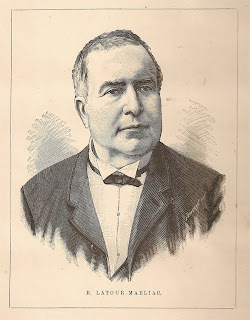
Monet was himself a horticulturalist, and he was impressed by Latour-Marliac's hybrids at the World's Fair. At Giverny, Monet was diverting a stream through his property and landscaping to create a water garden. By 1894, he was ready to begin planting, and he placed an order at the Latour-Marliac greenhouses for a wide variety of plants, including three types of water lilies: Nymphaea Mexicana, Nymphaea "Laydekeri Rosea," and Nymphaea "Odorata Sulphurea Grandiflora."

Nymphaea Mexicana

Nymphaea "Laydekeri Rosea"

Nymphaea "Odorata Sulphurea Grandiflora"
In 1904, Monet placed his second order for plants from the Latour-Marliac nursery, and this time it was only for red water lilies. Now, he could compose his palette of colors balanced between yellows, pinks, and reds--both in his garden and in his paintings of the garden. His garden would be in full bloom during the warmest months of the year--from May to September or October. During the colder months, the tender plants could be overwintered in his large greenhouse.
Latour-Marliac's precise method for making his crosses is unknown. But the general method for horticultural hybridizing is well understood. The pollen parent plant provides the male reproductive material. The seed parent plant provides the female material--the fertile womb. To make a cross, the hybridizer takes the pollen from a plant that has some desirable characteristics (such as flower color or hardiness) and applies it to the female reproductive part, the pistil, of another plant. Each seedling produced from this match will be a unique combination of traits from the parent plants.
This domestication and hybridizing of plants are important for Darwinian evolutionary thinking in six ways. The first is that Darwin developed his idea of evolutionary natural selection from his understanding of the artificial selection exercised by human beings in domesticating plants and animals. He made this clear in the first two chapters of the Origin of Species, where he compared "variation under domestication" and "variation under nature," and in the Introduction to his book The Variation of Animals and Plants Under Domestication. He explained that it was through his study of "domestic productions" that he "acquired a just idea of the power of Selection" (1998, 1:10). He saw that the term "natural selection" was "so far a good one as it brings into connection the production of domestic races by man's power of selection and the natural preservation of varieties and species in a state of nature" (1:6). Just as the human breeder of plants and animals selects those traits that show "adaptation to his wants and pleasures," nature selects those traits that give an organism some adaptation for survival and reproduction in the struggle for life (1:4).
The second important contribution to Darwinian thinking here is that the human domestication of plants illustrates the ecological coevolution of plants and animals, so that plants and animals evolve to be mutually dependent. This is true not just for human beings but for other animals as well. For example, fungal species have been domesticated by bees and beetles, which shows that agriculture evolved millions of years ago among these animals, long before the emergence of human agriculture (Farrell et al. 2001; Nygaard et al. 2016; Purugganan and Fuller 2009; Schultz and Brady 2008).
The third point is that the human domestication of plants is a form of Darwinian niche construction. In creating his water garden and planting it with Latour-Marliac's hybrid water lilies, Monet was creating a niche in which he could cultivate his artistic imagination. Other animals and plants also engage in niche construction, so that instead of just adapting to the given natural environment, they construct their environment so that it is more hospitable to them. I have written previously about this here and here.
The fourth way in which this contributes to Darwinian thinking is that understanding the artificial hybridization of plants helps us to think about the possibility that new species could have evolved by natural hybridization. There is now a growing recognition that hybridization has been important for the evolution of many species--including the evolution of iguanas and finches in the Galapagos and even human evolution. I have written previously about this here and here.
The fifth point is that the human breeding of Monet's water lilies illustrates the Darwinian evolution of a sense of beauty that could be crucial for a biological science of art. In the Origin of Species, Darwin observed that the human domestication of plants and animals showed "adaptation, not indeed to the animal's or plant's own good, but to man's use or fancy." And a plant might be adapted for man's "fancy" if it was made "beautiful in his eyes" (1859: 30). The vibrant colors of Latour-Marliac's hybrid water lilies made them beautiful in Monet's eyes and the eyes of those who have contemplated his water lily paintings. They human visual system has evolved to detect and appreciate colors that are wavelengths of light within the visible range for the human eye. Similarly, the visual system of some other animals makes certain colors attractive to them. This is part of what Darwin in The Descent of Man identified as the "sense of beauty" that human beings share with other animals. One reason for this is what Darwin called "sexual selection": in some animals, females prefer to mate with males they find colorful, or males select females that seem beautiful to them (2004, 114-16, 430-32, 461-65, 640-52, 664, 686-87). In a future post, I will say more about this as part of the biology of art.
Finally, Latour-Marliac's breeding of Monet's water lilies can also be understood as evolutionary economics. After all, Latour-Marliac's nursery was a business enterprise that had to struggle to survive in a competitive market. This nursery is still operating and still selling water lilies, as you can see at their website. In 2007, the business was purchased by Robert Sheldon, a professor of entrepreneurship at a business school in France. He has written about the economic history of the business as an illustration of Joseph Schumpeter's evolutionary theory of economics, in which a capitalist economy is understood as a process of creative destruction: the economy is in a constant state of flux, with firms failing and freeing resources for innovative entrepreneurs who invent new products and services and thus create new markets. Latour-Marliac showed this because to survive he had to innovate both in creating new plants by hybridization and in creating the markets for these plants. The popularity of Monet's water lily paintings helped to create the demand for Latour-Marliac's water lilies, and Latour-Marliac had to cultivate a network of customers around the world. After Sheldon took ownership of the firm, he innovated by creating a restaurant at the nursery and promoting the nursery as a tourist attraction (Sheldon 2017).
Another part of this story of evolutionary economics is the marketing of Monet's art and impressionist art generally, which was largely the work of the art dealer Paul Durand-Ruel--the subject of a future post.
You can see that going to Gallery 243 has given me a lot to think about.
REFERENCES
Darwin, Charles. 1859. On the Origin of Species. London: John Murray.
Darwin, Charles. 1998. The Variation of Animals and Plants Under Domestication. 2 vols. 2nd ed. Baltimore, MD: Johns Hopkins University Press.
Darwin, Charles. 2004. The Descent of Man. 2nd ed. New York: Penguin.
Farrell, Brian D., et al. 2001. "The Evolution of Agriculture in Beetles (Curculionidae: Scolytinae and Platypodinae)." Evolution 55 (10): 2011-2027.
Holmes, Caroline. 2015. Water Lilies and Bory Latour-Marliac, the Genius Behind Monet's Water Lilies. Woodbridge, UK: Garden Art Press.
Nygaard, Sanne, et al. 2016. "Reciprocal Genomic Evolution in the Ant-Fungus Agricultural Symbiosis." Nature Communications 7:12233, July 20.
Purugganan, Michael D., and Dorian Q. Fuller. 2009. "The Nature of Selection During Plant Domestication." Nature 457: 843-48.
Schultz, Ted. R., and Sean G. Brady. 2008. "Major Evolutionary Transitions in Ant Agriculture." Proceedings of the National Academy of Sciences 105 (14): 5435-5440.
Sheldon, Robert Charles. 2017. "Inventing Water Lilies: Latour-Marliac and the Social Dynamics of Market Creation." Entreprises et Histoire. Number 88: 147-65.
Subscribe to:
Posts (Atom)