Showing posts sorted by relevance for query woman the hunter. Sort by date Show all posts

Tuesday, November 28, 2023

Woman the Hunter? But Not Predominantly?


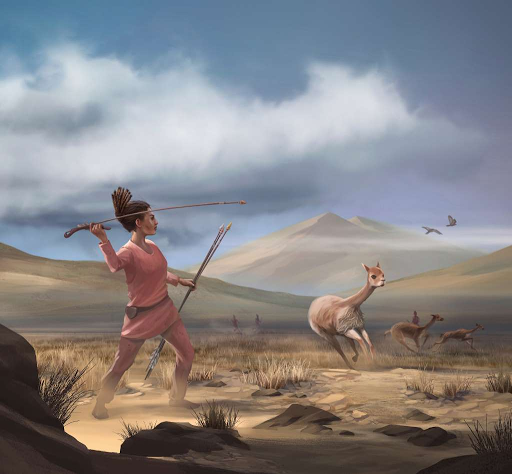
An Artistic Rendering of an Ancient Female Hunter Using an Atlatl to Hunt Vacunas in the Andean Highlands of Peru (Based on an Archaeological Discovery by Randall Haas and His Colleagues)


The cover article for the November issue of Scientific American is "Woman the Hunter" by Cara Ocobock and Sarah Lacy.  This article briefly summarizes the argument and evidence that Ocobock and Lacy have recently elaborated in two articles for American Anthropologist.  Much of the research that they cite in these articles has come up in some of my previous posts on this "Woman the Hunter" thesis.

Ocobock and Lacy frame their argument as a refutation of the book Man the Hunter, edited by Richard Lee and Irven DeVore, and first published in 1968.  This collection of papers was the first extensive survey of the hunter-gatherer way of life that was considered the first stage of human evolutionary development.  One of the central themes of the book was the sexual division of labor in the foraging for food, in which men were predominantly the hunters of wild animals, and women were predominantly the gatherers of wild plants.

Contrary to what Ocobock and Lacy repeatedly assert, the authors in Man the Hunter did not say that "only men hunted" or that "women were excluded from hunting" (see Ocobock and Lacy 2023a: 24; Lacy and Ocobock 2023: 2-3, 5-6, 9).  The claim of the "Man the Hunter" hypothesis was that while some women in foraging societies sometimes hunted, men were predominantly the hunters.  So, when Ocobock and Lacy present evidence that some foraging women hunted, and thus refute the idea that only men hunted, they are attacking a straw man (or straw woman).

Ocobock and Lacy offer three kinds of evidence for "Woman the Hunter"--ethnographic, archaeological, and physiological.  While this evidence does show that some foraging women hunted and that modern women today still have the mental and physical capacities required for hunting, this does not deny the fact that in foraging societies, hunting (and particularly the hunting of big mammals) has been mostly a male activity.  

Moreover, what they say about the comparative athletic physiology of men and women confirms that men have a power activity advantage, while women have an endurance activity advantage.  This explains why someone like Caster Semenya--a chromosomal (XY) male with some external female features--has an unfair male advantage in competing with women in an 800-meter race but not in a 5,000-meter race.


THE ETHNOGRAPHIC EVIDENCE

In their Scientific American article, Ocobock and Lacy report:

". . . A recent study of ethnographic data spanning the past 100 years--much of which was ignored by Man the Hunter contributors--found that women from a wide range of cultures hunt animals for food.  Abigail Anderson and Cara Wall-Scheffler of Seattle Pacific University and their colleagues report that 79 percent of the 63 foraging societies with clear descriptions of their hunting strategies feature women hunters. . . ." (29).

What Ocobock and Lacy fail to make clear for their readers, however, is that this study found that in these 50 foraging societies, some women sometimes engage in hunting.  This was said to refute "the traditional paradigm that women exclusively gather, and men exclusively hunt" (Anderson et al. 2023: 7).  

As I pointed out in my post on this article, the authors do a good job in refuting the idea that men are exclusively the hunters and women exclusively the gatherers.  James Woodburn expressed this idea in the original Man the Hunter volume when he said:  "Hunting is done exclusively by men and boys" (Woodburn 1968, 51).  But this one sentence is the only place in the book where this claim is made.  No one else said this.  The other authors explained that while hunting is "predominantly men's work," some women do sometimes hunt:  "women's hunting activities are confined to small animal hunts, communal hunts in which they take part in driving, and, very rarely, individual hunts of larger animals" (Lee and DeVore 1968: 74, 187). They would have agreed with Robert Kelly (2013, 218-24) that while hunting is not done exclusively by men, it is predominantly done by men, particularly the hunting of big game.  So, the difference between men and women is a matter of degree rather than kind.

None of the evidence in Anderson et al.'s article shows that women are the same as men in the regular hunting of large game.  Consider, for example, three societies where they see women hunting large game—the !Kung San, the Hadza, and the Bakola.  According to their authority for the !Kung San, although there are a few cases of women hunting small game, "basically they leave hunting to the men" (Lee 1979, 235).
According to their authority for the Hadza, although "the common view that males only hunt and females only gather is not true," it is nevertheless true that women mostly hunt small animals, and there is "a marked division of foraging labor" between men and women (Marlowe 2010, 269).
According to their authority for the Bakola, although the women participate in hunting, gathering "is reserved mostly for women and children" (Ngima 2006, 58); women participate in net hunting, but only as beaters and not as hunters (51, 57, 65-67); and women are excluded from ceremonial net hunting (66).
They cannot point to any evidence for a hunter-gatherer society where the hunting of big game is predominantly by women, or at least equally with men.

Anderson and her colleagues also cite the example of the Agta people of the Philippines.  Ocobock and Lacy repeat this claim: "Agta women hunt while menstruating, pregnant, and breastfeeding, and they have the same hunting success as Agta men" (Ocobock and Lacy 2023a: 29).  But they fail to point out that very few Agta women hunt (fewer than 100 in a population of 9,000), while all Agta men do hunt; and the most serious female Agta hunters are those who are sterile, those with children old enough to care for themselves, or those beyond their childbearing years (Kelly 2013: 218-22).


ARCHAEOLOGICAL EVIDENCE

In their paper on the archaeological evidence for "Woman the Hunter," Ocobock and Lacy present some indirect evidence that men and women in the Paleolithic might have been engaged in similar activities.  But that there might be evidence that women were engaged in hunting big game animals just as much as men is suggested in only one sentence: "In some cases, the grave goods and paleopathology agree in demonstrating women were well-practiced projectile hunters, such as at the Peruvian Early Holocene site of Wilamaya Pratxa (Haas et al. 2020)" (Lucy and Ocobock 2023: 7).

As I indicated in my post on the article cited here by Ocobock and Lucy, Richard Haas and his colleagues have provided us what looks like one clear case of an ancient female hunter.  In 2018, Haas's team excavated an archaeological site called Wilamaya Patjxa in the Andean highlands of southern Peru at an elevation of 12,877 feet. They found five human burial pits with six individuals.  Two of these individuals were associated with projectile points from the Early Holocene (beginning around 12,000 to 11,500 years ago).  

One of these two individuals--the Wilamayo Patjxa individual 6 (WMP6)--was identified as a 17-19 year old woman, which was determined by studies of her bones and tooth enamel protein. She was associated with stones that were identified as an integrated toolkit for hunting.  There were stone projectile points that could have been used to kill big game.  There were other stones that could have been used for dressing the game and red ochre nodules for tanning hides.  There were some mammal bone fragments that could have been from one of the species endemic to the Andean highlands--vicuna (a relative of llamas) or taruca (a species of deer).  As depicted in their artistic rendering of WMP6 hunting, Haas's team speculated that she used an atlatl made from a camelid radioulna bone to throw a spear at a vicuna.  However, there is nothing that looks like an atlatl at the burial site.  (I have a post on the evolution of the atlatl.)

And yet, even if one agrees that this is good evidence for identifying WMP6 as a female hunter of big game animals, one must then ask whether this is only one isolated case or part of a general behavioral pattern.  To find the evidence for a general pattern of female hunting, Haas's team reviewed the reports of Late Pleistocene and Early Holocene burials in the Americas.  They identified 429 individuals from 107 sites.  They found 27 individuals from 18 sites who were associated with big-game hunting tools.  Of theses, 11 of the individuals from 10 sites were identified as female, and 16 individuals from 15 sites were identified as male.  They see this distribution--11 female hunters and 16 male hunters--as "statistical parity" between males and females in hunting behavior, which supports "the hypothesis of non-gendered big-game hunting among early populations."

This step in their argument has been identified by their critics as the weakest part of their reasoning.  Notice that Haas and his colleagues have to assume that in ancient burials, "the objects that accompany people in death tend to be those that accompany them in life" (Haas et al. 2020, 5).  So, if individuals are buried with hunting tools, that proves that they were hunters.  Robert Kelly, Ben Potter, and others challenge this assumption: that individuals were buried with hunting tools does not directly prove that they were hunters.  Burial goods are symbolic offerings from the living to the dead, and the interpretations of their meaning are often ambiguous.

This problem is particularly clear in the case of the two female individuals buried at the Upward Sun River site in Alaska (dated to around 11,500 years ago), which has been studied by Potter and his colleagues (2014).  One individual was estimated to have died a few weeks after birth, and the other was identified as a late-term fetus.  Four antler rods, two large dart points, and a third biface lithic tool were found associated with these two individuals.  Potter's team observes: "The presence of the hafted points may reflect the importance of hunting implements in the burial ceremony at USR and within the population as a whole" (17064).  Potter's team does not see this as evidence that females were hunters in this ancient population of hunter-gatherers.  But Haas and his colleagues, in their online Supplement to their article, write: "The Upward Sun River females are both infants and thus were not hunters per se, although they appear to have been gendered in a way that recognized females as being associated with big game hunting."  So although these infants were not hunters, burying them with hunting tools was a symbolic ritual statement that they could have become hunters if they had lived to adulthood!  Potter disagrees.  In an email message to me, he wrote: "I think the most parsimonious and plausible interpretation of the hunting implements in the infants' grave is that they represent symbolic 'sacrifices' of perfectly usable hunting weapons by the father(s)."

There is another closely related problem here that Haas's team makes clear in their online Supplement but not in their article.  In determining whether females were buried with big-game hunting tools, they distinguish "secure" evidence and "tentative" evidence.  They also distinguish between "securely associated with big game hunting tools" and "securely identified as a big-game hunter burial."  There are "secure cases in which context, sex, and date estimates are each determined to be secure," and there are "tentative associations" where the evidence for context, sex, and dating is not so secure.

The WMP6 burial and the two Upward Sun River burials are the only female burials securely associated with big game hunting tools.  But the two Upward Sun River burials are not securely identified as big game hunter burials.  Consequently, in their Supplement, Haas's team concludes: "the WMP6 burial is the only burial securely identified as a big-game hunter burial in the entire sample of late Pleistocene and early Holocene burials in the Americas.  Under the most conservative criteria, we identify one female hunter burial and no male hunter burials."  

Remarkably, this statement is hidden away in the Supplement, and it does not appear in the article.  In effect, this concedes the point made by the critics--that Haas and his colleagues have at best found only one case of a female hunter burial, which suggests that while some individual females in hunter-gatherer societies will become hunters, there is still generally a sexual division of labor in which men hunt and women gather.

The 8 cases where Haas's team think they see "tentative" evidence for the burial of a female big-game hunter are actually quite dubious.  Consider this example, which they report: "Ashworth Shelter is a rockshelter site in Kentucky . . . .  The following summary is based on Walthall's review (46).  A primary inhumation identified as an adult female had a Kirk style projectile embedded in a vertebra and a second point located near the left patella."

Haas's team here is relying on an article by John Walthall (1999), in which he reports the findings of Philip DiBlasi (1981) in a Master's Thesis at the University of Louisville, which is available online.  In describing "burial #4" in the Ashworth Shelter, DiBlasi writes:

"As mentioned above, a projectile point was found imbedded in the body of the third thoracic vertebra.  This projectile entered from the left rear of the individual splitting the neural arch between the left superior and inferior articulating surfaces and the spinous process.  The extreme distal portion (tip) of the projectile entered the dorsal surface of the body of the vertebra with sufficient force to split the vertebra in half.  The left superior articular surface of the fourth vertebra was also damaged."

"A wound of this type would have caused death almost immediately.  The most apparent cause of death would have been hypotensive shock resulting from the direct reflex shock to the central nervous system caused by the impact and resulting rebound of the spinal cord. .  . Paralysis of intercostal muscles would make breathing impossible, again causing death within a short period of time" (1981, 74-75).

Neither DiBlasi nor Walthall identify this as evidence that this individual had been a female hunter. After all, how can the fact that she was killed by a projectile point thrust into her back with sufficient force to split her spine in half be even "tentative" evidence that she was a big-game hunter?

The careful reader might well conclude that the most important sentence in the writing of Haas and his colleagues is not in their published article but in the online Supplement to the article: "Thus the WMP6 burial is the only burial securely identified as a big-game hunter burial in the entire sample of late Pleistocene and early Holocene burials in the Americas."

The archaeological evidence for "Woman the Hunter" seems very skimpy indeed.


In my next post, I will take up Ocobock and Lacy's physiological evidence for female versus male athletic advantages, which they offer as evidence that women have the physiological capacity for hunting, particularly hunting that requires endurance running.


REFERENCES

Anderson, Abigail, Sophia Chilczuk, Kaylie Nelson, Roxanne Ruther, and Cara Wall-Scheffler. 2023. "The Myth of Man the Hunter: Women's Contribution to the Hunt Across Ethnographic Contexts."  PLoS ONE 18(6): e0287101.

DiBlasi, Philip. 1981. "A New Assessment of the Archaeological Significance of the Ashworth Site (15Bu236)." A Master's Thesis. University of Louisville

Haas, Randall, et al. 2020. "Female Hunters of the Early Americas." Science Advances 6: 1-10.

Kelly, Robert L. 2013. The Lifeways of Hunter-Gatherers: The Foraging Spectrum. Cambridge: Cambridge University Press.

Lacy, Sarah, and Cara Ocobock. 2023. "Woman the Hunter: The Archaeological Evidence." American Anthropologist, 1-13.  DOI: 10.1111/aman.13914

Lee, Richard B. 1979. The !Kung San: Men, Women, and Work in a Foraging Society. Cambridge: Cambridge University Press.

Lee, Richard B., and Irven DeVore, eds.  1968.  Man the Hunter.  Chicago: Aldine Publishing Company.

Marlowe, Frank W. 2010. The Hadza: Hunter-Gatherers of Tanzania.  Berkeley: University of California Press.

Ngima Mawoung, Godefroy.  2006.  "Perception of Hunting, Gathering, and Fishing Techniques of the Bakola of the Coastal Region, Southern Cameroon." African Study Monographs, Suppl. 33: 49-69.

Ocobock, Cara, and Sarah Lacy.  2023a.  "Woman the Hunter."  Scientific American.  November: 23-29.

Ocobock, Cara, and Sarah Lacy.  2023b.  "Woman the Hunter: The Physiological Evidence."  American Anthropologist, 1-12.  DOI: 10.1111/aman.13915.

Potter, Ben A., et al. 2014. "New Insights into Eastern Beringian Mortuary Behavior: A Terminal Pleistocene Double Infant Burial at Upward Sun River." Proceedings of the National Academy of Sciences. 111, no. 48: 17060-17065.

Walthall, John. 1999. "Mortuary Behavior and Early Holocene Land Use in the North American Midcontinent." North American Archaeologist 20: 1-30.

Woodburn, James. 1968. "An Introduction to Hadza Ecology." In Lee and DeVore, 49-55.


Friday, July 14, 2023

Man the Hunter, Woman the Gatherer--Predominantly But Not Exclusively. The Evolutionary Psychology of Sex Differences

In 1965, 67 of the leading scholars of human hunter-gatherers gathered at the University of Chicago for a symposium on "Man the Hunter," which resulted in a book with that title edited by Richard Lee and Irven DeVore (1968).  The fundamental idea underpinning the conference was that since through most of their evolutionary history, most human beings had lived in small bands of hunter-gatherer foragers--hunting wild animals and gathering wild plants--the hunter-gatherer way of life was the environment of evolutionary adaptation in which evolved human nature had been shaped.

As part of that adaptation, there were sex differences between "man the hunter" and "woman the gatherer"--men predominated in hunting, and women predominated in gathering.  One could infer from this that there were evolved natural differences on average in the psychological propensities of men and women, with men more inclined to be aggressive hunters and women more inclined to be caregiving mothers whose foraging was limited by their need to care for their children, which impeded women from hunting large animals.

For me, this supports the idea that there is an evolved natural desire for sexual identity.  Human beings generally desire to identify themselves as male or female.  All human societies have some sexual division of labor.  And although different societies assign somewhat different sex roles, there are some recurrent differences that manifest a universal sexual bipolarity in the pattern of human desires.

Those who want to deny or at least play down these natural sex differences will criticize the dichotomy of man the hunter and woman the gatherer, so that they can argue for male and female gender differences as being personal and cultural constructions rather than evolved natural propensities.  A recent example of this is an article in PLoS ONE--"The Myth of Man the Hunter: Women's Contribution to the Hunt Across Ethnographic Contexts" (Anderson et al. 2023).  This article has received wide coverage in the media, including the journal Science.

The authors report: "Of the 50 foraging societies that have documentation on women hunting, 45 (90%) had data on the size of game that women hunted.  Of these, 21 (46%) hunt small game, 7 (15%) hunt median game, 15 (33%) hunt large game and 2 (4%) of these societies hunt game of all sizes" (6).  They conclude from this that "the common belief that women exclusively gather while men exclusively hunt, and further, that the implicit sexual division of labor of 'hunter/gatherer' is misapplied" (6).

I think a better title for this article would be "The Myth of Man as Exclusively the Hunter."  The authors do a good job in refuting the idea that men are exclusively the hunters and women exclusively the gatherers.  James Woodburn expressed this idea in the original Man the Hunter volume when he said:  "Hunting is done exclusively by men and boys" (Woodburn 1968, 51).  But as far as I can see, most of the hunter-gatherer scholars have not said this.  Most have agreed with Robert Kelly (2013, 218-24) that while hunting is not done exclusively by men, it is predominantly done by men, particularly the hunting of big game.  So, the difference between men and women is a matter of degree rather than kind.  If I am right about that, then what Anderson and her colleagues are refuting is mostly a straw man (or straw woman).

All of their evidence supports the conclusion that the hunting of large game is usually men's work, although women regularly hunt small game, and occasionally there are individual cases of women hunting large game.
Their first cited evidence of female hunting is Haas et al. (2020).  But they do not acknowledge the remarkable admission in the online Supplement to that article that "the WMP6 burial is the only burial securely identified as a big-game hunter burial in the entire sample of late Pleistocene and early Holocene burials in the Americas."  Notably, Haas et al. do not include this statement in their published article.  I have written about this in a previous post.
As far as I can tell, none of the evidence in Anderson et al.'s article shows that women are the same as men in the regular hunting of large game.  Consider, for example, three societies where they see women hunting large game—the !Kung San, the Hadza, and the Bakola.  According to their authority for the !Kung San, although there are a few cases of women hunting small game, "basically they leave hunting to the men" (Lee 1979, 235).
According to their authority for the Hadza, although "the common view that males only hunt and females only gather is not true," it is nevertheless true that women mostly hunt small animals, and there is "a marked division of foraging labor" between men and women (Marlowe 2010, 269).
According to their authority for the Bakola, although the women participate in hunting, gathering "is reserved mostly for women and children" (Ngima 2006, 58); women participate in net hunting, but only as beaters and not as hunters (51, 57, 65-67); and women are excluded from ceremonial net hunting (66).
They cannot point to any evidence for a hunter-gatherer society where the hunting of big game is predominantly by women, or at least equally with men.


REFERENCES

Anderson, Abigail, Sophia Chilczuk, Kaylie Nelson, Roxanne Ruther, and Cara Wall-Scheffler. 2023. "The Myth of Man the Hunter: Women's Contribution to the Hunt Across Ethnographic Contexts."  PLoS ONE 18(6): e0287101.

Haas, Randall, et al. 2020. "Female Hunters of the Early Americas." Science Advances 6: 1-10.

Kelly, Robert L. 2013. The Lifeways of Hunter-Gatherers: The Foraging Spectrum. Cambridge: Cambridge University Press.

Lee, Richard B. 1979. The !Kung San: Men, Women, and Work in a Foraging Society. Cambridge: Cambridge University Press.

Lee, Richard B., and Irven DeVore, eds.  1968.  Man the Hunter.  Chicago: Aldine Publishing Company.

Marlowe, Frank W. 2010. The Hadza: Hunter-Gatherers of Tanzania.  Berkeley: University of California Press.

Ngima Mawoung, Godefroy.  2006.  "Perception of Hunting, Gathering, and Fishing Techniques of the Bakola of the Coastal Region, Southern Cameroon." African Study Monographs, Suppl. 33: 49-69.

Woodburn, James. 1968. "An Introduction to Hadza Ecology." In Lee and DeVore, 49-55.

Tuesday, November 10, 2020

Woman the Hunter? Were Prehistoric Women Big-Game Hunters?


                    A 9,000-year-old Burial of 17-19 Year-old Woman with a Hunting Toolkit


An Artistic Rendering of the Female Hunter (WMP6) Using an Atlatl to Hunt Vicunas in the Andean Highlands of Peru


                                               A Vicuna in the Andean Highlands of Chile


In 1966, some 75 scholars who studied the hunting and gathering peoples of the world gathered at the University of Chicago for a conference on "Man the Hunter" (Lee and DeVore 1968).  It was generally agreed that one of the most prominent features of hunter-gatherer life was the sexual division of labor in the provisioning of food in which men hunted large animals and women gathered plants and small animals.  

The subsequent studies of hunter-gatherers have largely confirmed this, as Robert Kelly (2013) has indicated in his survey of the research.  The investment that women typically make in pregnancy, breastfeeding, and childcare is usually incompatible with hunting large game.  For women the gathering of plant foods is more compatible with caring for children.  And insofar as this has been true for most of human evolutionary history as hunter-gatherers, this has shaped the evolved human mind so that men and women on average differ in their typical temperaments and propensities.  This supports my claim about there being an evolved natural desire for sexual identity: human beings generally desire to identify themselves as male or female, and there are some psychological differences between typical males and typical females.  But despite these sex differences on average, there is a lot of individual variation.  So, as Kelly observes, there are quite a few individual cases in hunter-gatherer societies of women becoming hunters, particularly when the hunting does not interfere with childcare.  (I have written a previous post on Kelly's book.)

Now, this week, we have a new report by Randall Haas and his colleagues of an archaeological discovery that appears to be evidence for women being big-game hunters in the hunter-gatherer societies of ancient South America (Haas et al. 2020).  The New York Times has a good article on this (Gorman 2020).

Here is the abstract:

"Sexual division of labor with females as gatherers and males as hunters is a major empirical regularity of hunter-gatherer ethnography, suggesting an ancestral behavioral pattern.  We present an archaeological discovery and meta-analysis that challenge the man-the-hunter hypothesis.  Excavations at the Andean highland site of Wilamaya Patjxa reveal a 9000-year-old human burial (WMP6) associated with a hunting toolkit of stone projectile points and animal processing tools.  Osteological, proteomic, and isotopic analyses indicate that this early hunter was a young adult female who subsisted on terrestrial plants and animals.  Analysis of Late Pleistocene and Early Holocene burial practices throughout the Americas situate WMP6 as the earliest and most secure hunter burial in a sample that includes 10 other females in statistical parity with early male hunter burials.  The findings are consistent with nongendered labor practices in which early hunter-gatherer females were big-game hunters."

There are three steps in their reasoning to support their general conclusion that "early hunter-gatherer females were big-game hunters."  The first step is to argue that while the ethnographic record shows that big-game hunting has been  indeed a predominantly male activity among recent hunter-gatherer societies, this does not prove that this was true for ancient prehistoric hunter-gatherer societies.  The second step is to describe their archaeological discovery of WMP6's burial as showing one clear case of an ancient hunter-gatherer female who was a big-game hunter.  The third step is to claim that this one case is part of a general behavioral pattern that can be seen by surveying the evidence of Late Pleistocene and Early Holocene burials across the Americas.  

In their first step, Haas and his colleagues agree with Kelly's assertion that the hunter-gatherers studied by ethnographers "are not humanity in a state of nature; they are not Pleistocene relics; we cannot, as E. O. Wilson (1978) suggested, reconstruct ancient human society by extrapolation backward from living hunter-gatherers" (2013, xv).  Kelly gives two reasons for this.  First, living hunter-gatherers have been influenced by the modern social and economic conditions in which they have lived, which must make them different from ancient hunter-gatherers who lived in ancient conditions.  Second, living hunter-gatherer societies are so variable that they cannot provide a universal pattern of hunter-gatherer life.

Nevertheless, Kelly does think that the ethnographic record shows at least one feature of living hunter-gatherer societies that can be projected back into the ancient past--"men hunt while women gather."  There is a good theoretical justification for this, Kelly observes, because "the division of labor is rooted in fundamental biological differences between men and women and the incompatibility of children with hunting" (2013, 274).  If we have correctly identified these causes for the sexual division of labor among living hunter-gatherers, and if we can reasonably assume that the same causes were at work among ancient hunter-gatherers, then we can infer that the division between man the hunter and woman the gatherer that we see among modern foragers is a model for what we should expect for ancient foragers.

If ancient foragers had two ways of provisioning food--gathering wild plants and hunting wild animals--and if the female biology for bearing and rearing children was more compatible with gathering than with hunting, then we can infer that women in general were more inclined to gathering than to hunting.  

It is true, however, as Haas and his colleagues indicate, that there are some circumstances in which women can mitigate the conflict between child care and hunting.  Mothers can find people (such as grandmothers or other relatives) to help with the caring of their children.  Mothers can also join in communal hunting in which even young children can participate.  Moreover, those women who are not bearing and caring for children might choose to become hunters, even big-game hunters, if they have the skills and temperament for hunting.  This all suggests that we should find some cases of female hunting, even though the general pattern will be a sexual division of labor with women gathering and men hunting.

In fact, Haas and his colleagues have provided us what looks like one clear case of an ancient female hunter.  In 2018, Haas's team excavated an archaeological site called Wilamaya Patjxa in the Andean highlands of southern Peru at an elevation of 12,877 feet. They found five human burial pits with six individuals.  Two of these individuals were associated with projectile points from the Early Holocene (beginning around 12,000 to 11,500 years ago).  

One of these two individuals--the Wilamayo Patjxa individual 6 (WMP6)--was identified as a 17-19 year old woman, which was determined by studies of her bones and tooth enamel protein. She was associated with stones that were identified as an integrated toolkit for hunting.  There were stone projectile points that could have been used to kill big game.  There were other stones that could have been used for dressing the game and red ochre nodules for tanning hides.  There were some mammal bone fragments that could have been from one of the species endemic to the Andean highlands--vicuna (a relative of llamas) or taruca (a species of deer).  As depicted in their artistic rendering of WMP6 hunting, Haas's team speculated that she used an atlatl made from a camelid radioulna bone to throw a spear at a vicuna.  However, there is nothing that looks like an atlatl at the burial site.  (I have a post on the evolution of the atlatl.)

And yet, even if one agrees that this is good evidence for identifying WMP6 as a female hunter of big game animals, one must then ask whether this is only one isolated case or part of a general behavioral pattern.  To find the evidence for a general pattern of female hunting, Haas's team reviewed the reports of Late Pleistocene and Early Holocene burials in the Americas.  They identified 429 individuals from 107 sites.  They found 27 individuals from 18 sites who were associated with big-game hunting tools.  Of theses, 11 of the individuals from 10 sites were identified as female, and 16 individuals from 15 sites were identified as male.  They see this distribution--11 female hunters and 16 male hunters--as "statistical parity" between males and females in hunting behavior, which supports "the hypothesis of non-gendered big-game hunting among early populations."

This step in their argument has been identified by their critics as the weakest part of their reasoning.  Notice that Haas and his colleagues have to assume that in ancient burials, "the objects that accompany people in death tend to be those that accompany them in life" (Haas et al. 2020, 5).  So if individuals are buried with hunting tools, that proves that they were hunters.  Robert Kelly, Ben Potter, and others challenge this assumption: that individuals were buried with hunting tools does not directly prove that they were hunters.  Burial goods are symbolic offerings from the living to the dead, and the interpretations of their meaning are often ambiguous.

This problem is particularly clear in the case of the two female individuals buried at the Upward Sun River site in Alaska (dated to around 11,500 years ago), which has been studied by Potter and his colleagues (2014).  One individual was estimated to have died a few weeks after birth, and the other was identified as a late-term fetus.  Four antler rods, two large dart points, and a third biface lithic tool were found associated with these two individuals.  Potter's team observes: "The presence of the hafted points may reflect the importance of hunting implements in the burial ceremony at USR and within the population as a whole" (17064).  Potter's team does not see this as evidence that females were hunters in this ancient population of hunter-gatherers.  But Haas and his colleagues, in their online Supplement to their article, write: "The Upward Sun River females are both infants and thus were not hunters per se, although they appear to have been gendered in a way that recognized females as being associated with big game hunting."  So although these infants were not hunters, burying them with hunting tools was a symbolic ritual statement that they could have become hunters if they had lived to adulthood!  Potter disagrees.  In an email message to me, he wrote: "I think the most parsimonious and plausible interpretation of the hunting implements in the infants' grave is that they represent symbolic 'sacrifices' of perfectly usable hunting weapons by the father(s)."

There is another closely related problem here that Haas's team makes clear in their online Supplement but not in their article.  In determining whether females were buried with big-game hunting tools, they distinguish "secure" evidence and "tentative" evidence.  They also distinguish between "securely associated with big game hunting tools" and "securely identified as a big-game hunter burial."  There are "secure cases in which context, sex, and date estimates are each determined to be secure," and there are "tentative associations" where the evidence for context, sex, and dating is not so secure.

The WMP6 burial and the two Upward Sun River burials are the only female burials securely associated with big game hunting tools.  But the two Upward Sun River burials are not securely identified as big game hunter burials.  Consequently, in their Supplement, Haas's team concludes: "the WMP6 burial is the only burial securely identified as a big-game hunter burial in the entire sample of late Pleistocene and early Holocene burials in the Americas.  Under the most conservative criteria, we identify one female hunter burial and no male hunter burials."  

Remarkably, this statement is hidden away in the Supplement, and it does not appear in the article.  In effect, this concedes the point made by the critics--that Haas and his colleagues have at best found only one case of a female hunter burial, which suggests that while some individual females in hunter-gatherer societies will become hunters, there is still generally a sexual division of labor in which men hunt and women gather.

The 8 cases where Haas's team think they see "tentative" evidence for the burial of a female big-game hunter are actually quite dubious.  Consider this example, which they report: "Ashworth Shelter is a rockshelter site in Kentucky . . . .  The following summary is based on Walthall's review (46).  A primary inhumation identified as an adult female had a Kirk style projectile embedded in a vertebra and a second point located near the left patella."

Haas's team here is relying on an article by John Walthall (1999), in which he reports the findings of Philip DiBlasi (1981) in a Master's Thesis at the University of Louisville, which is available online.  In describing "burial #4" in the Ashworth Shelter, DiBlasi writes:

"As mentioned above, a projectile point was found imbedded in the body of the third thoracic vertebra.  This projectile entered from the left rear of the individual splitting the neural arch between the left superior and inferior articulating surfaces and the spinous process.  The extreme distal portion (tip) of the projectile entered the dorsal surface of the body of the vertebra with sufficient force to split the vertebra in half.  The left superior articular surface of the fourth vertebra was also damaged."

"A wound of this type would have caused death almost immediately.  The most apparent cause of death would have been hypotensive shock resulting from the direct reflex shock to the central nervous system caused by the impact and resulting rebound of the spinal cord. .  . Paralysis of intercostal muscles would make breathing impossible, again causing death within a short period of time" (1981, 74-75).

Neither DiBlasi nor Walthall identify this as evidence that this individual had been a female hunter. After all, how can the fact that she was killed by a projectile point thrust into her back with sufficient force to split her spine in half be even "tentative" evidence that she was a big-game hunter?

The careful reader might well conclude that the most important sentence in the writing of Haas and his colleagues is not in their published article but in the online Supplement to the article: "Thus the WMP6 burial is the only burial securely identified as a big-game hunter burial in the entire sample of late Pleistocene and early Holocene burials in the Americas."


REFERENCES

DiBlasi, Philip. 1981. "A New Assessment of the Archaeological Significance of the Ashworth Site (15Bu236)." A Master's Thesis. University of Louisville.

Gorman, James. 2020. "Ancient Remains in Peru Reveal Young, Female Big-Game Hunter." New York Times, November 4.

Haas, Randall, et al. 2020. "Female Hunters of the Early Americas." Science Advances 6: 1-10.

Kelly, Robert L. 2013. The Lifeways of Hunter-Gatherers: The Foraging Spectrum. Cambridge: Cambridge University Press.

Lee, Richard B., and Irven DeVore, eds. 1968. Man the Hunter. Chicago: Aldine Publishing.

Potter, Ben A., et al. 2014. "New Insights into Eastern Beringian Mortuary Behavior: A Terminal Pleistocene Double Infant Burial at Upward Sun River." Proceedings of the National Academy of Sciences. 111, no. 48: 17060-17065.

Walthall, John. 1999. "Mortuary Behavior and Early Holocene Land Use in the North American Midcontinent." North American Archaeologist 20: 1-30.

Wilson, Edward O. 1978. On Human Nature. Cambridge: Harvard University Press.

Tuesday, December 05, 2023

The Evidence for Women and Men as (Persistent) Hunters


A Famous Photograph of the Ultrarunner Sophie Power in 2018, Who Was Running the 105-mile Ultra-Trail du Mont-Blanc Race in the Alps, While Breastfeeding Her Child at Rest Stations


One of the best arguments of Cara Ocobock and Sarah Lacy for "Woman the Hunter" is that the physiology of women's bodies and brains gives them an endurance activity advantage over men, and this would have made Early Stone Age women good as persistent hunters who chased their prey over long distances.  But because of Ocobock and Lacy's false view of the "Man the Hunter" theory as denying women's participation in hunting, they mistakenly criticize the proponents of the persistence hunting hypothesis for assuming that only men engaged in persistence hunting.  They thus fail to see how recognizing that men have predominated in hunting that requires endurance running is compatible with recognizing that women in foraging societies have often engaged in endurance running in hunting and scavenging for food.

The most important proponents of the persistence hunting hypothesis have been Daniel Lieberman, Dennis Bramble, and Louis Liebenberg (Bramble and Lieberman 2004; Liebenberg 2006).  The idea was first suggested by David Carrier (1984).  The best short summary of the reasoning is Lieberman and Bramble's "The Evolution of Marathon Running" (2007).  I first wrote about this in an essay six years ago.  Some critics have dismissed the endurance running hypothesis as implausible (Pickering and Bunn 2007).  Lieberman and his colleagues (2007) and Liebenberg (2008) have replied to these critics.

The reasoning begins with the observation that humans are unique among primates in their capacity for endurance running, defined as the ability to run at a high speed over long distances (over three miles) using aerobic metabolism.  Chimpanzees can only rarely sprint for short distances, and they never run marathon-length distances.  While most mammals good at running can out-sprint humans, humans can outrun most of them over long distances.  Sometimes they can even outrun horses in hot weather.

This raises the questions of how, when, and why this uniquely human capacity for running long distances evolved.

How?  The mass-spring mechanics of human running depends on storing spring-like energy in the tendons and ligaments of the legs and feet.  The largest tendon in the body is the Achilles tendon, which connects the calf muscles to the heel bone.  The non-human African apes do not have a well-developed Achilles tendon.  Humans also have long legs relative to body mass, more compact feet, and relatively short toes.  These and other bodily traits provide the energetic needs of human running.

There is also a need to stabilize the body's center of mass during running.  The trunk and neck of human runners are forwardly inclined in running, which creates a tendency to pitch forward.  The human body has many features that help to stabilize the trunk, including a greatly enlarged gluteus maximus.  This is the single largest muscle in the body and one of the most distinctive features of the human body--our big butts.


The greatest physiological challenge for runners is heat.  Running generates as much as ten times more internal heat in the body than walking.  Runners must cool down to avoid hyperthermia.  Most mammals cannot run over long distances without suffering hyperthermia, particularly in hot weather.  Humans are unique in their ability to run long distances in hot weather, because of their many eccrine sweat glands and reduced body hair that allow for dissipating heat more effectively than other mammals who cool the body by panting.  This reliance on sweating for thermoregulation does, however, create the problem of high water and salt demands for human runners.

When?  The fossil evidence for the first emergence of endurance running in our hominid ancestors is hard to interpret.  But Lieberman and his colleagues believe that this likely arose first about 2 million years ago with Homo erectus, because most of the structural bases of endurance running in the skeleton are present in early H. erectus.

Why? Archaeological and ethnographic evidence suggests that endurance running evolved when our early hominid ancestors became carnivorous hunters and scavengers without sophisticated projectile weaponry. As I have indicated in some previous posts, stone-tipped spears appeared first about 200,000 years ago, and the bow and arrow arose not much earlier than 50,000 years ago.

The first hunters probably had no weapons better than stones and untipped spears.  They could have scavenged carcasses left by lions, but to do this, they would have had to run to the carcasses before hyenas arrived.  It is hard (and dangerous) to kill large animals with a spear.  But in hot weather, human hunters could have persistently chased their prey until the animal was driven to hyperthermia, and then it could be safely killed at close range.

Ethnographic studies of hunter-gatherer societies in the modern world have few reports of persistence hunting, because recent foragers have not needed to rely on this hunting strategy.  Hunting with projectile weapons, hunting dogs, and other hunting tools works better.  And yet, persistent hunting has been documented for the Kalahari Bushmen, the Tarahumara of northern Mexico, the Navajo and Paiutes of the American Southwest, and the Australian Aborigines (Lieberman et al. 2007; Lieberman et al. 2009; Lieberman et al. 2020).  There is a good YouTube video of persistence hunting in the Kalahari.

Woman the Persistent Hunter?  Even if we are persuaded by Ocobock and Lacy's claim that women in foraging society hunted, we might assume that it would have been hard for women to engage in persistence hunting, particularly when they were encumbered by caring for young children.  But that picture of Sophie Power breastfeeding her three-month-old child while running a 105-mile race in the Alps is for Ocobock and Lacy a vivid refutation of that assumption.  Yes, of course, she needed some help from her husband, who transported the child between rest stations.  But we know that women in foraging societies have generally relied on "alloparenting" (relatives and friends helping women with their childcare), and so this could have allowed them to run down prey over long distances.

Ocobock and Lacy concede that men do have a "power activity advantage" that would have made them good hunters--the advantage that comes from high testosterone that increases muscle growth, more type II ("fast-twitch") fibers, a larger heart and lungs, a greater number of red blood cells for carrying oxygen, and increased glycogen utilization.

But, on the other hand, they stress the "endurance activity advantage" of women over men, because women have more type-I ("slow-twitch") fibers that increase endurance, greater fat stores that aid endurance, and higher estrogen levels that enhance athletic performance in various ways (Ocobock and Lacy 2023a).

Until recently, female ultra-racers like Sophie Powers have finished with slower times than the fastest men.  But now the women are sometimes winning these ultramarathon races.  In 2019, Jasmine Paris had the overall winning time for the 268-mile Spine Race through England and Scotland.  Perhaps this shows what their Early Stone Age female ancestors could do.

Ocobock and Lacy (2023b) complain that the proponents of the persistence hunting hypothesis assume that such hunting was exclusively male:
"Bramble and Lieberman's (2004) introduction to the persistence hunting hypothesis never mentions sex, so it is not clear whether values given related to human endurance running are averages of both sexes or are exclusively male.  They describe the Homo form in contrast to Australopithecus in what could be interpreted to be male or masculine terms, e.g., 'tall, narrow body form,' 'low, wide shoulders,' 'narrow pelvis' (348) along with masculine figures, as if it were obvious that the endurance runners of human evolution were male, and it need not be explicitly stated.  A discussion of sex and female endurance capabilities would actually further their argument if it were acknowledged and included rather than defaulting to males alone" (3).

Ocobock and Lacy are mistaken about this.  They ignore the many places in Lieberman's writing where he explicitly indicates that women have sometimes engaged in persistence hunting, and that they are as capable of endurance running as men are.  For example, in his book Exercised (2021), he writes: "These traditions remind us that running was never just for men.  If you attend any major race today, women comprise half the runners, thanks to pioneers like Bobbi Gibb and Katherine Switzer.  Although men do most hunting in hunter-gatherer societies, women also sometimes persistence hunted, and they ran races both sacred and secular" (213).  He has also quoted from Nisa, a San hunter-gatherer, recounting cases in which she used endurance running in hunting.  He sees this as showing: "Hunting is generally a male activity in recent hunter-gatherer societies, but older children and women (the latter unaccompanied by6 children or infants) who were good at endurance running would also have been effective persistence hunters with little risk" (Lieberman et al. 2009: 84, 86).  Lieberman has also written an article arguing that the wider pelvis of women does not impede their locomotion, and that "women and men are equally efficient at both walking and running" (Warrener et al. 2015).  Ocobock and Lacy actually cite this article, but without acknowledging that this denies their claim that Lieberman ignores women's capacity for endurance running and persistent hunting.

This all reinforces my general point that even if men in foraging societies have been predominantly the hunters, some women have often been hunters, even persistent hunters.


REFERENCES

Bramble, Dennis M., and Daniel E. Lieberman. 2004. "Endurance Running and the Evolution of Homo." Nature 432: 345-52.

Carrier, David R. 1984.  "The Energetic Paradox of Human Running and Hominid Evolution." Current Anthropology 25: 483-95.

Liebenberg, Louis. 2006. "Persistence Hunting by Modern Hunter-Gatherers." Current Anthropology 47: 1017-25.

Liebenberg, Louis. 2008. "The Relevance of Persistence Hunting to Human Evolution." Journal of Human Evolution 55: 1156-59.

Lieberman, Daniel E. 2021. Exercised: Why Something We Never Evolved to Do Is Healthy and 
Rewarding
. New York: Vintage.

Lieberman, Daniel E., and Dennis M. Bramble. 2007.  "The Evolution of Marathon Running." Sports Medicine 37: 288-90.

Lieberman, Daniel E., et al.  2007.  "The Evolution of Endurance Running and the Tyranny of Ethnography:  A Reply to Pickering and Bunn."  Journal of Human Evolution 53: 439-42.

Lieberman, Daniel E., et al. 2009.  "Brains, Brawn, and the Evolution of Human Endurance Running Capabilities." In Frederick Grine, John G. Fleagle, and Richard E. Leakey, eds., The First Humans--Origin and Early Evolution of the Genus Homo, 77-92.  New York: Springer.

Lieberman, Daniel E., et al. 2020. "Running in Tarahumara (Raramuri) Culture: Persistence Hunting, Footracing, Dancing, Work, and the Fallacy of the Athletic Savage." Current Anthropology 61: 356-79.

Ocobock, Cara, and Sarah Lacy. 2023a. "Woman the Hunter." Scientific American 329 (November): 22-29.

Ocobock, Cara, and Sarah Lacy. 2023b. "Woman the Hunter: The Physiological Evidence." American Anthropologist, 1-12.

Pickering, Travis Rayne, and Henry T. Bunn. 2007. "The Endurance Running Hypothesis and Hunting and Scavenging in Savanna-Woodlands." Journal of Human Evolution 53: 434-38.

Warrener, Anna G., Kristi L. Lewton, Herman Pontzer, and Daniel E. Lieberman. 2015. PLoS ONE 10 (3): e0118903.

Thursday, December 07, 2023

Caster Semenya and the Biological Justification for Sex-Segregated Sports

Over the years, I have written about the case of Caster Semenya--the Olympian and World Champion runner who has been excluded from running as a woman because she is a chromosomal (XY) male with a disorder (or difference) of sexual development.  The International Association of Athletics Federation (IAAF)--now named World Athletics--has banned her from running as a woman because she has the elevated testosterone levels of a man that give her an unfair advantage over women in athletic competition.

In her new book--The Race to Be Myself (Norton, 2023)--she says that her case is "about the struggle for universal human rights" (304); and for this reason, she has appealed her case to the European Court of Human Rights.  I have argued that the natural desire for sexual identity is one of the twenty natural desires of evolved human nature.  Semenya identifies herself as a "masculine woman" with the "natural body" of a chromosomal male with some of the bodily traits of a woman--such as a vagina but no penis (1-2, 173, 184, 279, 283, 303). She says that her body is not a man's body.  Nor is it the body of a transgender woman.  Does she have a natural human right to express her sexual identity as a "masculine woman" by competing athletically with other elite women runners?

I have argued that the natural desire for sexual identity is (mostly) binary.  For most of us, our biological sex is clearly male or female.  And for most of us, our gender identity corresponds to our sexual identity as male or female.  But in rare cases, an individual's sex is a biological mosaic of male and female traits.  Semenya is one of those rare exceptional cases, as she herself says.  Is it therefore fair to exclude her--as a chromosomal male with a female gender identity--from competing in women's races?  Should she either compete with other men, or artificially reduce her testosterone levels to the female range, and then compete with women?  Or should she compete in a third category--"intersex"?  There is a tragic conflict of desires here between Semenya's desire to run as a "masculine woman" in women's races and the desire of biologically typical women to compete with other biologically typical women.

Although I lean to the side of the IAAF in this debate, I see good arguments on both sides; and so, I remain undecided.


MORAL DISAGREEMENT AND VARIABLE DESIRES

The fundamental problem here is the moral disagreement that arises from naturally variable desires, and the need for prudence or practical judgment to resolve such cases.  I identified this problem in Darwinian Natural Right (44-49).

If the good is the desirable, and if there is a natural pattern of desires for human beings that includes the twenty natural desires, why do human beings fall into moral conflict?  The pervasiveness of moral disagreement is the one fact most often cited by proponents of moral relativism, who believe there are no natural, universal standards for resolving moral debate.  It does not follow, however, from the fact of moral controversy that there are no natural standards for moral judgment.

There are four sources of moral disagreement: fallible beliefs about circumstances, fallible beliefs about desires, variable circumstances, and variable desires.  In considering variable desires, we see both normal (typical) and abnormal (atypical) variation.  The normal variation arises from age, sexual identity, and individual temperament.  Natural human diversity is such that the young do not have exactly the same desires as the old, men do not have exactly the same desires as women, and individuals with one temperament do not have exactly the same desires as those with another temperament.  

The abnormal variation in desires arises from abnormality in innate dispositions or in social circumstances.  So, for example, while human beings are normally social animals with social desires that incline them to feel the pleasures and pains of those close to them, a few human beings are psychopaths who lack the social desires that normally characterize human beings, and these people are moral strangers who are not open to moral persuasion.

Intersex individuals like Semenya show an atypical variation in their desire for sexual identity.  Semenya's "natural body" (as a biological male with some female traits) inclines her to identify herself as a "masculine woman," who does not fit into the sexually binary categories of men's and women's athletics.


SEMENYA'S AMBIGUOUS SEXUAL IDENTITY

Here's how Semenya describes her sexual identity:

"I have what is called a difference in sex development (DSD), an umbrella term that refers to the varying genetic conditions where an embryo responds in a different way to the hormones that spark the development of internal and external sexual organs.  To put it simply, on the outside I am female, I have a vagina, but I do not have a uterus.  I do not menstruate, and my body produces an elevated amount of testosterone, which gives me more typically masculine characteristics than other women, such as a deeper voice and fewer curves.  I cannot carry a child because I don't have a womb; but, contrary to what many people think, I do not produce sperm.  I can't biologically contribute to make new life" (1-2).

Semenya says that at puberty, she developed typically masculine features, and she began fantasizing about girls.  She announced to her friends and family that she was "into girls" (54-55).  Later, she developed romantic feelings for a girl that she married.  At the marriage ceremony, Semenya dressed as a man, while her bride dressed as a woman.  She thought this was right because she had always been very masculine.  She and her wife now have two children by IVF.  She denies that she is a lesbian (193, 212, 248, 269).

Semenya's "difference in sex development" is 5a-Reductase 2 Deficiency, which is caused by a mutation in the gene encoding the enzyme 5a-reductase type 2 (5aR2).  5aR2 catalyzes the transformation of testosterone (T) to 5a-dihydrotestosterone (DHT), which drives the process of the sexual differentiation in the external genitalia during the development of the male fetus in the womb.  5aR2D in chromosomal males arises from deficient 5aR2 activity, resulting in decreased DHT levels.  Consequently, at birth, males will show ambiguous genitals--a micropenis or no penis and what looks like a vagina.  Sometimes, as in Semenya's case, these biological boys will be raised as girls.  But then at puberty, these biological males develop typically masculine features, because pubertal virilization is driven by elevated testosterone rather than DHT.

The circulating testosterone concentrations in Semenya's bloodstream is within the range for typical adult males (from 8 nanomoles per liter [nmol/L] to 25 nmol/L), which is much higher than the range for typical adult females (0.4 nmol/L to 2 nmol/L).  The International Association of Athletic Federations (IAAF) has said that this has given Semenya an unfair advantage in competing with women.  One can see this just by looking at the World Records for Running.  In every event, from the 100-meter race to the marathon, the world record times for men is lower than for the women.  For example, in Semenya's best event--the 800-meter race--the world record for men is 1:40.91, while the world record for women is 1:53.28.  The IAAF has pointed to scientific studies concluding that the primary reason for this large sex difference in athletic performance is exposure to high levels of endogenous testosterone in males beginning at puberty.  These male advantages associated with higher testosterone are considered the justification for sex-segregated sports (Hunter et al. 2023).  

In 2009, the IAAF told Semenya that she could compete in women's events only if she took estrogen pills that would reduce her testosterone levels to no more than 10 nmol/L for six months.  Notice that this is still far above the range for typical females.  In later years, the IAAF changed its regulations to drop the maximum level of testosterone first to 5 nmol/L and then to 2.5 nmol/L (Semenya, 195, 267, 299).  For over five years--from January of 2010 to August of 2015--Semenya took the estrogen pills.  By June of 2010, her testosterone had dropped below the 10 nmol/L maximum; and she was then free to run in IAAF races.  Once again, she was winning 800m races with good times like 1:59.90 and 1:58.16.  Any time under 2 is a good time for an elite female runner.  But still these times were well above her gold-medal-winning time of 1:55.45 at the Berlin World Championships.

After IAAF lost a court case in 2015 about their testosterone regulations for women, the regulations were dropped, and Semenya stopped taking the estrogen pills.  One year later, Semenya won the gold medal for the 800m at the 2016 Rio Summer Olympics with a time of 1:55.28.  8 women ran in the 800 meters women's final.  Of those 8, 3 of them were chromosomal (XY) males with disorders of sex development (DSD) who identify themselves as women.  Those 3 intersex women have levels of testosterone far higher than normal for women.  These 3 were the winners of the race: Caster Semenya (Gold), Francine Niyonsaba (Silver), and Margaret Nyaira Wambui (Bronze).  One of the women who lost that race--Great Britain's Lynsey Sharp--expressed her frustration in televised interviews with having to compete against intersex individuals with the unfair advantages that come from male testosterone levels.  She and other female runners called for the IAAF to impose new regulations that would ban biologically male DSD athletes from women's events.

In 2018, the IAAF announced new rules:  athletes with DSD competing with women in the 400m, 800m, and 1500m distances would have to lower their testosterone levels down to 5 nmol/L for a period of six months before they were eligible to compete.  Then, in the spring of this year, the IAAF announced new regulations requiring women with DSD to lower their testosterone to 2.5 nmol/L or below for a continuous twenty-four months.  Semenya is contesting those new rules in her appeal to the European Court of Human Rights.


THE IAAF'S BEST ARGUMENT

In her book, Semenya gives her version of her dispute with the IAAF as presented in 2019 at the Court of Arbitration for Sport in Lausanne, Switzerland (Semenya 274-88).  Reading this along with a recent article by scientists supporting the IAAF's position (Hunter et al. 2023) makes clear the best arguments on both sides of this debate.

The best argument for the IAAF is that the biological basis of sex differences in athletic performance show that biological males--including those with DSD--have an unfair advantage in athletic competition with women, and therefore fairness requires that these men be excluded from women's athletic events.

This argument makes three claims.  First, in elite athletic competition, the performance of men tends to be superior to that of women.  Second, a primary reason for this is the sex differences in anatomy and physiology as determined by sex chromosomes and sex hormones, so that adult men on average are typically stronger, more powerful, and faster than women of similar age and training. Third, biological males with DSD (such as 5a-reductase 2 deficiency) will on average have this male advantage over women in athletic competition.  Semenya seems to accept the first two claims, but she rejects the third one.

The claim of male athletic superiority is easily supported by glancing at the world records for athletics.  Consider just the racing events, for instance, in which all of the world record times for men are faster than those for women.  In the 800m race, the world record for men is 1:40.91, set by David Rudisha running for Kenya at the 2012 Olympic Games.  The record for women is 1:53.28, set by Jarmila Kratochvilova running for Czechoslovakia at the Munich World Championships in 1983.  In the Marathon, the world records were set just two months ago.  The men's record is 2:00:35, set by Kelvin Kiptum running for Kenya at the Chicago Marathon.  The women's record is 2:11:53, set by Tigst Assefa running for Ethiopia at the Berlin Marathon.

One good criticism of this kind of evidence is that what looks like a male superiority in biological ability is really only a consequence of the differences in the cultural circumstances of men and women.  For a long time, women have been discouraged from participating in athletic activity.  In 1896, at the first Olympic Games in the modern era (in Athens, Greece), no women were allowed to compete.  In 1967, Kathrine Switzer was the first woman to run the Boston Marathon as an officially registered competitor.  In 1984, the first women's Olympic marathon was held in Los Angeles.  It was not until 2021, that there were similar numbers of women and men at the summer Olympics in Tokyo.  So, historically, women have had much less time and opportunity to develop their athletic skills than the men have.

In 1992, the journal Nature published an article by two biologists with the title "Will Women Soon Outrun Men?" (Whipp and Ward 1992).  They pointed out that over the previous century, both men and women were improving their world record times in racing, but the rate of improvement for women was double that for men.  The predicted that if these trends continued into the future, the world record times for women in the marathon would be the same or better than those for the men by 1998.  They also predicted that the records in all other racing events would be no different for men and women by the middle of the 21st century.

This has not happened, however, because beginning sometime after about 1985, the rate of improvement in women's running times began to slow and level out, so that there has been no intersection with the times for men.  In all of the running events, the gap between men's and women's world records is narrower than it has even been, but it's still there.

The best explanation for this continuing performance gap, according to the second claim of the IAAF, is that this shows biological sex differences:

"Sex differences in athletic performance that involve strength, power, and/or endurance are sizable and determined by biological differences between males and females.  Adult men ov average are stronger, more powerful, and faster over short and long distances than women of similar age and training status.  The sex differences emerge with the onset of puberty, coinciding with the increase in endogenous sex hormones, in particular testosterone in males . . . . The sex differences in the world records and best performances of many athletic events that rely on endurance and muscular power ranges from 10% to 30%. . . . The largest sex differences are apparent for sports and events relying more on muscular power such as in weightlifting, jumping events, and short distance swimming. . . ." (Hunter et al. 2023: 2332-33).

On the other hand, sports that rely less on muscular power such as archery and shooting show minimal sex differences in performance.

But even if we agree with all this--that typically biological males tend on average to have an advantage in athletic competition over typically biological females--it's not clear that this must hold true for atypically biological males with DSD like Semenya.


SEMENYA'S BEST ARGUMENT

Consider what Semenya says here:

". . . The IAAF's position was that women with high testosterone levels had an unfair advantage equal to the advantage that male athletes had over female athletes.  On its face, this is ridiculous.  We are not men.  I am a great runner, and I train with men, some of whom I can maybe give a hard time to on my best day, just like any other elite female athlete could, but I have never been able to even approach an elite male runner's times.  Likewise, there are plenty of men who normal 'male' testosterone levels whose only hope of beating a female athlete with 'female' levels is in their dreams" (238).

In fact, Semenya observes: "The IAAF knew that not one woman with a confirmed DSD diagnosis had ever even approached the running times of male elite runners" (269).  If biological males with DSD have the same advantage as normal males over women in athletic competition, then why don't runners like Semenya achieve the same running times as elite male runners?  Since Semenya's running times are within the range of other elite female runners, that suggests that she does not have an unfair male advantage over her competitors.

To counter this argument from Semenya, some IAAF officials have accused her of cheating by running slower than what she is capable of, thus hiding the fact that she has the same male advantage as other elite male runners (Semenya 281-83).  But this is implausible.  Throughout her running career, Semenya's great ambition has been to break the world record time for the 800m in the women's event, but she has never done that.  If she was easily capable of breaking this record, why would she slow herself down and fall short of the record?

There is one alternative explanation.  Most men with normal male testosterone levels cannot run faster than elite female runners; and even most good male runners who can run as fast as elite women cannot run as fast as elite male runners.  Is Semenya a good male runner who is good enough to compete with elite female runners, thus showing his male advantage, but not good enough to compete with elite male runners?  If so, could this be true for other "46 XY males with DSD"?

I don't have good answers to those questions.


AN "INTERSEX" OLYMPICS?

In any case, we should consider that one way out of this debate would be to create a third category for sexually segregated athletic competition--"intersex" events in which atypicaly males/females could compete against one another.  This would be similar to what is done now with the Paralympic Games--a highly successful event for athletes with disabilities.

Kenya's Margaret Wambui--the biological male with DSD who won the bronze medal in the 2016 Olympic 800m event when Semenya won the gold--has proposed this.  But Semenya rejects it.


REFERENCES

Hunter, Sandra K., et al. 2023. "The Biological Basis of Sex Differences in Athletic Performance: Consensus Statement for the American College of Sports Medicine." Medicine and Science in Sports and Exercise 55: 2328-2360.

Semenya, Caster. 2023. The Race To Be Myself: A Memoir.  New York:  W. W. Norton & Company.

Whipp, Brian J., and Susan A. Ward. 1992. "Will Women Soon Outrun Men?" Nature 355 (January 2): 25.