Wednesday, February 02, 2022

The COVID-19 Virus Probably Leaked from Shi Zhengli's Lab in Wuhan: Should We Blame Francis Bacon?


                                     A Transmission Electron Micrograph of SARS-CoV-2 Viruses


It has killed almost six million people over the past two years, and it continues to kill more every day.  It has made hundreds of millions of people sick, some severely so.  It has disrupted the life of almost every person on the planet.  The evolution of the SARS-CoV-2 virus (SARS2) that has caused the COVID-19 pandemic has had--and will continue to have--a major effect on the evolutionary history of life on the Earth.  This evolutionary change will continue as the virus evolves, along with the coevolution of the human physiological and behavioral immune systems.   And yet, amazingly, we are still not sure exactly where, when, or how the SARS2 virus originated. 

There is growing evidence, however, that SARS2 emerged and was perhaps created in virologist Shi Zhengli's laboratory at the Wuhan Institute of Virology, with research funding from the U.S. government, and that the pandemic began in Wuhan when the virus accidently leaked out of her laboratory.  

I have changed my mind about this.  In the spring and summer of 2020, I suggested--in posts here and here--that the virus probably evolved naturally in bats before it passed into humans (perhaps through an intermediate animal).  But then beginning in May of last year--in posts here and here--I argued that there was plenty of evidence for the virus having evolved artificially in Shi's lab and then accidently leaking out of her lab into Wuhan, when some of her lab workers became infected.

If this is true, it should provoke lots of questions about who we should blame and how we might prevent this from happening again.  But the deepest question, I have suggested, is whether we should blame Francis Bacon and the modern scientific project that he initiated, because Shi's governmentally funded research looks like the sort of publicly sponsored scientific research carried out in Salomon's House in Bacon's New Atlantis.  Bacon promised that modern science and technology could master nature "for the relief of the human estate."  Shi and her colleagues have justified their research with the same promise.  They have promised that their research would allow us to predict and prepare for new infectious viruses, so that we could avoid future pandemics and produce new vaccines to give us immunity to dangerous viruses.  But now it seems likely that this research produced not a vaccine but a plague.  

Should we conclude from this that our support for modern science and technology has been a Faustian bargain with the Devil?  Or should we say that this is a good bargain--as long as we understand that regulating scientific research to avoid unnecessary risks is part of the bargain?

We now have a new book to help us think about these questions--Alina Chan and Matt Ridley's Viral: The Search for the Origin of Covid-19 (New York: HarperCollins, 2021).  In the debate between those who believe the Covid-19 pandemic began with a natural spillover of the SARS2 virus from animals (originally horseshoe bats in southern China) and those who believe it began with an accidental leak of that virus from a lab in Wuhan, Chan and Ridley concede that there is no demonstrative proof for either side.  But as of now, they argue, the greater weight of the evidence is on the side of the accidental lab leak theory.

To support that conclusion, they engage in what the medieval scholastic philosophers would have identified as "disputation."  They imagine opposing attorneys summarizing their arguments before a jury.  In chapters 12 and 13 of their book, Chan and Ridley present the attorney for the natural spillover theory followed by the attorney for the lab leak theory--with the first attorney making 12 arguments and the second making 10 arguments.  I will briefly state those arguments here.


12 ARGUMENTS FOR A NATURAL SPILLOVER

(1)  What we know about the evolution of the 2003 SARS virus indicates that it almost certainly originated through a natural spillover from horseshoe bats to humans.  Shi Zhengli and her colleagues identified the bat coronaviruses that were the precursors of the SARS virus that infected human beings.  These same scientists have argued that the SARS2 virus probably originated in the same way--as a natural spillover from bat coronaviruses.  And although they have not yet found the direct ancestor of the SARS2 virus, they have found bat coronaviruses that are remarkably similar to SARS2.  That should be enough to convince us that the Covid-19 pandemic probably originated from a natural spillover.

(2)  The primary reason that some people believe that the SARS2 virus leaked out of Shi's lab in Wuhan is that the first people infected with the virus were in Wuhan; and the researchers in Shi's lab had been sampling and studying bat coronaviruses from southern China for many years.  But the proximity of the Wuhan lab to the first identified infections is only a coincidence.  We should assume that someone was infected with the virus somewhere in southern China and then the virus was passed to people in Wuhan.

(3)  This natural spillover of infectious viruses to humans from bats has occurred many times--not just with the SARS virus but also the Ebola, MERS, Nipah, and Hendra viruses.  We should assume that SARS2 fits into the same evolutionary pattern.

(4)  The SARS2 virus appears to be the product of recombination: combining parts from many different viruses.  That happens all the time with viruses--they evolve by switching genetic parts in and out of closely related viruses.  We can assume that SARS2 emerged naturally from that evolutionary process of viral recombination.

(5)  It is true that for many years Shi and her colleagues have been visiting bat caves in the southern province of Yunnan, and therefore there could have been a spillover from a bat to the scientists.  But a small proportion of people in Yunnan have antibodies to SARS, which indicates occasional natural spillovers.  We can easily imagine that someone became infected with SARS2 and then travelled north through China until the virus reached Wuhan.

(6)  In February of last year, a team of investigators from China and the World Health Organization held a press conference at which they proposed that the SARS2 virus could have been transmitted to Wuhan on some frozen food.  This has been ridiculed as the "Popsicle Theory."  And scientists have generally rejected it as implausible.  But a good lawyer defending the natural spillover theory could rightly concede this without weakening his case.

(7)  From the beginning of the Covid-19 pandemic, Shi and her colleagues have been remarkably secretive about their research, as if they were concealing evidence that might support the lab leak theory.  For example, on February 3, 2020, Nature published the first paper on the SARS2 virus by Shi and her colleagues, which reported that they had found in the Wuhan lab's collection a bat coronavirus called RaTG13 that was a 96.2 percent genome match to SARS2.  They did not report, however, that this RaTG13 strain had been collected in 2012 from patients who had become sick in Yunnan Province after visiting a mine cave to clean bat feces in order to mine copper.  Nor did they report that between 2012 and 2015, they had collected from the same cave eight other betacoronaviruses that were SARS-related, and that in 2018 they had obtained almost the full-length genome sequence of RaTG13.  They finally reported all of this on December 3, 2020, in an Addendum to their February Nature article.  Why did they keep all of this secret for almost a year?  Well, their defense lawyer might argue, they were afraid of being blamed for the pandemic, and so they hid any information that might be interpreted as suggesting a lab leak of the Covid virus.  But even if we can rightly criticize their lack of openness, this is no proof of their guilt.

(8)  The SARS2 genomic sequence does not match any known virus reported anywhere prior to the identification of SARS2 in January of 2020.  Even the RaTG13 virus genome is only a 96 percent match, which is still not close enough to be a direct precursor of SARS2.  Proving the lab leak theory would require evidence that scientists had a SARS2 precursor in their labs before the pandemic began.  Until such evidence appears, the lab leak theory is only an unsubstantiated speculation. 

(9)  Many of the early cases of Covid were linked to an animal market in Wuhan.  We now know that although there were no bats or pangolins in that market, other kinds of live mammals were sold there.  A transmission of the virus from these animals to humans is a serious possibility.  Although no animals have been found to have the SARS2 virus, it is possible that wildlife vendors quickly hid their infected animals when they heard about the outbreak.

(10)  One primary reason why the SARS2 virus so easily infects human beings is that it has a furin cleavage site.  Furin is an important protein in human cells, because it cleaves proteins in two so that they can change shape to better perform their functions.  Furin is attracted to the right place in each protein by special sequences of amino acids.  The furin cleavage site in SARS2 has a genetic recipe for four amino acids in a key spot of the spike gene of the virus, which attracts the furin protein to cut the spike protein in just the right way so that it forces the fusion of the virus to a human cell and allows the virus genome to enter the cell.  Other coronaviruses that infect humans attract furin, but they are not in the subgenus of SARS-like (sarbecovirus) viruses.  SARS2 is the only sarbecovirus with a furin cleavage site.  Virologists can experimentally insert furin cleavage sites in the spike genes of coronaviruses.  And so proponents of the lab leak theory have argued that the furin cleavage site in SARS2 must be the product of a lab experiment.  But the lawyer for the natural spillover theory could argue that the furin cleavage site could easily have emerged by recombination or mutation in this part of the spike gene.

(11)  Perhaps the best argument against the lab leak theory is that there is no direct evidence for it.  No one has identified an infected laboratory worker.  No one has reported a laboratory accident in Wuhan.  Even if the Chinese government has tried to suppress any evidence for a lab leak, it's hard to believe that this explains why there has been no whistleblower.

(12)  Finally, we should notice that the proponents of the lab leak theory are personally motivated to do this, because many of them are opponents of genetic engineering and of experiments with virus that might have some risks.  Moreover, there is a natural human resistance to believing that a global catastrophe like a pandemic can arise from random events in nature.  When we suffer from a plague, we want to blame someone; and in the tradition of the Frankenstein story, many of us want to blame the mad scientist.


10 ARGUMENTS FOR A LABORATORY ACCIDENT

Now let's hear the response from the attorney for Chan and Ridley.  This attorney would begin by making it clear that he is not trying to argue that the scientists in Wuhan intentionally created the pandemic.  They were not designing a bioweapon.  Their intention was good: they wanted to study potentially dangerous viruses so that they could predict pandemics and find ways to avoid them.  If there was a lab leak, it was accidental.  A scientist was accidentally infected with the SARS2 virus either through contact with bats in the wild or in the laboratory, and then this infection was transmitted to others in Wuhan.

(1)  The first point to make is that lab leaks do occur.  Alison Young, a journalist who has tracked lab leaks in the United States for the past 15 years, has written about this in USA Today ("Could an Accident Have Caused Covid-19?," March 22, 2021).  Around the world, in even the most secure labs, there have been accidental releases of SARS, anthrax, smallpox, foot-and-mouth, Marburg virus, and other pathogens.  Luckily, there has been no clearly identified case of a major pandemic caused by a lab leak.  There is only one possible case of a pandemic that began in a lab, although there is disagreement about it among the scientists who have studied it.  In 1977, an Influenza A (H1N1) strain of flu swept over the world, beginning in China.  This strain of flu was genetically identical to an H1NI flu that had been common in the 1950s but then disappeared.  One theory about this is that in some lab somewhere, this flu strain from the 1950s had been thawed out to develop new vaccines, and that the live attenuated virus used as a vaccine recovered its ability to cause the disease.  There's a dispute, however, as to whether this should count as a lab leak (see Chan and Ridley, 148-51).  In any case, as long as lab leaks occur, causing a pandemic is possible.

(2)  Consider also that although it has been over two years since the SARS2 virus was identified, there is still no direct evidence for its natural origin.  By contrast, in the case of the SARS epidemic in 2003, it was quickly determined that the first people who were infected were food handlers.  Scientists visited a live animal market in Shenzhen, Guandong, in southern China.  The SARS virus was isolated from five of the animals.  They also found that some of the animal handlers had antibodies to SARS.  The highest antibody prevalence was found in those who primarily traded civets.  No evidence like this has been found for SARS2.  None of the animals from the Huanan seafood market in Wuhan tested positive for SARS2.  Thousands of animals across China have been tested, and there is no sign of the SARS2 virus in any of them.

(3)  Unlike the SARS virus of 2003, which was seen to evolve during the early months of the outbreak to become better adapted for infecting humans, the SARS2 virus was well adapted for infecting humans from the start of the outbreak.  We have to wonder whether the SARS2 virus had developed its remarkable ability for infecting and transmitting among humans through evolving in a laboratory.

(4)  Why have the Chinese authorities and the scientists at the Wuhan Institute of Virology (WIV) refused to release the two kinds of data that could refute the lab leak theory?  The WHO investigators have not been permitted to see the hospital records of the early Covid-19 cases or the information about the locations and professions of the first people infected.  If this showed no connection to any laboratory in Wuhan, this would be evidence against the lab leak theory.  Another important kind of data is the WIV's database of fifteen thousand bat samples from southern China.  That database could be found online until it was taken offline in 2019 on September 12 between 2 a.m. and 3 a. m.  Why?  What's the point of building such a database over many years and then not allowing anyone to see it?

(5)  Another big question is: why Wuhan?  Is it just a coincidence that the SARS2 virus emerged first in the one city in the world with the largest collection of bat sarbecoviruses and the most active lab studying these viruses?  Isn't it odd that this city is over 620 miles from the region of China where SARS-like viruses are found naturally?

(6)  It was almost a full year after the beginning of the pandemic before the WIV revealed that it had a collection of SARS-like viruses collected in an abandoned copper mine in Mojiang with many bats, where workers had been sickened with a SARS-like illness in 2012.  This collection had nine viruses very genetically similar to the SARS2 virus.  Why the delay?

(7)  International journalists trying to visit that Mojiang mine have been blocked by police and by people guarding the entrance to the mine.  Why?  Shouldn't this create some suspicion that the SARS2 virus might have originated there, and that the WIV scientists taking samples from the bats there might have taken the virus back to their lab in Wuhan?

(8)   Some of the best evidence that laboratory scientists were probably responsible, even if unintentionally, for the pandemic is the record of their research.  Here's how Chan and Ridley describe that research:

"They did not just bring viruses from caves and mines in southern China to the laboratory for storage; they sequenced their genomes, made infectious clones of them, rescured live viruses from culture, passaged them through a range of laboratory-made cell lines of different animal species and cell types, synthesized and altered their genomes to insert specific sequences, hybridized genomes to combine parts of one virus's spike gene with backbones from another virus, and used these viruses to infect human respiratory tract cells and humanized mice genetically engineered to have human ACE2 in them.  This type of research carries a risk of, unintentionally, generating a more virulent or infectious version of a virus or selecting for bat viruses that are efficient at infecting human tissues and humanized animals" (287).

Moreover, we now know that Peter Daszak of the EcoHealth Alliance in collaboration with Shi Zhengli and others submitted a grant proposal in March of 2018 to the U.S. Defense Department's Defense Advanced Research Projects Agency (DARPA).  A leaked copy of this proposal was published a few months ago by The Intercept.  They proposed to insert cleavage sites into engineered SARS-like viruses: "We will analyze all SARSr-CoV S gene sequences for appropriately conserved proteolytic cleavage sites in S2 and for the presence of potential furin cleavage sites . . . we will introduce appropriate human-specific cleavage sites and evaluate growth potential in Vero [monkey kidney] cells and HAE [human airway epithelial] cultures."  The proposal was rejected.  One of the criticisms coming from a DARPA program manager was that the proposal "did not mention or assess potential risks of Gain of Function (GoF) research and DURC [Dual Use Research of Concern]."

Although this grant proposal was unsuccessful, we know that Daszak and Shi have had other sources of funding that they could have used.  We also know that scientists often write proposals to support research that they have already undertaken, and so it is likely that Daszak and Shi have been inserting furin cleavage sites into SARS-like viruses, which could have created the SARS2 virus.

(9)  Another argument for the lab leak theory is that many of the scientists who rejected the lab leak idea in the spring of 2020 had changed their minds by the spring of 2021 as the evidence for a lab leak piled up.  The critical turning point was a letter signed by eighteen scientists published in Science in the middle of May 2021, which said that the lab leak idea needed to be taken seriously.  For example, Bernard Roizman, a virologist at the University of Chicago, had rejected the lab leak theory in February of 2020.  But in May of 2021, he said: "I'm convinced that what happened is that the virus was brought to a lab, they started to work with it . . . and some sloppy individual brought it out . . . they can't admit they did something so stupid."

(10)  Moreover, we now know that the first reaction of many scientists early in February of 2020 was that the SARS2 virus must have been leaked from a lab, but that this should not be said in public for fear of promoting distrust of scientists.  Some Republican congressmen have recently forced the release of emails exchanged between scientists after a conference call on February 1, 2020, that show that these scientists were privately worrying about a lab leak even though they publicly denied this.  Ridley has written about this on his blog.

Jeremy Farrar organized the call on February 1 with Patrick Vallance, Francis Collins, Anthony Fauci, and a group of virologists.  In the emails after the call, many of the participants indicated that they thought a lab leak was the most likely source of the SARS2 virus.  But then a few days later, many of these people signed their names to public statements and articles rejecting the lab leak theory.  None of them has explained why they changed their minds, but their emails suggest that they thought publicly stating the truth would be too dangerous for science.


BLAMING BACON'S SCIENCE?

In those emails, Ron Fouchier warned that taking seriously the lab-leak theory would "do unnecessary harm to science in general and science in China in particular."  Similarly, Francis Collins warned about "doing great potential harm to science and international harmony."  Anthony Fauci said: "I would not do anything about this right now.  It is a shiny object that will go away in time."

If it were to become generally accepted that the Covid-19 pandemic was caused by a leak from the Wuhan lab, would that force us to reassess the whole Baconian project of modern science and technology?  In Bacon's New Atlantis, the scientific laboratories in Salomon's House are regulated by the scientists themselves, who decide what should be made public and what should be kept secret.  Can scientists be trusted to regulate themselves in deciding whether the likely benefits of their research outweigh the likely risks?  Or should ordinary citizens and politicians demand regulatory restrictions on what the scientists can do?

Even if we end up blaming Bacon's science for causing the Covid-19 pandemic, we must remember that Bacon's science also created the Covid-19 vaccines that have saved millions of lives.  Amazingly, the biotech firm Moderna completed the design of its experimental messenger-RNA (mRNA) vaccine to fight the SARS2 virus by January 13, 2020, only a few days after the sequencing of the SARS2 genome was made public!

We should also notice that Bacon's science seems to be close to developing a new universal coronavirus vaccine that could prevent future SARS-like coronavirus pandemics.  Ralph Baric and his colleagues have developed and tested such a vaccine in mice.  They started with mRNA--like the Moderna and Pfizer vaccines used today--but instead of including the mRNA code for only one virus, they created a hybrid or chimeric mRNA from multiple coronaviruses.  When presented to mice, this chimeric vaccine generates antibodies against multiple spike proteins, which viruses use to enter healthy cells.  This vaccine has the potential to be effective against every variant of the virus (David Martinez et al., "Chimeric Spike mRNA Vaccines Protect against Sarbecovirus Challenge in Mice," Science 373 [2021]: 991-998).

Even as we restrict Bacon's scientists to reduce the risks from accidental laboratory leaks that could cause another pandemic, we need to promote that research of Bacon's scientists that is likely to lead to new vaccines and therapies that protect us from dangerous pathogens. 

Sunday, January 30, 2022

Has the Liberty Fund Departed from its Founder's Original Intent? Can Liberty be Promoted by the Intellectual Study of Liberty without Political Partisanship?

I have been thinking about the two questions in the title for this post after reading a disturbing article by Adam Wren in the Indianapolis Monthly about the turmoil within the Liberty Fund and the tragic suicide of Nicolas Maloberti last summer after he was fired from his position as a Liberty Fund Fellow.

On this blog, I have often mentioned my participation in conferences organized by the Liberty Fund.  From 1989 to 2019, I have participated in over 30 conferences, and I was the organizer for 15 of them.  I regard this as one of the highlights of my intellectual life.

The Liberty Fund was founded in 1960 by Pierre F. Goodrich, a successful Indiana businessman.  Its headquarters was in Indianapolis until it was moved a few years ago to Carmel, a suburb of Indianapolis.  Goodrich was a lawyer, with his law degree from Harvard.  His family was prominent in Indiana.  His father had been Governor of Indiana.

He was an avid reader of the Great Books--the classic texts of Western Culture in philosophy, poetry, theology, history, science, and the arts.  For a time, he was President of Mortimer Adler's Great Books Foundation.

In his reading of the Great Books, his primary interest was the idea of liberty.  For many years, he worked on making a list of those written texts that taught something about liberty.  This led to his supporting the building of the Goodrich Seminar Room at Wabash College, which had the names of the authors of these texts arranged chronologically on the marble walls.  The first symbol on the walls was the cuneiform symbol amagi, which is thought to be the Sumerian word for "liberty." The room has bookcases containing the books identified on the walls and a huge seminar table in the middle of the room.  I have written about this room.

This room manifests Goodrich's vision.  He wanted people to consider how the history of thinking about liberty could be traced through the Great Books, which would require that people read those books and then meet around a seminar table to talk about them.

Goodrich founded the Liberty Fund to execute this vision, endowing it with most of his wealth, which was close to $400 million.  The Liberty Fund would support the publication of some of the Great Books of liberty, and it would also support scholars who were writing about those books.  But the primary activity of the Liberty Fund would be conferences in which small groups of people (about 15) would be invited to read some texts and then meet for two or three days to talk about those texts that taught something about liberty.  The participants would be paid for their travel expenses and also receive a small stipend.  The number of these conferences per year has been as high as 200.  Now it's around 100.

Goodrich had a classical liberal's understanding of liberty--in the tradition of John Locke, Adam Smith, and Friedrich Hayek.  He was a friend of Hayek and one of the founding members of Hayek's Mont Pelerin Society.  As one might expect, therefore, the Liberty Fund has been generally identified as politically right-wing, conservative, or libertarian.  But those invited to Liberty Fund's conferences have always included many people who would identify themselves as left-wing or progressive liberals.  At the beginning of each conference, the Liberty Fund representative made it clear that the conference was not intended to promote any particular point of view, because people should be free to speak their mind without feeling compelled to agree to any pre-determined conclusions.

And in any case, in Goodrich's founding documents for Liberty Fund, he made it clear that this would not be a politically partisan organization; and that as a tax-exempt educational organization, it would be legally prohibited from engaging in any political activity, political journalism, or any attempt to influence public policy making.

In recent years, however, there has been some controversy over whether the Liberty Fund has departed from Goodrich's founding vision for the organization, because some people within and outside the organization have seen it as becoming politically partisan in favoring the Republican Party (and particularly Donald Trump's Republican Party), and thus violating Goodrich's plan that Liberty Fund would be free from partisan political debate.

The most shocking effect of that controversy was Maloberti's suicide on June 22.  Although I did not know him well, I was acquainted with him from meeting him at a Liberty Fund conference in 2015 on "Liberal Thought in Argentina, 1837-1940."  He was an Argentinian who had moved to the United States for his graduate education in philosophy.  He then worked for Liberty Fund for almost 14 years.  His most important work was organizing conferences about liberty in Latin America, many of them located in Latin America.  When he died, he was only 46 years old.

In recent years, Maloberti had become worried that Liberty Fund was moving away from Goodrich's purely intellectual and educational mission in studying liberty in the Great Books.  He saw that the organization was sponsoring political journalism--commenting on political events and politicians--with a slant favoring the Republican Party and political conservatism.  He saw this most clearly in the blog that the Liberty Fund had started in 2012--"Law and Liberty."

As you can see if you go to this blog, much of what it publishes is conservative political journalism.  (I have written one essay for this blog on "The Biological Sociology of the Good Society.")  Maloberti and other Liberty Fund Fellows have complained to the Liberty Fund's Board of Directors that this political journalism is not what Goodrich wanted the Liberty Fund to do, and that it is illegal insofar as it violates the legal terms for the organization's tax-exempt status.  

In his article for the Indianapolis Monthly, Adam Wren suggests that the political slant of "Law and Liberty" clearly favors Trump and Trumpism.  But I would say that's an overstatement.  For example, Wren notes that the title of one of the essays on the blog is "The Trump Trial Is Unconstitutional."  But if you look at the essay, you will see that the author (Stephen Wirls) is actually criticizing Trump: "I am generally conservative in political matters and lean toward the Republican Party, although less so given the loyalty of some and craven silence of others in the face of Trump's gross disregard for the constitutional and legal order.  I would be very pleased if Trump were disqualified from ever holding any national office.  There is, however, no constitutional path for achieving this outcome."

Wren also says that "Law and Liberty" has published essays on "the virtues of Hungarian autocrat Viktor Orban."  But if you look at Richard Reinsch's essay praising Orban for his Christian democratic populism, you might notice that on the same day that this essay was published (May 13, 2019), "Law and Liberty" published Marc Plattner's essay on "Orban's Misapprehension of Liberalism," in which Plattner criticized Orban for praising "Christian democracy" as "illiberal" and superior to "liberal democracy."  Plattner indicated that what we see in the debate among conservatives about Orban is a disagreement as to whether conservatives should support the classical liberal tradition initiated by John Locke or whether true conservatism requires endorsing the illiberal Christian nationalism of people like Orban.  Apparently, the editors wanted to present both sides of this debate, which probably shows the debate inside Liberty Fund between the classical Lockean liberals and the traditionalist Burkean conservatives--a debate over the meaning of liberty.

Goodrich wanted to promote this debate over the meaning of liberty.  He included the names of both Locke and Burke on the wall of the Goodrich Seminar Room.  And I can testify to the fact that many of the Liberty Fund conference discussions have become debates between Lockean liberals and Burkean conservatives.  But Maloberti's point was that Goodrich would not have wanted such discussions directed towards partisan political controversies like the debate over Orban's illiberal populism.

Maloberti joined with David M. Hart, another Liberty Fund Fellow, in arguing that Goodrich's founding documents for the Liberty Fund make it clear that he did not intend that the organization would engage in political activity or political journalism.  I can agree with that from having studied those documents for a Liberty Fund conference some years ago.

From his reading of these documents, Hart proposed a standard to guide Liberty Fund:

"I think the rule of thumb for LF should be that we should never mention by name any sitting politician or political party, any piece of legislation which is currently before Congress, or any other policy matter currently under discussion.  If we want to talk about 'free trade' or 'peace' we should do so historically (by referring to past historical debates about free trade vs. protectionism) and theoretically (by referring to classic texts like Adam Smith's Wealth of Nations). That way we can be true to PFG's 'founder's intent' and our tax exempt status as an educational foundation."

Hart was fired from Liberty Fund in 2019.  Maloberti was fired in May of last year.  He took his life a few weeks after that.

The President and Board of Directors have not provided a clear response to the claim of Maloberti and others that Liberty Fund no longer follows the founding mandate of Goodrich.  There would seem to be two possible responses.  They could say that Maloberti misinterpreted Goodrich's founding documents, and that Goodrich actually intended that Liberty Fund should engage in partisan political journalism in promoting liberty.  Or they could say that the current leaders of Liberty Fund have decided to set aside Goodrich's original mandate, so that they can engage in conservative Republican political activity in a way that Goodrich would not have endorsed.

The deeper question in this controversy is whether Goodrich was right in thinking that the intellectual study of liberty through reading and discussing the Great Books is the best way to promote liberty itself, or whether the proper promotion of liberty necessarily requires partisan political activity and political journalism that goes beyond purely intellectual study.

After all, some of the authors of those Great Books of liberty--such as Locke and Burke--were not only political philosophers but also political partisans putting into political practice their intellectual understanding of liberty.  Or would Goodrich have said that the political theory of liberty needs to be developed intellectually by organizations like Liberty Fund separate from and prior to the political practice of liberty?

Even if liberty requires partisan political activity, one must wonder which political party best promotes liberty.  If the choice in the United States is between the Democrat Party and the Republican Party, it's not clear that either of those parties has consistently promoted liberty in all of its forms.  Or should one turn to the Libertarian Party, despite the fact that it has had only very limited success in electoral politics?  Does the fact that the proportion of the American electorate identifying as "Independent" is greater than those identifying as either Republican or Democrat suggest the possibility that a third party devoted to liberty could win if it appealed to the Independents?

Thursday, January 27, 2022

Five Moral and Legal Questions Raised by the Covid-19 Pandemic

The world has now endured two years of the Covid-19 pandemic.  Four days ago--January 23--was the second anniversary of China's announcement of the lockdown of Wuhan.  The World Health Organization officially declared a pandemic on March 11, 2020.  On March 16, President Trump initiated the move to lockdowns in the United States in announcing "The President's Coronavirus Guidelines for America."  Within a few weeks, most state governors in the United States following Trump's lead and many political leaders around the world announced compulsory lockdowns.

In recent months, the Covid numbers--rates of infection and death--in many parts of the world have been as high as they were in the spring of 2020.  And yet, most governments have refused to reimpose the hard lockdowns.  There seems to be a move among many leaders to saying that this Covid virus is not going away, and so we might as well learn to live with it.  If so, doesn't this imply that the lockdowns of the spring of 2020 were mistaken, because most of us can see now that the likely social costs of prolonged lockdowns are greater than the likely social benefits?  I began arguing for that conclusion in April of 2020.

That was my answer to one of five moral and legal questions raised by the Covid pandemic that I have considered on this blog over the past two years.

Here are the five questions: (1) When and how did the public health experts decide that the Covid pandemic justified a lockdown of our social and economic life?  (2) Do the benefits of a hard lockdown exceed the costs?  (3) In the United States, are governmentally imposed lockdowns constitutional?  (4) When, where, and how did the SARS2 virus originate?  (5) If the virus leaked out of a laboratory in Wuhan, should we blame Francis Bacon, because the virologists in Wuhan were carrying out the modern scientific project first proposed by Bacon?

The surprising answer to my first question is that in fact public health experts have never done the moral analysis that would rationally justify the lockdowns.  After studying the history of public responses to pandemics and the pertinent documents about the deliberations in the winter and spring of 2020, I cannot see that public health experts ever demonstrated to themselves and others that a moral cost-benefit analysis showed that the costs of a governmental lockdown of society were far less than the public health benefits.  Political leaders stumbled into issuing lockdown orders without any rational justification for doing this.  I wrote about this in April of 2020.

To the question of whether in fact the likely benefits of a lockdown outweigh the likely costs, my answer has been no.  I wrote about this in April and November of 2020.

To the question of whether the lockdowns in the United States were constitutional, I have answered no.

In answering the last two questions about the origins of the SARS2 virus, I have changed my mind.  Originally, in May and August of 2020, I agreed with the popular belief that the virus originated by natural evolution through a spillover from bats to humans, perhaps through some intermediary animals such as pangolins.

But then, in May and August of 2021, I argued that there was increasing evidence for the claim that the virus probably leaked out of Shi Zhengli's laboratory in Wuhan, and that the virus was probably created in her laboratory by "gain-of--function" research funded by the U.S. government.  Over the past six months, the evidence for this has continued to increase; and I will write about this in my next post.

Now I am sure many readers are thinking that there is a sixth great moral and legal question raised by the pandemic that I have not addressed:  Are the legally coercive mandates for Covid vaccinations justifiable restrictions of individual liberty?  

This question has come up only briefly in my post with references to the U.S. Supreme Court case of Jacobson v. Massachusetts (1905), which upheld the constitutionality of compulsory smallpox vaccinations.  In his opinion for the majority in that decision, Justice Harlan rightly appealed to the Lockean principle that the liberty of the individual may be properly restricted to prevent injury to others.  I may freely exercise my rights to life, liberty, and property so long as this does not harm others in their life, liberty, or property.

I have decided that for me the likely benefits of Covid vaccination are far greater than the likely costs.  I have had three shots of the Moderna vaccine. Like most of the people who have been vaccinated, I have made a rough calculation of the risks:  if I were unvaccinated, there might be a one percent chance that Covid would make me severely ill or kill me; and being vaccinated reduces that chance to almost zero.

Those who refuse to be vaccinated make a different calculation.  They reason that since there's a ninety-nine percent chance that they will not be killed by Covid, but there is some serious risk of harm from vaccination, it's best for them not to be vaccinated; and they should be free to make that choice for themselves.

We should agree with that only as long as we can see that their free choice to refuse vaccination does not impose any unreasonable harm on others.  It has been said that since the development of the vaccines, the Covid pandemic has become a "pandemic of the unvaccinated."  In that case, we could say that the unvaccinated are harming society by prolonging the pandemic.  But this might be debatable considering that even the vaccinated have some slight chance of "breakthrough" infections (maybe 1 in a 100).

The clearest harm to society from the unvaccinated is that they are more likely than the vaccinated to become so severely ill that they need hospitalization, and this can create a scarcity of hospital beds.  If this creates a need for "triage" rationing of scarce medical resources, this might justify telling the unvaccinated who need medical care for severe Covid cases that they will have to go to the bottom of the waiting list.

In any case, it seems to me that it's generally better to rely on social persuasion rather than legal coercion in promoting vaccination.  But that social persuasion would include allowing private individuals and organizations (including businesses and employers) to enforce vaccination mandates.

Saturday, January 22, 2022

The Darwinian Liberalism of Monet's Water Lilies: The Evolutionary Invention of Water Lilies and Their Markets


                                    Video of Monet's Water Lily Garden and Japanese Footbridge


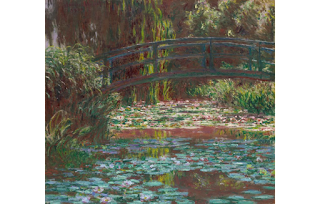
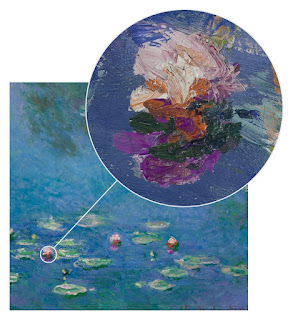
                                 Two of Monet's Water Lily Paintings, 1900 and 1906


One of my favorite locations in the world is Gallery 243 in the Art Institute of Chicago, where some of Claude Monet's series paintings are displayed--one painting of water lilies ("Water Lily Pond," 1919), six paintings of wheat stacks (from 1891), and three of the foggy London paintings (Charing Cross Bridge, Waterloo Bridge, and the Houses of Parliament).  Every time I go there, I am reminded of the day when I first became fascinated with Monet's paintings, when I was a graduate student at the University of Chicago.  It was March 13, 1975, and it was the first day of an exhibition at the Art Institute--"Paintings by Monet"--that had 122 of Monet's paintings from around the world.  I was particularly moved by the series of huge water lily paintings.  Ever since then, I have been trying to understand the attraction of these paintings.

A few days ago, I arrived early at the museum so that my wife and I could be the first people in the gallery.  I had recently read an article by Gloria Bloom--"The Real Water Lilies of Giverny"--that started me thinking about the Darwinian liberalism of Monet's water lily paintings.  

The paintings are Darwinian in many respects. The water lilies in Monet's water garden were products of evolutionary artificial selection by horticultural domestication, which is a process of plant-animal coevolution.  Monet's landscaping of his gardens and his gardening of the plants can be understood as evolutionary niche construction.  The paintings and the plants were also products of a liberal order of global trade and free markets, which allows for the evolutionary economics of entrepreneurship in the markets for plants and art.  This also illustrates how Darwinian liberalism satisfies the natural desire of evolved human nature for the aesthetic pleasures of nature represented in visual art.  The universality of these aesthetic pleasures is indicated by the fact that these paintings by Monet have become some of the most popular images in the history of art.  They have also been commercially successful.  In recent years, some of the paintings have sold for over $50 million.  Amazon sells canvas print reproductions for about $37.


LATOUR-MARLIAC: THE INVENTION AND MARKETING OF MONET'S WATER LILIES

There are over 300 paintings of water lilies or Nymphaea (the subgenus of hardy water lilies) that Monet made over the last 27 years of his life (1899-1926) at his home in Giverny, a village 50 miles northwest of Paris.  Wikipedia has a good list of these paintings.

As Bloom indicates, art consumers and art historians have taken for granted the colorful water lilies planted in Monet's water garden, assuming that Monet must have found these plants easily available in the landscape of France.  But that is not true.  At the end of the 19th century, the only water lily that grew naturally in France was the hardy white species Nymphaea alba, which had been first identified by Carl Linnaeus.


                                                                         Nymphaea alba

In the 19th century, European botanist-explorers were importing colorful water lilies found in tropical regions of the world.  The gardening public was excited by these new brightly colorful water lilies, but these tropical plants could not tolerate the European winter.

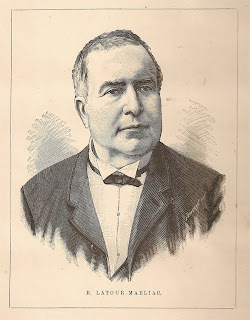
In 1889, at the World's Fair in Paris, the French horticulturalist Joseph Bory Latour-Marliac won a prize for his exhibition of water lilies that he had created by crossbreeding hybridization.  By crossing European species with species found in America and the tropics, he had created colorful lilies that were hardy enough to grow in the European climate (Holmes 2015).  


                                                           Joseph Bory Latour-Marliac


Monet was himself a horticulturalist, and he was impressed by Latour-Marliac's hybrids at the World's Fair.  At Giverny, Monet was diverting a stream through his property and landscaping to create a water garden.  By 1894, he was ready to begin planting, and he placed an order at the Latour-Marliac greenhouses for a wide variety of plants, including three types of water lilies: Nymphaea Mexicana, Nymphaea "Laydekeri Rosea," and Nymphaea "Odorata Sulphurea Grandiflora."


                                                                    Nymphaea Mexicana


                                                           Nymphaea "Laydekeri Rosea"


                                                 Nymphaea "Odorata Sulphurea Grandiflora"


In 1904, Monet placed his second order for plants from the Latour-Marliac nursery, and this time it was only for red water lilies.  Now, he could compose his palette of colors balanced between yellows, pinks, and reds--both in his garden and in his paintings of the garden.  His garden would be in full bloom during the warmest months of the year--from May to September or October.  During the colder months, the tender plants could be overwintered in his large greenhouse.

Latour-Marliac's precise method for making his crosses is unknown.  But the general method for horticultural hybridizing is well understood.  The pollen parent plant provides the male reproductive material.  The seed parent plant provides the female material--the fertile womb.  To make a cross, the hybridizer takes the pollen from a plant that has some desirable characteristics (such as flower color or hardiness) and applies it to the female reproductive part, the pistil, of another plant.  Each seedling produced from this match will be a unique combination of traits from the parent plants.

This domestication and hybridizing of plants are important for Darwinian evolutionary thinking in six ways.  The first is that Darwin developed his idea of evolutionary natural selection from his understanding of the artificial selection exercised by human beings in domesticating plants and animals.  He made this clear in the first two chapters of the Origin of Species, where he compared "variation under domestication" and "variation under nature," and in the Introduction to his book The Variation of Animals and Plants Under Domestication.  He explained that it was through his study of "domestic productions" that he "acquired a just idea of the power of Selection" (1998, 1:10).  He saw that the term "natural selection" was "so far a good one as it brings into connection the production of domestic races by man's power of selection and the natural preservation of varieties and species in a state of nature" (1:6).  Just as the human breeder of plants and animals selects those traits that show "adaptation to his wants and pleasures," nature selects those traits that give an organism some adaptation for survival and reproduction in the struggle for life (1:4).

The second important contribution to Darwinian thinking here is that the human domestication of plants illustrates the ecological coevolution of plants and animals, so that plants and animals evolve to be mutually dependent.  This is true not just for human beings but for other animals as well.  For example, fungal species have been domesticated by bees and beetles, which shows that agriculture evolved millions of years ago among these animals, long before the emergence of human agriculture (Farrell et al. 2001; Nygaard et al. 2016; Purugganan and Fuller 2009; Schultz and Brady 2008).

The third point is that the human domestication of plants is a form of Darwinian niche construction.  In creating his water garden and planting it with Latour-Marliac's hybrid water lilies, Monet was creating a niche in which he could cultivate his artistic imagination.  Other animals and plants also engage in niche construction, so that instead of just adapting to the given natural environment, they construct their environment so that it is more hospitable to them.  I have written previously about this here and here.

The fourth way in which this contributes to Darwinian thinking is that understanding the artificial hybridization of plants helps us to think about the possibility that new species could have evolved by natural hybridization.  There is now a growing recognition that hybridization has been important for the evolution of many species--including the evolution of iguanas and finches in the Galapagos and even human evolution.  I have written previously about this here and here.

The fifth point is that the human breeding of Monet's water lilies illustrates the Darwinian evolution of a sense of beauty that could be crucial for a biological science of art.  In the Origin of Species, Darwin observed that the human domestication of plants and animals showed "adaptation, not indeed to the animal's or plant's own good, but to man's use or fancy."  And a plant might be adapted for man's "fancy" if it was made "beautiful in his eyes" (1859: 30).  The vibrant colors of Latour-Marliac's hybrid water lilies made them beautiful in Monet's eyes and the eyes of those who have contemplated his water lily paintings.  They human visual system has evolved to detect and appreciate colors that are wavelengths of light within the visible range for the human eye.  Similarly, the visual system of some other animals makes certain colors attractive to them.  This is part of what Darwin in The Descent of Man identified as the "sense of beauty" that human beings share with other animals.  One reason for this is what Darwin called "sexual selection":  in some animals, females prefer to mate with males they find colorful, or males select females that seem beautiful to them (2004, 114-16, 430-32, 461-65, 640-52, 664, 686-87).  In a future post, I will say more about this as part of the biology of art.

Finally, Latour-Marliac's breeding of Monet's water lilies can also be understood as evolutionary economics.  After all, Latour-Marliac's nursery was a business enterprise that had to struggle to survive in a competitive market.  This nursery is still operating and still selling water lilies, as you can see at their website.  In 2007, the business was purchased by Robert Sheldon, a professor of entrepreneurship at a business school in France.  He has written about the economic history of the business as an illustration of Joseph Schumpeter's evolutionary theory of economics, in which a capitalist economy is understood as a process of creative destruction: the economy is in a constant state of flux, with firms failing and freeing resources for innovative entrepreneurs who invent new products and services and thus create new markets.  Latour-Marliac showed this because to survive he had to innovate both in creating new plants by hybridization and in creating the markets for these plants.  The popularity of Monet's water lily paintings helped to create the demand for Latour-Marliac's water lilies, and Latour-Marliac had to cultivate a network of customers around the world.  After Sheldon took ownership of the firm, he innovated by creating a restaurant at the nursery and promoting the nursery as a tourist attraction (Sheldon 2017).

Another part of this story of evolutionary economics is the marketing of Monet's art and impressionist art generally, which was largely the work of the art dealer Paul Durand-Ruel--the subject of a future post.

You can see that going to Gallery 243 has given me a lot to think about.


REFERENCES

Darwin, Charles. 1859. On the Origin of Species. London: John Murray.

Darwin, Charles. 1998.  The Variation of Animals and Plants Under Domestication. 2 vols. 2nd ed.  Baltimore, MD: Johns Hopkins University Press.

Darwin, Charles. 2004. The Descent of Man. 2nd ed. New York: Penguin.

Farrell, Brian D., et al. 2001. "The Evolution of Agriculture in Beetles (Curculionidae: Scolytinae and Platypodinae)."  Evolution 55 (10): 2011-2027.

Holmes, Caroline. 2015. Water Lilies and Bory Latour-Marliac, the Genius Behind Monet's Water Lilies. Woodbridge, UK: Garden Art Press.

Nygaard, Sanne, et al. 2016. "Reciprocal Genomic Evolution in the Ant-Fungus Agricultural Symbiosis."  Nature Communications 7:12233, July 20.

Purugganan, Michael D., and Dorian Q. Fuller. 2009. "The Nature of Selection During Plant Domestication." Nature 457: 843-48.

Schultz, Ted. R., and Sean G. Brady. 2008. "Major Evolutionary Transitions in Ant Agriculture." Proceedings of the National Academy of Sciences 105 (14): 5435-5440.

Sheldon, Robert Charles. 2017. "Inventing Water Lilies: Latour-Marliac and the Social Dynamics of Market Creation." Entreprises et Histoire. Number 88: 147-65.

Wednesday, January 12, 2022

Was Edward O. Wilson a Racist? Monica McLemore's Fraudulent Claim

I was shocked to see that Scientific American has published an article by Monica McLemore (a professor at the University of California-San Francisco) identifying Edward O. Wilson as a racist scientist.  I was shocked by this because there is no evidence to back up her claim, and one doesn't expect Scientific American to publish fraudulent research.  I was also shocked to see that Arts and Letters Daily has a prominent link to this article.  Scientific American should issue a public retraction of this article and apologize for publishing it without checking it for accuracy.

Here is how she begins her article:

"With the death of biologist E. O. Wilson on Sunday, I find myself again reflecting on the complicated legacies of scientists whose works are built on racist ideas and how these ideas came to define our understanding of the world."

"After a long clinical career as a registered nurse, I became a laboratory-trained scientist as researchers mapped the first draft of the human genome. It was during this time that I intimately familiarized myself with Wilson’s work and his dangerous ideas on what factors influence human behavior."

"His influential text Sociobiology: The New Synthesis contributed to the false dichotomy of nature versus nurture and spawned an entire field of behavioral psychology grounded in the notion that differences among humans could be explained by genetics, inheritance and other biological mechanisms. Finding out that Wilson thought this way was a huge disappointment, because I had enjoyed his novel Anthill, which was published much later and written for the public."

Notice that she does not cite or quote any passages in his published writing where Wilson endorsed racism.  I have emailed McLemore asking that she give me some citations of Wilson's writing showing racism, but she has not yet responded.

She does cite Wilson's Sociobiology.  But that's strange because Wilson never says anything in that book favoring racism.  In the whole book, the word "race" appears only once; and that's in a quotation from Garrett Hardin identifying racism as a form of tribalism (565).  But since Wilson is warning against the dangers of tribalism, there's no way to see this as his endorsement of racism.

Wilson does have one paragraph on the slave society of Jamaica as an example of "societies that contain obvious inefficiencies and even pathological flaws" (549).  Wilson quotes from Orlando Patterson (a famous black sociologist at Harvard) as describing Jamaican slave society as showing "the astonishing neglect and distortion of almost every one of the basic prerequisites of normal human living."  Where's the racism here?

In On Human Nature, Wilson wrote: "it is a futile exercise to try to define discrete human races.  Such entities do not in fact exist" (48).  He also identified "nationalism and racism" as "the culturally nurtured outgrowths of simple tribalism" (92).  Where's the racism here?

In Consilience, Wilson identified "racialist fascism" as "totalitarian ideology" (34).  He also described Ruth Benedict and Margaret Mead as having "led a crusade against what they perceived (correctly) to be the eugenics and racism implicit in Social Darwinism" (184).  Where's the racism here?

Monica McLemore says that Wilson's racism was implicit in his contributing to "the false dichotomy of nature versus nurture."  In fact, however, Wilson was famous for promoting the idea of "gene-culture coevolution" (in Consilience and other writings), which rejects "the false dichotomy of nature versus nurture."  Where's the racism here?

If I have overlooked some passage somewhere in Wilson's writings where he endorses racism, I am sure that McLemore will point me to it.  But if she can't do this, she should be ashamed of herself.

A few hours after I first published this post, I received an email response from McLemore.  She did not cite or quote any evidence of Wilson's racism, which I will take as indicating that she doesn't have any evidence for her claim.

I have written a series of posts on Wilson, the most recent one just two weeks ago.

Leon Kass's Bioethics in Darwinian Liberal Education


DARWINIAN LIBERAL EDUCATION

Kass’s richer “more natural science” of his early writings supports a richer public bioethics as part of a Darwinian liberal education that unifies all intellectual disciplines—the natural sciences, the social sciences, and the humanities—within the unifying framework of Darwinian evolutionary science.  The aim of liberal education is to probe all the fields of intellectual inquiry to understand how the complex interaction of natural propensities, cultural traditions, and individual choices shapes the course of human experience within the cosmic order of nature.  Darwinian science provides a general conceptual framework for such liberal learning grounded in the scientific study of the evolution of life within the evolution of the universe (Arnhart 2006).

          Kass’s primary contribution to this Darwinian liberal education has been in developing what he has called “a richer bioethics, one that recognizes and tries to do justice to the deep issues of our humanity raised by the age of biotechnology” (Kass 2005:221).  Kass agrees with the argument of John Evans that the public bioethical debate has become too “thin,” and that it needs to become “thicker” (Evans 2002).  Kass’s “richer” bioethics is what Evans would call a “thicker” bioethics.  For bioethics to become richer or thicker, it must become part of a Darwinian liberal education, which became clear in the work of the President’s Council as led by Kass (Briggle 2010).

          Evans uses the metaphor of thick and thin to distinguish the substantive rationality of the bioethical debate from the late 1960s to the early 1970s and the formal rationality that came to dominate bioethics beginning in the late 1970s.  In the earlier period, the substantive rationality of the debates over biotechnology required that people argue about whether some technology such as human genetic engineering was consistent with ultimate values or ends, which required that people argue about those ultimate ends.  So, for example, a scientist promoting human genetic engineering might argue that this was the best means for achieving the ultimate end of human control of nature and human nature, so that human beings could engineer the perfection of their species by eliminating genetic defects and pursuing genetic enhancements.  But then a theologian might argue that this was “playing God,” in that man was trying to become his own self-creator and thus take the place of God the Creator, in violation of God’s ends.  There would then be a debate over which ultimate end should be higher—striving for a human God-like power over nature for human self-perfection or a humble and reverent acceptance of a God-given human nature with all its imperfections.  Since many conflicting ends could be considered in such debates, reaching agreement on which end should predominate was difficult if not impossible, so that the debates could become endless.  In this way, the substantive rationality of these debates was thick.

          By contrast, beginning in the late 1970s, bioethics became dominated by professional bioethicists—typically, academic philosophers and lawyers—who developed bioethics as a specialized field of study promoting an argumentation of formal rationality.  According to this view, any biotechnological means that maximized ends was ethical; and the ends were predetermined by consensus of the experts to be limited in number.  The ends were eventually reduced to four principles: personal autonomy (informed consent), beneficence (benefits greater than costs), nonmaleficence (avoiding harm), and justice (fair distribution of benefits, costs, and risks) (Beauchamp and Childress 2001).  It was assumed that these were universal ends to which all human beings could agree.  All other ends for which there was no universal agreement were excluded from the bioethical debates.  Once they had agreed to their four ends, bioethicists would only debate about calculating the best means to these four ends; and they saw no need to debate about ends other than these four.  In this way, the formal rationality of their debates was thin.

          Kass’s thicker or richer bioethics accepts the four principles adopted by the professional bioethicists—autonomy, beneficence, nonmaleficence, and justice.  But in his writings and in his work with the President’s Council, Kass has shown that a deep deliberation about bioethical issues must consider many important moral ends beyond these four principles; and because these many moral ends often conflict with one another, different people will come to different conclusions about how to weigh these ends.  The moral deliberation about these ends will often not reach consensus.

          For example, consider the debate over whether parents should be free to use stimulant drugs—such as Ritalin (methylphenidate) or Adderall (amphetamine)—to modify the behavior of children who are inattentive, impulsive, or hyperactive.  For thin bioethics, there might be only two principles for this debate—autonomy and nonmaleficence.  Are parents exercising their autonomy in giving these drugs to their children?  Are these drugs safe for the children?  If the answer to both questions is yes, then we should allow parents to use these psychotropic drugs in helping them to rear their children.

          But for the thick bioethics of the Beyond Therapy report, some important moral considerations have been passed over in silence.  For example, one crucial part of parental rearing of children is the moral education of children through shaping their moral character so that they are capable of self-control and behaving appropriately in society.  Will behavior-modifying drugs interfere with this moral education?  Will this teach children that good behavior is caused by chemistry, and that the responsibility for their conduct belongs not to themselves but to their pills?  Will this diminish their sense of moral agency? (President’s Council 2003a:87-92).  The thin bioethics of the professional bioethicists does not ask such questions.

          Furthermore, while thin bioethics requires only a narrowly specialized training—learning the four moral ends and how biotechnological means can maximize those ends—thick bioethics requires a broadly interdisciplinary liberal education that integrates the natural sciences, the social sciences, and the humanities in seeking wisdom about the conditions for a flourishing human life and how biotechnology might impede or promote that human flourishing.  That liberal education is best pursued, Kass believes, through reading and discussing the Great Books of the Western intellectual tradition.  One can see that in the anthology of 92 selected texts published by the President’s Council—Being Human: Readings from the President’s Council on Bioethics.  The authors of the texts include scientists (such as Edward O. Wilson, Richard Feynman, and James Watson), physicians (such as Hippocrates and Richard Selzer), philosophers (such as Plato, Aristotle, Lucretius, and Thomas Hobbes), poets (such as Homer, Shakespeare, and Walt Whitman), and novelists (such as Leo Tolstoy, George Eliot, and Willa Cather) (President’s Council 2003b).

          In its devotion to a bioethics rooted in liberal education, the President’s Council was different from the other five general federal bioethics commissions preceding it.  Those other commissions were concerned mostly with developing specific public policy proposals.  By contrast, the Kass Council made few policy proposals.  Kass has admitted that the Council has had “no demonstrable effect” on “specific policy issues.”  He conducted the Council’s meetings and supervised the Council’s reports to promote seminar-like discussions that allowed open debate about the moral and intellectual questions raised by bioethical disputes without ever reaching consensus.  He said that Beyond Therapy was “a purely educational work, with no policy recommendations.”  He explained that his primary goal was educational: he hoped that the published discussions and reports of the Council would be adopted as readings for college seminar courses on bioethics or for groups of ordinary citizens who wanted to discuss deep questions about the implications of biotechnology for human life (Kass 2005:229, 240-41, 244-47).

          We can see here that Kass’s educational goal is to revive the tradition of liberal education as a unification of all knowledge in the quest for wisdom about the meaning of our humanity, of our human nature within the natural order of the whole.  That unity of knowledge requires a unifying framework of thought.  There is today only one plausible source for such a common ground of knowledge, and that is Darwinian evolutionary science.

          Although Kass does not explicitly affirm this idea of a Darwinian liberal education, he does at least implicitly suggest it in some of his early writings and in some of the reports of the President’s Council.  For example, as we have seen, the Council’s report Beyond Therapy is organized around natural human desires—“desires for longer life, stronger bodies, sharper minds, better performance, happier souls, better children” (Kass 2005:235).  These natural desires are the “essential sources of concern” that set the standards for any moral assessment of biotechnology.  They constitute “what is naturally human,” “what is naturally and dignifiedly human.”  They are “naturally given” to us as inherent in our human nature.  If we seek the source of this gift, we find that our natural desires are “wondrous products of evolutionary selection,” because “the human body and mind” are “highly complex and delicately balanced as a result of eons of gradual and exacting evolution” (President’s Council 2003a:286-87).

          This unification of knowledge founded on evolutionary science suggests something like what Edward O. Wilson called “consilience” (Wilson 1998).  Wilson argued that the natural human desire to understand the world as an orderly whole was a quest for the fundamental unity of all knowledge.  This longing for a comprehensive knowledge of the whole began with ancient philosophers such as Thales and Aristotle.  It was renewed by the Enlightenment of the seventeenth and eighteenth centuries.  Now, Wilson claimed, the progress in modern science has created the realistic prospect for satisfying this ancient longing by developing a web of causal explanations that would combine all the intellectual disciplines.  Crucial to this unification of knowledge is its foundation in evolutionary biology as explaining the nature of human beings and their place in the natural whole, including the evolution of the universe from the Big Bang to the present, which some historians now call Big History (Christian 2004; Christian, Brown, and Benjamin 2014).  Darwinian liberal education must encompass all of this.


THE NATURAL LIMITS OF BIOTECHNOLOGY

One objection to this pursuit of a Darwinian liberal education that studies an evolved human nature is that this assumes the stability of that human nature, even though we know now that biotechnology is giving us the power to change and even abolish that human nature.  After all, isn’t Kass’s bioethics driven by his fear that biotechnology can lead to what C. S. Lewis called “the abolition of man”?

          The problem with this objection, however, is that it shows how the power of biotechnology for changing human nature has been exaggerated (Arnhart 2003).  The most fervent advocates of biotechnology welcome the prospect of using it to transform our nature to make us superhuman.  The most fervent critics of biotechnology warn us that its power for transforming our nature will seduce us into a Faustian bargain that will dehumanize us.  Both sides agree that biotechnology is leading us to a “posthuman future” (Fukuyama 2002). 

This is a mistake.  It ignores how evolution has shaped the adaptive complexity of our human nature—our bodies, our brains, and our desires—in ways that resist technological manipulation.  A Darwinian view of human nature—one truer to the facts of human biology and human experience—reveals the limits of biotechnology, so that we can reject both the redemptive hopes of its optimistic advocates and the apocalyptic fears of its pessimistic critics.

          Biotechnology will be limited both in its technical means and in its moral ends.  It will be limited in its technical means because complex behavioral traits are rooted in the intricate interplay of many genes, which interact with developmental contingencies and unique life histories to form brains that respond flexibly to changing circumstances.  Consequently, precise technological manipulation of human nature to enhance desirable traits while avoiding undesirable side effects will be very difficult if not impossible.  Biotechnology will also be limited in its moral ends because the motivation for biotechnological manipulations will come from the same natural desires that have always characterized human nature.

          In Beyond Therapy, Kass and his Council recognized both these natural limits on biotechnology.  For example, they noted the technical limits to any attempt to use genetic engineering to design “better children”: “Growing recognition of the complexity of gene interactions, the importance of epigenetic and other environmental influences on gene expression, and the impact of stochastic events is producing a strong challenge to strict genetic determinism.  Straightforward genetic engineering of better children may prove impossible, not only in practice but even in principle.”  Consequently, “genetically engineered ‘designer babies’ are not in the offing” (President’s Council 2003a:38, 276).  They also recognized that biotechnology would be limited in its moral ends as set by the natural desires of evolved human nature, including those desires around which the whole discussion in Beyond Therapy is organized.


CONCLUSION

I have identified three problems in Leon Kass’s “richer bioethics.”  He contradicts himself when he shifts back and forth between his appeal to natural reason and his appeal to supernatural revelation—Athens and Jerusalem.  His attempt to develop a biblical bioethics fails because he Bible lacks the moral authority, the moral clarity, and the moral reliability required for settling debates over biotechnology.  In claiming that all modern science is blinded by a crudely reductionistic, mechanistic, and antiteleological understanding of nature, he fails to recognize how modern science sees the emergent complexity and teleological structure of life.

          Kass could avoid these problems by renewing his project for a “more natural science” in his early writings.  This expansive conception of modern science would support a Darwinian liberal education that could help us to think deeply and act morally in our modern world as shaped by modern science and technology.

          More broadly, Darwinian liberal education can help us understand our human place in nature.  We are neither mindless machines nor disembodied spirits.  We are animals.  As animals, we display the animate powers of nature for movement, desire, and awareness.  We move to satisfy our desires in the light of our awareness of the world.  We are a unique kind of animal, but our distinctively human traits—such as symbolic speech, practical deliberation, and conceptual thought—are emergent elaborations of powers shared in some form with other animals.  Our powers for habituation and learning allow us to alter our natural environments, but even these powers are emergent extensions of the behavioral flexibility shown by other animals.  So even if the natural world was not made for us, we were made for it, because we are adapted to live in it.  We have not been thrown into nature from some place far away.  We come from nature.  It is our home.


REFERENCES

Arnhart, Larry. 2003. “Human Nature Is Here to Stay.” The New Atlantis, Number 2 (Summer): 65-78.

Arnhart, Larry. 2006. “Darwinian Liberal Education.”  Academic Questions 19 (Fall):6-18.

Beauchamp, Tom L., and James F. Childress. 2001. Principles of Bioethics. 5th edition. New York: Oxford University Press.

Christian, David. 2004. Maps of Time: An Introduction to Big History. Berkeley: University of Chicago Press.

Christian, David, Cynthia Stokes Brown, and Craig Benjamin. 2014. Big History: Between Nothing and Everything. New York: McGraw-Hill.

Evans, John H. 2002. Playing God? Human Genetic Engineering and the Rationalization of Public Bioethical Debate.  Chicago: University of Chicago Press.

Briggle, Adam. 2010. A Rich Bioethics: Public Policy, Biotechnology, and the Kass Council. Notre Dame, IN: University of Notre Dame Press.

Fukuyama, Francis. 2002. Our Posthuman Future: Consequences of the Biotechnology Revolution. New York: Farrar, Straus, and Giroux.

Kass, Leon. 2005. “Reflections on Public Bioethics: A View from the Trenches.” Kennedy Institute of Ethics Journal 15:221-50.

President’s Council on Bioethics. 2003a. Beyond Therapy: Biotechnology and the Pursuit of Happiness. Washington, DC: President’s Council on Bioethics.

President’s Council on Bioethics. 2003b. Being Human: Readings from the President’s Council on Bioethics. Washington, DC: President’s Council on Bioethics.

Wilson, Edward O. 1998. Consilience: The Unity of Knowledge. New York: Knopf.