Traditionalist conservatives and classical liberals need Charles Darwin. They need him because a Darwinian science of human nature supports Burkean conservatives and Lockean liberals in their realist view of human imperfectibility, and in their commitment to ordered liberty as rooted in natural desires, cultural traditions, and prudential judgments. Arnhart's email address is larnhart1@niu.edu.
Sunday, December 09, 2012
John Locke and the "Appeal to Heaven" Flag
As I have suggested in some previous posts, John Locke's "appeal to Heaven" shows a natural inclination to violent resistance to exploitation that is fundamental for classical liberalism. As a manifestation of Darwinian natural right, this can be explained as rooted in an evolved animal disposition to aggressive retaliation against attacks, which arises in human beings as a natural propensity to vengeance against injustice. Human beings can use their unique capacities for language and conceptual reasoning to express this natural propensity through abstract principles of justice, but these abstract principles are ultimately rooted in this evolved animal tendency to self-protection.
Locke's "appeal to Heaven" is his answer to what he takes to be an ultimate question of politics--"Who shall be judge?" This is the question when there is an irresolvable debate over whether political power has been rightly used or not. Locke's answer comes from the Biblical story of Jeptha (in Judges, chapter 11). In the conflict between the people of Israel and the Ammonites, Jeptha is selected by the people to be their chief and war leader. He negotiates with the Ammonites. But when this negotiation fails to reach an agreement, Jephtha declares, "Let Yahweh the Judge give judgment today." That divine judgment will come through war. That's what Locke means by the "appeal to Heaven" when there is no "appeal on Earth." (See First Treatise, sec. 163; and Second Treatise, secs. 21, 109, 155, 168, 176, 232, 240-43.)
As far as I can tell this phrase "appeal to Heaven" is Locke's. It doesn't appear in the Bible.
It's similar to the way Confucius speaks of the "mandate of Heaven," as I have indicated in a previous post on "Confucian Liberalism." If there is any heavenly standard of judgment to settle moral and political disputes, it's ultimately expressed in the natural tendency of the people to rebel against unbearable oppression.
This is what I mean in my previous post affirming the truth of might makes right: the threat or use of violent vengeance is the ultimate natural restraint on injustice.
Notice also how Locke interprets the Bible--at least the Old Testament--as a work of historical anthropology. He assumes that what is being described in the history of the judges is the earliest emergence of government in primitive societies, where the natural drive for dominance in a few individuals motivates them to become war leaders chosen by their people. Notice also how Locke interprets this as showing government by the consent of the governed, in that these informal leaders like Jephtha depend on popular support for their authority. Thus the Biblical history coincides with what Locke sees in the history of the American Indians as a record of how government arose among the earliest human ancestors.
The influence of this Lockean idea in the American Revolution was vividly displayed in the design of what apparently was the first flag of the American navy in 1775--perhaps commissioned by General Washington--which had an evergreen tree of liberty and the motto "Appeal to Heaven." Some of the variations of this design can be found here and here.
Saturday, July 30, 2022
Locke in the Declaration of Independence: A Response to Claire Rydell Arcenas's Argument
Over the years, I have written a lot about Lockean liberalism in American political thought--particularly as expressed in the Declaration of Independence. But a new book by Claire Rydell Arcenas--America's Philosopher: John Locke in American Intellectual Life--argues that this idea that Locke's ideas (particularly in his Second Treatise of Government) influenced the Declaration of Independence is a "myth." There are, however, two major weaknesses in Arcenas's argument that are illustrated by her handling of the intellectual history of the Declaration of Independence.
Nevertheless, I should say that her book is valuable as an intellectual history of John Locke's influence in America from the colonial period to the present. She shows that that influence has been so deep and so enduring that Locke can indeed be identified as "America's Philosopher." I find much of what she says persuasive.
I am not fully persuaded for two reasons. She is not a careful reader of Locke. And she employs a deceptive silence that allows her to ignore the best criticisms of her reasoning. I will explain these two points, and then I will show how they are manifested in her account of the Declaration of Independence.
Although Arcenas's denial of the Lockean character of the Declaration of Independence is only a small part of her history of Locke in America, it is the crucial turn in her general argument.
A CARELESS READER
Arcenas speaks about what "careful readers of Locke's work" know about his writings (50). Unfortunately, Arcenas offers no evidence that she is one of those careful readers. On the contrary, she often suggests that either she has not read Locke at all, or that she has only glanced at some passages in Locke's texts with the help of some summaries by some scholarly commentators. For example, after a brief survey of Locke's life and work, she refers her reader to "some succinct summaries of Locke's work" in The Cambridge Companion to Locke and elsewhere (6, 174, n.18). When she writes about Locke's Reasonableness of Christianity and his Paraphrase and Notes on the Epistles of St. Paul, she does not quote or cite any passages in those books, but instead, once again, she cites some scholarly summaries of those books (28-29, 184, nn. 115, 119).
At no point in her book, does Arcenas develop a careful reading of any portion of Locke's texts. Now Arcenas might respond by saying that she does not present her book as an accurate interpretation of Locke's writing. She explains: "This, then, is not a book about John Locke, the seventeenth-century English philosopher, but rather a book about how Americans over time have understood and made sense of him, his work, his ideas, and his relevance. I present interpretations of Locke's life, ideas, and works through the eyes of my subjects--not the lenses of modern scholars" (4-5). But, as we have just seen, she does rely on "the lenses of modern scholars" to provide accurate summaries of Locke's writings. Moreover, she often corrects what she claims to be distortions of Locke's texts. For example, she asserts that "careful readers of Locke's works" know that what the Declaration of Independence calls "the pursuit of Happiness" cannot be found in Locke's writing (50-51, 127).
DECEPTIVE SILENCE
A second weakness in Arcenas's book is that she is deceptively silent about the many good objections to her arguments. One of the fundamental standards for scholarly writing is that if a scholar takes a position on some controversial topic, that scholar is obligated to explain and then rebut the best arguments for the opposing positions in the debate. Arcenas does not do that. Nowhere in her book does she explain to her reader the objections to her reasoning and then refute those objections. Her silence allows her to ignore her critics without directly engaging them in debate.
She might respond by saying that in fact she identifies her critics by citing their writings. And, indeed, in a few of the endnotes to her book, she does list some articles and books that argue against her position (176, n. 8, and 190, n. 72, 191, n. 75). But she never explains the evidence and arguments laid out by these critics, and she never attempts to show how these critics are mistaken. In this way, she makes it impossible for her reader to weigh the opposing sides in this debate.
LOCKE'S SECOND TREATISE IN THE DECLARATION OF INDEPENDENCE
Both of these weaknesses are manifest in what she says about "a central myth of the American Revolution"--that the Declaration of Independence shows the influence of Locke's ideas, particularly his political teaching in the Second Treatise (49-51).
The most obvious way to resolve this question is to compare the texts of the Declaration of Independence and the Second Treatise to see if there are any similarities in the language and ideas of these two works. Surprisingly, Arcenas never does that, although she does argue that the language of "Life, Liberty, and the pursuit of Happiness" in the Declaration of Independence is very different from "Lives, Liberties, and Estates" in the Second Treatise.
A careful reader who compares these two texts will see some remarkable similarities in their language, and these similarities have been noticed by many Americans from the time of the American Revolution to the present as clear evidence of Locke's influence on the Declaration. Here I will point to ten of these similarities.
1. In its first sentence, the Declaration appeals to "the Laws of Nature and of Nature's God." Any careful reader of Locke's Second Treatise will recognize this as similar to expressions used by Locke. He often speaks of the "Laws of God and Nature" (66, 142, 195), the "Law of Nature" (1, 4), and "God and Nature" (60). Similar expressions can be found widely in authors of the seventeenth and eighteenth century. I have written about "Nature's God" as the deity of the Declaration.
2. The famous second sentence of the Declaration begins by invoking those "truths" that are held to be "self-evident," of which the first is that "all men are created equal." This echoes Locke's holding the "equality of Men by Nature" as "so evident in it self," there being "nothing more evident, than that Creatures of the same species and rank" should be "equal one amongst another" (4-5). Locke also speaks of "Men being . . . by Nature, all free, equal and independent" (95). In Jefferson's first draft of the Declaration, he wrote that "all men are created equal & independent; that from that equal creation they derive rights inherent & inalienable" (Becker 1942, 142). Locke's phrase "equal and independent" also appeared in George Mason's Virginia Bill of Rights: "That all men are by nature equally free and independent."
3. Also in the second sentence of the Declaration, the "unalienable Rights" are said to include "Life, Liberty, and the pursuit of Happiness." This is the only passage in the Declaration that draws Arcenas's attention. She says that this language cannot be found in Locke's Second Treatise. Locke says that in leaving the state of nature, people "unite for the mutual Preservation of their Lives, Liberties and Estates, which I call by the general Name, Property" (123). Clearly, Arcenas claims, this language in the Second Treatise cannot be the source for the passage in the Declaration. Most importantly, she asserts, the phrase "pursuit of Happiness" is not Locke's (Arcenas 50-51). This assertion will seem strange to anyone who has read Locke's Essay Concerning Human Understanding, because this book has a long chapter on "Power" that speaks repeatedly of the "pursuit of happiness" (II.xxi.39, 44, 48, 52-53, 61-63, 70). It is surprising that Arcenas says nothing about this, particularly since she argues that for most of American history, Locke's Essay Concerning Human Understanding was more widely read and studied than his Two Treatises of Government. One has to wonder whether she has actually read Locke's Essay. One also has to wonder why she says nothing about the passage in Locke's Letter Concerning Toleration where he summarizes the Second Treatise in arguing that governments were established to secure people in their lives and property and in the things that contribute to the "Happiness of this Life," while "leaving in the mean while to every Man the care of his own Eternal Happiness" (Locke 2010, 46-47). In such passages, we see Locke affirming that people have a natural right to the "pursuit of happiness," the same idea that is affirmed in the Declaration.
That Arcenas is unaware of what Locke says about the "pursuit of happiness" is especially surprising because she cites C. Bradley Thompson's book America's Revolutionary Mind, which has a long section on how Jefferson could have borrowed the phrase "pursuit of happiness" from Locke's Essay Concerning Human Understanding (Arcenas 2022, 190, n. 72; Thompson 2019a, 206-220). Arcenas either cited this book without actually having read it, or she did read it but decided to pass over Thompson's argument in silence.
4. In the third sentence of the Declaration, it is claimed that governments are instituted among men "to secure these rights." Similarly, the Second Treatise often says that governments are established "to secure" or "preserve" natural rights (87, 131, 222, 225).
5. This establishment of government to secure natural rights is said by the Declaration to be based on "the consent of the governed." This idea appears many times in the Second Treatise (102, 104-106, 112, 119, 121-22, 138, 140, 168, 175, 198).
6. When a government fails to secure these rights, then the Declaration recognizes "the Right of the People to alter or abolish it," and to institute a new government that is "most likely to effect their Safety and Happiness." But prudence dictates caution in overthrowing any government that has been long established, "and accordingly all experience hath shown, that mankind are more disposed to suffer, while evils are sufferable, than to right themselves by abolishing the forms to which they are accustomed." Locke expresses a similar thought in the Second Treatise, in responding to the objection that if people are taught that they have a right to dissolve a government that they don't like, this will lead to frequent rebellions and thus anarchy. In fact, Locke insists, people are slow to rebel. "For till the mischief be grown general, and ill designs of the Rulers become visible, or their attempts sensible to the greater part, the People, who are more disposed to suffer, than right themselves by Resistance, are not apt to stir" (230). This phrasing of "more disposed to suffer" is identical in the Declaration and the Second Treatise.
7. Similarly, the Declaration's phrasing of "abolishing the forms to which they are accustomed" repeats Locke's wording in the Second Treatise: "People are not so easily got out of their old Forms, as some are apt to suggest. They are hardly to be prevailed with to amend the acknowledg'd Faults, in the Frame they have been accustom'd to" (223).
8. But even though people are slow to rebel against their long-established governments, the Declaration explains, "when a long train of abuses and usurpations, pursuing invariably the same Object evinces a design to reduce them under absolute Despotism, it is their right, it is their duty, to throw off such Government, and to provide new Guards for their future security." This echoes Locke's language about how a government that shows an evident tendency towards despotism can provoke the people to revolution: "if a long train of Abuses, Prevarications, and Artifices, all tending the same way, make the design visible to the People, and they cannot but feel, what they lie under, and see, wither they are going; 'tis not to be wonder'd, that they should then rouze themselves, and endeavour to put the rule into such hands, which may secure to them the ends for which Government was at first erected" (225; compare 210, 230).
9. Next, the Declaration asserts: "The history of the present King of Great Britain is a history of repeated injuries and usurpations, all having in direct object the establishment of an absolute Tyranny over these States. To prove this, let Facts be submitted to a candid world." This introduces the longest section of the Declaration--a long list of grievances, a factual indictment of Great Britain based on an asserted history of abuses. This part of the Declaration corresponds to Locke's many references to the political history of England under the Stuart Monarchy, in which he identified acts that might have justified a revolution against Charles II and that did in fact justify the Revolution of 1688 overthrowing James II and installing King William.
10. Finally, in the last two sentences of the Declaration that formally declare the independence of America from British rule, there is an appeal "to the Supreme Judge of the world for the rectitude of our intentions" and to "the Protection of Divine Providence." Similarly, Locke appeals to the "Supreme Judge of all Men," which is part of his "appeal to Heaven," which is an appeal to the God of Battles to settle the revolutionary dispute between the People and the government in war (21, 240-43). And, in fact, the Declaration of Independence was a declaration of war, an "appeal to Heaven."
The phrase "appeal to Heaven" was coined by Locke, and this phrase was put on the Americans' "Appeal to Heaven" flag, the first flag of the American Navy in 1775. I have written about this previously.
THE AMERICAN DEBATE OVER WHETHER JEFFERSON PLAGIARIZED FROM LOCKE: 1801-1826
Arcenas might respond to all this by saying that this is irrelevant to what she has done in her book. After all, as we have seen, she says that her book is not a book about John Locke or about what scholars today might see in Locke's texts. Since she is writing about the intellectual history of how Locke has been interpreted by Americans from colonial times to the present, it doesn't matter for this purpose whether scholars today can see verbal parallels between the Declaration of Independence and Locke's Second Treatise. The question is whether contemporary Americans of Jefferson's time thought that Locke's Second Treatise was a primary source for Jefferson's Declaration of Independence. "In a word," she says, "the answer is no" (49).
But for Arcenas to say this, she must ignore the historical evidence that Jefferson's contemporaries really did see the remarkable influence of the Second Treatise on Jefferson's writing of the Declaration. For example, Arcenas is silent about the American debate--during the last 25 years of Jefferson's life, 1801-1826--over whether Jefferson had plagiarized much of the Declaration of Independence from Locke's Second Treatise. Oddly, in one endnote of her book (191, n. 75), Arcenas cites an article by Brad Thompson (2019b) that tells the story of this debate, but then she never explains the story or explains why this should not be considered crucial evidence against one of the main arguments of her book.
In 1800, Jefferson was elected president in one of the most acrimonious elections in American history. This was the first presidential election in which two deeply partisan factions fought an ideological battle--with the Federalists led by John Adams and the Republicans led by Jefferson. A few months after Jefferson's inauguration in 1801, the staunchly Republican New York City newspaper the American Citizen and General Advertiser published a two-part essay by the editors on "John Locke." They identified Locke as "the first writer on political science that ever justly defined the principles of civil government," and they said that Jefferson's Declaration of Independence had stated those principles as first set forth in Locke's Second Treatise. In fact, they observed, the reader of the Second Treatise "will find in it all the ideas and nearly the words verbatim, which are contained in that declaration." They said that the "sentiments" in Jefferson's Declaration were "more elegantly expressed than in Locke's Essay, but the ideas are precisely the same, and the words nearly so." So these pro-Jefferson newspaper editors in 1801 had seen the same similarities between the Second Treatise and the Declaration that we have just laid out.
Many Federalist newspapers were happy to reprint passages from the American Citizen's editorial as showing that Jefferson's reputation as the great author of the Declaration of Independence was fraudulent because he had plagiarized from Locke. For example, the editors of Boston's Columbian Centinel said that Jefferson had "stolen all the ideas in the Declaration of Independence from Locke."
Writers for the Republican newspapers then tried to defend Jefferson from this charge of plagiarism. The editors of Boston's Independent Chronicle said that if "Mr. Jefferson had copied from" Locke, "who was the parent and apologist of the modern revolutionary principles," then Jefferson "would have no reason to blush, nor his friends to be ashamed, that he had the wisdom to adopt the sentiments of that illustrious republican."
As Thompson has shown, this debate continued, off and on, until Jefferson's death in 1826. And as Thompson indicates, what is remarkable is that everyone in this debate agreed that Locke's influence on Jefferson's Declaration was clear, and many of them compared passages from the Second Treatise and the Declaration to show the verbal echoes that confirmed the Lockean origins of the Declaration.
If the Declaration of Independence was intended to be "an expression of the American mind," as Jefferson said in 1825, then the evidence from this debate, Thompson concludes, supports a syllogism:
Major premise: The Declaration of Independence is an expression of the American mind.
Minor premise: America's revolutionary mind was an expression of Locke's political philosophy.
Conclusion: The Declaration of Independence was an expression of Locke's mind.
In writing her book, Arcenas decided not to confront and refute the evidence and arguments for this syllogism. That was a mistake.
REFERENCES
Arcenas, Claire Rydell. 2022. America's Philosopher: John Locke in American Intellectual Life. Chicago: University of Chicago Press.
Becker, Carl L. 1942. The Declaration of Independence: A Study in the History of Political Ideas. New York: Vintage Books.
Locke, John. 1970. Two Treatises of Government. Ed. Peter Laslett. Cambridge: Cambridge University Press.
Locke, John. 1975. An Essay Concerning Human Understanding. Ed. Peter H. Nidditch. Oxford: Oxford University Press.
Locke, John. 2010. A Letter Concerning Toleration and Other Writings. Ed. Mark Goldie. Indianapolis, IN: Liberty Fund.
Thompson, C. Bradley. 2019a. America's Revolutionary Mind: A Moral History of the American Revolution and the Declaration that Defined It. New York: Encounter Books.
Thompson, C. Bradley. 2019b. "John Locke and the American Mind." American Political Thought 8 (Fall): 575-593.
Tuesday, August 30, 2022
America's First Lockean Civil War--1774
The Appeal to Heaven Flag, a Battle Flag for the American Continental Army in 1775
With all of the disturbing talk these days about the possibility of another American civil war, perhaps now's the time to think about the origins of the two previous civil wars in America. Of course, we tend to think only about the civil war that broke out with the secession of the Confederate States in 1861. But we should recognize that the American Revolutionary War could rightly be identified as a Civil War, because Americans fought on both sides of that war--American Revolutionaries fighting against American Loyalists. In a letter written in 1813, John Adams estimated that about one third of the American people were enthusiastic supporters of the Revolution, one third were not committed to either side of the war, and one third were loyalists supporting the British side. In fact, some Americans as early as 1774 and 1775 spoke about what was happening as an "American civil war."
To explain the origins of that war, we need to keep in mind three points. First, it began not in 1776 with the signing of the Declaration of Independence but in 1774 when Americans mobilized to resist British imperial rule after Parliament passed the Coercive Acts for punishing Boston in retaliation for the Boston Tea Party. The second point is that the primary impetus for the revolution came not from the "Founding Fathers" (those prominent American intellectual leaders who wrote about the abstract principles of liberty) but from those ordinary Americans who joined the popular insurgency for overthrowing British political authority. The third point is that these popular insurgents were "Lockeans"--not in the sense that they had read and been persuaded by John Locke's writings, but in the sense that their insurgent activity conformed to Locke's teaching.
A good survey of the evidence for all three of these points is T. H. Breen's American Insurgents, American Patriots: The Revolution of the People (Hill and Wang, 2010).
After the Boston Tea Party in December of 1773, the British Parliament felt compelled to punish the city of Boston by passing a series of statutes in the spring of 1774 known as the Coercive Acts (also known as the Intolerable Acts in the colonies), which closed the port of Boston to all commerce and restructured the Massachusetts government so that the council would be filled with Crown appointees to carry out the will of the Crown. This new system was to be enforced by an army of occupation under the command of General Thomas Gage. Many colonists were outraged by this because they thought this was not a fair way to punish the Tea Party. They saw this as part of a conspiracy to tyrannize over the American colonies.
Across New England, many towns and villages had public meetings to decide how they should express their resentment against British rule. They adopted four kinds of action. First, they decided to boycott British manufactured goods. To enforce this boycott, they established committees of people in every community to put pressure on those individuals who continued to buy British goods. The names of people who violated the boycott were published in local newspapers so that they could be ostracized by the community and sometimes threatened with being tarred and feathered. This boycott worked because within a year the sale of British goods in the colonies had dropped dramatically.
Their second action was to have town meetings that voted for representatives to go to a Continental Congress to formulate policies for a union of the colonies. This Congress--the First Continental Congress--was an extralegal body that had no legal authority under the British imperial constitution. But the colonists claimed that the people had the ultimate authority to institute new governmental institutions.
Their third action was to dismantle imperial authority. They vowed not to obey orders from officials appointed by General Gage. They also closed the British courts by organizing public protests that prevented the courts from meeting. By September of 1774, General Gage was writing to the Earl of Dartmouth in London, the secretary of state for the colonies, confessing his frustration: "Civil Government is near its end, the Courts of Justice expiring one after another." The town meetings also voted to refuse to transfer tax revenues to loyalist treasurers.
Finally, these town meetings also decided to order their militia officers to resign, and then new militia units were established under the control of the local community. They were preparing for armed resistance.
Throughout the summer of 1774, angry crowds harassed suspected loyalists and British officials, often with threats of violence. But generally the colonial resistance was nonviolent.
This resistance movement began in New England, but it soon spread through all the colonies, particularly through newspaper stories that promoted the political argument against British authority.
Early in September, a rumor spread around New England that General Gage had destroyed Boston with a bombardment of cannon. In response, across many towns, thousands of men took up arms and marched toward Boston. This rumor turned out to be false. But the New Englanders were proud of the strength they had shown by this massive mobilization of armed force.
This military mobilization happened during the first weeks of the meeting of the Continental Congress in Philadelphia in September. The fifty-five men in the Congress were the elite political leaders in the colonies, who assumed that they could guide the colonists through the imperial crisis they faced. But the popular insurgency had become so powerful that it seemed that the people were marching ahead of their leaders, and so the congressmen felt compelled to become more radical than many of them would have liked.
On September 17, 1774, the Congress almost unanimously adopted the Suffolk Resolves, named after the county in Massachusetts where it was originally drafted by a convention of town delegates. This was a radical statement of the right of the people to nullify parliamentary statutes that they considered unlawful: "that no obedience is due from this Province [Massachusetts] to either or any part of the Acts above mentioned, but that they be rejected as the attempts of a wicked Administration to enslave America." Loyalists denounced the Suffolk Resolves as the work of "rebellious Republicans" and "a complete declaration of war against Great Britain."
The Congress also debated how to make the boycott of British goods more effective. Since the Stamp Act crisis of 1765, a boycott of imported goods had been a primary strategy of nonviolent resistance to Parliamentary taxation of the colonies. The hope was that the stoppage of British imports would punish British businesspeople so that they would be motivated to put pressure on Parliament to yield to the colonists' demands. The problem with this strategy was that it was difficult to enforce. If the American merchants in one city reduced their orders for imported goods, they complained that their competitors in other cities were continuing their normal trade.
The Congress needed a plan that would win the support of all Americans for a boycott, with serious penalties for those who refused to cooperate. On October 20, 1774, the Congress enacted the "Articles of Association" that was a "non importation, non consumption, and non exportation agreement." The crucial article for solving the problem of enforcement was Article Eleven. They ordered "that a committee be chosen in every county, city, and town, by those who are qualified to vote for representatives in the legislature, whose business it shall be attentively to observe the conduct of all persons touching this association." They also declared that when a majority of the members of a local committee saw that someone was refusing to cooperate in the boycott, they were "forthwith to cause the truth of the case to be published in the gazette; to the end, that all such foes to the rights of British America may be publicly known, and universally condemned as the enemies of American liberty; and thenceforth we respectively with break off all dealings with him or her."
At first glance, this establishment of local committees to enforce the boycott of British goods was nothing new. For many years, "committees of correspondence" had been formed in the colonies to coordinate resistance to unpopular British policies for the colonies. The first such committee was formed in Boston in 1764. Through handwritten letters and printed pamphlets, they disseminated information about the resistance movement within and between the colonies. Often these committees were accountable to town meetings. Most of the colonial legislatures had created such committees.
But the Congress's Articles of Association turned out to be a more radically revolutionary step. Since the great majority of adult white males were eligible to vote in colonial elections, the local selection of committees by these voters became a highly democratic process. Moreover, these local committees were given a wide latitude to expand their powers. As British authority in the colonies disintegrated, these committees took over the government of the colonies. Hundreds of committees were created throughout America in the fall of 1774 and the spring of 1775. By electing these committees and serving as committee members, ordinary people gained experience in self-government. By some estimates, as many as 10,000 Americans served on these committees. In effect, this was a federal system of government, with power divided between the local committees and the Congress as the central ruling body. Thus, the Association functioned as the first American Constitution.
Abraham Lincoln recognized this in his First Inaugural Address (March 4, 1861): "The Union is much older than the Constitution. It was formed in fact, by the Articles of Association in 1774. It was matured and continued by the Declaration of Independence in 1776" (Speeches and Writings 1859-1865, New York: Library of America, 1989, pp. 217-18). In declaring the independence of the United States as "one people" separated from the British people, the Declaration of Independence was recognizing the national union of the American people that had already been asserted in 1774. The purpose of the Constitution, then, was not to create the Union but to perfect it, as the Preamble said.
In 1774, the members of the local committees understood the revolutionary implications of the Association. For example, one of the committees in Philadelphia published a statement in the Pennsylvania Journal saying that "in the present unnatural struggle, where the child is obliged to defend itself against the violence of the parent, an attempt on our liberty is made, under the form of law." Once Parliament forfeited its authority over the colonies, they explained, "we were obliged to recur to the first principles of the Constitution, and to delegate to men, chosen for the purpose, powers to suspend the former laws and customs of our Country, so far as was necessary for the preservations of our privileges, and to establish others of a temporary nature, to answer the present exigencies."
Notice the implicitly Lockean character of what they were doing. In response to what they saw as Parliament's "attempt on our liberty," they claimed the right of the people to withdraw their consent to Parliamentary authority over them, and thus to dissolve the government, thereby reverting to a state of nature without government, and then to establish new governmental institutions to secure their liberty. In reverting to a state of nature, they entered not a state of complete anarchy but rather a social state in which they acted as a community that could consent to establishing the Continental Congress and the local committees as agencies of government.
This confirmed Locke's argument that a dissolution of government does not require a dissolution of society, because human beings are naturally social animals who can spontaneously organize a social order in a state of nature, and then act as a community to establish formal governmental institutions.
In April of 1775, General Gage, the military governor of Massachusetts, had lost all control of Massachusetts outside of Boston. The colonial governments across Massachusetts were building up their militias to prepare for military hostilities with the British soldiers. Gage planned to send an expedition of soldiers to seize military supplies that he believed were stored in Concord. On the morning of April 19, his soldiers entered Lexington where they were met by Lexington militiamen blocking their way. It's unclear who fired the first shot. But the colonials reported that the British soldiers fired first, killing some of the militiamen. This set off an outpouring of popular rage, and from this point, the largely nonviolent revolutionary resistance of the previous year was turned into a revolutionary war.
As I have indicated in a previous post, proponents of nonviolent resistance to despotism have wondered why the American revolutionaries in 1775 gave up their nonviolent strategy in going to war. But I think Breen is correct in saying that the colonial leaders in the Congress were forced into this by the passionate surge of ordinary Americans towards a violent response to the British attacks at Lexington and Concord.
On May 10, the Second Continental Congress convened in Philadelphia for the first time. The First Continental Congress had adjourned on October 26, 1774. This Second Continental Congress became the provisional central government for the United States until 1781.
On June 14, the Congress organized the militia around Boston into the Continental Army, and George Washington was appointed as the Commanding General. On July 6, the Congress approved a Declaration of the Causes and Necessity of Taking Up Arms, which justified colonial military action as a defense against British attacks, but it also explained that it was not declaring independence from Great Britain. One year later, on July 2, 1776, the Congress approved a resolution for declaring independence; and on July 4, the Congress approved the text of the Declaration of Independence.
What we see here, as Breen observes, is that the American insurgents were "popular Lockeans," although most of them had never read Locke. Breen explains:
"In general terms, the Americans were all children of the great seventeenth-century philosopher John Locke. But one should not exaggerate his influence. Many Americans had never read Locke's work; quite a few would not have even recognized his name. They are probably best described as popular Lockeans. They subscribed to his rights-based philosophy without much caring about intellectual genealogies. We encounter this perspective on state power in humble statements. Early in 1773, the inhabitants of Hubbardston, a small farming community in Massachusetts, worked out for themselves the ligaments of this system of thought. In the language of the folk, they announced, 'We are of opinion that Rulers first Derive their Power from the Ruled by Certain Laws and Rules agreed upon by Ruler and Ruled, and when a Ruler Breaks over Such Laws and Rules as agreed to by Ruler and Ruled, and makes new ones that then the Ruled have a Right to Refuse Such new Laws and that the Ruled have a right to Judge for themselves when Rulers Transgress'" (Breen 2010, 242-43).
As I have indicated in some previous posts on Claire Rydell Arcenas's America's Philosopher: John Locke in American Intellectual Life, Arcenas does not recognize that identifying Locke as "America's Philosopher" does not depend only upon showing that many Americans have read Locke, because we might show that many Americans have been Lockean in their moral and political thinking even without ever reading Locke. The ordinary people of Hubbardston manifested that in affirming the Lockean teaching that political authority rests ultimately on the consent of the people, and that it is the right of the people to judge for themselves when the rulers have violated that popular agreement to a government that will secure the people's liberty.
The American revolutionaries also understood Locke's teaching that when there is a disagreement between the people and their rulers as to whether the rulers have violated the people's trust, the people can "appeal to Heaven," which is to say that the people can go to war and allow the God of battles to decide the dispute. That's what happened when the American insurgents went to war against Great Britain.
On July 18, 1775, Major General Israel Putnam was leading soldiers of the Continental Army in the Siege of Boston; and at dawn on that day, he organized a ceremony for unfurling a new battle flag--the Appeal to Heaven Flag. It had a single pine tree against a white background. Underneath the tree ran the words APPEAL TO HEAVEN. Later, George Washington commissioned a similar flag for flying on Continental naval vessels.
The pine tree had long been a symbol of New England, and it became known as the "Liberty Tree." As I have indicated in a previous post, the phrase "Appeal to Heaven" came from Locke's Second Treatise, where it appears many times (see ST, 21, 109, 155, 168, 176, 232, 240-43). This was Locke's phrase for the Old Testament story of Jephtha, who was chosen by the people of Israel as their Judge and as the General to lead them in war against the Ammonites. Jeptha prayed that God would give the victory in war to the Israelites, and this would be the judgment of God in Heaven.
When the people go to war against rulers whom they regard as despotic, the people are invoking what Locke called "the executive power of the law of nature"--the natural power and right that people have in the state of nature to punish those who harm them and thus violate the law of nature. The American Continental soldiers who went into battle under that Appeal to Heaven flag were confirming that Lockean teaching.
Wednesday, March 23, 2022
Putin's "Eurasian Empire" and Locke's "Appeal to Heaven" in the War in Ukraine: Can Might Make Right?
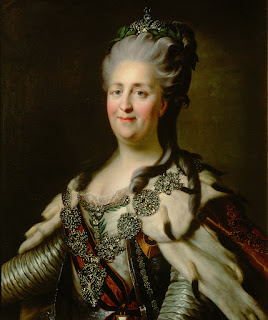
Catherine the Great
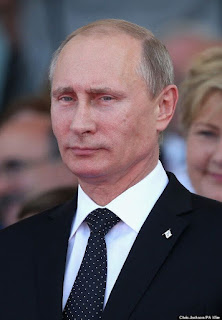
Vladimir Putin
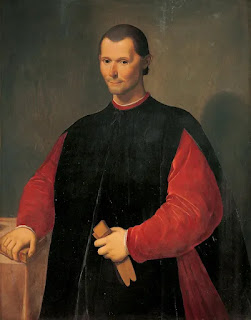
Niccolo Machiavelli
On February 21, Vladimir Putin gave a long speech on how he saw the events in Ukraine. Some of the material in this speech is drawn from Putin's article "On the Historical Unity of Russians and Ukrainians" that was published on July 12, 2021. Only three days after that speech, the Russian invasion of Ukraine began. This speech and the earlier article provide Putin's most elaborate explanation and justification for his launching the war in Ukraine.
Some of Putin's argument has been endorsed by the "realist" political scientists--like John Mearsheimer--who say that Putin is practicing Machiavellian great power politics that has been provoked by the United States and its NATO allies who have threatened the security of Russia. But this fails to recognize that what we see here is not just the Machiavellian pursuit of power in Putin's invasion but also the Lockean pursuit of liberty in the Ukrainian resistance to his invasion. To understand wars like this, we need a moral realism that sees that human beings are moved by both interest and justice, both force and freedom. Even some of the modern realists of international relations--like Hans Morgenthau--have understood this.
In his speech, Putin makes two kinds of arguments. In the first half of the speech, he argues that he will protect "the true cultural, economic, and social interests of the people" of Ukraine as part of "the population of historical Russia" established by Catherine the Great, who conquered Ukraine to make it part of her Russian Empire. Here we see Putin's ultimate goal-the glory of a Russian-Eurasian Empire. An independent Ukraine frustrates Putin's achievement of that imperial glory.
In the second half of his speech, he argues that to do this he will have to defend against the aggressive threat to the security of Russia coming from the eastward expansion of NATO.
The Machiavellian realists like Mearsheimer concentrate on the second argument but ignore the first. Consequently, they ignore Putin's dependence on popular consent and on the support of those few powerful people who might conspire to overthrow him to satisfy their own ambition to rule.
NATO: PURELY DEFENSIVE? OR AN AGGRESSIVE THREAT TO RUSSIAN SECURITY?
Let's start with Putin's second argument. He says that "Ukraine's accession to NATO is a direct threat to Russia's security," and while the NATO countries have tried "to convince us that NATO is a peace-loving and purely defensive alliance," there is no reason to take them at their word because they have often broken their promises. In 1990, Putin asserts, the Soviet leadership was promised that allowing the reunification of Germany would not threaten Russia, because NATO would never be expanded eastward.
But then, Putin points out, there were five waves of NATO expansion into Eastern Europe toward Russia's borders. In 1999, Poland, the Czech Republic, and Hungary were admitted to NATO. In 2004, it was Bulgaria, Estonia, Latvia, Lithuania, Romania, Slovakia, and Slovenia. This was followed in 2009 by Albania and Croatia, in 2017 Montenegro, and in 2020 Northern Macedonia.
This allowed for the expansion of the U.S. global missile defense project into Romania and Poland. These supposedly defensive missiles have offensive capabilities, he insists, which creates the danger of a surprise missile attack on Russia.
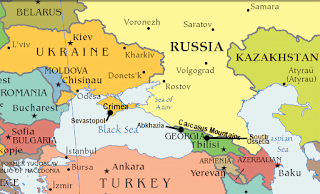
Putin says that the trouble over Ukraine actually began in 2008. At NATO's Bucharest summit in April, George W. Bush's administration pushed for an announcement that Ukraine and Georgia "will become members" of NATO. There were reports that Putin was outraged by this and declared that he would go to war to prevent it. Both Ukraine and Georgia had been part of Imperial Russia. In his speech of February 21, Putin says that "Ukraine joining NATO is a direct threat to Russia's security," and that the Bucharest summit announcement was the beginning of "a clearly anti-Russia policy."
In Georgia, on the southern Caucasian border of Russia, there was a movement beginning in 2003 toward the West and away from Russia, which was led by President Mikheil Saakashvili. In August of 2008, Putin launched the Russo-Georgian War and took the regions of Abkasia and South Ossetia from Georgia.
In Ukraine, in 2013 and 2014, there was a violent insurrection--the Maidan Revolution--against the government of pro-Russian President Viktor Yanukovych, who was forced to leave Ukraine, because he wanted to move Ukraine away from the European Union and towards Russia. The Parliament deposed him and called for new elections, in which Petro Poroshenko was elected president, with the promise to move Ukraine towards the West and away from Russia.
As Putin indicates in his speech, he regarded this as a coup d'etat, and it justified his military intervention in Ukraine in 2014, in which he annexed Crimea into Russia and supported the separatist states of Donetsk and Luhansk in eastern Ukraine in the Donbas War, which has continued to the present.
John Mearsheimer has written an essay for The Economist agreeing with Putin's arguments as showing that "the West, and especially America, is principally responsible for the crisis which began in February 2014," and which now has led to Putin's war in Ukraine. (In America, the Trumpian "Putin wing" of the Republican Party agrees with this.) Mearsheimer does not, however, identify the weaknesses in Putin's arguments.
First of all, there is no evidence that Western leaders promised Soviet leaders in 1990 that NATO would never admit Eastern European countries into NATO. In 2014, during the 25th anniversary of the fall of the Berlin wall, former Soviet leader Mikhail Gorbachev said that there had been no such promise, and there was not even any discussion of the issue of NATO expansion, although Gorbachev did add that the expansion was a "big mistake" and "a violation of the spirit of the statements and assurances made" in 1990.
Putin simply assumes that a Great Power alliance like NATO cannot be a purely defensive alliance, because it must be an aggressive threat to other great powers like Russia--because that's what great powers have always done in competition with one another. Mearsheimer agrees with this assumption, because this is what he has called "the tragedy of great power politics" (the title of his best book): even if a great power seeks only security from being attacked, it must preemptively attack other great powers, because it can never trust other great powers to not use their offensive capabilities to attack first. By this tragic Machiavellian logic of great power politics, as soon as Putin saw NATO building up its offensive capacity near the borders of Russia, he had to assume NATO would soon strike Russia, and so he had to strike first.
For that reason, Mearsheimer insists, the decision of the United States and its NATO allies to expand NATO membership into Eastern Europe is the root cause of Putin's war in Ukraine, because they created the circumstances in which Putin was forced by the logic of great power politics to launch the war.
Contrary to Mearsheimer's claim, however, the historical evidence of the behavior of the NATO powers toward Russia does not support this logic. First of all, the fact that the NATO alliance has prevented any great power wars in Europe for over 70 years contradicts the predictions of Mearsheimer's "tragedy of great power politics."
Secondly, the NATO countries have never directly attacked Russia or shown any propensity to do so. Five NATO countries share a border with Russia--Norway, Estonia, Latvia, Lithuania, and Poland. None of these countries have shown any inclination to attack Russia, although they have aided Ukraine in preparing to defend itself against the kind of attack from Russia that was launched in 2014 and a few weeks ago.
Moreover, the economic and political integration of the European countries through NATO and the European Community has contributed to a "Long Peace": since 1945, the great powers have not been involved in any direct military conflict with one another. This long period of peace among the great powers is unprecedented in modern history, and it contradicts Mearsheimer's whole theory that great power wars are inevitable, because it is impossible for great powers to cooperate for their common defense.
If Putin was not motivated by a fear of a NATO attack on Russia, then one must turn to his first argument as possibly indicating his true motivation for the invasion of Ukraine.
"ANCIENT RUS" AND "THE RUSSIAN IDEA" OF THE "EURASIAN EMPIRE"
"For Russia's leaders," Mearsheimer claims, "what happens in Ukraine has little to do with their imperial ambitions being thwarted; it is about dealing with what they regard as a direct threat to Russia's future." "Furthermore," he asserts, "Russian policymakers--including Mr. Putin--have said hardly anything about conquering new territory to recreate the Soviet Union or build a greater Russia."
Anyone who reads Putin's speech of February 21 will see that what Mearsheimer says here is patently false. Putin devotes the first two-thirds of this long speech to arguing that Ukraine has always been part of "historical Russia"--"an integral part of our own history, culture, and spiritual space." In his article of July 12--"On the Historical Unity of Russians and Ukrainians"--he traces the origin of this "same historical and spiritual space" uniting Ukrainians and Russians to 988 when Vladimir the Great (Volodymyr in Ukrainian) converted to Orthodox Christianity and became the ruler of "Ancient Rus":
"Russians, Ukrainians, and Belarusians are all descendants of Ancient Rus, which was the largest state in Europe. Slavic and other tribes across the vast territory--from Ladoga, Novgorod, and Pskov to Kiev and Chernigov--were bound together by one language (which we now refer to as Old Russian), economic ties, the rule of the princes of the Rurik dynasty, and--after the baptism of Rus--the Orthodox faith. The spiritual choice made by St. Vladimir, who was both Prince of Novgorod and Grand Prince of Kiev, still largely determines our affinity today."
"The throne of Kiev held a dominant position in Ancient Rus. This had been the custom since the late 9th century. The Tale of Bygone Years captured for posterity the words of Oleg the Prophet about Kiev, 'Let it be the mother of all Russian cities.'"
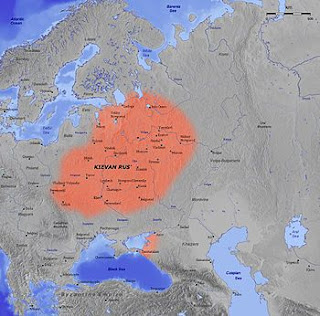
Kyivan Rus (882-1240)
Vikings who called themselves the Rus settled along the Dnipro River at the end of the 9th century. Their rule was centered at a trading post called Kyiv. The Rus had a pagan religion. But in 988, the ruler of Kyiv--Volodymyr or Vladimir--decided that conversion to a monotheistic religion would solidify control of territory. After considering Judaism and Islam, he decided to convert to Orthodox Christianity, and to make all of Kyivan Rus an Orthodox Christian civilization. Around 1240, Kyivan Rus was broken up by the invasion of the Mongols.
Notice that in the map above, Moscow was not part of Kyivan Rus. In fact, Moscow did not even exist at the time. After the Mongol invasion, in a new city called Moscow, princes gained power by collecting tribute for the Mongols. Then, as the western Mongol empire broke up, a new ruling order called Muscovy asserted its independence and expanded its power.
In 1721, Muscovy was renamed the "Russian Empire," so that there was a mythical connection to ancient Rus, which had not existed for 500 years. Between 1772 and 1795, Catherine the Great expanded the empire westward and proclaimed that she had restored the original Rus.
Putin is renewing Catherine's myth of a restored Rus. This allows him to say that "Russians and Ukrainians are one people--a single whole." He can also identify this as a "spiritual unity" because Ukrainians and Russians share their Orthodox Christian faith going back to Vladimir the Great's conversion. With this, he can justify the Russian invasion of Ukraine as serving the "true cultural, economic, and social interests of the people" of Ukraine as part of "historical Russia." He thus provides a moral and religious justification for Russian rule over Ukraine.
And yet there are three deep flaws in Putin's rhetoric. First, he ignores the fact that Kyivan Rus and Ukraine existed for seven hundred years beyond Russia. Second, he also ignores the fact that the Ukrainian Orthodox Church has existed for most of its history independently of the Russian Orthodox Church. Finally, and most importantly, he refuses to recognize the will and agency of the Ukrainian people in deciding for themselves whether they want to exist as a free people separated from Russia, and whether they want to fight a war for that independence. These three mistakes by Putin explain why his war plan has failed, and why Ukraine has a chance to win.
In Putin's speeches justifying the invasion of Ukraine, he manifests a rhetorical theme running throughout many of his speeches over his twenty-two years of rule: the choice between the ethnic nationalist autocracy of Russia and the multiethnic liberal democracy of the West. It's the illiberal "Russian World" (russkiy mir) versus the liberal "Western World." This is the Counter-Enlightenment alternative to liberalism presented by Russian conservative political thought, which defends a Russian World based on a shared Russian history, Russian language, and Russian religion. Oddly, however, Putin has often been forced to contradict this myth of Russian World in recognizing the multiethnic and multicultural reality of Russia.
This contradiction in Putin's rhetoric has been well studied by Fiona Hill and Clifford Gaddy in their book Mr. Putin: Operative in the Kremlin (2015). See pages 38-62, 96-105, and 362-374.
In a previous post, I have written about the incoherence in the rhetoric of ethnic nationalism as an evolutionary adaptation.
After the fall of the Berlin Wall in 1989, which Putin experienced as a KGB operative posted to Dresden in East Germany, and then the collapse of the Soviet Union in 1991, some Russian thinkers began to wonder how a new Russian state could be founded on "the Russian Idea" (Russkaya ideya). This suggests an ethnic Russian identity, because russkiy is an adjective associated with ethnic Russianness. This became the language of the ethnic Russian nationalists. But other thinkers spoke of "the Russian Idea" as Rossiyskaya ideya, which suggests an ethnically neutral Russian identity, because rossiyskiy is derived from Rossiya, a word for "Russia" as an abstract state to which all Russian citizens could belong regardless of their ethnic identity. Putin's rhetoric has shifted back and forth between these two conceptions of Russian national identity.
In the fall of 1999, Putin was appointed first prime minister and then acting president of Russia. Early in 2000, he was elected president. On December 29, 1999, as part of his political campaign, Putin published a 5,000-word treatise on "Russia on the Threshold of the New Millenium."
His main argument in this "Millenium Message" was that since the Russian state had always been weakened whenever its people were divided, the power of the new Russian state would depend upon the unification of the Russian people in affirming the "Russian Idea" (Rossiyskaya ideya) that makes Russia distinctive. This would require that the majority of Russian citizens (rossiyane)--not just ethnic Russians--would voluntarily embrace the general ideas supporting the state. This Russian Idea would be broad enough to encompass all of Russian society in its multiethnic and multireligious diversity.
This kind of rhetoric was necessary to support Putin's response to the renewed war in Chechnya in 1999 and 2000. Most of the people in Chechnya are ethnic Chechens who are predominantly Muslim believers, which sets them apart from the ethnic Russian minority of people are predominantly Russian Orthodox Christians. Islamist Chechen separatists had exploited these divisions in fighting for independence from the Russian Federation. Russian federal soldiers entered Chechnya to fight alongside some pro-Russian Chechen paramilitary against the Chechen separatists.
Putin needed to pull some ethnic Chechens to the Russian side. For example, Ramzan Kadyrov was a Chechen paramilitary leader who fought against the Russians in the First Chechen War (1994-1996); but in the Second Chechen War (1999-2009), he switched sides and led his men to fight for the Russians against the Chechen separatists. He is now Head of the Chechen Republic and a staunch supporter of Putin who has fought for the Russians in Ukraine. To pull people like this--people who are not ethnic Russians and not Orthodox Christians--to the side of the Russian Federation, Putin had to speak of Russia as a multiethnic and multireligious state.
But then, in 2014, Putin was trying to keep Ukraine from breaking away from Russia, as he is now in 2022, and for that purpose, Putin has employed the rhetoric of restoring and reuniting the russkiy mir--the world of ethnic Russians and the Orthodox community of Holy Russia. But when he does this, he risks alienating people like Kadyrov. Why should ethnic Chechen Muslims fight in Ukraine to restore a Russian World of ethnic Russians and Orthodox believers? So, in a speech in 2014 commemorating the end of World War II, Putin said: "The unity of our multinational, multiconfessional nation is the greatest legacy or our victory" over Nazi Germany. Putin's rhetoric of the Russian Idea is caught in an inescapable contradiction.
To overcome that contradiction, Putin has adopted the expansive concept of "Eurasianism"--the idea that Russia is destined to create a glorious Russian Empire that stretches across the entire Eurasian continent. Russia has always had an empire, and the Russian people have always been an "imperial people." Putin got this idea from White Russian emigres like Ivan Ilyin (1883-1954) and Nikolai Trubetskoi (1890-1938) and recent Russian thinkers like Lev Gumilev (1912-1992) and Alexander Dugin. I have written about Dugin in a previous post. Jane Burbank has written an essay about this as "The Grand Theory Driving Putin to War."
The Eurasianists see the emergence of a bipolar geopolitical battle in which the opponent of a Russian Eurasia will be the "Atlantic" world led by the United States. The "Atlantic" is Dugin's term for the modern liberal democracies around the North Atlantic--the United States, Great Britain, and Western Europe.
This is a moral and metaphysical battle. On the one side, the Atlantic world stands for the decadent values of liberal modernity--atomistic individualism, rootless cosmopolitanism, bourgeois consumerism, and soulless secularism (Nietzsche's "Last Man"). On the other side, Russian Eurasianism stands for the noble values of illiberal traditionalism--family life, patriotic nationalism, manly militarism, and transcendent spirituality (Nietzsche's New Nobility). This explains why many traditionalist conservatives in the West support Putin as a defender of the "traditional values" of Christianity against the moral decadence of Western liberalism.
Putin's conception of the Eurasian Empire embraces both the Russakaya ideya of the ethnic and Orthodox Russian people and the Rossiyskaya ideya of the multiethnic and multireligious Russian people, so that the apparent contradiction between these two ideas is resolved by combining the two in the larger idea of Eurasia. Throughout his twenty-two years of power, Putin has been obsessed with the need for a unifying vision of Imperial Russia that overcomes the disintegrating effects of ethnic and religious divisions.
In a January 2012 article, Putin wrote about "Russia: The National Question" and said:
"I am convinced that the attempts to preach the idea of a 'national' or monoethnic Russian state contradict our thousand-year history [that is, the history from 'ancient Rus' to the present]. Moreover, this is a shortcut to destroying the Russian people and Russian statehood, and for that matter any viable, sovereign statehood on the planet. . . . As for the notorious concept of self-determination, a slogan used by all kinds of politicians who have fought for power and geopolitical dividends, from Vladimir Lenin to Woodrow Wilson, the Russian people made their choice long ago. The self-determination of the Russian people is to be a multiethnic civilization with Russian culture as its core. The Russian people have confirmed their choice time and time again during their thousand-year history--with their blood, not through plebiscites or referendums."
A few months after this article appeared, a member of the Russian Duma suggested to Putin that the preamble to the Russian constitution be changed from beginning with "We the multinational people [narod] of Russia," to "We the [ethnic] Russian [russkiy] people and the people who have joined with it." Putin vehemently rejected this by saying:
"Do you understand what we would do [if we did that]? Part of our society would consist of first-class people and part would be second class. We must not do that if you and I want to have a strong single nation, a single people [narod], if we want each person who lives on the territory of the country to feel that this is their homeland, and that there is no other homeland, nor can there be one. And if we want each person to feel like that, then we have to be equal. This is the principal question. The fact that the [ethnic] Russian [russkiy] people are--without a doubt--the backbone, the fundament, the cement of the multiethnic Russian [rossiyskiy] people cannot be questioned. . . . But to divide everyone up into first, second, third categories, you know, this is a very dangerous path. You and I, all of us, must not do this."
An independent Ukrainian people is the great obstacle to achieving this Eurasian Russian people. In 1927, Trubetzkoy wrote an article on "The Ukrainian Problem," arguing that Ukrainian culture was an "individualization of all-Russian culture," and that the Ukrainian people should be assimilated into the Russian people based on their shared Orthodox faith. That's exactly Putin's argument for justifying the invasion. Similarly, in 1997, Dugin said that Ukrainian sovereignty created a "huge danger to all of Eurasia." To unite a Eurasian Russia, Ukraine had to become "a purely administrative sector of the Russian centralized state." As President Zelensky said in his recent speech to the Israeli Knesset, Putin sees his invasion of Ukraine as the "final solution" to the "Ukrainian problem."
THE UKRAINIANS "APPEAL TO HEAVEN"--THE NEW BATTLE OF THE DNEIPER RIVER
When the Russians invaded Ukraine, the Ukrainians could have submitted by not showing any resistance, by surrendering. The Ukrainian people would thus have consented, if not expressly at least tacitly, to Russian rule over them. But most of them chose either to flee the country or to stay and fight, even though the Russians seemed to have superior military power. The Ukrainians chose what John Locke called "the appeal to Heaven."
Locke's "appeal to Heaven" is his answer to what he takes to be the ultimate question in political disputes--"Who shall be judge?" This is the question when there is an irresolvable debate over whether political power has been right used or not. Locke's answer comes from the Biblical story of Jeptha (in Judges, chapter 11). In the conflict between the people of Israel and the Ammonites, Jeptha is selected by the people to be their chief and war leader. He negotiates with the Ammonites. But then this negotiation fails to reach an agreement, Jeptha declares, "Let Yahweh the Judge give judgment today." That divine judgment will come through war. He's appealing to the God of Battles. That's what Locke means by the "appeal to Heaven" when there is no "appeal on Earth." (See First Treatise, para. 163; and Second Treatise, para. 21, 109, 155, 168, 176, 232, 240-43.) As far as I can tell, this phrase "appeal to Heaven" is Locke's. It doesn't appear in the Bible.
The influence of this Lockean idea in the American Revolution was vividly displayed in the design of what apparently was the first flag of the American navy in 1775--perhaps commissioned by General Washington--which had an evergreen tree of liberty against a white background and the motto "Appeal to Heaven."
Locke's "appeal to Heaven" shows a natural human inclination to violent resistance to attack or exploitation that is fundamental for classical liberalism. As a manifestation of Darwinian natural right, this can be explained as rooted in an evolved animal disposition to aggressive retaliation against attacks, which arises in human beings as a natural propensity to vengeance against injustice. Human beings can use their unique capacities for language and conceptual reasoning to express this natural propensity through abstract principles of justice, but these abstract principles are ultimately rooted in this evolved animal tendency to self-protection.
Human social and political evolution has brought a general decline in violence (as Steven Pinker has shown). But that decline in violence can never bring perpetual peace (contrary to the hopes of utopian pacificists), because the enforcement of the liberal norm of voluntary peaceful cooperation will always depend on the threat or use of force against those who would violate that norm. That's what we are seeing in Ukraine and around the world in the punishing resistance to Putin's aggression.
This suggests that if it is rightly understood, it's really true that might makes right. The threat or use of violent vengeance is the ultimate natural restraint on injustice. This is what Locke means by "the executive power of the law of nature"--the natural propensity of human beings to punish those who attack or threaten them. Natural rights emerge in human history as those conditions for human life and well-being that cannot be denied without eventually provoking a natural human tendency to violent resistance against attacks and exploitation.
For this reason, the history of Lockean liberalism has often turned on the history of warfare, both revolutionary and international warfare. So, for example, the Declaration of Independence was not just a declaration of Lockean principles of natural right but also a declaration of war, so that the practical success of those principles depended on the fortunes of war. Similarly, the American debate over the justice of slavery was finally settled by the bloodiest war in American history. And the establishment of the liberal international order after World War Two depended on the defeat of Nazi Germany in the war.
We have seen that in the Ukrainian resistance to conquest--not only today in their resistance to the Russian occupation of their country, but also in 1943 in their resistance to Nazi occupation. In 1943, the Battle of the Dneiper River was one of the biggest and decisive military campaigns of World War II, involving almost four million troops. The Dneiper (or Dnipro) River is one of the longest rivers in Europe, and it flows through Kyiv and the middle of Ukraine, dividing the east bank region from the west bank. By the middle of 1943, the Germans were in full retreat on the Eastern Front, falling back from the attack of the Red Army. The German troops had retreated from Russia to the Dneiper. Beginning on August 26, the Red Army launched a campaign to take the eastern bank and then cross to the western bank, knowing that if they did that, it would be a turning point in the war against Germany. As the Red Army moved through the villages, cities, and countryside where the Germans had brutally killed and tortured innocent people, the Red Army soldiers became ever more aroused to vengeful retaliation to punish the Germans. The Red Army crossed the Dnieper in early October and then liberated Kyiv on November 6.
On November 7, the day after the Germans had been expelled from Kyiv, Leo Strauss delivered a public lecture in New York City as part of a public session on "The Re-education of Axis Countries Concerning the Jews" at the annual meeting of the Conference on Jewish Relations. Strauss said that any talk about the need for "re-educating" the Germans was mistaken if this implied that the Nazis had "educated" them in the pretended theoretical doctrines of Nazism--about the rule of "the master race"--which would suggest that these doctrines should be taken seriously. In fact, Strauss observed, these Nazi doctrines were nothing more than "pedantic follies."
Strauss said that the only Nazi doctrine that was persuasive with the Germans was the claim that Nazi arms would win a short and decisive war that would give Germany global dominance that would solve all German problems and satisfy the needs of the German people. And this would be possible because the Nazi leaders--under "the most efficient man in the land"--would be Machiavellian in being unconstrained by any moral considerations and consequently free to use all of the brutal means necessary for fighting a successful war. According to Strauss, the Nazis assumed that the "moralistic countries" would be defeated by an utterly immoral country. The Nazis would thus prove the Nazi doctrine "that large scale and efficiently prepared and perpetuated crime pays."
Strauss claimed that that Nazi doctrine is "subject to the test of sense-experience," because we can see with our own eyes whether immoral warfare is victorious or not on the battlefield. And so the defeat of the Nazis in World War Two is "the refutation of the Nazi doctrine." Therefore, Strauss observed, "the re-education of Germany will not take place in classrooms: it is taking place right now in the open air on the banks of the Dnieper."
Strauss also explained that this re-education of Germany would be consummated by a meeting of Allied tanks in Berlin, and then the Western and Eastern occupying forces would bring the German leaders to trial for war crimes. He was anticipating what became the Nuremburg war crimes trials that began in November of 1945, acting under international law and the laws of war. Adolf Hitler and Joseph Goebbels escaped this punishment by committing suicide in the spring of 1945 before they were captured. This outcome of the war would prove the Nazi doctrine wrong by proving that "large scale and efficiently prepared and perpetrated crime" does not pay. But this lesson in the legal rule of just punishment had to be preceded by the lesson taught by the meeting of Allied tanks in Berlin.
Notice that to refute the Nazi doctrine of the immoral rule of the stronger over the weaker, Strauss suggests, we cannot appeal to some transcendent standard of right set by God, Nature, or Reason. Rather, we must appeal to "the test of sense-experience" by seeing that "moralistic countries" can defeat immoral countries in war as an exercise of Locke's "executive power of the law of nature" to punish those who violate that law by an "appeal to Heaven."
In this way, might does make right.
We can see this in Ukraine today--in another Battle of the Dnieper. As Francis Fukuyama has recently said: "A Russian defeat will make possible a 'new birth of freedom,' and get us out of our funk about the declining state of global democracy. The spirit of 1989 will live on, thanks to a bunch of brave Ukrainians."
I have elaborated some of these points in previous posts here, here, and here.
Saturday, November 24, 2012
Spielberg's "Lincoln": The Nobility of Politics and the "Appeal to Heaven"
That's the message that David Brooks--writing in The New York Times--sees in Steven Spielberg's movie "Lincoln." The power of that message depends largely on the extraordinary acting of Daniel Day-Lewis, who may well have given us the best film portrayal of Lincoln that we will ever see. (It also helps to have an Aaron-Copland-style musical score composed by John Williams and played by the Chicago Symphony Orchestra.)
This movie reminds me of why I regard my course on Abraham Lincoln as one of the best courses I teach--because it helps students to understand the nobility of politics in combining "high vision" and "low cunning."
It is hard for students to understand the nobility of this combination, because many of them want to see one without the other, and thus they are caught between idealism and cynicism. The idealists assume that nobility is found only in a pure moral vision uncontaminated by practical cunning. The cynics assume that there is no nobility in politics because it's all a matter of Machiavellian cunning with no moral purpose. Lincoln's moral realism shows that both the idealists and the cynics are wrong.
Doris Kearns Goodwin's book Team of Rivals: The Political Genius of Abraham Lincoln is the basis for Spielberg's movie, and it's one of the best books for showing Lincoln's combination of moral purpose and prudential realism. It's one of the books that I have used in my course. Apparently, this book is now a bestseller because of the movie. This is a tribute to American popular culture, in showing how a popular but serious movie can direct many people to an even more serious treatment of a topic in a good book.
Some of the best parts of this movie come from the thoughtful material in the book. One example is Lincoln's explanation of his reasoning for his issuing of the Emancipation Proclamation as a constitutional exercise of his powers as a Commander in Chief in time of war, and why the constitutional limits of that power made it necessary to have a constitutional amendment to achieve a complete abolition of slavery, which could not be done by presidential decree.
Another thoughtful scene in the movie presented Lincoln explaining his fascination with Euclid's geometry. One of Euclid's self-evident postulates--that two things equal to a third are equal to each other--captured the self-evident truth that slavery is wrong: if two human beings are equally human, then they are equal to each other as members of the human species.
Appealing to such reasoning shows how persuasion can be used to resolve moral disagreements in politics like the debate over the justice of slavery. But persuasion is not enough, because human beings are too imperfect in both their knowledge and their virtue to finally settle their disagreements by persuasion alone. And when persuasion fails, and the urgency of the issue requires some final resolution of the debate, then often the debate must be settled by violence, as was the case in the American Civil War.
Modifying Brooks' conclusion, I would say that Spielberg's movie portrays Lincoln in a way that shows the nobility of politics in the marriage of high vision, low cunning, and brute violence. Showing Lincoln riding his horse to Richmond with piles of bodies all around him reminds us of the brutality of the war.
The importance of war in settling moral debates in politics is also conveyed in Lincoln's Second Inaugural Address. The movie gives us the last few lines of this speech. But it does not convey what Brooks rightly identifies as the acknowledgement in the speech of the "moral ambiguity on both sides." "Both sides," Lincoln observed, "read the same Bible, and pray to the same God. And each invokes his aid against the other." But God cannot answer the prayers of both sides. And ultimately God speaks his will here through war.
Lincoln is implicitly, I think, pointing to the Biblical story of Jephtha asking God to judge between the people of Israel and the Ammonites. He makes an appeal to Heaven for judgment, and he leads his army out to battle (Judges 11:27). This appeal to Heaven is always risky, however. Even the leader of the winning side in a war is exposed to vengeful retaliation, as in Lincoln's assasination.
As Mark Noll has argued, the American Civil War was a theological crisis, because in a country where the Bible was the ultimate moral authority, the Bible was open to conflicting interpretations on the issue of slavery: the explicit teaching of the Bible was to support slavery, but some of the Bible's general teachings--such as the Golden Rule--could be interpreted by abolitionists as condemning slavery. This dispute over the interpretation of the Bible was finally settled, Noll observed, by Generals Grant and Sherman.
This "appeal to Heaven" principle is fundamental to John Locke's teaching in the Second Treatise of Civil Government (secs. 19-21, 155, 168, 175-96, 232, 240-43). In a constitutional crisis, where there is a dispute over whether the government is exercising force without authority, the ultimate judge is the contest of battle. Consequently, the moral history of politics--as in the debate over slavery--is military history. This shows the ultimate ground for Locke's law of nature and his political liberalism in the natural inclination of human beings to violence in resisting exploitation. "In all States and Conditions," Locke writes, "the true remedy of Force without Authority, is to oppose Force to it. The use of force without Authority, always puts him that uses it into a state of War, as the Aggressor, and renders him liable to be treated accordingly" (sec. 155).
We should remember that Locke was suspected by Charles II of conspiring with other Whigs for insurrection and assassination. We should also remember that Locke denied his authorship of the Two Treatises, for fear of facing execution for treason, as happened when Algernon Sidney published his attack on monarchy and defense of republicanism in his Discourses Concerning Government.
Charles Darwin saw the importance of political violence, because he saw that moral progress in evolutionary history often turned on group selection through warfare. He was a fervent opponent of slavery, and he used his Descent of Man to support the Euclidean logic of the argument against slavery, because he showed that the human races were not separate species but merely varieties of the same species, and thus endowed with the same moral and intellectual faculties, including the natural propensity to violence in resisting exploitation. (As I have indicated in a recent post, there is now some evidence that even ant slaves rebel against their enslavement.) Darwin cheered when he read the news reports of Lincoln's Emancipation Proclamation, the passage of the 13th Amendment, and the military victory of the North over the South.
I have elaborated some of these points in a previous post. I have also written some posts on the evolutionary decline in violence as part of Darwinian liberalism and on whether the idea of human rights requires Biblical religious beliefs.
Thursday, January 04, 2024
The Evolutionary History of the Jews in the Levant Up to 1914
The current military conflict between Hamas and Israel should be understood in the context of the deep evolutionary history of the Jews in the Levant. Knowing that evolutionary history will also help us understand Israel's Declaration of Independence as compared with the American Declaration of Independence.
For me, the three books that are most helpful in sketching this history is Martin Gilbert's Routledge Atlas of the Arab-Israeli Conflict (10th ed., 2012), the NIV Cultural Backgrounds Study Bible, with editorial notes and commentary by John Walton and Craig Keener (2016), and John Walton's Ancient Near Eastern Thought and the Old Testament (2018).
There are three interrelated themes in this history--Jewish theology, Jewish ethnicity, and Jewish militarism. The survival and identity of the Jewish people as a people has depended on their defining themselves as the chosen people of the God Yahweh (as distinct from the other gods in the ancient Near East), who is the God of their ancestral ethnic group (the "God of the fathers," the "God of Abraham, Isaac, and Jacob"), and also the God of Battle who defeats the deities of the enemy, although Yahweh can also fight against Israel when they became unfaithful to Him.
Archaeological evidence of Paleolithic human and hominid species in the Levant suggest that the primary route for the migration of human ancestors out of Africa and into Eurasia over one million years ago went through the Levant. The oldest Neolithic agricultural settlements are also found here, dating from around 20,000 to 9,000 BC. So, it is probably here that human hunter-gatherers first shifted from foraging to farming. Later, the first small towns and cities (such as Uruk) appeared from 5,000 to 3,000 BC. We also see the rise of agrarian states and their evolution up to global empires (Liverani 2014). I have written about this in previous posts. The Jewish people emerged out of this genetic and cultural evolution of humanity in the Levant.
According to the Hebrew Bible, the Jews originated as the children of Abraham, who was born around 2166 BC in Ur in southern Mesopotamia (what is now southern Iraq). Abraham had been born into a family that was polytheistic and did not worship Yahweh (Jos. 24:2,14). When Yahweh appeared to Abraham, Yahweh did not demand worship or rituals. Rather He made an offer to Abraham. Yahweh told Abraham to migrate to the land of Canaan with the promise that there his people would someday become a great nation:
The LORD had said to Abram, "Go from your country, your people, and your father's household to the land I will show you. I will make you into a great nation, and I will bless you; I will make your name great, and you will be a blessing. I will bless those who bless you, and whoever curses you I will curse; and all peoples on earth will be blessed through you" (Gen. 12:1-3).
In effect, John Walton has observed, in one of his notes in the NIV Cultural Backgrounds Bible, Yahweh was offering Abraham a grant of land that would secure the survival, flourishing, and identity of his family and extended ethnic group:
"God's covenant with Abram targets the most essential elements of identity in the value system of the ancient Near East. Land was connected to one's survival, livelihood, and political identity (more so than self). Inheritance fixed one's place in the family and ensured that the generations past would be remembered in the present and future. When Abram gave up his place in his father's household, he forfeited his security. He was putting his survival, his identity, his future and his security in the hands of the Lord."
Yahweh had said: "Go from your country, your people, and your father's household." Walton explains:
"One reason God may ask Abram to leave these behind is because it is in these three connections that one related to deity. The gods one worshiped tended to be national or city gods ('country'), the clan god ('people'), or ancestral gods, i.e., ancestors who have taken a place in the divine world ('father's household'). As Yahweh severed the ties Abram would have had with other deities, he then filled the resulting void as the only God Abram would need" (NIV Cultural Backgrounds Bible, 33).
I have written previously about how Walton's account of the "cultural context" of the Hebrew Bible supports the position of theistic evolution as advocated by Deborah Haarsma, Francis Collins, and others. These are believing Christians who argue that Christian theism and Darwinian evolution are compatible because God has acted through genetic and cultural evolution. Walton's contribution is in showing how God revealed Himself in the Hebrew Bible by conveying His message through the language and ideas of ancient Near Eastern culture while gradually correcting the mistakes in that culture. And, thus, Walton explains: "One of the main reasons God makes a covenant with Abram is in order to reveal what he is really like--to correct the false view of deity that people have developed. But this is projected to take place in stages, not all at once" (34). Of course, Jews will not agree with the Christian claim that the prophecies of a Messiah in the Hebrew Bible are fulfilled in the New Testament's revelation of Jesus as the Messiah and Son of God.
According to the Bible, Abraham lived in Canaan for a hundred years--from his arrival in 2091 BC to his death in 1991 BC. But then, within a little over one hundred years after his death, his descendants migrated to Egypt, where they lived for over 500 years.
Having become enslaved in Egypt, the Israelites escaped from Egypt under the leadership of Moses and entered the Desert of Sinai around 1446 BC. They camped for almost a year at the foot of Mt. Sinai, where Moses received Yahweh's law for His people.
Then, just before starting their 40-year march through the desert on their way to Canaan, Yahweh ordered Moses to take a census for the purpose of military conscription--counting every man 20 years old or more in each of the 12 tribes of Israel. Yahweh then ordered the arrangement of the tribal camps and the marching orders of the tribes (Numbers 1-2, 10:11-33). The people of Israel were then ready to move through the desert and into Canaan as a well-organized army.
Their divine wars of conquest were brutal: they were commanded "in the towns of those peoples whom Yahweh your God is giving you as an inheritance, do not leave alive anything that breathes. Completely destroy them" (Deu. 20:16-17). So, for example, when the Israelites conquered the Midianites and killed all the men, Moses was angry that they had allowed the women and children to live; and he commanded: "Now kill all the boys. And kill every woman who has slept with a man, but save for yourselves every girl who has never slept with a man" (Numbers 31:17-18).
Remarkably, modern Jews and Christians (such as Popes John Paul II and Benedict XVI) have condemned the divinely sanctioned violence of the Hebrew Bible. Is it possible that the Jews misinterpreted Yahweh's message? Or was such violence justified in the circumstances the Jews faced?
After 40 years of wandering in the Sinai desert, the Israelites entered Moab (around 1406 BC) on the eastern banks of the Jordan river, where they could see Canaan. Moses died, and the leadership of Israel passed to Joshua. Yahweh told Joshua that he must cross the Jordan River and begin the conquest of Canaan, which would fulfill Yahweh's promise that all of this land would belong to Israel (Jos. 1:1-6). The fall of Jericho became the first victory in Joshua's military campaign of conquest.
Around 1375 BC, Joshua died. At his death, there were still large areas of Canaan that had not fallen to conquest by the Jews; and so, they were still at war with their enemies.
Israel was governed by the elders of each tribe who exercised the senior leadership in making judicial and administrative decisions in the towns and tribes. The assembly of elders represented the people in making major decisions. These ruling councils of elders were common in the ancient Near East. I have written about this previously as showing the early evolution of "council democracy" in Mesopotamia and among many tribal societies such as the Huron of Canada that John Locke had studied in his reading of Gabriel Sagard.
In time of war, the elders could ask someone they trusted to become a judge to lead them in war. Unlike the English term "judge," judges in the Biblical book of Judges did not exercise judicial activity. Rather, they were military chieftains. Whenever the people of Israel fell away from Yahweh and worshipped other gods, Yahweh allowed the people to be defeated by raiders in war. Then, the people would cry for help, and Yahweh would raise up a judge to lead them against their enemies (Judges 2:6-19).
For example, when the Israelites began to serve foreign gods and no longer served Yahweh, he allowed the Ammonites to attack them. Then, the Israelites asked Yahweh to rescue them; and the elders of the people sought for someone who would become their leader in attacking the Ammonites. The people and their elders made an agreement with Jephthah, who was a mighty warrior, to become their judge, their head and commander. Jephthah then challenged the Ammonites: "I have not wronged you, but you are doing me wrong by waging war against me. Let the LORD, the Judge, decide the dispute this day between the Israelites and the Ammonites" (Judges 11:27). And, indeed, Yahweh did allow Jephthah to defeat the Ammonites in battle.
Like many of the other gods in the ancient Near East, Yahweh was seen by the Israelites as a divine warrior who decided whether his people won or lost their battles with their enemies. But the Bible also indicates that Yahweh was not so all-powerful that He could decide by Himself the outcome of any battle. His followers won their wars only when they were well-trained, well-armed, and guided by military leaders who were shrewd in their tactics and strategy.
Consider, for example, the stories of Ehud and Deborah. After being under the oppressive rule of Eglon king of Moab for eighteen years, the Israelites cried out to Yahweh for help. He gave them Ehud as a deliverer (Judges 3:12-30). The Israelites sent him with tribute to Eglon. Ehud had been trained as an ambidextrous warrior, so that he could be equally effective in holding weapons with either his left or his right hand. He made a double-edged sword, which would be good for stabbing straight into a man's body. He strapped the sword to his right thigh so that it was hidden under his clothing. Since most men are right-handed, and they wear their sword on their left side, Ehud's dagger hidden on his right side would probably not be noticed by Eglon's bodyguards. After Ehud had presented his tribute to Eglon, he told Eglon: "I have a secret message for you." The king told his attendants to leave the room.
"Ehud then approached him while he was sitting alone in the upper room of his palace and said, 'I have a message from God for you.' As the king rose from his seat, Ehud reached with his left hand, drew the sword from his right thigh and plunged it into the king's belly. Even the handle sank in after the blade, and his bowels discharged. Ehud did not pull the sword out, and the fat closed in over it. Then Ehud went out to the porch; he shut the doors of the upper room behind him and locked them."
By the time the servants had unlocked the room and found the king dead, Ehud had escaped. He then gathered the Israelites for a surprise attack on the Moabite soldiers, and they killed them all. Moab was then subject to Israel, and there was peace for eighty years.
Later, however, the Israelites fell under the oppressive rule of Jabin king of Canaan for twenty years. Jabin's rule over them was enforced by his army, commanded by Sisera, which had "nine hundred chariots fitted with iron" (Judges 4:1-3). Once again, the Israelites cried to Yahweh for help. At the time, Israel was being led by Deborah, a prophet, who spoke for Yahweh. She sent for Barak and told him to organize ten thousand men for an attack on the Canaanites.
But she knew it would be difficult to fight against Sisera's "chariots fitted with iron." Years before, Yahweh had led the men of Judah against the Canaanites: Yahweh "was with the men of Judah. They took possession of the hill country, but they were unable to drive the people from the plains, because they had chariots fitted with iron" (Judges 1:19). Although chariots are useless in the hill country of Judah, they are formidable weapons in the valleys and river plains.
Deborah devised a plan to blunt the effectiveness of the chariots. She lured Sisera into moving his chariots and troops to the Kishon River where Barak's men were prepared for battle. She anticipated that because of recent rains, the Kishon River plain would be flooded, and thus the overflowing river would create a muddy battlefield in which the chariots would be bogged down. As a result, Sisera's army was utterly destroyed (Judges 4:4-17, 5:4-5, 20-21, 31).
And yet, after over 300 years of being ruled by judges acting as military leaders, the people of Israel and their elders decided that they wanted a king to rule over them, so that they could be like all the other nations with kings. They asked the prophet Samuel to appoint a king. Yahweh told Samuel to warn them about how oppressive kingly rule would be. "But the people refused to listen to Samuel. 'No!' they said. 'We want a king over us. Then we will be like all the other nations, with a king to lead us and to go out before us and fight our battles.' When Samuel heard all the people said, he repeated it before the LORD. The LORD answered, 'Listen to them and give them a king'" (1 Samuel 8:19-21).
Yahweh revealed to Samuel that Saul was to be anointed the king. "Then Samuel took a flask of olive oil and poured it on Saul's head and kissed him, saying, 'Has not the LORD anointed you ruler over his inheritance" (1 Sam. 10:1). Later, David became the second king when the people of Judah anointed David king over the tribe of Judah (2 Sam. 2:4).
So, what's the significance of the "anointing" of the ruler? Walton observes: "Anointing is known from Hittite enthronement texts . . . . It is possible that anointing represents a contract between the ruler and the people, hence the anointing of David by the people in 2 Sa 2:4. Texts from Nuzi show individuals anointing each other when entering a business agreement" (476). Understanding anointing as a contract between ruler and ruled might explain the recent anointing of King Charles III.
The Israelites established an independent kingdom under the kingly rule of first Saul, then David, and then Solomon (1050-930 BC). This Kingdom of Israel had the most extended territory that Israel would ever have.
John Locke thought this Biblical history of Israel under the rule of their judges and first kings showed how political societies originally evolved in human history out of the state of nature by the consent of the people who needed a military leader. The story of Jephtha illustrates this. The people selected him as a judge because they needed his military leadership against the Ammonites: "And the People made him head and captain over them, Judg. 11. 11, which was as it seems, all one as to be Judge" (ST, 109). Locke also sees in the dispute between Jephtha and the Ammonites the need for what Locke called "an appeal to Heaven." When there is a dispute, and the question is, who shall be Judge?, then if there is no Judge on Earth, "the Appeal lies to God in Heaven," and God will judge by the clash of armies in a battle. Jephtha appealed to Heaven by fighting the Ammonites and defeating them (ST, 20-21, 109).
For Locke, this becomes a general principle for settling political disputes about ultimate authority--such as when the people believe their ruler has exercised absolute, arbitrary power to which they have not consented. To the question, Who shall be Judge? The answer is, The People shall be Judge. And the judgment of the people will be expressed by their violent resistance to unjust power. So, the appeal to "God in Heaven" is actually an appeal to the People, who are willing to fight for their rights (ST, 232, 240-43).
I have written about how this Lockean idea of the Appeal to Heaven entered the American Revolutionary War in the "Appeal to Heaven" flag. As far as I can tell, Locke coined this term "Appeal to Heaven." Although he derives the idea from the Biblical story of Jephtha, the phrase does not appear in the Biblical text. (Amazingly, there are reports now that in recent years, American Christian Nationalists have adopted the "Appeal to Heaven" flag as their banner!)
Locke also sees that the establishment of a kingship in Israel was by consent of the people: "the Children of Israel desired a King, like all the nations to judge them, and to go out before them, and to fight their battels, 1 Sam. 8. 20. God granting their Desire, says to Samuel, I will send thee a Man, and thou shalt anonit him to be Captain over my People Israel, that he may save my People out of the hands of the Philistines, c. 9. v. 16. As if the only business of a King had been to lead out their Armies" (ST, 109). The people of Israel wanted a king, for the limited purpose of leading them in war, and God granted their desire.
Vox populi, vox Dei? In fact, in the early 18th century, some Whig pamphlets in England adopted this slogan as an implied Lockean teaching: an appeal to Heaven is actually an appeal to the People, because the voice of the People is the voice of God.
Around 930 BC, after the death of King Solomon, a tribal civil war split the kingdom into two independent kingdoms--the northern kingdom of Israel (or Samaria) and the southern kingdom of Judah--which covered most of the Southern Levant, except for the Philistine settlements in the southwest (from Jaffa to Gaza) and the Phoenician settlements in the northwest.
Around 722 BC, the Northern Kingdom was conquered by the Assyrian Empire. In 586 BC, the Southern Kingdom fell to the Babylonians, who conquered Jerusalem, destroyed Solomon's Temple, and sent many if not most of the Jews into exile in Babylon and elsewhere.
In 538 BC, Babylon fell to the Persian Empire. The Persian King Cyrus allowed the Jews to return to Jerusalem and build the Second Temple. For that, Cyrus was said to be anointed by God to save the Jews (Isa. 41:1-7, 44:28-45:7). But many of the Jews chose to remain in Babylon or scatter elsewhere.
It might seem strange that Cyrus is identified as Yahweh's "anointed" one, because the Hebrew word for "anointed" (mashiyach) is the word for "messiah." As I noted in previous posts, the New Testament cites these Old Testament references to the "messiah" as prophecies of the coming of Jesus; but the context for these Old Testament references usually make clear that they refer to political leaders like Cyrus. This is odd because Yahweh actually says to his anointed Cyrus: "you do not acknowledge me" (Isa. 45:4-5). Cyrus did not worship Yahweh. So, how can Cyrus be the Messiah? (Surprisingly, some of Donald Trump's Christian supporters have identified him the new Cyrus--the political leader anointed by God to be the Messiah for America!)
Walton explains that while the Hebrew term "messiah" developed "an eschatological significance in Israel of a promised deliverer," it also had a more ordinary political significance as the anointing of a leader such as a priest or king. So, even though Cyrus assumed the "anointed" role of the Davidic monarchy in restoring the people of Israel to their land and rebuilding the Temple, he was not the eschatological deliverer, although he was God's deliverer of the Jews from the Babylonian exile.
To explain why Cyrus chose to become Yahweh's messiah for Israel, Walton points to the text on the "Cyrus Cylinder" that is now held in the British Museum. (Just a few months ago, I saw the Cyrus Cylinder at the Museum for the first time.)
The Cyrus Cylinder in Room 52 of the British Museum in LondonThe Cyrus Cylinder is a clay barrel with a text in Akkadian cuneiform attributed to Cyrus the Great. It was found in 1876 at the ancient site of the Mesopotamian city of Babylon. It dates to the 6th century BC. A translation of the text can be found in James Pritchard's Ancient Near Eastern Texts (1969, 315-316). The text is Cyrus's account of how he conquered Babylon, restored the Babylonian worship of Marduk, and freed the people in Babylonian exile to return to their native lands and renew their religious traditions.
Although the text makes no reference to Israel or to Israel's God, Walton thinks the text confirms what Isaiah says about Cyrus in releasing the Jews from exile. Cyrus claims to worship Marduk, and he acknowledges that other peoples worship different gods who control their own people. Cyrus is willing to seek the support of those other gods. Walton explains this as a mutually beneficial arrangement:
"In a polytheistic system, adding deities is not a theological problem. In fact, in claiming support from a new god, the theologically neutral becomes an economic and political advantage. Cyrus thus had no problem in recognizing Yahweh, though he would not have personally worshiped him, since such recognition cost nothing but gained the support of Yahweh worshipers through their tribute and allegiance. Polytheistic priests of the newly recognized god would also likely expect royal support for their religious endeavors, so they also benefited" (1190).
Some people today have seen the Cyrus Cylinder as an early document of "human rights" that upholds the natural right to religious liberty and toleration. Even if that's an overstatement, there might be some truth to it.
Some Biblical scholars have argued that from the evidence of the Hebrew Bible and recent archaeological studies of the Levant, we can infer that it was in response to the catastrophe of the fall of Jerusalem and the destruction of Solomon's Temple that the Jews were led to Biblical monotheism. Originally, Yahweh was one of many gods in the Ancient Near East. The people of Israel adopted Yahweh as their premier god or divine patron, but they also worshipped other gods (Deu. 29:24-28). Then, after their exile from Jerusalem, they explained this as Yahweh's punishment for not obeying his laws. And if Yahweh had the power to use Cyrus as the Messiah for the Jews, that proved that Yahweh was all-powerful (2 Chronicles 36:11-23; Ezra 1:1-11). In this way, the Jews moved from seeing Yahweh as one god to seeing Him as the only god: Yahweh became the exclusive and unitary, invisible, transcendent, and universal God. Yahweh was the particular God of the People of Israel, but also the universal God over all humanity.
Some Biblical scholars have called this the "the invention of God" (Romer 2015). But the theistic believer (Jewish, Christian, or Muslim) can say that this shows how God revealed Himself by communicating to Israel through the cultural context of their time and gradually drew them out of their familiar polytheistic theology until they recognized Him as the only God.
For more than a thousand years, before the Arab conquest in 636 AD, the Jews were the main settled population of Palestine. Although they were often conquered, they had long periods of political independence, such as the Hasmonean Jewish Kingdom (165-63 BC). In 70 AD, in response to a Jewish revolt against Roman rule, the Romans captured Jerusalem, destroyed the Temple and the city, and took many Jews as captives to Rome.
From 637 to 1099 AD, the Jews in Palestine were ruled by Arab Muslims, who tolerated the Jews and their religious practices, although the Jews were sometimes badly treated. From 1099 to 1291, the Jews were persecuted and killed by Christian Crusaders. The Jews fought on the side of the Arabs against the Crusaders. The Muslim Mameluks expelled the Crusaders in 1291, and ruled until 1516. During this time, many European Jews moved to Palestine to escape persecution in Europe.
After 1517, under the Ottoman Turks, Palestine continued to be a place of refuge for persecuted Jews. Sometimes they were badly treated by the Ottoman rulers, but at least the Jews were better off in Palestine than in Europe. Jerusalem became a center of Jewish learning. And by 1880, the majority of the population of Jerusalem was Jewish. In four Holy Cities in Palestine--Jerusalem, Hebron, Tiberias and Safed--there was continuous Jewish settlement from Biblical times.
From 1880 to 1914, as the Zionist movement gained influence, there was increasing Jewish migration into Palestine. Jews developed land that they had purchased from European, Turkish, and Arab landlords. Tel Aviv became the first town founded entirely by Jews. By 1914, the population of Palestine was about 500,000 Arabs and 90,000 Jews. During this period, there was growing violent conflict between Arabs and Jews, with some Arab leaders demanding that Constantinople prohibit Jewish migration and settlement.
REFERENCES
Gilbert, Martin. 2012. The Routledge Atlas of the Arab-Israeli Conflict. 10th edition. New York: Routledge.
Liverani, Mario. 2014. The Ancient Near East: History, Society, Economy. New York: Routledge.
NIV Cultural Backgrounds Study Bible. 2016. Edited with Notes and Commentaries by John Walton and Craig Keener. Grand Rapids, MI: Zondervan.
Pritchard, James B., ed. 1969. Ancient Near Eastern Texts Relating to the Old Testament. 3rd edition. Princeton, NJ: Princeton University Press.
Romer, Thomas. 2015. The Invention of God. Cambridge, MA: Harvard University Press.
Walton, John. 2018. Ancient Near Eastern Thought and the Old Testament: Introducing the Conceptual World of the Hebrew Bible. 2nd edition. Grand Rapids, MI: Baker Academic.