Showing posts sorted by relevance for query Patrick Deneen Rod Dreher. Sort by date Show all posts

Wednesday, February 20, 2019

The Failure of Deneen and Dreher in Their Critique of Liberalism

Last year, I wrote a series of posts on Rod Dreher's The Benedict Option and Patrick Deneen's Why Liberalism Failed (herehereherehere, and here).  I argued that their critique of liberalism failed at four levels.  They failed to provide an accurate interpretation of liberal political theory.  They failed to analyze the factual evidence of liberalism's performance.  They failed to provide any attractive illiberal alternative to liberal social order.  And they failed to provide any coherent argument for rejecting liberalism.

Recently, their books have been published in paperback editions with new forewords.  I assumed that they would use these new forewords to answer their critics.  I was disappointed when I saw that they had decided not to do that.  Deneen's foreword does end with four pages under the title "Responding to Some Critics" (xx-xxiv).  But he responds in only a very general way without any detailed responses to the particular criticisms that I and others have offered.

My first criticism--their inaccurate interpretation of liberal theory--is mentioned briefly by Deneen in saying that "the book has been criticized for an inaccurate or unfair depiction of 'classical' liberalism" (xx).  But he and Dreher are completely silent about my specific claim that they have failed to develop any good interpretation of John Locke's liberalism.  This is important because they agree that Locke is "the first philosopher of liberalism" (Dineen, 32).

While Deneen insists that Lockean liberalism teaches "pursuit of immediate gratification" (39) and the "absence of restraints upon one's desires" (116), he says nothing about how Locke contradicts this claim in Some Thoughts Concerning Education.  In that book, Locke stresses the importance of parents educating their children so that they have a sense of shame in caring about their good reputation (secs. 56, 61, 78).  Locke says that "the great principle and foundation of all virtue and worth is placed in this, that a man is able to deny himself his own desires, cross his own inclinations, and purely follow what reason directs as best though the appetite lean the other way" (sec. 33). "It seems plain to me that the principle of all virtue and excellency lies in a power of denying ourselves the satisfaction of our own desires where reason does not authorize them" (sec. 38). Children must be taught that "covetousness and the desire of having in our possession and under our dominion more than we have need of" is "the root of all evil" (sec. 110). 
Above all, Locke insists, children must be taught and habituated to show "civility"--respect and good will to all people (secs. 66-67, 70, 109, 117, 143-44). Here Locke's emphasis on the need for "civility" is part of what Norbert Elias identified as the "civilizing process" promoted by early modern liberalism to overcome the incivility, violence, and corrupt manners of medieval pre-modern Europe.  Deneen and Dreher are silent about all of this.

They are also silent about my second criticism--their failure to survey the factual evidence of liberalism's performance.  They say nothing about how the empirical indicators of human freedom correlate with the indicators of human happiness.  They say nothing about the historical evidence that modern liberal cultures have inculcated virtues of self-control that account for the stunning decline in violence over the past 500 years.  They say nothing about how the empirical evidence denies Deneen's claim that liberalism produces "titanic inequality far outstripping the differences between peasant and king" (139): this historical evidence shows that rigid inequality was far higher in medieval Europe than it is today.  They also say nothing about the evidence for social connectedness--social bonds within families and voluntary associations--being high in liberal social orders.

In another post, I have written about the evidence that the level of inequality (as measured by the Gini Coefficient) in some Lockean liberal social orders is close to what it was in hunter-gatherer societies.

Rather than looking at the empirical evidence of what liberalism has done, Deneen and Dreher employ a distinctive rhetorical strategy: they find authors who agree with them in criticizing liberalism, they summarize what these authors say, and then they conclude that this proves that liberalism has failed.  They do not even ask the question of whether the empirical evidence supports what these critics of liberalism say.  And whenever one of their favored authors says something positive about liberalism, they are silent about this.  Deneen's selective reporting of Charles Murray's research is an example of this.

In short, the primary mode of argument for both Deneen and Dreher is begging the question.

My third criticism--the failure to defend any illiberal alternative to liberalism--is acknowledged by Deneen (xxii).  But he doesn't offer any clear answer to this criticism.  

My fourth criticism is that both Deneen and Dreher are incoherent in that while they profess to reject liberalism, they actually embrace the fundamental principles of liberalism--such as voluntarism and religious liberty.

Deneen and Dreher would have a coherent argument for rejecting liberalism if they endorsed the radical Catholic traditionalists like Edmund Waldstein who defend Catholic "integralism" in recommending a return to the medieval theocratic kingdom of Saint Louis IX in 13th century France.  But both Deneen and Dreher reject the medieval illiberal order because of the corruption of the medieval Church, its violent exercise of power, and its failure to secure liberty, equality, and justice.

Deneen and Dreher agree with Alasdair MacIntyre's recommendation at the end of After Virtue that we need "the construction of local forms of community within which the moral life could be sustained so that both morality and civility might survive the coming ages of barbarism and darkness."  For Deneen the best example of such "local forms of community" is the Amish communities.  For Dreher such communities can arise whenever families form households organized around private religious schools and traditionalist Christian churches.

All of this depends on religious liberty.  Dreher explains: "Religious liberty is critically important to the Benedict Option.  Without a robust and successful defense of First Amendment protections, Christians will not be able to build the communal institutions that are vital to maintaining our identity and values" (84).  But in their appeal to this liberal principle of religious liberty, Dreher and Deneen contradict their claim to be anti-liberal.

Deneen does say in his new foreword that the political history of the past two years--particularly, the populist revolts against liberal democracy in the United States and Europe--suggests that within the next few years we will see the emergence of a "postliberal political theory," perhaps developed in a book written by one of the young readers of Deneen's book (xxiii-xxiv).  But what will make this new political theory postliberal?

Deneen explains: "the achievements of liberalism must be acknowledged, and the desire to 'return' to a preliberal age must be eschewed.  We must build upon those achievements while abandoning the foundational reasons for its failures.  There can be no going back, only forward" (182).

So what are "the foundational reasons for its failure" that must be abandoned, but without abandoning the "achievements of liberalism"?  Are they the liberal principles of "anthropological individualism and the voluntarist conception of choice" (Deneen, 31)?  But as I have pointed out in my previous posts, what Deneen and Dreher scorn as atomistic individualism--human beings living as completely solitary creatures with no social bonds--is rejected by liberals like Locke, Adam Smith, and Friedrich Hayek as "false individualism."  Liberal individualism is actually a communal individualism in which human beings as naturally social animals live as family members, as friends, and in voluntary associations such as schools, churches, and other groups.

Or would Deneen and Dreher say that what must be rejected in a "postliberal political theory" is "the voluntarist conception of choice"?  Deneen observes: "Ironically, given the default choice-based philosophy that liberalism has bequeathed to us, what might someday become a nonvoluntary cultural landscape must be born out of voluntarist intentions, plans, and actions" (192).  What is he saying here?  Is he saying that what start out as voluntary associations must eventually become coercive?  So, for example, while children in Amish communities are now free to choose as adults whether they will stay or leave the community, the "postliberal political theory" of the future will coercively enforce their staying in the community?  Would there be a multiplicity of different communities, in which people would be forced to stay in whatever community in which they were born?  Or would there be only one comprehensive community--perhaps a theocratic Catholic Church--that would constitute the "nonvoluntary cultural landscape"?  So at some point, the Benedict Option will no longer be optional but coercively enforced by law?

But surely this cannot be what Deneen and Dreher are suggesting, because this would abandon "the achievements of liberalism" that come from the voluntarist principle of free choice.  So we are left in a state of total confusion as to what they mean by "postliberal political theory."

As an alternative to Deneen and Dreher, one should consider another modern defender of Christian orthodoxy--C. S. Lewis.  As I have indicated in a previous post (here), Lewis was a Lockean liberal who rejected theocracy as a form of tyranny, who believed that government should not have the power to legally enforce Christian morality, and who thought the only proper aim of government was to secure individual liberty from legal interference except when necessary to prevent harm to others.
"
Deneen and others have recently launched a new journal--Postliberal Thought--that will be published both online and in print.  One of the introductory articles is "The Postliberal Moment" by Andrew Willard Jones, which concludes:

"Christianity has deep resources from which to draw. Christianity has the depths from which to offer a meta-critique and the solutions that can save all that was good and right in modernity. If modernity is indeed a Christian heresy, then orthodoxy contains its strengths and even its pathos, but without its exaggerated errors. Within a recasting of the liberal lexicon in terms of a Christian lexicon, liberalism itself, like the Christian heresies that have come before it, is capable of some measure of redemption."

"We are launching Postliberal Thought in order to provide a place for this work. We understand the project to be the work of generations and we are fully aware that by breaking free from the dominant paradigm, we thrust ourselves into areas of intellectual instability and obscurity. Much of what we propose will often no doubt turn out to be mistaken; many of the roads we go down will no doubt turn out to be dead-ends. Postliberal Thought is therefore a place for open-minds and forgiving spirits. We hope to forge a community of Christian thinkers who are animated not by certainty concerning what to do or what to think, but by the hope that we, humbled in prayer before God, will find a way forward."

I find it hard to understand what he is saying, because, like Deneen and Dreher, he seems to be caught in the incoherent position of both denying and affirming liberalism.  Jones is the author of a book--Before Church and State--defending the "Sacramental Kingdom of St. Louis IX" in 13th century France as "the most Christian kingdom."  Wouldn't his position be more coherent if he simply argued for the illiberal regime ruled by Saint Louis as being the model of the best regime designed to secure both the temporal and eternal ends of human life?  In doing this, he would be embracing the Catholic theocratic authoritarianism of the French Counter-Enlightenment that began with Joseph de Maistre and then was renewed by Charles Maurras and the Action francaise.

In identifying liberal modernity as a "Christian heresy," is he referring to Protestant Christianity?  Would postliberal thought require the persecution and suppression of all thought contrary to medieval Catholic social thought, which would deny Vatican II's affirmation of religious liberty?  Would communitarian Christian groups like the Amish have to be persecuted because they arose from the heresy of Anabaptism, which interprets the New Testament as teaching separation of Church and State ("Render unto Caesar . . .") and religious liberty, so that Christian communities must be based on the voluntary consent of the adult members?

Saturday, June 29, 2024

Catholic Integralists for Trump? Sohrab Ahmari and J. D. Vance

I have a question mark in my title because the Catholic integralists for Trump are often evasive in avoiding the term "integralism."  But if you look at what they say about what they call their "political Catholicism" or "common-good conservatism," it's clear that they are Catholic integralists who want to use Trump's MAGA movement as a step towards establishing America as a Catholic confessional state that would coercively enforce the authority of the Catholic Church and persecute Jews, Protestants, Orthodox Christians, Muslims, atheists, and generally all non-Catholics.  

Sure, that's preposterous. And that's why they are so hesitant to say openly what they have in mind.  It's so preposterous that even many of the Christian conservative "post-liberals" like Rod Dreher and Patrick Deneen, who should be sympathetic to their cause, have scorned the integralists.  Dreher has said that his "unwillingness to fully surrender liberalism is in large part because we still live in a highly pluralistic and diverse society," and "liberalism arose in the first place to accommodate pluralism."  Consequently, "any non-liberal alternative would probably be tyrannical."  Notice what he is saying:  while claiming to be a "post-liberal," he is still a liberal, because he cannot endorse a truly illiberal alternative like integralism.

Clearly, people like Dreher and Deneen agree with Kevin Vallier's critique of integralism: "You can't go there, you can't stay there, and it's unfair."  You can't go there, because you can't establish a Catholic confessional state in a society like America where Catholics are a minority of less than 20 percent, and where even most Catholics would not want to persecute non-Catholics.  You can't stay there, because even if you could establish a Catholic confessional state, it would be overthrown by rebellion.  It's unfair, because an American Catholic state would have to be an unjust tyranny.

As I said in my previous post, the evasiveness of the integralists makes me suspect that their integralism is only an insincere affectation that disguises the fact that while they want to pose as opponents of liberalism, they are really liberals--like Dreher and Deneen--who cannot openly give up the liberal principles of religious liberty and toleration as necessary for preserving social order in a pluralistic society.

As I have pointed out, the French Far Right has the same problem: they pretend to be Catholic integralists, but even in a historically Catholic country like France, a Catholic state in a pluralistic society is absurd; and so, the fake French integralists remain liberals in accepting the liberal principle of religious liberty.

This raises an obvious question:  if integralism is such an obviously preposterous idea, why have some otherwise intelligent American conservatives tried to embrace it?  One way to answer this question is to examine the personal histories of the integralists to see what motivated them to adopt this idea in the first place.  For example, one could go to Sohrab Ahmari's memoir--From Fire, By Water: My Journey to the Catholic Faith (San Francisco: Ignatius Press, 2019).

Ahmari became one of the leaders of American integralism in May of 2019 with the publication of his widely discussed essay "Against David French-Ism" in First Things.  At the time, he was the op-ed editor of the New York Post.  He wrote to explain the reasoning behind a manifesto that had been published the previous March in First Things--"Against the Dead Consensus"--which was signed by mostly Roman Catholic conservatives who had supported Trump in 2016 in opposition to the "Never Trump" conservatives.  "There is no returning to the pre-Trump conservative consensus that collapsed in 2016," they proclaimed.  "Any attempt to revive the failed conservative consensus that preceded Trump would be misguided and harmful to the right."  The mistake of that earlier Reaganite conservative consensus was its commitment to a liberal conservatism of classical liberalism that "too often tracked the same lodestar liberalism did--namely, individual autonomy."  Ahmari's "Against David French-Ism" identified the classical liberal David French as the prototypical liberal conservative whose devotion to individual autonomy blinded him to the wisdom of Trump's common-good conservatism.

The most prominent passage of Ahmari's essay was his insistence that conservatives must "fight the culture war with the aim of defeating the enemy and enjoying the spoils in the form of a public square re-ordered to the common good and ultimately the Highest Good."  "French prefers a different Christian strategy," Ahmari explained, because he has a different "political theology" from that favored by Ahmari and his friends.  A careful reader of Ahmari's essay could see that his political theology was Catholic Political Integralism, in which the "public square" is directed "to the common good and ultimately the Highest Good"--the "Highest Good" being the eternal salvation of the soul in Heaven.

That this required a Catholic confessional state was made clear by the Catholic integralists, particularly those writing for the online blog The Josias.  Edmund Waldstein, a Cistercian monk, summarized integralism on the blog in three sentences: "Catholic Integralism is a tradition of thought that, rejecting the liberal separation of politics from concern with the end of human life, holds that political rule must order man to this final goal.  Since, however, man has both a temporal and an eternal end, integralism holds that there are two powers that rule him: a temporal power and a spiritual power.  And since man's temporal end is subordinated to his eternal end, the temporal power must be subordinated to the spiritual power."  Of course, "the spiritual power" is the Catholic Church and its claim to be the only true religion with the authority to speak for God's Revelation of the Truth and to demand that the "temporal power" of the state be used to coercively enforce obedience to the Church.

Waldstein's statement and many other essays from The Josias were published in a two-volume book--Integralism and the Common Good: Selected Essays from "The Josias" in 2021 and 2022.  Waldstein identified Ahmari in the book as one of the most important proponents of integralism.  And Ahmari wrote a laudatory blurb for the book: "The good, the common good, the highest good--these and other concepts have once more come to permeate political discourse in the West.  While this is a salutary development, there is also much confusion in the air over what they really mean.  No more: this lucid and learned anthology is a fantastic one-stop primer for the perplexed layman."

As he tells his story in his memoir, Ahmari's conversion to Catholicism and Catholic Integralism in December of 2016, just after Trump's election, was the latest of many conversions that he had experienced.  He was born and raised in Iran in the years after the establishment of the Muslim Republic of Iran in 1979.  As a child, he and his family rebelled against the stultifying cultural conformity of fundamentalist Islam.  Then, as a teenager, he became a staunch atheist who looked to modern secular society, particularly in America, as the best way of life.  When he immigrated to the United States, at age 14, he was shocked by the religiosity of many Americans, particularly in Utah where he lived.

Then, just before his senior year in high school, he discovered Friedrich Nietzsche's Thus Spoke Zarathustra, and it took over his mind and heart.  He says that this book "set me off on an intellectual and spiritual road that, years later, would bring me to a most unlikely destination: the Roman Catholic Church" (85).  

If Ahmari had discovered Nietzsche's Human, All Too Human rather than Thus Spoke Zarathustra, this might have set him off on a different road that would not have led him to Catholic Integralism.  I think Lou Salome was right in seeing that after going through his middle period of writing in Human, All Too Human--devoted to evolutionary Darwinian science, Socratic philosophy, and liberal democracy, Nietzsche in his later writings--beginning with Zarathustra-- returned to his earlier fear of science as subversive of life--in The Birth of Tragedy--as he looked to "the eternalizing powers of art and religion" as the only way to restore meaning to life through religious transcendence.  In Salome's book on Nietzsche--the first book on Nietzsche's writings--she explained this history of his writing as showing his struggle with a "religious drive" that he could never shake off. On the one hand, he denied the God in whom he had devotedly believed in his Lutheran household by proclaiming "God is dead." On the other hand, he needed to replace that orthodox religion with a new Dionysian religion of the Superman. She thought that only in his middle writings--during the time of his deep philosophic friendships with Paul Ree and herself--did Nietzsche achieve a position of scientific skepticism and liberalism free of religious longings.

Just as Lutheran piety was instilled in Nietzsche as a boy, which created a life-long religious longing for redemption, Islamic piety had moved Ahmari as a boy in Iran.  In his Islamic education as a schoolboy, he says that he "discovered the Shiite faith's jagged beauty and deep pathos.  Most important, I learned about Hussein ibn Ali, the third Shiite imam and the greatest martyr in a faith of martyrs.  To this day, I hear in Hussein's story an echo of Christ's teaching that 'greater love has no man than this, that a man lay down his life for his friends'" (38).

When Ahmari announced his conversion to Catholicism in 2016 to his friends, who had known him as a classical liberal who was skeptical of religion, they questioned his motivation, implicitly asking "Had I found in the Catholic faith a way to express the reactionary longings of my Persian soul, albeit in a Latin key?" (18).  From my reading of his memoir, my answer would be yes.  Even Ahmari himself says: "that my becoming Catholic had something to do with being Iranian- and Muslim-born but that it was ultimately a response to the universal call of grace."

But before that conversion to Catholicism at age 31 in 2016, Ahmari went through four other conversions over a period of fifteen years--from Nietzscheanism to Marxism, then to postmodernism, and then to neoconservatism.  But none of these enthusiastic conversions satisfied the deepest longing in his soul.  

That deepest longing was manifest one day, when he was 18 years old, and he happened to open the Bible and read the Gospel of Saint Matthew.  As he read the first twenty-five chapters, he was not impressed: "Here we go with the hocus-pocus, blah-blah, Jesus is born, blah-blah, Jesus tells a parable, blah-blah, Jesus performs a miracle, blah-blah, another parable."  

But then when he got to chapter 26, he began reading attentively the story of the crucifixion of Jesus.  "I was an atheist, yes, but I also held onto certain fragments of my Islamic education."  He thought "that the Jesus portrayed by Matthew is an extraordinary figure."  

"When the strong torment the weak, we pity the latter and are outraged by the former.  The martyrdom of Imam Hussein was the quintessential example of this. . . . But the Passion of Christ is radically different.  On the Cross, it is the strong one who condescends to the weak and evil many.  He allows them to persecute him" (109).

Ahmari wonders: "What was it about sacrifice, whether Hussein's or Jesus', that left such a searing imprint on my mind?  Why did I long for sacrifice?"

That spiritual longing was expressed again, five years later, when he was 23, and he happened to walk into a Capuchin monastery in New York City, where a Sunday evening Mass was beginning.  As a friar held up the bread that was the body of Christ and then the golden cup with the blood of Christ, Ahmari choked with sobbing.  "I was in the proximity of an awesome and mysterious force--a force bound up with sacrifice, with self-giving unto death, the idea that had made my heart tremble ever since I was a boy."  

After the Mass was ended, and he walked out to the vestibule, he happened to see a portrait of Pope Benedict XVI hanging on a wall.  Seeing that image of the Pope, he once again was choking back tears.  Ahmari explains:  "Pope Benedict XVI stood for the principle of continuous, even absolute, authority--the authority of the Catholic Church, in other words, which the pope embodied, and which shone through his portrait.  I longed for stable authority as well as redemption" (147).

From this point, he was no longer an atheist, but he had not yet fully assented to a Christian faith.  That came 13 years later, in 2016, when he was 31 years old, and he converted to Roman Catholicism.  He was in London, where he was an editorial page writer and editor for the European edition of the Wall Street Journal.  He had considered becoming an evangelical Protestant, but he saw a problem: "I couldn't help but detect the problem of authority in the Protestant orbit, which, I came to suspect, lay behind Protestantism's theological shortcomings.  At that point, mind you, I had yet to recognize the authority of the Catholic Church--though, as my weeping over Benedict's photo showed, I was instinctively drawn to Catholic authority.  But in 2016, my attraction to Catholic authority was strong enough that I sensed the fragility and thinness of authority among Protestants" (193-94).

Before he was baptized and confirmed on December 19, 2016, Ahmari underwent six months of instruction in the Catholic Catechism, guided by his reading of Monsignor A. N. Gilbey's book We Believe.  The critical first step was understanding and accepting the authority of the Catholic Church:

"Start with the authority of the Catholic Church.  To believe in God, it sufficed to rely on natural reason alone, as I had done.  But to go further with him, as it were, it was necessary to believe divine revelation on the authority of the Revealer.  And there was nothing wrong with accepting things on authority.  As Gilbey put it, 'We ought not to make heavy weather about doing in our relationship with Almighty God what we do daily in our dealings with other people'--that is, to accept all sorts of propositions solely on authority."

"And the whole of revelation turned on a single proposition: namely, that the Catholic Church was Christ's supreme revelation.  Assent to Jesus Christ thus meant assent to the Church he founded and the powers he granted her, chiefly to forgive sins (Jn 20:23; Mt 16:19) and to teach all nations (Mt 28:19).  Scripture and Tradition confirmed all this, yet the Church didn't need to appeal to these things for her authority.  Before Scripture or Tradition existed, the Catholic Church was there at the Cross and the Resurrection" (201).

Once he had accepted the supreme authority of the Church based on Scripture and Tradition, it was a short step to integralism.  If the Catholic Church is the only church with the authority of Christ's supreme revelation through Scripture and Tradition, and if Scripture and Tradition teach that the Catholic Church has the supreme authority to use the state as its "secular arm" in coercively punishing heretics, apostates, and schismatics, then the Catholic Church has the authority to establish a Catholic confessional state.

But while Ahmari rightly recognizes "the problem of authority" in the Protestant churches, he is silent about how the same problem of authority arises in the history of the Catholic Church.  The authority of divine revelation in Christianity depends on the belief that the Holy Spirit will convey the truth of revelation to all Christians.  But the inspiration of the Holy Spirit has always been too obscure to lead Christians to agreement about revelation.  Protestants believe that revelation comes from reading the Bible, but the Bible is so obscure that Protestant Christians disagree about its meaning.  Catholic Christians believe that while the Bible is sometimes obscure, Biblical revelation is clarified by the Church's tradition in which the Holy Spirit infuses priests with the truth of revelation.  But the history of the Catholic Church shows that this does not work, because even as conveyed through tradition, the Holy Spirit is obscure.

As I have indicated in some previous posts, the history of the Catholic Church's tradition is a history of schisms, in which divinely inspired Christians have disagreed about the truth of revelation.  There have been over two dozen major schisms in the Church--such as the Great Schism of 1054 that separated the Latin Church in the west from the Greek Orthodox Church in the east and the Protestant Reformation of the 16th century.

Consider, for example, the case of Jan Hus.  In 1415, Hus, a Catholic priest who sought to reform the Church, was condemned by the Council of Constance to be burned at the stake for heresy.  He sang hymns as he was burned to death.  Hus was a charismatic priest who inspired his followers in Bohemia to defeat five consecutive papal crusades against them from 1420 to 1431--the Hussite Wars.  Hus and the Hussites were intensely pious Christians.  Similarly, Martin Luther and the other Protestant Reformers were all intensely pious.  Thus does the mystical experience of grace--of being divinely inspired with an experience of the transcendent--often move Christians to dissent from Catholic orthodoxy.

In 1999, Pope John Paul II offered a public apology for the Church's killing of Hus, praised him for his "moral courage," and condemned the Church's policy of killing heretics.  Thus, the Pope had to correct the Church's tradition of killing heretics.  Here the Pope was following the Second Vatican Council's "Declaration of Religious Liberty" that overturned the Church's tradition of Catholic Integralism.

Ahmari says nothing about this.

This shows that John Locke was correct in seeing that "everyone was orthodox to themselves," in that everyone must believe in whatever they decided was necessary for them to believe to be saved, but with the understanding that they might be wrong, and that others must be free to believe other doctrines that seemed orthodox to them.

Now, what does this have to do with Donald Trump and the MAGA populist movement?  In his 2019 essay for First Things, Ahmari suggested that conservatives had to support Trump in order "to fight the culture war with the aim of defeating the enemy and enjoying the spoils in the form of a public square re-ordered to the common good and ultimately the Highest Good," with the implication that this would require that America become a Catholic confessional state.

If this is what he was saying, it was just as preposterous as the general argument for Catholic Integralism.  Because it's preposterous to believe that most Americans--including the evangelical Protestants who support Trump--would ever agree to an American Catholic confessional state.  This is why I suspect that Catholic integralists like Ahmari are not really what they say they are because they cannot sincerely deny the American liberal principle of religious liberty.

For the same reason, I doubt the recent claim by Vallier that if Ohio Senator J. D. Vance became vice president in a second Trump administration, that could give an intellectual and political boost to Catholic Integralism.  Vance converted to Catholicism in 2019, just a few months before Ahmari's Catholic baptism.  But it's not clear to me that Vance's Catholicism is integralist.

It is true, however, that during his campaign for the Senate in 2022, Vance spoke at a conference at Franciscan University of Steubenville in Steubenville, Ohio, that was organized by Ahmari that was devoted to the themes of Catholic Integralism.  And yet, as far as I can tell from the reports about the conference, none of the speakers explicitly endorsed the establishment of a Catholic confessional state in America.

Josh Hammer, a Newsweek opinion editor, did say this during one panel discussion: "Overt biblically grounded lawmaking, a concomitantly biblically informed constitutional jurisprudence, and an approach to God in the public square that we might think of as an ecumenical integralism, represents our only hope for recovery at this late hour in our ailing, decadent republic."

Well, there it is--"integralism."  But, strangely, it's "ecumenical integralism."  Isn't that self-contradictory?  If "ecumenical" means cooperation among different churches, that must deny the integralist supremacy of the Catholic Church as the one true church.  

Was Hammer suggesting that Catholics and Protestants should cooperate in reaching agreement about what "biblically grounded lawmaking" means?  If so, that's not Catholic Integralism.  

But maybe he was suggesting a kind of Christian Integralism, in which American Catholics and Protestants would cooperate in coercively enforcing "biblically grounded lawmaking" that would persecute non-Christian believers (like Jews and Muslims) and atheists.  This sounds like what Father Antonio Spadaro has described as the "surprising ecumenism" of evangelical fundamentalism and Catholic integralism in America.

Even if that's a little less preposterous than Catholic Integralism, it's still hard to believe that most Americans would tolerate a government that would persecute those who would resist "biblically grounded lawmaking."

Tuesday, October 10, 2023

Religious Liberty or Killing Heretics? Thomas Pink's Catholic Integralist Reading of "Dignitatis Humanae"


                                          Preparing the Burning of Jan Hus at the Stake in 1415


In 1415, the Council of Constance (1414-1418), an ecumenical council of the Catholic Church, conducted the heresy trial of Jan Hus, a Czech priest.  Hus had condemned the ethical abuses of the Church, such as the selling of indulgences, and he had called for the moral reform of the Church.  His teaching would later influence Martin Luther and other Protestant reformers of the sixteenth century.  The council declared Hus to be a "contumacious heretic."  He was turned over to the Holy Roman Emperor Sigismund for punishment--by being burned to death.  Hus's supporters in Bohemia revolted in protest to his execution.  Popes called four crusades to put down the Hussite rebellions.

The Council of Constance was following the traditional doctrine of the Church that popes and councils of bishops have the supreme authority over the religious life of baptized believers, which includes the power to coerce belief in the Church's doctrines, and to ask the state to act as the "secular arm" of the Church in punishing those baptized Christians who have been identified as heretics or apostates.

In 1999, Pope John Paul II offered a public apology for the Church's killing of Hus, praised him for his "moral courage," and condemned the Church's policy of killing heretics.

Ever since the Second Vatican Council issued its "Declaration on Religious Liberty"--Dignitatis Humanae--in 1965, which declared that the "dignity of the human person" required the free exercise of religion without coercion by the state, most Catholics have assumed that the Catholic Church has rejected its traditional practice of religious coercion such as killing heretics.  But over the past ten years, some Catholic philosophers and theologians who identify themselves as "integralists" have argued that Dignitatis Humanae has been misinterpreted as a change in the Church's doctrine, and that one should see how Dignitatis Humanae leaves unchanged the traditional Catholic doctrine of the Church's authority to coercively enforce religious belief among baptized Christians.

This intellectual movement began in 2012 with the publication in First Things--the leading journal for right-wing Christian intellectuals--of an article by Thomas Pink (a professor of philosophy at Kings College London).  Pink interpreted Dignitatis Humanae as a change in policy but not a change in doctrine.  "The Church is now refusing to license the state to act as her coercive agent, and it is from that policy change, and not from any change in underlying doctrine, that the wrongfulness of religious coercion by the state follows."  The unchanged doctrine is that while the state has no authority on its own to coerce religious belief, because the ultimate authority over religious belief belongs to the Church, the Church can authorize the state to act as the "secular arm" of the Church in enforcing religious belief.  In particular, the Church can ask the state to punish those baptized Christians who have been condemned by the Church as heretics, apostates, or schismatics.  

Pink relies heavily on a passage in the first section of Dignitatis Humanae: "Religious freedom, in turn, which men demand as necessary to fulfill their duty to worship God, has to do with immunity from coercion in civil society.  Therefore, it leaves unchanged (integram) traditional Catholic doctrine on the moral duty of men and societies toward the true religion and toward the one Church of Christ."  Pink infers that if "traditional Catholic doctrine" remains "unchanged" by Dignitatis Humanae, that must mean that the traditional doctrine about the Church's authority to use the state as the "secular arm" of the Church in coercing religious belief has not been changed by Vatican II.  

There are lots of problems with this interpretation.  One is that there is no reference anywhere in Dignitatis Humanae to the "secular arm" doctrine of the Church.  Another problem is that when the Catechism of the Catholic Church (2105) quotes this passage about the "unchanged traditional Catholic doctrine on the moral duty of men and societies toward the true religion," the Catechism identifies this as affirming the moral duty of the Church to be "constantly evangelizing men," and nothing is said about the possibility of using a "secular arm" to coerce Catholic faith.

Pink concluded his article by saying that we need to deepen our understanding of the theology of the Church's authority to use the coercive power of the state to promote the Catholic religion as the one true religion.  Here are his last two sentences: "This will involve an appropriate theology of baptism and in particular of the obligations to the Church incurred through baptism.  These are the very obligations that, as traditionally understood, could take political form and thus underpin state involvement in coercion, and which Dignitais Humanae so carefully undertakes to preserve, but not to explain."

The last sentence seems to suggest that the policy change in Dignitatis Humanae--that the Church no longer asks the state to act as the Church's agent in enforcing Catholic religious belief--could be (or even should be) reversed, so that the Catholic Church could reclaim its authority to ask the state to act as its "secular arm" in enforcing Catholic religious belief coercively--perhaps even by killing heretics and apostates.

This would support Catholic integralism--the idea that we need a confessional Catholic state enforced by religious coercion--as grounded in the theological doctrines of the Catholic Church as the one true religion.  In fact, Pink has identified himself as a Catholic integralist; and he has explained how his interpretation of Dignitatis Humanae shows that integralism is part of the infallible teaching of the Church--the Magisterium--as declared by the popes and the councils of the bishops.

In my previous posts on integralism, I noted Edmund Waldstein's summary of Catholic integralism in three sentences:  "Catholic Integralism is a tradition of thought that rejects the liberal separation of politics from concern with the end of human life, holding that political rule must order man to his final end. Since, however, man has both a temporal and an eternal end, integralism holds that there are two powers that rule him: a temporal power and a spiritual power. And since man’s temporal end is subordinated to his eternal end the temporal power must be subordinated to the spiritual power." 

Waldstein recommends the medieval Catholic kingdom of St. Louis IX in thirteenth-century France as a historical model of a social order in which the temporal power of government was subordinated to the spiritual power of the Church.  Here then is a clear rejection of the modern liberal regime and endorsement of the medieval illiberal regime.

Oddly, even the most radical right-wing critics of liberalism--like Patrick Deneen and Rod Dreher--refuse to embrace the illiberalism of integralism.  While they reject modern liberalism, they also reject medieval illiberalism, because they want to build on the achievements of liberalism in promoting liberty, equality, and justice.  That's what I mean in saying that their argument is incoherent.

Deneen condemns the medieval social order for its "practices of slavery, bondage, inequality, disregard for the contributions of women, and the arbitrary forms of hierarchy and application of law" (19, 23, 185).  Similarly, Dreher says that medieval Europe was "no Christian utopia," because "the church was spectacularly corrupt, and the violent exercise of power--at times by the church itself--seemed to rule the world."  

The Catholic Church's "violent exercise of power"--particularly against Protestant Christians--was justified by Counter-Reformation Catholic theologians like Francisco Suarez and Robert Bellarmine, and Pink defends Suarez and Bellarmine as reliable exponents of the Church's doctrine of religious coercion.  Bellarmine argued that just as a heretic like Hus was rightly punished with death, so could all Protestants be identified as heretics and executed by Catholic rulers acting as the "secular arm" of the Catholic Church (Bellarmine 2012, pp. 102-20).  Pink (2016) agrees.

It should be noted that Bellarmine cannot cite any New Testament texts for his Catholic theocracy.  Instead, he has to rely on Old Testament teaching about coercive religious authority in ancient Israel.  This confirms my observation that the New Testament can be read as teaching classical liberalism, in that the New Testament churches were voluntary associations that did not employ violent coercion to enforce belief.  Roger Williams made this argument in his criticism of the theocracy of the Massachusetts Bay Colony as violating Christian religious liberty.  Dignitatis Humanae also appealed to the New Testament as teaching religious liberty (see secs. 9-12).

Although the modern proponents of Catholic Integralism are often evasive about the need for religious violence to enforce Catholic belief, they occasionally admit that this will be required.  For example, Thomas Crean and Alan Fimister--in their book Integralism: A Manual of Political Philosophy (2020)--have said that in a Catholic state, capital punishment for public heresy and blasphemy will be a duty of the Church acting through the state as its "secular arm" (249-53).  Presumably, all Protestant Christians would be threatened with capital punishment for their heresy.


REFERENCES

Crean, Thomas, and Alan Fimister.  2020.  Integralism: A Manual of Political Philosophy.  London: Eurospan.

Pink, Thomas.  2012. "Vatican II's Teaching on Religious Freedom Changed Policy, Not Doctrine."  First Things,  August.

Pink, Thomas.  2016.  "Suarez and Bellarmine on the Church as Coercive Lawgiver."  In Legge e natura: I dibatti teologici e giuridici fra XV e XVII secolo, eds. Ricccardo Saccenti and Cinzia Scilas, 187-221.  Arricia, Italy: Aracne Editrice.

Pink, Thomas.  2018.  "In Defense of Catholic Integralism."  Public Discourse, August 12.

Bellarmine, Robert. 2012.  On Temporal and Spiritual Authority.  Edited with an Introduction by Stefania Tutino.  Indianapolis: Liberty Fund.

Sunday, February 12, 2023

The Bourgeois Liberalism of Paul Kingsnorth's Wild Christianity


"There's money in mysticism."

That's what Sally said to me when I asked her about her business selling meditation lessons in Zen Buddhism.  We were both students at the University of Chicago in the 1970s, and we met at a student party in a crowded apartment in Hyde Park.  Although the tuition was low compared to tuition today at Chicago, we were all so poor that we were always looking for income to pay our expenses.  Some of us were envious of Sally's success as a spiritual entrepreneur in marketing her Buddhism to other students.

I thought about Sally a few days ago when I read Paul Kingsnorth's essay in the March 2023 issue of First Things--"A Wild Christianity."  Kingsnorth is a novelist, poet, and essayist living in Ireland.

Kingsnorth says he is returning to the "wild Christianity" or "cave Christianity" of the ancient Christian ascetics; and in doing that, he says he is rebelling against the degrading materialist culture of modern secular liberalism.  But a careful reading of this and other essays by Kingsnorth will show that in his longing for Christian spirituality, he is not so much rebelling against bourgeois liberalism as expressing it.  

Like Sally, Kingsnorth is a spiritual entrepreneur who sells his Christian writing to consumers who long for the experience of a Christian transcendence of the world.  There is nothing wrong with that, because it shows that the bourgeois virtues of a liberal society include the Christian virtues of faith, hope, and charity.  The natural desire for religious transcendence is part of evolved human nature that will be manifested in a liberal social order where human beings go to the free marketplace of religion to choose among the competing religious traditions in finding the one that is most satisfying to them.

There is something wrong, however, in Kingsnorth's refusal to see that far from working against liberal culture, he is working within it, because he depends on the religious liberty in the pursuit of spirituality that is secured by a liberal social order to live a happy and profitable life as a writer of spiritual literature.  

His talent for engaging writing is evident from the very beginning of his First Things essay:

"Through the mouth of the cave, I watched the storm front move in from the east.  I could already her the approaching thunder; the low bank of cloud was gray with it.  I was perched on a low ledge inside the cave, which was just long enough to accommodate a human body laid prone.  I had filled the place with candles, which guttered and danced in the wind that was rising now with the coming storm."

"The storm broke in an instant, and then everything was roaring.  Great nails of rain hammered down on the hazels, and the rumbles of thunder were replaced by an explosion right above me.  The dimming evening sky was suddenly ripped from horizon to horizon by a great sheet of white lightning.  More rain.  More thunder.  More electricity.  It roared on and then, eventually, it roared past.  Ten minutes later, the rain had slowed, but the pause in hostilities was only temporary.  I could see another front approaching over the mountains."

"Four hours it went on.  A night of storm and screaming skies.  In the end, everything was black but for the light the candle flames threw on the weeping walls of the limestone cave, and irregular explosions of light, which would suddenly imprint on my retinas a white cave mouth like an opening to heaven or hell.  The roof of the cave was dripping now.  Outside there was nothing to be sseen unless the lightning came down, seeking the ground like a long-lost brother.  No ruined church, no well, no spring, no wood:  Everything that had surrounded me during the day had been swallowed by the Atlantic winter."

"This was how I spent the eve of my fiftieth birthday."

He explains that his stormy night in this cave was his attempt to relive the experience of the sixth-century Irish Saint Colman Mac Duagh, who is said to have lived a monastic solitary life in this cave for seven years.  Here's a picture of the cave in the Burren, a region on the west coast of Ireland:


In a previous essay for First Things--"The Cross and the Machine" (June 2021)--Kingsnorth recounted his spiritual journey that eventually led to this night in St. Colman's cave.   As a child, he had no interest in religion because it seemed to be irrelevant to his life.  Then, as a teenager, he became an atheist.  But he often visited empty churches.  And he often walked and camped in the mountains of England and Wales, where he felt the wondrous mystery of the natural world.  He thus became an animist or pantheist, and this pantheistic religion of nature was then expressed in his environmentalist activism, which included chaining himself to construction equipment to stop building projects.

Then he saw that there was a deeper issue here: the ecological crisis arose from the refusal of the liberal way of life to accept any limits to human action on the world, and this was a crisis of culture that was also a crisis of spirit.  He saw that every culture is built around a spiritual core that looks to a divinely transcendent reality that limits human action.  Without that spiritual core, no culture can survive.

He saw that every culture might need to look to one of the great spiritual traditions to provide some understanding of a transcendent reality beyond the world.  He chose Zen Buddhism.  On his fortieth birthday, he went on a week-long Zen retreat.  But then over the next five years, he saw that Zen Buddhism would not satisfy him, because he needed to worship, but he did not know what it was that he could rightly worship.

He decided that since he had a reverence for nature, he could worship God in nature.  That led him to become a priest of the witch gods: he joined a Wiccan coven.  Wicca is a modern pagan religion developed in the first half of the twentieth century, in which all Wiccans are priests or priestesses of two gods--the Great Goddess and the Horned God--who are two aspects of a greater pantheistic deity.  Kingsnorth observes: "My coven used to do its rituals in the woods under the full moon.  It was fun, and it made things happen.  I discovered that magic is real.  It works.  Who it works for is another question."

But he still had a vague sense that there was a void inside of him, and that the Wiccan stuff was just play-acting.  Then, he began to dream of Jesus speaking to him.  And, finally, he had an ecstatic experience: "Suddenly, I could see how everyone in the room was connected to everyone else, and I could see what was going on inside them and inside myself.  I was overcome with a huge and inexplicable love, a great wave of empathy, for everyone and everything.  It kept coming and coming until I had to swagger out of the room and sit down in the corridor outside.  Everything was unchanged, and everything was new, and I knew what had happened and who had done it, and I knew that it was too late.  I had just become a Christian."  He explains: "In the end, though, I didn't become a Christian because I could argue myself into it.  I became a Christian because I knew, suddenly, that it was true."  In January of 2021, he joined the Romanian Orthodox Church and was baptized in the River Shannon.

But notice that while now he knows that Christianity is true, previously he knew that pantheism was true, that Zen Buddhism was true, and that Wicca was true.  How is what he knows now to be true any better than what he previously thought he knew to be true?  He doesn't explain.  And yet perhaps his account of his reliving the monastic experience of St. Colman in the cave can show us how his experience of Christian truth rises above his experience of pantheistic truth, Buddhist truth, or Wiccan truth.

Kingsnorth says he was drawn to Colman because from a young age he was obsessed by hermits and mystics like Tolkein's Gandalf.  "Maybe this sort of thing is in my blood, or maybe I just read too many fantasy novels."  Above all, he loves the story of strange men who retreat to the wilds to find wisdom and God.  And so, he loves the story of Colman:

"Colman lived in his cave, it is said, for seven years.  He drank water from the spring, ate hazelnuts and berries from the forest, and wandered the 'pathless woods' praying.  He built a small oratory church, of which no traces remain, though a later stone ruin stands on the same site. . . ."

. . .

"My favorite story about Colman concerns his wild companions.  The saint, the legends tell us, somehow befriended a cockerel, a mouse, and a fly, and trained them to help him out.  The cockerel's job was to crow when he needed to get up in the morning to pray.  The mouse's role was to step in if Colman didn't feel like getting out of bed:  It would nibble his ear until he roused himself.  As for the fly, Colman trained it to walk along the lines of his Bible in the dim light, so he could follow it as he read.  A new stained glass church window in the nearby town of Gort portrays the saint with his three animal companions rather sweetly."

Notice that Kingsnorth identifies this "story" as based on "legends."  Actually, everything he says about Colman comes from a short biography posted on the St. Colman.com website.  The source for this website biography is a book by Father Jerome Fahey--The History and Antiquities of the Diocese of Kilmacduagh (Dublin: M. H. Gill and Son, 1893)--which can be found online.  I don't see any evidence that Kingsnorth has read the book.  When Fahey tells the story about the cock, the mouse, and the fly, he warns his reader: "It should be remembered that those eminent writers who reproduce those legends never professed to do more than carefully reproduce what they found in ancient writings, without at all holding themselves responsible for their credibility" (60).  Fahey repeatedly makes remarks like this: "some of our medieval writers have added some incredible marvels of the usual legendary character" (62).

So, is Kingsnorth presenting this story of Colman as historically true?  Or does he see it as only a legend that might have little credibility?  He certainly makes no effort to persuade his readers that this story is historically accurate, as if this does not matter to him.

Consider this last paragraph of his essay:

"There is a wild-haired man in the desert clad in camel skin.  He is the start of things.  He lives on honey and insects and he calls us to prepare for the coming of one who will baptize not with water but with fire.  God, he says, will come in human form.  He will be born in a cave, he will walk on the water and battle in the desert and when he comes to the city it will kill him.  But that will not be the end of the story.  We can't write the ending to this story.  We can only trace the lines on the page in the dim light of the cave mouth.  We can only wait patiently for the storm to come over and for the lightning to come down, and illuminate everything."

So, now, Kingsnorth presents the stories of John the Baptist and Jesus as if they are at the same level as the stories of Colman in the cave.  If the stories of Colman are legends, are these New Testament stories also only legends?

If so, then Jesus exists as a character in a good fictional story, but he does not really exist.  If this is what Kingsnorth is suggesting, then he is still an atheist, as he was as a teenager, but now he's a religious atheist.  He is promoting the same atheistic religiosity that I have identified in people like Friedrich Nietzsche, Roger Scruton, Leon Kass, and Jordan Peterson.

If this is so, then Kingsnorth shows us that there is a global market for atheistic spirituality.  Kingsnorth's global marketing of his writing seems at odds with his vehement scorn for global capitalism and modern technology.  His first novel--The Wake--was published through internet crowdfunding.  Film rights to this novel were then sold to a global group of investors led by the actor Mark Ryland and the former president of HBO Films Colin Callender.

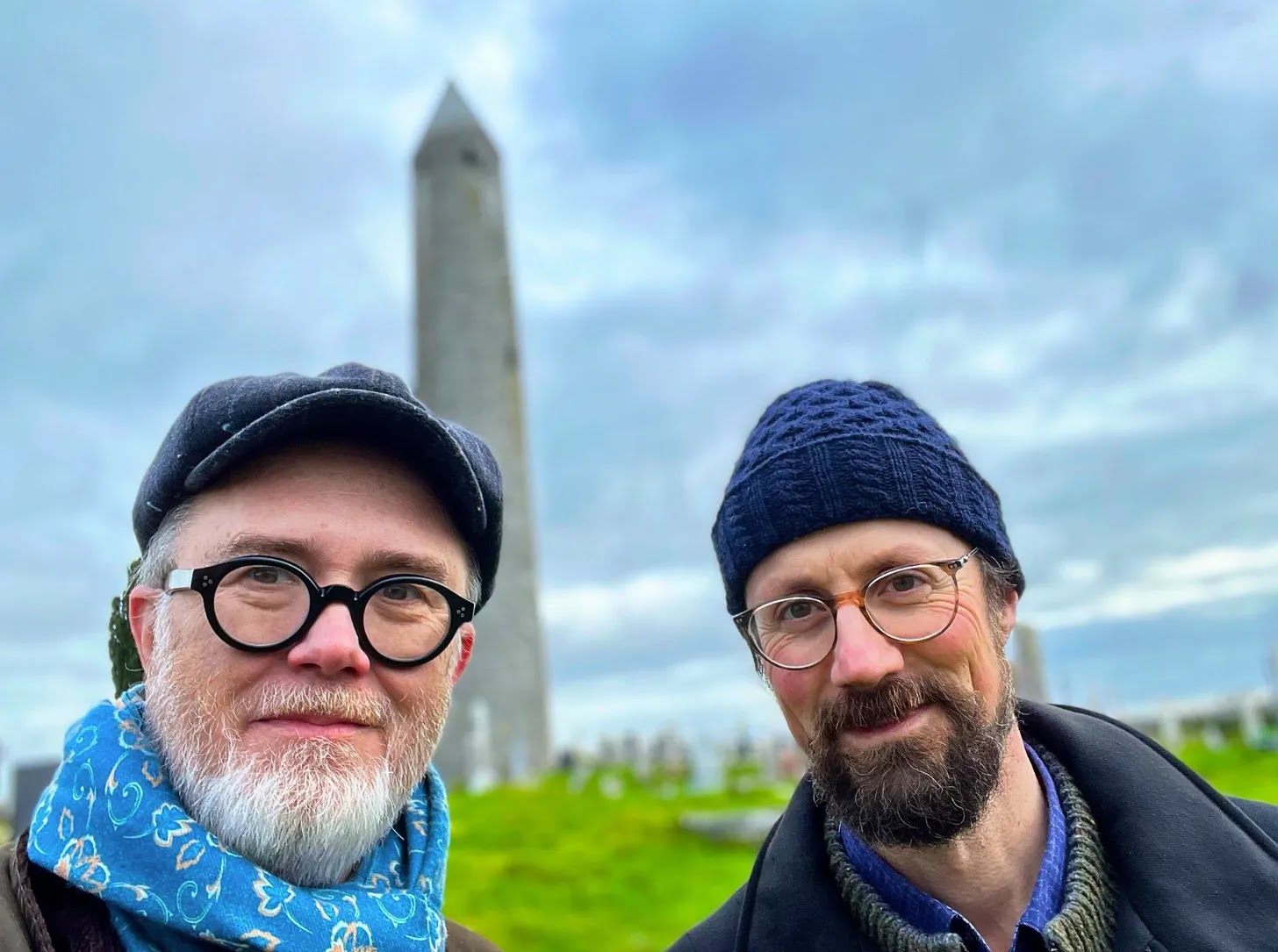
If you go to Kingsnorth's website, you will see how he markets his books and his blog to generate revenue.  A subscription to his "Abbey of Misrule" blog costs 50 Euros a year (about $53 USD).  In his use of internet marketing and in other respects, Kingsnorth has a lot in common with Rod Dreher.  This past week, Dreher was in Ireland to interview Kingsnorth for Dreher's new book on "reinchantment" movements around the world.


                Rod Dreyer and Paul Kingsnorth, Near the St. Colman Tower in County Clare


Just as Dreher argues for the "Benedict Option," in which religious believers form small local communities with their own schools, churches, and social groups of families to live out their religious faith, Kingsnorth recommends that people build voluntary associations of religious families and groups at the local level.  

Notice that both Kingsnorth and Dreher are incoherent in that while they profess to reject liberalism, they actually embrace the fundamental principles of liberalism--such as voluntarism and religious liberty--and they reject the illiberalism of theocratic regimes that would coercively enforce religious belief.  As I have indicated in previous posts, they share this incoherence (both affirming and denying liberalism) with Patrick Deneen.

When I went to Dreher's Substack website, I discovered that to read his blog, I would have to subscribe for $50 a year.  I then received this email message from Dreher:

Hey friend, if you’d like to receive the Daily Dreher, um, daily, please subscribe. It’s only five dollars per month (25 cents per day), or fifty dollars per year. Come on, it’ll be fun. Peel me a grape! French me a fry!

Why is it different from my blog? For one thing, it’s a spiritual exercise for me. On my TAC blog, I chronicle the Continuing Crisis. Here, I write in a much quieter and more reflective mode, trying to train my eye to perceive the beauty, the goodness, and the meaning in the world — reasons to hope. On this blog, I attempt to discover the truth of Auden’s lines: “Life remains a blessing/Although you cannot bless.”

I write more candidly and personally about religion here. Also, about books, ideas, travel, and food — but always striving to do so in a “what’s good about the world” sense. Crazy, innit? I hope you will join me. I also feature reader letters. Let’s make this a collective venture. We’re all trying to figure out how to “stagger onward rejoicing” (Auden again), so let’s help each other.

Thanks,

Rod.


Notice that for every 2,000 subscribers, this brings in a cool $100,000 of yearly revenue.  And it's only 25 cents per day!


This reminds us of Sally's wisdom: There's money in mysticism.

Monday, March 06, 2023

Freedom in Estonia


                                                                         Kaja Kallas


Yesterday, the general elections in Estonia became a big victory for Prime Minister Kaja Kallas and a big defeat for Vladimir Putin.  Nine political parties were running candidates for Estonia's unicameral parliament--known as the Riigikogu.  Kallas' center-right Reform Party took 31.4 percent of the vote, with the far-right EKRE party a distant second with 16.1 percent, and the Center Party 15 percent.  It appears that the Reform Party will take 37 seats in the parliament, so that Kallas will need only 14 more seats in a coalition to control the 101-seat body and continue as Prime Minister.

The EKRE party is a right-wing populist party in the style of Trump--Euroskeptic, anti-immigrant, anti-gay, and determined to "put Estonians first" rather than Ukrainians.  When the Reform Party took the lead in the election, the head of the EKRE Party (Martin Helme) claimed that the election had been stolen.

This is a defeat for Putin because he has hoped that the support for Ukraine from the NATO countries would start to weaken as voters become frustrated by the economic costs of backing Ukraine in the war.  Under the leadership of Kallas, Estonia has been one of the strongest supporters of Ukraine among all the NATO nations.  Estonia has given the equivalent of 1 percent of its entire Gross National Product in military and humanitarian assistance to Ukraine, which includes 44 percent of Estonia's military budget.  Estonia is one of only seven countries out of the 30 NATO members that meets a military spending target of 2 percent of Gross National Product; and Kallas has pledged to increase this to 3 percent.  Some of her political opponents have criticized her for this military spending and for giving too much to the support of Ukraine.

The Estonians have a good reason to be afraid of Russian aggression because Estonia is one of only four NATO countries that share a border with Russia, which includes Latvia, Lithuania, and Poland.

I have previously written about Estonia as ranking near the top of the Human Freedom Index and as being the best model for Ukraine to emulate.  Estonia and Ukraine have similar histories as having been under the rule of the Soviet Union until declaring independence in 1991.  But Estonia has been more successful than Ukraine in becoming a free society that follows the principles of classical liberalism.

In the Human Freedom Index 2021 (based on data for 2019), Estonia ranked fourth in the top five freest countries out of 165 countries:

1. Switzerland

2. New Zealand

3. Denmark

4. Estonia

5. Ireland

Ukraine ranked at 98th, while Russia ranked at 126th, and China at 150th.  At the bottom were Venezuela at 164th and Syria at 165th.

In the recently released Human Freedom Index 2022 (based on data for 2020), Estonia has moved up to third place, with Denmark at fourth place.  Switzerland and New Zealand are still first and second respectively.  Ukraine has moved up to 89th, while Russia has moved up only slightly to 119th.  Venezuela and Syria are still at the bottom.

As I have previously argued, this Human Freedom Index allows us to judge the empirical evidence for the success of liberalism, because we can see that the liberal regimes tend to be high in both freedom and happiness, while the illiberal regimes tend to be low.  Most human beings would rather live in free societies like Switzerland, New Zealand, and Estonia than in oppressive societies like Russia, Venezuela, and Syria.

The recent critics of liberalism--like Patrick Deneen and Rod Dreher--who speak confidently about "how liberalism failed" are silent about this empirical evidence for the success of liberalism.  

By contrast, many of the people of Ukraine have been persuaded by this empirical evidence, so that they're willing to risk their lives in war in the hope that Ukraine can become more like Estonia than Russia.

Thursday, January 23, 2025

The Illiberalism of the MAGA Intellectual: Curtis Yarvin's "Confederate Racist Fascism."

Meta CEO Mark Zuckerberg, Amazon CEO Jeff Bezos, Google CEO Sundar Pichai, Tesla and SpaceX CEO Elon Musk, Apple CEO Tim Cook, and TikTok CEO Shou Zi Chew.  

Why did Donald Trump place these tech CEOs--some of the richest human beings in the world--in the front row immediately behind him at his inauguration, while the most prominent elected Republican leaders were forced to sit in the back row, hidden from view?

One possible answer is that this shows the influence of the MAGA intellectual Curtis Yarvin, who argues that the only escape from the obvious failures of liberal democracy is to establish an American feudal autocracy ruled by tech CEOs.  A few days ago, the New York Times published an interview of Yarvin where he briefly stated some of his ideas.  What he says here is vague and incoherent, but he is clear about his hope that tech CEOs will take over monarchic control of America under Trump's Caesaristic leadership.

A better exposition of Yarvin's thinking comes in his extensive internet writing over the past twenty years, which I have analyzed in a series of posts a few years ago.  Here I will briefly summarize some of my main points.

I had never heard of Curtis Yarvin until I saw that the Claremont Institute was publishing some of his writing.  Once I began looking at his work, I knew that something strange was happening at the Claremont Institute.  

Yarvin ridicules the Declaration of Independence, scorns the American Revolution as "thuggery, treason, and hypocrisy," and takes the side of the Loyalists in their defense of King George III's monarchic rule over America.  He also praises the Confederacy for fighting a war of secession to defend slavery, which he regards as "a natural human relationship."  The only mistake the Confederates made, Yarvin believes, is that they did not see themselves as reactionary Cavaliers trying to restore the Stuart monarchy.  Yarvin says that he likes to "flirt" with "Confederate racist fascism."

I think I know what Harry Jaffa would have said about this.  Is this what the Claremont Institute now stands for?

I have said that Yarvin is intellectually stimulating because he is one of the few--maybe the only one--of the Anglo-American Far Right thinkers today willing to be truly reactionary by rooting far-right thinking in the Tory ideology of divine-right monarchy and Robert Filmer's Patriarcha in opposition to the Whig Lockean ideology of natural rights to equal liberty and government by the consent of the governed.

But still there are two big problems in his remarkably weak arguments.  First, his favorite form of argumentation is begging the question: he finds a writer who agrees with him, he paraphrases or quotes from that writer, and he then he concludes: ah, you see, I must be right because this writer agrees with me!  I have seen the same kind of sophistical rhetoric in the work of other critics of liberalism, such as Patrick Deneen and Rod Dreher.

The second problem with Yarvin's rhetorical style of arguing is that he does not survey the relevant empirical evidence for deciding the historical disputes that he enters.  So if he wants to prove that modern liberal democracy inevitably leads to disorder, while archaic autocratic authoritarianism leads to order, he needs to present the empirical evidence for that, which he rarely does.

An example of the first problem is Yarvin's attack on the Declaration of Independence.  He calls as his "first witness"--Thomas Hutchinson, a leading Loyalist.  He allows Hutchinson to speak through his 1776 pamphlet Strictures upon the Declaration of the Congress at Philadelphia--a Loyalist attack on the Declaration of Independence.  He calls other witnesses, but they are all Loyalists.  He does this even though he says that "there is no such thing as a neutral primary source," which leads us to expect that he will introduce primary sources on both sides of the debate, but he never does.

Even in his exposition of Hutchinson's Strictures, Yarvin does not tell his readers that a dozen or more scholars studying the Declaration of Independence have critically responded to Hutchinson's pamphlet.  For example, Hans Eicholz has done this in his book Harmonizing Sentiments: The Declaration of Independence and the Jeffersonian Idea of Self-Government (New York: Peter Lang, 2001), which includes a reprint of Hutchinson's whole pamphlet.

An example of the second problem with Yarvin's rhetoric--failing to survey the relevant empirical evidence--is his prediction that feudal illiberal societies will have low rates of violent crime, while modern liberal societies will have high rates.  In making this argument, he is silent about the quantitative historical evidence that from high rates of violence and homicide in the Middle Ages, there has been a long decline in modern liberal societies, which shows that liberalism promotes moral self-command, and that peop0le in pre-modern illiberal societies suffered from a lack of self-control.

Another example is his claim that "slavery is a natural human relationship."  He says that most slave masters have been benevolent in their treatment of their slaves.  He dismisses the depiction of the brutality of slavery in Harriot Beecher Stowe's Uncle Tom's Cabin as "propaganda."  But he is silent about the factual evidence for the brutality of slavery that Stowe presented to show that her novel was not just "propaganda."  She published a book--A Key to Uncle Tom's Cabin: Original Facts and Documents--in which she provided extensive documentation to confirm her claim that the fictional story of her novel was an accurate depiction of what American slavery was like.  Now, maybe Yarvin would want to say that her evidence is not persuasive, but he would have to argue for that, which he has not done, because he never wants the burden of responding to possible criticisms of what he says.

I draw two conclusions from all of this.  Yarvin is not a serious thinker.  And if Trump and his people decide to embrace his "Confederate racist fascism" ruled by tech CEO billionaires, they will destroy the liberal pluralist coalition that voted for Trump in November.