Traditionalist conservatives and classical liberals need Charles Darwin. They need him because a Darwinian science of human nature supports Burkean conservatives and Lockean liberals in their realist view of human imperfectibility, and in their commitment to ordered liberty as rooted in natural desires, cultural traditions, and prudential judgments. Arnhart's email address is larnhart1@niu.edu.
I had never heard of Curtis Yarvin until I saw that the Claremont Institute was publishing some of his writing. Once I began looking at his work, I knew that something strange was happening at the Claremont Institute.
Yarvin ridicules the Declaration of Independence, scorns the American Revolution as "thuggery, treason, and hypocrisy," and takes the side of the Loyalists in their defense of King George III's monarchic rule over America. He also praises the Confederacy for fighting a war of secession to defend slavery, which he regards as "a natural human relationship." The only mistake the Confederates made, Yarvin believes, is that they did not see themselves as reactionary Cavaliers trying to restore the Stuart monarchy.
I think I know what Harry Jaffa would have said about this. Is this what the Claremont Institute now stands for?
For many years, Yarvin was known as "Mencius Moldbug," writing for his blog "Unqualified Reservations." Although he no longer writes for that blog, it is still available online, and it is still the best place to go for his extensive writing. I will be writing a series of posts on Yarvin with references to that blog indicated by the dates of the posts.
Although his writing is often hard to understand, I find that Yarvin is the most intellectually stimulating of all the far-right commentators that I have studied, even though I am not persuaded by what he says.
What I mean by "intellectually stimulating" is that Yarvin is one of the few--maybe the only one--of the Anglo-American Far Right thinkers today willing to be truly reactionary by rooting far-right thinking in the Tory ideology of divine-right monarchy and Robert Filmer's Patriarcha in opposition to the Whig Lockean ideology of natural rights to equal liberty and government by the consent of the governed.
I see three general theories in Yarvin's work. First, there's a theory of Anglo-American political history over the past 400 years. Second, there's a theory of American political history from 1933 to the present. Third, there's a theory of what a neoreactionary political future might look like.
According to the first theory, Anglo-American political history has moved consistently for four centuries away from the healthy order of archaic feudal autocracy to the unhealthy disorder of modern liberal democracy--moving from the extreme far right to the extreme far left. This historical movement has been driven by a struggle between moderns of the left and archaics of the right, manifested in a series of wars in which the modern left has always defeated the archaic right: the English Civil War (1642-1649), the Glorious Revolution of 1688, the American Revolution (1774-1782), the American Civil War (1860-1865), the First German War (1914-1918), and the Second German War (1939-1945) (see Yarvin's post for 3/5/09.)
According to the second theory, since the election of Franklin Roosevelt in 1933, the United States has been ruled by an "Orwellian mind-control state" that Yarvin calls the "Cathedral." The purpose of the Cathedral is to "manufacture consent." In a democracy, the ultimate source of legitimacy is the consent of the people expressed as public opinion. But public opinion does not come from people thinking for themselves. The people have to be told what to think, and that's the job of the Cathedral. Unlike other mind-control states like Nazi Germany, the Soviet Union, and Communist China, the Cathedral operates as a self-organizing and synchronized system without any central coordinating executive authority--there is no Goebbels or Gestapo to run things--which makes it harder to identify and attack it.
The most powerful people in the Cathedral are the professors in the most highly ranked universities--Harvard, Yale, Columbia, Stanford, and so on. The people in the "Brain Trust" who advised FDR came from these universities. These professors are the ones who create all the new ideas about politics, economics, culture, and religion; and they pass these new ideas on to journalists at the most prestigious newspapers (such as the New York Times and the Washington Post). These new ideas are then passed on to government bureaucrats, politicians, and public educators. Over time--perhaps a generation--these new ideas seep down into the minds of the voters who then vote for those politicians who agree with these new ideas. This then becomes public policy. All of these new ideas are ever more extreme in their leftward movement. And thus over time, public opinion and public policy move from right-wing thinking to ever more left-wing thinking (1/8/09).
As an example of how this works, Yarvin points to the remarkable change in public opinion in California from 1963 to 2008. In 1963, a nearly two-thirds majority of California voters passed a referendum called Proposition 14, which amended the state constitution to add the following:
"Neither the State nor any subdivision or agency thereof shall deny, limit or abridge, directly or indirectly, the right of any person, who is willing or desires to sell, lease, or rent any part or all of his real property, to decline to sell, lease or rent such property to such person or persons as he, in his absolute discretion, chooses."
If you don't want to live with persons of color, the government cannot compel you to.
But then, 45 years later, in 2008, the voters of California by a nearly two-thirds margin voted for Barack Obama for president. What explains this remarkable change in public opinion in California about race relations? Yarvin's answer is that the left-wing idea of abolishing racial segregation and discrimination originated in the university and then was passed through the Cathedral until it become part of public opinion. One way to see this, Yarvin suggests, is to notice that the public opinion of California in 2008 was very similar to the public opinion of Stanford in 1963. That's how the Cathedral moves public opinion in a democracy to the left.
But moving ever leftward means moving away from archaic order to modern disorder, which means that eventually all modern democratic states will have to decay and dissolve. Then what? Well, Yarvin assumes, the world will have to move to the right--to the sort of authoritarian governance that can enforce order. How could that happen?
Yarvin's answer is his third theory--a theory of how a new feudal authoritarian governance could emerge in the future. This will not be a simple return to the feudal monarchy of the past. This will be something new. But it will resemble the feudal monarchy in some ways.
Yarvin speculates that the most likely possibility is the emergence of hundreds or even thousands of sovereign joint-stock corporations, which each one claiming ownership of a small patch of land--a city or a small region of territory--each sovereign and independent (11/13/08).
The corporation would be owned and controlled by its shareholders, who would select a chief executive officer with monarchic power to make all decisions final, although perhaps consulting with a board of directors.
This joint-stock corporation would want to maximize corporate efficiency and profitability. The residents of the territory would sign customer service contracts specifying the services the corporation would provide, primarily security. If they become unsatisfied, the residents can leave and look for a more attractive sovereign corporation somewhere else.
This proposal might explain why the high-tech multibillionaire Peter Thiel has been a close friend and supporter of Yarvin. Would Thiel like to become CEO of one of these sovereign corporations?
I want to write some more posts on Yarvin. And I will concentrate on what I see as the two biggest problems with his arguments. The first problem is confirmation bias. Yarvin supports his theories of history by going to "primary sources"--material written by people who lived during the historical period Yarvin is studying--and then drawing out conclusions from these sources. His selection and reading of these sources is biased, however, in that he tends to pick sources that he agrees with, and largely ignores sources that he disagrees with. If it is true, as he admits, that no primary source about a historically contested issue can be neutral, then he needs to bring opposing sources into debate and then show how one side of the debate really is stronger than the other. He almost never does that.
The second problem with Yarvin's rhetorical style of arguing is that he does not survey the relevant empirical evidence for deciding the historical disputes that he enters. So if he wants to prove that modern liberal democracy inevitably leads to disorder, while archaic autocratic authoritarianism leads to order, he needs to present the empirical evidence for that, which he rarely does.
I expect to concentrate on the debates over the Declaration of Independence, slavery, the American Civil War, and the disputes over divine right monarchy in 17th century England.
In the struggle of the Ukrainians to defeat the Russian invasion of their country, we can see the conflict between two kinds of patriotism: the patriotism of a liberal nation versus the patriotism of illiberal nationalism. To see this, we need to understand that the idea of a nation is distinguishable from the ideology of nationalism, because a people can feel a patriotic attachment to their nation without the xenophobic feelings of nationalism. Liberal democracy supports a patriotic sense of national identity but denies the illiberalism of xenophobic nationalism. The nationalist critics of liberalism are wrong when they say that liberalism must dissolve any sense of national patriotism.
As I have indicated in a previous post, Ukraine is a far more liberal country than Russia, at least as measured by the Human Freedom Index, although Ukraine has far to go in moving towards the liberalism of countries like Estonia. As Putin has clearly stated, the purpose of his invasion is to prevent Ukraine from moving towards the liberalism of the "Atlantic" world and to advance the illiberal vision of a Russian Eurasian Empire opposed to the liberalism of the West.
The courage of the Ukrainian people in risking their lives in defense of their liberal nation shows how liberalism can sustain national patriotism. But this Ukrainian liberal patriotism shows none of the xenophobia of malignant nationalism. This Ukrainian patriotism is not based on a national identity defined by race, religion, ethnicity, or language. One of many signs of that is that while Zelensky belongs to the small Jewish minority in Ukraine, he was elected president with over 70% of the vote. Ukraine must be one of the few countries in the world--other than Israel--where that could happen. And even as they fight this war against the Russian invaders, the Ukrainians have not shown any hatred of ethnic Russian, Russian-speaking, or Russian Orthodox citizens.
In thinking about how liberalism can be compatible with the human desire for national identity, one needs to raise a fundamental question: what does the existence of nations say about human beings? My thinking about this question has been stimulated by Steven Grosby, in his book Nationalism: A Very Short Introduction (Oxford, 2005), although my answer differs slightly from his.
First, we must ask what we mean by "nation." The Oxford English Dictionary defines "nation" as "a people or group of peoples," or "a large aggregate of communities united by factors such as common descent, language, culture, history, or occupation of the same territory, so as to form a distinct people." Notice the ambiguity in that a nation shows the unity of "a people" and the multiplicity of a "group of peoples."
Grosby conveys this ambiguity in saying that a nation exhibits "only a relative cultural uniformity" that is not absolute, because every nation will territorially encompass a number of different localities, regions, cultural traditions, languages, religions, and legal systems. Sometimes that will lead to separatist movements like that of Quebec in Canada, Scotland in Great Britain, or Catalonia in Spain. Consequently, every nation must try to manage the conflicts that arise from this diversity.
Grosby's brief definition of nation is "a territorial community of nativity." More elaborately, he explains:
"A nation requires a relatively extensive, bounded territory or an image of such a territory, the existence of which usually involves the following: a self-designating name, a centre (with institutions), a history that both asserts and is expressive of a temporal continuity, and a relatively uniform culture that is often based on a common language, religion, and law. Still, it is more faithful to the historical evidence to realize that each of these characteristics is rarely found to be absolute or complete; rather, they are processes in the development of interests, practices, and institutions, all of which are beset with ambiguities and tensions" (20).
The word nation is derived from the Latin word natus for "birth," which Grosby conveys by speaking of "nativity." Membership in a nation arises from being born into it. But then there are different ways to be born into a nation. According to the "ethnic" criterion of birth, one joins a nation by being born to parents who are recognized as members of that nation. According to the "civic" criterion of birth, one joins a nation by being born in the territory of that nation. According to the "naturalization" criterion of birth, the laws of immigration and citizenship can set procedures by which immigrants become "naturalized" citizens--that is, they are treated as if they were natural-born citizens.
What this shows is that membership in a nation is a social reality that human beings create and maintain through the language of collective recognition or acceptance: someone belongs to our nation when we agree to designate them as such. This means that the standards for membership in a nation are always changing as we change the institutional facts of citizenship. This is an example of what John Locke called "mixed modes" and what John Searle has called "institutional facts." (I have written about this previously.)
Our standards for membership in our nation will depend upon what we believe to be the best standards for promoting the well-being of our nation, and there will be debate over this. Liberals like Locke will argue for general laws of naturalization that make it easy for foreigners to immigrate to our nation. (I have written about Locke's open borders immigration policy as cultural group selection.) But illiberal nationalists like Trump, Le Pen, and Viktor Orban will argue that the well-being of the nation requires strict barriers to immigration.
This debate over open borders versus border walls depends ultimately on what we think the existence of nations says about human nature. For example, if you agree with someone like Frank Salter that people need to live in nations to satisfy their natural desire for ethnic identity, then you will probably agree with him that every nation should practice ethnic nepotism that favors its ethnic group over others.
But I have argued against this by claiming that while there is evidence for evolved instinctive tribalism or coalitional affiliation by which we distinguish between in-group and out-group, the cues for identifying who belongs to which group are set by social experience that is not instinctive but learned. Consequently, we can decide that the well-being of our nation requires a broad sense of national identity that does not depend on ethnicity, race, religion, or other narrowly exclusive forms of identity.
According to the ideology of nationalism, the existence of nations shows us that human beings naturally desire to live in a national community that is uniform and fixed in its biological and cultural identity as defined by race, ethnicity, religion, or language, which defines those who belong to "us" against those who belong to "them"--or the "people" against the "enemies of the people." There are the true Americans and those who are not. There are the true French and those who are not.
This ideology of nationalism makes two mistakes. First, no national community is absolutely uniform and fixed biologically or culturally. Even the most seemingly homogeneous country will have some cultural diversity that will create potential conflicts that have to be managed. So, for example, Putin is forced to recognize this problem in that while he often appeals to Russian nationalism based on a shared Russian ethnicity and religion, he also has to admit that Russia is a multiethnic and multireligious society, and so Russian national identity must somehow recognize that diversity.
A liberal nation will manage those multicultural conflicts by looking for compromises and promoting civility. One way a liberal regime does that is by distinguishing state and society and saying that while the state will coercively enforce those criminal and civil laws necessary to secure individual liberty, but without enforcing a tight moral community based on some conception of the best way of life, people will be free in civil society to form such moral communities organized around families, churches, schools, neighborhoods, and other voluntary associations. One example of this is how the Amish immigrated to North America so that they would be free to establish and maintain their tightly organized moral communities without being persecuted. I have spoken about this in my responses to the communitarian critique of liberalism coming from people like Patrick Deneen and Rod Dreher.
The second mistake made by the ideology of nationalism is the assumption that human beings cannot extend their sense of affiliation beyond their own nation. In fact, human beings engage in all kinds of activities, occupations, and organizations that bind them into global networks of cooperation and affiliative attachments. The monotheistic religions, global charities, international commercial trade, scientific research, human rights organizations, and all of those millions of global networks of cooperation show how we extend our social concern beyond our nations to all of humanity.
We see that displayed now when people around the world wave the Ukrainian flag, sing the Ukrainian national anthem, and come to the aid of Ukraine in its war against Russia, because they see that the victory of this liberal nation in defending its liberal social order from conquest by an illiberal power will serve the interests of many nations by showing the resoluteness of liberal patriotism in defense of national liberty.
Here is the full debate between Emmanuel Macron and Marine Le Pen from two days ago. It's long--almost three hours--followed by commentary. The presidential election is coming up on Sunday.
As I have indicated in my two previous posts, I have been trying to understand the intellectual grounds of the French far right conservatives. On the one hand, some of the French conservatives--particularly, those writing for the journal L'Incorrect--say that they are in the French intellectual tradition of Joseph de Maistre and Charles Maurras, who embraced an illiberal counter-revolutionary Catholic theocracy as the foundation of French national identity. On the other hand, the French conservatives contradict this when they endorse the idea that the French state must always be secular, which suggests that they are actually very liberal conservatives, and thus not counter-revolutionaries at all. I see no way to resolve this incoherence in their thinking.
I was reminded of that in watching the debate. Le Pen stressed economic issues--particularly, the popular complaints about inflation and the other concerns about economic security and preserving France's welfare state.
She did speak about the importance of preserving French national identity against the threat of Islamic immigration, which is where we might see evidence of her far right illiberalism. She reaffirmed her promise that she would ban Muslim women from wearing Muslim veils in public. Macron criticized that proposal as unconstitutional and warned that it could provoke a "civil war." Notably, writing in L'Incorrect, Alexander de Galzainsaw this as most important moment in the debate.
Le Pen also affirmed her proposal for having a national referendum to change the French Constitution, including an amendment to prohibit the settlement of a "number of foreigners so large that it would change the composition and identity of the French people," which is a rewording of the far right "Great Replacement" theory.
But notice that she never suggests that the "identity of the French people" should be tied to French Catholic Christianity, and thus she never challenges the secularism of French public life.
Jacques de Guillebon, editor of L'Incorrect, would say that this shows how the French conservatives do not understand the "metaphysics of power"--the idea that political power depends on supernatural authority, which in France means restoring Catholic theocracy. Thus, far from being too reactionary, the French far right is not reactionary enough.
Le Pen could show herself to be a true illiberal reactionary by embracing Putin and supporting his invasion of Ukraine, which he has justified as a reclaiming of the Russian Orthodox Christian civilization as the alternative to a decadent liberal West. She has in fact been a supporter of Putin in the past. But she has tried to reverse her position in recent weeks by declaring her support for Ukraine. Her leaning towards Putin has become her biggest weakness in the election. In the debate, Macron criticized her Russian connections, particularly in taking a loan for her party from a Russian bank linked to Putin's circle of oligarchs. She appeared vulnerable at that moment.
That illustrates how the Russian invasion of Ukraine has become a huge liability for the European far right, which has long seen Putin as their ideological ally.
Remarkably, in the last few days, in her last campaign swing before the voting, Le Pen has said the French people have a clear choice: "Macron or France?" So defining the national identity of France is easy for Le Pen: she is France!
I should say, however, that the French liberal voters don't have a good choice in this election: Macron is only a little less authoritarian than Le Pen.
As expected, Emmanuel Macron and Marine Le Pen will face each other in the presidential runoff April 24. In a field of 12 candidates, Macron received 27.4% of the votes cast yesterday, and Le Pen received 24.3%. Eric Zemmour, the other far right candidate, received only 7%. He has immediately pledged his support for Le Pen in the runoff.
Zemmour's defeat was predicted by Jacques de Guillebon in his April 6th editorial for L'Incorrect. He predicted an 8% vote for Zemmour. Guillebon scorns Zemmour for his decision to run for president, which took far right votes away from Le Pen. Even Marion Marechal betrayed Le Pen (Marechal's aunt) by campaigning for Zemmour. Guillebon still hopes that Le Pen can win, but he gives off a tone of pessimism.
The reason for his pessimism is suggested by his editorial, which has the title De Profundis Droitibus (To the Depths of the Right). He points out that in some public opinion surveys, 45% of the French identify themselves as right-wing. But somehow the French right has failed to fully mobilize those voters to win power. Why?
Guillebon says "this identity right has completely forgotten its people." The right has offered the French people "to rid them of scum and Islamists, a healthy idea but oh so incomplete." He laments that the French right is "far from the time of Thomism and organic Maurrasism." "In truth, this right will not have been too reactionary, it will not have been reactionary enough."
He concludes with a remark that I quoted in my post yesterday: "In truth, if we knew anything about our history, we would know that one never seeks temporal power without having taken spiritual power: without Saint Remi, no Clovis. We demand a right of the soul."
As I said yesterday, Guillebon is intimating here that the French far right could be far more successful than it has been so far if it embraced the French Catholic Integralism of Maurras. Neither Le Pen nor Zemmour has done this.
Both Le Pen and Zemmour have warned about the threat to French cultural identity coming from the increasing number of foreign people immigrating to France, with Muslim immigrants being the greatest threat. Le Pen has proposed to ban Muslim women from wearing head scarves and to fine them if they do. She has said there is "a choice of civilization," in which "the legitimate preponderance of French language and culture" should be protected and full "sovereignty reestablished in all domains." She has also argued for changing the French Constitution to ban any policies that lead to "the installation on national territory of a number of foreigners so large that it would change the composition and identity of the French people." But notice that she does not define the "identity of the French people" as rooted in Catholic Christianity, which is what the Catholic Integralists want.
French Catholic Integralism would require the repeal of "The Law of December 9, 1905, on the Separation of the Churches and the State." This law was enacted during the Third Republic to establish state secularism and the freedom of religious exercise in civil society. After repealing this law, Catholicism could be established as the state religion of France, as it was before the Revolution of 1789.
Is this what Guillebon wants the French far right to do? If so, then it's striking, as I have said in my post yesterday, that none of the writers in Guillebon's magazine clearly endorses this. As I suggested, the reason for this is probably that they know that there are not enough "counter-revolutionary Catholics" in France to support this.
We thus see that even those people on the French far right turn out to be liberal conservatives who reject the illiberal conservatism of Maistre and Maurras.
Today the French are voting in a presidential election. If no candidate receives a majority of the votes today, there will be a runoff election on April 24 with the top two vote getters on the ballot.
Emmanuel Macron is running for his second term of five years. He is a political centrist. Five years ago, he won easily in a runoff against the far right Marine Le Pen. Until recently, it was assumed that Macron in this election would repeat that easy victory over Le Pen.
But in recent months, polls have suggested that the race is tightening and that Le Pen could win, which would be a shocking far right turn for France. Elisabeth Zerofsky has written a good essay for the New York Times on what this could mean for the French far right. Zerofsky highlights the role of Marion Marechal (Marine Le Pen's niece) in pushing the far right towards a French Catholic nationalism that roots French national identity in Catholicism, which can sound like a move towards French Catholic theocracy in the tradition of Joseph de Maistre (1753-1821) and Charles Maurras (1868-1952). (I have put a picture of Marechal up at the top to show you one reason for her popular appeal.)
This is what I have called a "metaphysical conservatism," which says that human social order must be grounded in a divinely ordained political order. But while Marechal and some others in the French far right talk in ways that suggest this, I think this is not the case because they are actually liberal conservatives who reject the illiberal conservatism of Catholic theocracy. If I am right about this, then a victory for a far-right candidate in this election would not be a radical right turn for French politics.
I first began to think about the French far right four years ago when I was interviewed by Benjamin Demeslay, a journalist writing for the French right-wing magazine L'Incorrect. I wrote a post about that. The magazine is edited by Jacques de Guillebon, a Catholic conservative who is good friends with Marechal and who has brought her into a circle of far-right Catholic conservatives.
Here is Demeslay's first question for me:
"You defend a 'Darwinian conservatism' against 'metaphysical conservatism.' These expressions are enough to surprise the French reader. The French conservative tradition remains strongly impregnated by Catholicism, a certain counter-revolutionary and anti-liberal tropism (from Joseph de Maistre to Charles Maurras), even a mistrust of 'the Technique' (the essays of the Christian Jacques Ellul or the last Heidegger). English conservatism, heir to Edmund Burke, is now attracting renewed interest, with the translation of the philosopher Roger Scruton. There is nothing comparable to your conservatism in France. How would you define it?"
I explained my "Darwinian conservatism" as a liberal conservatism that is a fusion of classical liberalism and traditionalist conservatism, which is opposed to the illiberal conservatism of people like Maistre and Maurras. I also argued that Demeslay was mistaken in identifying the sort of French conservatism manifested in L'Incorrect with the "anti-liberal tropism" of Maistre and Maurras. (In a previous post, I have elaborated on what I mean by distinguishing Darwinian conservatism and metaphysical conservatism.)
In reaction against the French Revolution, Maistre initiated a Counter-Enlightenment tradition of thought based on a theocratic authoritarianism--the idea that all government comes from some unquestioned coercive authority that is divinely infallible and that all such authority is derived from the Pope as God's representative on Earth. He proposed a restoration of the Bourbon monarchy to the throne of France, ruling under the supreme authority of the Pope in both temporal and spiritual matters. Atheists, Jews, and heretical Christians (such as the Protestants) should be suppressed. He claimed that the rationalist rejection of Catholic Christianity and theocratic monarchy was responsible for the disorder that followed the French Revolution of 1789.
Carrying on the tradition of Maistre's thinking, Maurras became the organizer and primary philosopher for Action francaise, a French far-right Catholic royalist organization, advocating the restoration of the House of Bourbon and of Roman Catholicism as the state religion of France. Oddly, Maurras was himself an agnostic, although it was claimed that he had a death-bed conversion and received the last rites at his death in 1952. Even though he was an agnostic, he argued that Catholicism was necessary for the social order and national identity of France. This purely utilitarian view of Catholicism as politically useful for legitimizing monarchic authority alienated some conservative Catholics. In 1926, Pope Pius XI condemned Action francaise. Later, some of Maurras's writings were put on the Catholic Church's list of prohibited books.
If you look at the writing in L'Incorrect over the past four years, you will see many references to Maistre and Maurras; and you might assume, therefore, that these French far-right conservative writers have embraced the Catholic theocratic authoritarianism of Maistre and Maurras. But if you look carefully at this writing, you will see that these gestures toward Maistre and Maurras are vague, and there's no explicit affirmation of Catholic theocracy.
In recent weeks, Guillebon's editorials for L'Incorrect have expressed a frustration that the far-right candidates for the presidency--Le Pen and Eric Zemmour--and French conservatives generally do not understand the "metaphysics of power"--the idea that political power depends on supernatural authority (see the editorials for March 8 and April 6). The French far right should find their foundation in France's "Christian virtues." But since they lack a Maurras, they "obviously lack metaphysics." Guillebon looks to "the depths of the right" to reveal "a right of the soul," but he cannot find it, because the right has no "organic Maurrasism."
"In truth," he observes, "if we knew anything about our history, we would know that one never seeks temporal power without having taken spiritual power: without Saint Remi, no Clovis."
Remi was the Bishop of Reims who, on December 25, 496, baptized Clovis I, King of the Franks, which initiated the Christianization of the Franks and the Frankish empire. Beginning in 816, each French monarch was coronated in the Reims Cathedral and anointed with the Holy Spirit, so that the French kings ruled by divine right. Is Guillebon intimating that the French far right needs to revive this tradition of Catholic royal theocracy?
Strangely, however, neither Guillebon nor his writers ever say this explicitly. And most of what they say indicates that they endorse the liberal principle of separating church and state and reject any reestablishment of Catholicism as the state religion for France, which thereby rejects the theocratic authoritarianism of Maistre and Maurras.
For the past few days, I have been reading all of the articles in L'Incorrect that mention Maistre or Maurras. I have found a few that come close to endorsing their ideas. For example, Luc-Olivier d'Algange wrote an article (May 7, 2020) on the political thought of Juan Donoso Cortes (1809-1853), who was a Spanish Catholic counter-revolutionary whose thinking was shaped by his reading of Maistre. D'Algange groups Donoso Cortes together with Maistre and Rene Guenon as "good masters" for French Catholic conservatives.
According to d'Algange, Donoso Cortes "refutes this first and fatal modern error, which consists in thinking that religion, politics, and philosophy are separate, autonomous domains, which would belong to their respective occupations as impervious to each other as academic specialities, with their jargons, their particular and unusual ends. For Donoso Cortes, not only is religion not absent from politics or philosophy, but they are always religious." Against the corrupting materialism of modernity, Donoso Cortes should teach us that "the only possible right is divine right."
But then d'Algange never draws from this the conclusion that Donoso Cortes drew--that the only good form of government is a divine right monarchy that enforces Catholicism as the state religion and persecutes other religions, including Protestant Christianity.
Moreover, L'Incorrect also publishes articles that denigrate appeals to divine right. For example, consider the recent interview of Renauld Camus (April 7, 2022), who is famous for his "great replacement" conspiracy theory--the idea that globalist conspirators are pushing for waves of immigrants--particularly Muslims--into Europe so that in a few years native Europeans will be outnumbered by foreign immigrants, which will mean the disappearance of European civilization. (Many of the Trumpist Republicans in the United States have been promoting this same idea.)
In the interview, Guillebon asked Camus: "Is the solution to return to God?" He answered: "Personally, I do not think so, but I understand it. Even historically and philosophically, this is very conceivable. This is probably what Charles Maurras thought. Yet, it seems to me that this is a somewhat trivial conception of religion. I am no Maurrasian at all. Conceiving God as a social necessity testifies to a certain spiritual triviality. I find that quite undignified. Certainly, however, it made things a lot easier."
When the question of whether Catholicism should be made the state religion of France is raised, this is rejected. One can see that, for example, in Guillebon's interview of Pierre Manent and Remi Brague, which Guillebon calls a "dialogue of giants" (January 4 and 9, 2018). They were discussing Manent's book The Situation of France, in which he argued that Muslims should be welcomed to live in France as long as they respect the religious identity of France as a Christian nation.
Here's the first question that Guillebon asked: "Michel Houellebecq recently told Spiegel that solving the problem of Islam in France would imply that Catholicism would become a state religion. What do you think?"
Manent answered: "The idea seems to me to be fundamentally correct. Not that Catholicism is recognized as the state religion, no one is seriously thinking about that, but that the role of the Catholic religion in the history of France, but also in the social life of the country, in the consciousness of the country, is recognized in public forms. Now, for thirty years, we have agreed to endorse the big lie that there is no Muslim problem by postulating that there can be no problem posed by a religion in our country since we have found the solution to all problems of this kind: secularism. . . . We have become prisoners of a far too restrictive definition of the French regime by reducing it to secularism. We must broaden our awareness of ourselves, and in this enlargement make an adequate place for Catholicism, which plays such a great role in the history and consciousness of France. Of course, this cannot take an institutional or constitutional form, and this is where Houellebecq's proposal crosses the boundaries of political reasonableness, as he knows very well."
Manent goes on: "In order for Muslims to be welcomed decently and to be able to live happily in France, it is important that they know that they are not in a Muslim nation, that this nation is of Christian character, that the Jews play an eminent role, that religion does not command the State and that the State does not command religion. We have a complex operation to carry out: to persuade Muslims that we want to welcome them in reasonable numbers, that they have their place in society, and that . . . this nation as a human whole is not, does not want to be and will not be a Muslim society but will remain and wants to remain a nation of Christian brand where the Jews play an eminent role, and where the state and religion know a regime of secularism."
Remi Brague then answers Guillebon's question: "I did not know this interview with Michel Houellebecq, in which it is clear that he overstepped his thought. Speaking of Catholicism as a state religion, I think he was thinking above all, not of the state, but of civil society, of how a nation should understand itself and how it understood itself until relatively recently."
Notice how Manent seems to contradict himself--first rejecting secularism but then endorsing it. And notice how both Manent and Brague are liberal conservatives in separating civil society (as a realm of voluntary religious belief) from the state (as a secular public realm separated from religion). I have written about Brague's metaphysical conservatism--here, here, and here. But in this interview, he contradicts himself in embracing liberal conservatism.
Notice also that while Manent identifies France as a Christian nation, many of the writers for I'Incorrect identify France as a Catholic nation, so that Jews and Protestants in France would have to be considered as a foreign element along with the Muslims and other religious believers.
Can the French far right plausibly identify France as a Catholic nation? Of course, in the Ancien Regime before the French Revolution, Catholicism was the state religion, often enforced by the persecution of those who were not Catholics. But that is no longer true. Many of the writers for L'Incorrect would say that the tradition of Catholic belief still prevails in French civil society, even if the French state is officially secular. Is that really true?
For answering this question, Guillebon's interview of Yann Raison du Cleuziou is pertinent (October 29, 2019). Cleuziou has written a book about the history of "counter-revolutionary Catholics" in France explains the Manif Pour Tous (Protest for All) protests against legalized same-sex marriage in 2013. Across France, many French people turned out for mass demonstrations against the law that legalized same sex-marriage. In Paris, one demonstration drew over 100,000 protesters. This was encouraging for the French far right because it seemed to show that support for the far-right cultural agenda was much greater than most people had thought.
In defining what he means by "counter-revolutionary Catholics," Cleuziou quotes from Maistre: "The counter-revolution will not be a revolution in the opposite direction, but the opposite of the revolution." Many conservative Catholics in France have followed Maistre's lead in adhering to a traditionalist Catholicism that is the opposite of the French Revolution of 1789 and everything that the Revolution represented.
But although there seemed to be a large number of such Catholics in the Manif Pour Tous protests, Cleuziou concedes that their number as a proportion of the French population is actually very small. According to one public opinion survey in 2019, 41% of the French identify themselves as Catholics, and the representation for other religions is much smaller. But then roughly equal to the Catholic population is the 40% of the French who identify as "no religion." It seems that the French are not very religious at all. Moreover, of those who identify as Catholics, only about 2% attend mass weekly. The "counter-revolutionary Catholics" turn out to be a very small group after all.
That probably explains why the far-right candidates in today's presidential election are not promoting counter-revolutionary Catholicism, because it doesn't have a broad appeal in France today.
That probably also explains why the far-right Catholics at L'Incorrect do not generally embrace the Catholic theocratic monarchism of Maistre and Maurras.
To find that full endorsement of Catholic theocracy, one has to turn to the "integralists" in the United States--"integralism" being the term first adopted by Maurras. Edmund Waldstein has nicely summarized Catholic integralism in three sentences:
"Catholic Integralism is a tradition of thought that, rejecting the liberal separation of politics from concern with the end of human life, holds that political rule must order man to his final goal. Since, however, man has both a temporal and an eternal end, integralism holds that there are two powers that rule him: a temporal power and a spiritual power. And since man's temporal end is subordinated to his eternal end, the temporal power must be subordinated to the spiritual power."
Some integralists have suggested that the "Sacramental Kingdom of St. Louis IX" in 13th century France is the model for the illiberal regime that they want to see established, although it's not clear as to how serious they are about this. I have written briefly about this at the end of a previous post. I am hoping to write more about this sometime soon.
Like the French far right conservatives, the American far right conservatives (like Patrick Deneen and and Rod Dreher) show the same intellectual incoherence: both endorsing an illiberal Catholic Christian theocracy and endorsing the liberal principle of religious liberty.
They could be coherent if they consistently pointed to the medieval Catholic theocracy of Louis IX as the best regime and then argued for a counter-revolutionary overthrow of liberalism to establish a regime like that of Louis IX. King Louis of France (1226-1270 CE) was canonized in 1297 by the Catholic Church, and thus the ruling family of France, the Capetians, became joined to Heaven, thereby adding religious legitimacy to their dynastic rule. Various parts of the saintly King Louis were placed as relics, in different monasteries throughout the territory of France, thus providing religious support for the territorial unity of the kingdom. By recognizing national saints, an otherwise universalistic, transnational monotheistic religion sanctifies the territorial identity of a nation.
Why don't the far right Catholic integralists in France and the United States strive to restore such a sacramental national kingdom based on a state religion? Is it because that would be too illiberal for them?
Skeptic magazine is one of my favorite journals, and its editor--Michael Shermer--is one of my favorite writers. The most recent issue has an article by me: "Nature's God: Why Christians Should Accept the Theory of Evolution" (pages 41-50).
American Christian fundamentalists tend to reject Darwinian evolution for at least two reasons. The first is their belief that the Bible is God's Revelation and that part of that Revelation is its clear teaching about the divine creation of the world that denies Darwinian evolution. The second reason is their belief that Darwinian evolution contradicts the foundational principle of the American creed that human beings have been created equal and endowed with rights by their Creator, as affirmed in the Declaration of Independence.
In my article, I argue that both beliefs are mistaken, and that Christians should all accept the theory of evolution. My general aim here is to promote peace between science and religion. I am especially interested in persuading American evangelical Christians to see that evolutionary science does not necessarily deny their faith. My motivation for this probably comes from the fact that as a young man I was an evangelical Baptist who denied the truth of evolution.
My article incorporates some material from some of my blog posts--here, here, and here.
In this same issue of Skeptic, there is another article that takes a position similar to mine in looking to reconcile science and religion. Nathan Lents (an atheist and evolutionary biologist) has an article ("Mytho-History: The 'Evolution' of Adam and Eve") on William Lane Craig's book In Quest of the Historical Adam. Craig is one of the most influential philosophers and theologians in the evangelical tradition of Christianity.
In this book, he argues that the Biblical story of Adam and Eve as the first human beings created by God can be understood as compatible with the truth of evolutionary science. His argument has two steps. First, he claims that the creation story of Genesis should be identified as "mytho-history." It is a "myth" like other creation myths in the Ancient Near East in that it was not intended to be taken literally in all of its details, because it employs poetic imagery or allegory. But it is still a true myth insofar as it asserts that Adam and Eve were true historical persons who were the ancestors of the entire human race.
His second step is to claim that there is scientific evidence to support this as historically true, because there is scientific evidence for the historical Adam as a real individual of the species Homo heidelbergensis that lived in central Africa about 750,000 years ago.
In this way, Craig promotes a peaceful relationship between science and religion, in a way similar to the position taken by the theistic evolutionists at Biologos (Francis Collins and his colleagues).
Craig concedes, however, that two parts of the Genesis creation story that are essential for evangelical Christians are theological articles of faith that are unfalsifiable and thus outside the realm of science. The first is the belief that Adam and Eve rebelled against God, and God cursed them for this. The second is the belief that this sin of Adam and Eve has been transmitted to all human beings by inheritance as "original sin."
As Lents indicates, Craig has provoked opposition from both of the evangelical camps debating the question of whether the historical reality of Adam can be reconciled with evolutionary science. The traditionalist camp says that Adam and Eve really existed and that this cannot be compatible with evolutionary science. The revisionist camp says that the story of Adam and Eve is purely allegorical and thus does not contradict the evolutionary science of human evolution. Craig irritates the traditionalists by claiming that there is an evolutionary explanation for the historical reality of Adam and Eve. And he irritates the revisionists by claiming that Adam and Eve are not purely allegorical.
I have written previously about the evolution of Adam and Eve and about Craig's argument that the scientific idea of the universe coming out of the Big Bang supports the cosmological argument for the existence of God.
I have also written about what Darwin thought about the Bible here and here.
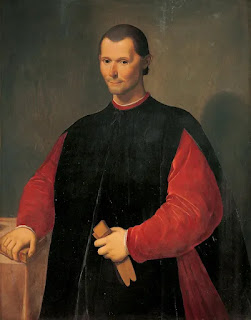
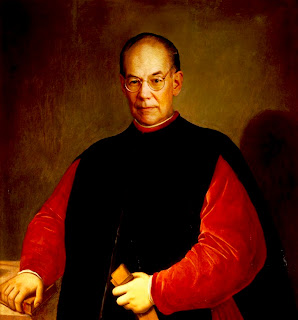
A Picture of "Mearchiavelli" Taken from John Mearsheimer's Website
President Volodymyr Zelensky Addresses the U.S. Congress
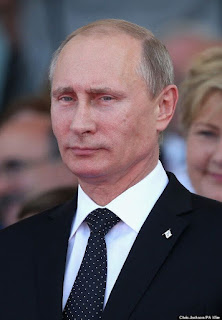
On February 21, Vladimir Putin gave a long speech on how he saw the events in Ukraine. Some of the material in this speech is drawn from Putin's article "On the Historical Unity of Russians and Ukrainians" that was published on July 12, 2021. Only three days after that speech, the Russian invasion of Ukraine began. This speech and the earlier article provide Putin's most elaborate explanation and justification for his launching the war in Ukraine.
Some of Putin's argument has been endorsed by the "realist" political scientists--like John Mearsheimer--who say that Putin is practicing Machiavellian great power politics that has been provoked by the United States and its NATO allies who have threatened the security of Russia. But this fails to recognize that what we see here is not just the Machiavellian pursuit of power in Putin's invasion but also the Lockean pursuit of liberty in the Ukrainian resistance to his invasion. To understand wars like this, we need a moral realism that sees that human beings are moved by both interest and justice, both force and freedom. Even some of the modern realists of international relations--like Hans Morgenthau--have understood this.
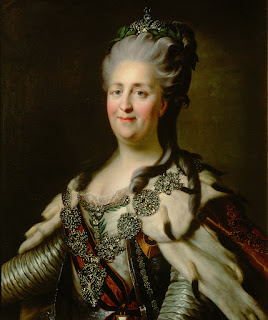
In his speech, Putin makes two kinds of arguments. In the first half of the speech, he argues that he will protect "the true cultural, economic, and social interests of the people" of Ukraine as part of "the population of historical Russia" established by Catherine the Great, who conquered Ukraine to make it part of her Russian Empire. Here we see Putin's ultimate goal-the glory of a Russian-Eurasian Empire. An independent Ukraine frustrates Putin's achievement of that imperial glory.
In the second half of his speech, he argues that to do this he will have to defend against the aggressive threat to the security of Russia coming from the eastward expansion of NATO.
The Machiavellian realists like Mearsheimer concentrate on the second argument but ignore the first. Consequently, they ignore Putin's dependence on popular consent and on the support of those few powerful people who might conspire to overthrow him to satisfy their own ambition to rule.
NATO: PURELY DEFENSIVE? OR AN AGGRESSIVE THREAT TO RUSSIAN SECURITY?
Let's start with Putin's second argument. He says that "Ukraine's accession to NATO is a direct threat to Russia's security," and while the NATO countries have tried "to convince us that NATO is a peace-loving and purely defensive alliance," there is no reason to take them at their word because they have often broken their promises. In 1990, Putin asserts, the Soviet leadership was promised that allowing the reunification of Germany would not threaten Russia, because NATO would never be expanded eastward.
But then, Putin points out, there were five waves of NATO expansion into Eastern Europe toward Russia's borders. In 1999, Poland, the Czech Republic, and Hungary were admitted to NATO. In 2004, it was Bulgaria, Estonia, Latvia, Lithuania, Romania, Slovakia, and Slovenia. This was followed in 2009 by Albania and Croatia, in 2017 Montenegro, and in 2020 Northern Macedonia.
This allowed for the expansion of the U.S. global missile defense project into Romania and Poland. These supposedly defensive missiles have offensive capabilities, he insists, which creates the danger of a surprise missile attack on Russia.
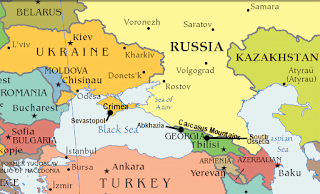
Putin says that the trouble over Ukraine actually began in 2008. At NATO's Bucharest summit in April, George W. Bush's administration pushed for an announcement that Ukraine and Georgia "will become members" of NATO. There were reports that Putin was outraged by this and declared that he would go to war to prevent it. Both Ukraine and Georgia had been part of Imperial Russia. In his speech of February 21, Putin says that "Ukraine joining NATO is a direct threat to Russia's security," and that the Bucharest summit announcement was the beginning of "a clearly anti-Russia policy."
In Georgia, on the southern Caucasian border of Russia, there was a movement beginning in 2003 toward the West and away from Russia, which was led by President Mikheil Saakashvili. In August of 2008, Putin launched the Russo-Georgian War and took the regions of Abkasia and South Ossetia from Georgia.
In Ukraine, in 2013 and 2014, there was a violent insurrection--the Maidan Revolution--against the government of pro-Russian President Viktor Yanukovych, who was forced to leave Ukraine, because he wanted to move Ukraine away from the European Union and towards Russia. The Parliament deposed him and called for new elections, in which Petro Poroshenko was elected president, with the promise to move Ukraine towards the West and away from Russia.
As Putin indicates in his speech, he regarded this as a coup d'etat, and it justified his military intervention in Ukraine in 2014, in which he annexed Crimea into Russia and supported the separatist states of Donetsk and Luhansk in eastern Ukraine in the Donbas War, which has continued to the present.
John Mearsheimer has written an essay for The Economist agreeing with Putin's arguments as showing that "the West, and especially America, is principally responsible for the crisis which began in February 2014," and which now has led to Putin's war in Ukraine. (In America, the Trumpian "Putin wing" of the Republican Party agrees with this.) Mearsheimer does not, however, identify the weaknesses in Putin's arguments.
First of all, there is no evidence that Western leaders promised Soviet leaders in 1990 that NATO would never admit Eastern European countries into NATO. In 2014, during the 25th anniversary of the fall of the Berlin wall, former Soviet leader Mikhail Gorbachev said that there had been no such promise, and there was not even any discussion of the issue of NATO expansion, although Gorbachev did add that the expansion was a "big mistake" and "a violation of the spirit of the statements and assurances made" in 1990.
Putin simply assumes that a Great Power alliance like NATO cannot be a purely defensive alliance, because it must be an aggressive threat to other great powers like Russia--because that's what great powers have always done in competition with one another. Mearsheimer agrees with this assumption, because this is what he has called "the tragedy of great power politics" (the title of his best book): even if a great power seeks only security from being attacked, it must preemptively attack other great powers, because it can never trust other great powers to not use their offensive capabilities to attack first. By this tragic Machiavellian logic of great power politics, as soon as Putin saw NATO building up its offensive capacity near the borders of Russia, he had to assume NATO would soon strike Russia, and so he had to strike first.
For that reason, Mearsheimer insists, the decision of the United States and its NATO allies to expand NATO membership into Eastern Europe is the root cause of Putin's war in Ukraine, because they created the circumstances in which Putin was forced by the logic of great power politics to launch the war.
Contrary to Mearsheimer's claim, however, the historical evidence of the behavior of the NATO powers toward Russia does not support this logic. First of all, the fact that the NATO alliance has prevented any great power wars in Europe for over 70 years contradicts the predictions of Mearsheimer's "tragedy of great power politics."
Secondly, the NATO countries have never directly attacked Russia or shown any propensity to do so. Five NATO countries share a border with Russia--Norway, Estonia, Latvia, Lithuania, and Poland. None of these countries have shown any inclination to attack Russia, although they have aided Ukraine in preparing to defend itself against the kind of attack from Russia that was launched in 2014 and a few weeks ago.
Moreover, the economic and political integration of the European countries through NATO and the European Community has contributed to a "Long Peace": since 1945, the great powers have not been involved in any direct military conflict with one another. This long period of peace among the great powers is unprecedented in modern history, and it contradicts Mearsheimer's whole theory that great power wars are inevitable, because it is impossible for great powers to cooperate for their common defense.
If Putin was not motivated by a fear of a NATO attack on Russia, then one must turn to his first argument as possibly indicating his true motivation for the invasion of Ukraine.
"ANCIENT RUS" AND "THE RUSSIAN IDEA" OF THE "EURASIAN EMPIRE"
"For Russia's leaders," Mearsheimer claims, "what happens in Ukraine has little to do with their imperial ambitions being thwarted; it is about dealing with what they regard as a direct threat to Russia's future." "Furthermore," he asserts, "Russian policymakers--including Mr. Putin--have said hardly anything about conquering new territory to recreate the Soviet Union or build a greater Russia."
Anyone who reads Putin's speech of February 21 will see that what Mearsheimer says here is patently false. Putin devotes the first two-thirds of this long speech to arguing that Ukraine has always been part of "historical Russia"--"an integral part of our own history, culture, and spiritual space." In his article of July 12--"On the Historical Unity of Russians and Ukrainians"--he traces the origin of this "same historical and spiritual space" uniting Ukrainians and Russians to 988 when Vladimir the Great (Volodymyr in Ukrainian) converted to Orthodox Christianity and became the ruler of "Ancient Rus":
"Russians, Ukrainians, and Belarusians are all descendants of Ancient Rus, which was the largest state in Europe. Slavic and other tribes across the vast territory--from Ladoga, Novgorod, and Pskov to Kiev and Chernigov--were bound together by one language (which we now refer to as Old Russian), economic ties, the rule of the princes of the Rurik dynasty, and--after the baptism of Rus--the Orthodox faith. The spiritual choice made by St. Vladimir, who was both Prince of Novgorod and Grand Prince of Kiev, still largely determines our affinity today."
"The throne of Kiev held a dominant position in Ancient Rus. This had been the custom since the late 9th century. The Tale of Bygone Years captured for posterity the words of Oleg the Prophet about Kiev, 'Let it be the mother of all Russian cities.'"
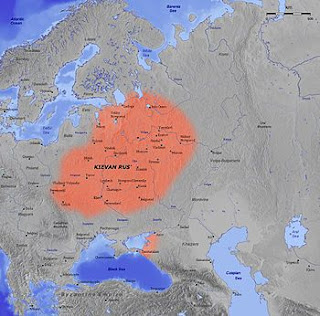
Kyivan Rus (882-1240)
Vikings who called themselves the Rus settled along the Dnipro River at the end of the 9th century. Their rule was centered at a trading post called Kyiv. The Rus had a pagan religion. But in 988, the ruler of Kyiv--Volodymyr or Vladimir--decided that conversion to a monotheistic religion would solidify control of territory. After considering Judaism and Islam, he decided to convert to Orthodox Christianity, and to make all of Kyivan Rus an Orthodox Christian civilization. Around 1240, Kyivan Rus was broken up by the invasion of the Mongols.
Notice that in the map above, Moscow was not part of Kyivan Rus. In fact, Moscow did not even exist at the time. After the Mongol invasion, in a new city called Moscow, princes gained power by collecting tribute for the Mongols. Then, as the western Mongol empire broke up, a new ruling order called Muscovy asserted its independence and expanded its power.
In 1721, Muscovy was renamed the "Russian Empire," so that there was a mythical connection to ancient Rus, which had not existed for 500 years. Between 1772 and 1795, Catherine the Great expanded the empire westward and proclaimed that she had restored the original Rus.
Putin is renewing Catherine's myth of a restored Rus. This allows him to say that "Russians and Ukrainians are one people--a single whole." He can also identify this as a "spiritual unity" because Ukrainians and Russians share their Orthodox Christian faith going back to Vladimir the Great's conversion. With this, he can justify the Russian invasion of Ukraine as serving the "true cultural, economic, and social interests of the people" of Ukraine as part of "historical Russia." He thus provides a moral and religious justification for Russian rule over Ukraine.
And yet there are three deep flaws in Putin's rhetoric. First, he ignores the fact that Kyivan Rus and Ukraine existed for seven hundred years beyond Russia. Second, he also ignores the fact that the Ukrainian Orthodox Church has existed for most of its history independently of the Russian Orthodox Church. Finally, and most importantly, he refuses to recognize the will and agency of the Ukrainian people in deciding for themselves whether they want to exist as a free people separated from Russia, and whether they want to fight a war for that independence. These three mistakes by Putin explain why his war plan has failed, and why Ukraine has a chance to win.
In Putin's speeches justifying the invasion of Ukraine, he manifests a rhetorical theme running throughout many of his speeches over his twenty-two years of rule: the choice between the ethnic nationalist autocracy of Russia and the multiethnic liberal democracy of the West. It's the illiberal "Russian World" (russkiy mir) versus the liberal "Western World." This is the Counter-Enlightenment alternative to liberalism presented by Russian conservative political thought, which defends a Russian World based on a shared Russian history, Russian language, and Russian religion. Oddly, however, Putin has often been forced to contradict this myth of Russian World in recognizing the multiethnic and multicultural reality of Russia.
This contradiction in Putin's rhetoric has been well studied by Fiona Hill and Clifford Gaddy in their book Mr. Putin: Operative in the Kremlin (2015). See pages 38-62, 96-105, and 362-374.
In a previous post, I have written about the incoherence in the rhetoric of ethnic nationalism as an evolutionary adaptation.
After the fall of the Berlin Wall in 1989, which Putin experienced as a KGB operative posted to Dresden in East Germany, and then the collapse of the Soviet Union in 1991, some Russian thinkers began to wonder how a new Russian state could be founded on "the Russian Idea" (Russkaya ideya). This suggests an ethnic Russian identity, because russkiy is an adjective associated with ethnic Russianness. This became the language of the ethnic Russian nationalists. But other thinkers spoke of "the Russian Idea" as Rossiyskaya ideya, which suggests an ethnically neutral Russian identity, because rossiyskiy is derived from Rossiya, a word for "Russia" as an abstract state to which all Russian citizens could belong regardless of their ethnic identity. Putin's rhetoric has shifted back and forth between these two conceptions of Russian national identity.
In the fall of 1999, Putin was appointed first prime minister and then acting president of Russia. Early in 2000, he was elected president. On December 29, 1999, as part of his political campaign, Putin published a 5,000-word treatise on "Russia on the Threshold of the New Millenium."
His main argument in this "Millenium Message" was that since the Russian state had always been weakened whenever its people were divided, the power of the new Russian state would depend upon the unification of the Russian people in affirming the "Russian Idea" (Rossiyskaya ideya) that makes Russia distinctive. This would require that the majority of Russian citizens (rossiyane)--not just ethnic Russians--would voluntarily embrace the general ideas supporting the state. This Russian Idea would be broad enough to encompass all of Russian society in its multiethnic and multireligious diversity.
This kind of rhetoric was necessary to support Putin's response to the renewed war in Chechnya in 1999 and 2000. Most of the people in Chechnya are ethnic Chechens who are predominantly Muslim believers, which sets them apart from the ethnic Russian minority of people are predominantly Russian Orthodox Christians. Islamist Chechen separatists had exploited these divisions in fighting for independence from the Russian Federation. Russian federal soldiers entered Chechnya to fight alongside some pro-Russian Chechen paramilitary against the Chechen separatists.
Putin needed to pull some ethnic Chechens to the Russian side. For example, Ramzan Kadyrov was a Chechen paramilitary leader who fought against the Russians in the First Chechen War (1994-1996); but in the Second Chechen War (1999-2009), he switched sides and led his men to fight for the Russians against the Chechen separatists. He is now Head of the Chechen Republic and a staunch supporter of Putin who has fought for the Russians in Ukraine. To pull people like this--people who are not ethnic Russians and not Orthodox Christians--to the side of the Russian Federation, Putin had to speak of Russia as a multiethnic and multireligious state.
But then, in 2014, Putin was trying to keep Ukraine from breaking away from Russia, as he is now in 2022, and for that purpose, Putin has employed the rhetoric of restoring and reuniting the russkiy mir--the world of ethnic Russians and the Orthodox community of Holy Russia. But when he does this, he risks alienating people like Kadyrov. Why should ethnic Chechen Muslims fight in Ukraine to restore a Russian World of ethnic Russians and Orthodox believers? So, in a speech in 2014 commemorating the end of World War II, Putin said: "The unity of our multinational, multiconfessional nation is the greatest legacy or our victory" over Nazi Germany. Putin's rhetoric of the Russian Idea is caught in an inescapable contradiction.
To overcome that contradiction, Putin has adopted the expansive concept of "Eurasianism"--the idea that Russia is destined to create a glorious Russian Empire that stretches across the entire Eurasian continent. Russia has always had an empire, and the Russian people have always been an "imperial people." Putin got this idea from White Russian emigres like Ivan Ilyin (1883-1954) and Nikolai Trubetskoi (1890-1938) and recent Russian thinkers like Lev Gumilev (1912-1992) and Alexander Dugin. I have written about Dugin in a previous post. Jane Burbank has written an essay about this as "The Grand Theory Driving Putin to War."
The Eurasianists see the emergence of a bipolar geopolitical battle in which the opponent of a Russian Eurasia will be the "Atlantic" world led by the United States. The "Atlantic" is Dugin's term for the modern liberal democracies around the North Atlantic--the United States, Great Britain, and Western Europe.
This is a moral and metaphysical battle. On the one side, the Atlantic world stands for the decadent values of liberal modernity--atomistic individualism, rootless cosmopolitanism, bourgeois consumerism, and soulless secularism (Nietzsche's "Last Man"). On the other side, Russian Eurasianism stands for the noble values of illiberal traditionalism--family life, patriotic nationalism, manly militarism, and transcendent spirituality (Nietzsche's New Nobility). This explains why many traditionalist conservatives in the West support Putin as a defender of the "traditional values" of Christianity against the moral decadence of Western liberalism.
Putin's conception of the Eurasian Empire embraces both the Russakaya ideya of the ethnic and Orthodox Russian people and the Rossiyskaya ideya of the multiethnic and multireligious Russian people, so that the apparent contradiction between these two ideas is resolved by combining the two in the larger idea of Eurasia. Throughout his twenty-two years of power, Putin has been obsessed with the need for a unifying vision of Imperial Russia that overcomes the disintegrating effects of ethnic and religious divisions.
In a January 2012 article, Putin wrote about "Russia: The National Question" and said:
"I am convinced that the attempts to preach the idea of a 'national' or monoethnic Russian state contradict our thousand-year history [that is, the history from 'ancient Rus' to the present]. Moreover, this is a shortcut to destroying the Russian people and Russian statehood, and for that matter any viable, sovereign statehood on the planet. . . . As for the notorious concept of self-determination, a slogan used by all kinds of politicians who have fought for power and geopolitical dividends, from Vladimir Lenin to Woodrow Wilson, the Russian people made their choice long ago. The self-determination of the Russian people is to be a multiethnic civilization with Russian culture as its core. The Russian people have confirmed their choice time and time again during their thousand-year history--with their blood, not through plebiscites or referendums."
A few months after this article appeared, a member of the Russian Duma suggested to Putin that the preamble to the Russian constitution be changed from beginning with "We the multinational people [narod] of Russia," to "We the [ethnic] Russian [russkiy] people and the people who have joined with it." Putin vehemently rejected this by saying:
"Do you understand what we would do [if we did that]? Part of our society would consist of first-class people and part would be second class. We must not do that if you and I want to have a strong single nation, a single people [narod], if we want each person who lives on the territory of the country to feel that this is their homeland, and that there is no other homeland, nor can there be one. And if we want each person to feel like that, then we have to be equal. This is the principal question. The fact that the [ethnic] Russian [russkiy] people are--without a doubt--the backbone, the fundament, the cement of the multiethnic Russian [rossiyskiy] people cannot be questioned. . . . But to divide everyone up into first, second, third categories, you know, this is a very dangerous path. You and I, all of us, must not do this."
An independent Ukrainian people is the great obstacle to achieving this Eurasian Russian people. In 1927, Trubetzkoy wrote an article on "The Ukrainian Problem," arguing that Ukrainian culture was an "individualization of all-Russian culture," and that the Ukrainian people should be assimilated into the Russian people based on their shared Orthodox faith. That's exactly Putin's argument for justifying the invasion. Similarly, in 1997, Dugin said that Ukrainian sovereignty created a "huge danger to all of Eurasia." To unite a Eurasian Russia, Ukraine had to become "a purely administrative sector of the Russian centralized state." As President Zelensky said in his recent speech to the Israeli Knesset, Putin sees his invasion of Ukraine as the "final solution" to the "Ukrainian problem."
This vision of a Russian Eurasian Empire explains Putin's miscalculation in invading Ukraine. Putin has said that for a thousand years, the Russian people have confirmed their choice to be one Eurasian people "with their blood"--that is, fighting in wars of conquest and resistance to invaders. And so he thought that this same bloody spirit of Russian imperial glory would support a quick and decisive victory in the Russian invasion of Ukraine. But he did not foresee that the Ukrainian people would confirm their choice for freedom from Russian domination "with their blood."
THE UKRAINIANS "APPEAL TO HEAVEN"--THE NEW BATTLE OF THE DNEIPER RIVER
When the Russians invaded Ukraine, the Ukrainians could have submitted by not showing any resistance, by surrendering. The Ukrainian people would thus have consented, if not expressly at least tacitly, to Russian rule over them. But most of them chose either to flee the country or to stay and fight, even though the Russians seemed to have superior military power. The Ukrainians chose what John Locke called "the appeal to Heaven."
Locke's "appeal to Heaven" is his answer to what he takes to be the ultimate question in political disputes--"Who shall be judge?" This is the question when there is an irresolvable debate over whether political power has been right used or not. Locke's answer comes from the Biblical story of Jeptha (in Judges, chapter 11). In the conflict between the people of Israel and the Ammonites, Jeptha is selected by the people to be their chief and war leader. He negotiates with the Ammonites. But then this negotiation fails to reach an agreement, Jeptha declares, "Let Yahweh the Judge give judgment today." That divine judgment will come through war. He's appealing to the God of Battles. That's what Locke means by the "appeal to Heaven" when there is no "appeal on Earth." (See First Treatise, para. 163; and Second Treatise, para. 21, 109, 155, 168, 176, 232, 240-43.) As far as I can tell, this phrase "appeal to Heaven" is Locke's. It doesn't appear in the Bible.
The influence of this Lockean idea in the American Revolution was vividly displayed in the design of what apparently was the first flag of the American navy in 1775--perhaps commissioned by General Washington--which had an evergreen tree of liberty against a white background and the motto "Appeal to Heaven."
Locke's "appeal to Heaven" shows a natural human inclination to violent resistance to attack or exploitation that is fundamental for classical liberalism. As a manifestation of Darwinian natural right, this can be explained as rooted in an evolved animal disposition to aggressive retaliation against attacks, which arises in human beings as a natural propensity to vengeance against injustice. Human beings can use their unique capacities for language and conceptual reasoning to express this natural propensity through abstract principles of justice, but these abstract principles are ultimately rooted in this evolved animal tendency to self-protection.
Human social and political evolution has brought a general decline in violence (as Steven Pinker has shown). But that decline in violence can never bring perpetual peace (contrary to the hopes of utopian pacificists), because the enforcement of the liberal norm of voluntary peaceful cooperation will always depend on the threat or use of force against those who would violate that norm. That's what we are seeing in Ukraine and around the world in the punishing resistance to Putin's aggression.
This suggests that if it is rightly understood, it's really true that might makes right. The threat or use of violent vengeance is the ultimate natural restraint on injustice. This is what Locke means by "the executive power of the law of nature"--the natural propensity of human beings to punish those who attack or threaten them. Natural rights emerge in human history as those conditions for human life and well-being that cannot be denied without eventually provoking a natural human tendency to violent resistance against attacks and exploitation.
For this reason, the history of Lockean liberalism has often turned on the history of warfare, both revolutionary and international warfare. So, for example, the Declaration of Independence was not just a declaration of Lockean principles of natural right but also a declaration of war, so that the practical success of those principles depended on the fortunes of war. Similarly, the American debate over the justice of slavery was finally settled by the bloodiest war in American history. And the establishment of the liberal international order after World War Two depended on the defeat of Nazi Germany in the war.
We have seen that in the Ukrainian resistance to conquest--not only today in their resistance to the Russian occupation of their country, but also in 1943 in their resistance to Nazi occupation. In 1943, the Battle of the Dneiper River was one of the biggest and decisive military campaigns of World War II, involving almost four million troops. The Dneiper (or Dnipro) River is one of the longest rivers in Europe, and it flows through Kyiv and the middle of Ukraine, dividing the east bank region from the west bank. By the middle of 1943, the Germans were in full retreat on the Eastern Front, falling back from the attack of the Red Army. The German troops had retreated from Russia to the Dneiper. Beginning on August 26, the Red Army launched a campaign to take the eastern bank and then cross to the western bank, knowing that if they did that, it would be a turning point in the war against Germany. As the Red Army moved through the villages, cities, and countryside where the Germans had brutally killed and tortured innocent people, the Red Army soldiers became ever more aroused to vengeful retaliation to punish the Germans. The Red Army crossed the Dnieper in early October and then liberated Kyiv on November 6.
On November 7, the day after the Germans had been expelled from Kyiv, Leo Strauss delivered a public lecture in New York City as part of a public session on "The Re-education of Axis Countries Concerning the Jews" at the annual meeting of the Conference on Jewish Relations. Strauss said that any talk about the need for "re-educating" the Germans was mistaken if this implied that the Nazis had "educated" them in the pretended theoretical doctrines of Nazism--about the rule of "the master race"--which would suggest that these doctrines should be taken seriously. In fact, Strauss observed, these Nazi doctrines were nothing more than "pedantic follies."
Strauss said that the only Nazi doctrine that was persuasive with the Germans was the claim that Nazi arms would win a short and decisive war that would give Germany global dominance that would solve all German problems and satisfy the needs of the German people. And this would be possible because the Nazi leaders--under "the most efficient man in the land"--would be Machiavellian in being unconstrained by any moral considerations and consequently free to use all of the brutal means necessary for fighting a successful war. According to Strauss, the Nazis assumed that the "moralistic countries" would be defeated by an utterly immoral country. The Nazis would thus prove the Nazi doctrine "that large scale and efficiently prepared and perpetuated crime pays."
Strauss claimed that that Nazi doctrine is "subject to the test of sense-experience," because we can see with our own eyes whether immoral warfare is victorious or not on the battlefield. And so the defeat of the Nazis in World War Two is "the refutation of the Nazi doctrine." Therefore, Strauss observed, "the re-education of Germany will not take place in classrooms: it is taking place right now in the open air on the banks of the Dnieper."
Strauss also explained that this re-education of Germany would be consummated by a meeting of Allied tanks in Berlin, and then the Western and Eastern occupying forces would bring the German leaders to trial for war crimes. He was anticipating what became the Nuremburg war crimes trials that began in November of 1945, acting under international law and the laws of war. Adolf Hitler and Joseph Goebbels escaped this punishment by committing suicide in the spring of 1945 before they were captured. This outcome of the war would prove the Nazi doctrine wrong by proving that "large scale and efficiently prepared and perpetrated crime" does not pay. But this lesson in the legal rule of just punishment had to be preceded by the lesson taught by the meeting of Allied tanks in Berlin.
Notice that to refute the Nazi doctrine of the immoral rule of the stronger over the weaker, Strauss suggests, we cannot appeal to some transcendent standard of right set by God, Nature, or Reason. Rather, we must appeal to "the test of sense-experience" by seeing that "moralistic countries" can defeat immoral countries in war as an exercise of Locke's "executive power of the law of nature" to punish those who violate that law by an "appeal to Heaven."
In this way, might does make right.
We can see this in Ukraine today--in another Battle of the Dnieper. As Francis Fukuyama has recently said: "A Russian defeat will make possible a 'new birth of freedom,' and get us out of our funk about the declining state of global democracy. The spirit of 1989 will live on, thanks to a bunch of brave Ukrainians."
I have elaborated some of these points in previous posts here, here, and here.
Philip Jaffa has written a comment on my March 9th post ("Appeasing Putin"). Since his comment is an instructive statement on how far the Claremont Institute has departed from his father's thinking, I thought I should republish it here as a post:
Larry … Philip Jaffa checking in here. I would like to say that you are absolutely correct on this issue. My father would have rejected Angelo Codevilla’s latest work in its entirety. Angelo abandoned my father’s views pretty much across the board—quite some time ago.
Angelo was a personal friend. We hung out together, starting when he was in graduate school and continuing through the time his oldest kids were in High School. His views were always quirky—never quite matching up with my father’s. But everything changed after his heart transplant. He went through something of a personality transformation. He had always had a tendency towards conspiracy theories. After the transplant, every time I talked to him, he had gone down another wacky rabbit hole. Of course, this just made him increasingly popular in conservative circles. Conservatism today appears to be nothing but rabbit holes.
I like to say that when Angelo and I began hanging out together I was Methodist and he was Catholic. I converted to Catholicism and he converted to libertarianism.
My father lost influence at the Claremont Institute, starting around 2005. He had zero influence … and I mean that literally … after 2010. My father’s exact words, which he repeated over and over again, were: “They did not wait to bury the teaching with the teacher. What they are trying to do is put a top hat on Jefferson Davis and call him Abraham Lincoln … and put the dust cover of the Nichomachean Ethics on Atlas Shrugged and call it Aristotle.”
My father loathed libertarianism and isolationism—both before and after Angelo adopted those views.
At any rate, to turn back to the matter at hand, my father was a stern critic of the America First movement, including its latter day nativist descendants. The Claremont Institute has become one of the leading voices for immigration restriction. My mother and father were the most pro-immigration people you ever met in your life. They dug into their own pockets on several occasions to hire legal representation for illegal immigrants. No one ever dared to say a bad word about immigrants in our household. I remember my first visit to New York City, when I was 16. We visited the Statue of Liberty. When my father read aloud the plaque with Emma Lazarus words … “Give me your tired, your poor, your hungry, yearning to be free” … he broke down and cried. It was the first time I had ever seen my father cry. I didn’t know how to respond. I remained silent, as did he, until we were on the boat back to shore. Then he turned and pointed to the Statue of Liberty. “That,” he said, “is Europe’s version of the Lincoln Memorial.” My father then launched into a lecture on Lincoln’s immigration bill of 1864, which set the stage for the huge flow of European immigration that was to transform this country. And he added that the Civil War needs to be seen not merely as a fight over slavery but also as a fight over immigration. The same racial theories that were applied to blacks also were applied to immigrants. My father liked to point out that one quarter of the union army was foreign born, and if you include soldiers who had at least one parent who was foreign born, the number was 40%. After the Civil War, the fight to restrict the rights of black was matched by a movement to restrict immigration, culminating in the Johnson-Reed Act of 1923. My father referred to the Johnson Reed Act as “An Act to Prevent the Contamination of the Gene Pool from Jews.” Tom Cotton’s immigration bill is just Johnson-Reed revisited.
Donald Trump (with a little help from the Claremont Institute) has reconstituted the Republican Party around four core principles: isolationism, nativism, protectionism, and nihilism. My father opposed all four.