Showing posts sorted by date for query Jefferson Notes on Virginia. Sort by relevance Show all posts

Saturday, January 24, 2026

America as the Anglo-Protestant Nation Is Unconstitutional

Recently, I wrote a long essay criticizing Mark Brennan's article in Chronicles Magazine arguing that Gordon Wood was wrong to identify America as a "creedal nation," because this would contradict the history of "America's Anglo-Protestant culture" as the real identity of the American nation.  Paul Gottfried then defended Brennan's argument against my criticism, and I wrote a response to Gottfried's defense.

If you read my original essay and Gottfried's defense of Brennan, you will notice that Gottfried is totally silent about my historical evidence.  This is strange because both Brennan and Gottfried insist that all the historical evidence is in their favor.  Most remarkable is their silence about the constitutional evidence that those who wrote and ratified the Constitution and the first ten amendments did not see America as an Anglo-Protestant nation.  But since I wrote only two paragraphs on the constitutional evidence, I decided that I should say more about this.

My main idea is that what we see in the Constitution is the influence of Roger Williams' principles of toleration, religious liberty, and a "wall of separation" between church and state.  Baptist preachers like Isaac Balbus and John Leland preserved the legacy of Williams by arguing for religious liberty in Virginia, and they were influential with Virginia political leaders like James Madison and Thomas Jefferson.


THE FIRST FOUNDING FATHER

Who was the First Founding Father of America?  

Some scholars say it was John Winthrop, who led the Puritan founding of the Massachusetts Bay Colony in 1630--the "shining city on a hill" and all that (Bremer 2003).

Others say it was Roger Williams, who founded the city of Providence (later incorporated into Rhode Island) in 1637 (Johnson 2015).

There is some truth in both claims.  But we should see that the Puritan theocracy of the Massachusetts Bay Colony was the first founding of illiberal America, while the establishment of religious liberty and separation of church and state in Providence was the first founding of liberal America.

We should also see that the liberal America of Williams eventually prevailed over the illiberal America of Winthrop.  Because while the legacy of Puritan theocracy has dwindled to almost nothing today, the principles of religious liberty and separation of church and state established by Williams have been foundational for American political culture.  

When these principles are combined with freedom of speech and of the press in the First Amendment, this establishes liberal America as an open society with freedom of thought and speech that allows for the free pursuit of both philosophic or scientific understanding and religious experience, with an open debate over Reason versus Revelation. 

In his book Illiberal America, Steven Hahn rightly begins his history of illiberal America with Winthrop and the theocracy of the Massachusetts Bay Colony (49-63).  But then he passes over Williams in four sentences (54, 60, 63, 70), and he does not allow his reader to see how in the debate between Winthrop's illiberal America and Williams' liberal America, Williams' arguments eventually (over 200 years) prevailed.  As one can see, for example, in the history of state-established religion in Massachusetts (Witte and Latterell 2019).

This sets the pattern for Hahn's rhetorical strategy throughout his book.  He moves through nine periods of American history from the early 17th century to the present.  For each period, he shows the emergence of some illiberal tradition of American history.  But then he obscures the fact that each of these illiberal traditions has either been utterly defeated or seriously weakened by the success of liberalism.  Hahn's deceptive rhetorical strategy then allows him to mistakenly claim that today Donald Trump and his MAGA movement manifest the triumphant convergence of all of America's illiberal traditions.

The influence of William's principles in shaping Liberal America can be seen in the text of the Constitution.


THE PREAMBLE

If the framers of the Constitution had wanted to identify America as a Christian nation, they would have done so in the Preamble.  But they did not.  

By contrast, it was common in the state constitutions to do that.  For example, the Preamble to the Massachusetts Constitution of 1780 affirmed "the people of Massachusetts, acknowledging, with grateful hearts, the goodness of the Great Legislator of the Universe," and "devoutly imploring His direction in so interesting a design."  And Article 2 declared that "it is the right as well as the duty of all men in society, publicly, and at stated seasons, to worship the SUPREME BEING, the great creator and preserver of the universe."  But there is no language like this anywhere in the U.S. Constitution.

The Constitution's silence about God provoked a debate that continues up to today.  Some of the people who want to identify America as a "Christian nation" have said that the Constitution needs a "God Amendment."  The most prominent example of this movement to put God into the Constitution was the National Reform Association that emerged during and after the American Civil War.  This was a movement of evangelical Protestant ministers, theologians, academics, lawyers, and judges, who claimed that the Civil War was God's punishment of America for having a godless Constitution, and that this showed the need for amending the Constitution.  

They proposed an amended version of the Preamble to the Constitution--with the new language in italics:

"We the People of the United States, humbly acknowledging Almighty God as the source of all authority and power in civil government, the Lord Jesus Christ as the Ruler among the nations, his revealed will as the supreme law of the land, in order to constitute a Christian government, and in Order to form a more perfect Union, establish Justice, insure domestic Tranquility, provide for the common defense, promote the general Welfare, and secure the Blessings of Liberty to ourselves and our Posterity, do ordain and establish this Constitution for the United States of America" (National Reform Association 1874, p. 7).

Beginning in 1864, the NRA formally petitioned President Lincoln and the Congress of the United States to support this amendment to the Constitution.  The leaders of the NRA argued that they were not proposing an established church or a merging of church and state.  Rather, they were proposing a constitutional recognition of the fact that America was a Christian nation, and this could be done without denying religious liberty and the separation of church and state.  But they failed to persuade President Lincoln or the Congress to take their proposed amendment seriously.


OATH OR AFFIRMATION AND NO RELIGIOUS TEST

Article VI of the Constitution prescribes that all of the legislative, executive, and judicial officers of the United States and the several States "shall be bound by Oath or Affirmation, to support this Constitution; but no religious Test shall ever be required as a Qualification to any Office or public Trust under the United States."

An oath is a solemn calling upon God as a witness.  But an affirmation does not invoke God.  Allowing people to consent to government by affirmation rather than a sacred oath followed the precedent set by Williams.  

On August 20, 1637, Williams and 12 other people who had followed him to Providence signed the "Providence Agreement":

"We whose names are hereunder, desirous to inhabit in the town of Providence, do promise to subject ourselves in active and passive obedience to all such orders or agreements as shall be made for the public good of the body in an orderly way, by the major consent of present inhabitants, masters of families, incorporated together in a Towne fellowship, and others whom they shall admit unto them only in civil things" (Lutz 1998: 162).

This is the beginning of Liberal America.  Previously, Puritan settlers in America had signed "covenants" in which they took an oath "in the presence of God and one another" to combine themselves into a civil polity "for the glory of God, and advancement of the Christian Faith" (Mayflower Compact).  But notice that in this Providence Agreement, they make a "promise" rather than an oath, God is not mentioned, and they submit themselves to the political body "only in civil things"--not in spiritual things.  This was the first founding in America of government by the consent of the governed with a separation of church and state.

The "no religious test" clause was also in the tradition of Williams' liberalism.  All of the state constitutions except for Virginia and New York had religious tests for their public officers.  For example, the members of the Pennsylvania state legislature had to swear an oath: "I do believe in one God, the creator and governor of the universe, the rewarder of the good and punisher of the wicked, and I do acknowledge the scriptures of the Old and New Testament to be given by divine inspiration."

Before the adoption of the Constitution, most of the states had a religious test requiring that the officers of government be Protestant Christians, and thus excluding Jews, Catholics, Muslims, and atheists.  In some cases, even dissenting Protestants were excluded.  With the passage of Thomas Jefferson's Statute on Religious Freedom in Virginia in 1786, Virginia became the first state to protect religious liberty.  Then, in the decades after the adoption of the Constitution, all of the states dropped religious tests for office.

In the Ratification Debates, some of the Antifederalists objected to the "no religious test" clause.  For example, at the North Carolina convention, David Caldwell objected to this as "an invitation for Jews, and Pagans of every kind, to come among us," and he worried that "this might endanger the character of the United States" (Bailyn 1993, 2:908).  One speaker at the Massachusetts ratifying convention warned that no religious tests "would admit deists, atheists, etc., into the general government; and, people being apt to imitate the examples of the court, these principles would be disseminated, and, of course, a corruption of morals ensue."

This shows the primary reason why people wanted religious tests and the legal establishment of religion--without religion, there would be a "corruption of morals."  That's why any proponent of religious liberty had to argue, as Williams did, that the "civil peace" of a community could be sustained by a natural moral sense without any particular religious belief.  One can be good without God.


NO ESTABLISHMENT OF RELIGION

The First Amendment to the Constitution declares: "Congress shall make no law respecting an establishment of religion."  By directing this prohibition only against the Congress, it seemed that state governments were free to have religious establishments.  It was not until 1940 that the Supreme Court ruled that under the 14th Amendment, the "no establishment" rule applied to state governments.  But the "no establishment" principle contributed to the movement to disestablish religion in the states.

Indicating their agreement with Williams, Madison and Jefferson attacked the establishment of a state-supported church in Virginia as a violation of the unalienable natural right to religious liberty.  Their arguments were set forth in Madison's "Memorial and Remonstrance against Religious Assessments" and Jefferson's "Virginia Statute of Religious Liberty."  Madison's "Memorial and Remonstrance" was a written petition opposing a bill introduced in the Virginia General Assembly in 1784 and 1785 that would have required the people of Virginia to pay an annual tax "for the support of the Christian religion or of some Christian church."  Jefferson first proposed his "Bill for Establishing Religious Freedom" in 1779, but it was not ratified until 1786 (Johnson 2015, 273-79).

All of their arguments can be found in the writings of Williams.  For example, Madison repeated Williams' claim that the New Testament shows that the early Christian churches were voluntary associations that did not depend on the support of human laws, because the spiritual kingdom of God was separated from the earthly kingdom of the world.  Ecclesiastical establishments supported by human laws began with the Roman Emperor Constantine, over three hundred years after the first Christian churches (Madison 1973, 12).  

Madison also agreed with Williams in arguing that not only did the Christian religion not depend on the support of human laws, but the civil government did not depend on an established religion, because as Williams indicated, the "civil peace" of a political community did not depend on the "spiritual peace" of a true church.  After all, native Americans and pagans have kept the peace of their communities without belonging to the true church of God (BT, 72-73).  Here Williams agreed with Pierre Bayle that a society of atheists could live together in a peaceful social order based on their natural moral sense without any religious beliefs.

When the Virginia General Assembly ratified Jefferson's "Statute of Religious Liberty" on January 16, 1786, that effectively ended the legal establishment of religion in Virginia.

Prior to the Revolution, most of the American colonies--with the exception of Rhode Island and Pennsylvania--had established churches supported by the government with compulsory taxation and various kinds of coercive persecution of religious dissenters.  That began to change after 1776, as the states moved away from illiberal theocracy towards liberal toleration.  By 1833, none of the states had an established religion.  There were still some state laws enforcing religious belief--such as laws criminalizing blasphemy--but these laws were almost never enforced.

It is clear, then, that the "no establishment" clause denies that there is any constitutional support for the Christian Nationalism of people like House Speaker Mike Johnson.

After  Mike Johnson was reelected Speaker of the House of Representatives speaking in his acceptance speech, he summarized the major points of Donald Trump's MAGA agenda for the Congress; and in doing that, he insisted that the election of Donald Trump and the new Republican Congress was an act of divine providence.  He explained: "I don't believe in luck or coincidence.  I believe in the idea of providence."  As evidence that the belief in God's providential care for America is part of America's exceptional position in the world, he read what he identified as Thomas Jefferson's "Prayer for America," and he said that Jefferson had said this prayer each day of his eight years as president, and every day thereafter until his death.  In the video above, this comes at around 14 minutes into the speech.  You can also read the text of the speech at Johnson's congressional website.

Johnson identified Jefferson as "the primary author of the Declaration of Independence," in the context of noting that the 250th anniversary of the Declaration of Independence would occur during the term of this 119th Congress in 2026.

Here's the prayer:

Almighty God who has given us this good land for our heritage. We humbly beseech thee that we may always prove ourselves, that people mindful of thy favor and glad to do thy will bless our land with honorable ministry, sound learning and pure manners. Save us from violence, discord and confusion, from pride and arrogance, and from every evil way. Defend our liberties and fashion into one united people, the multitude brought hither out of many kindreds and tongues endow with thy spirit of wisdom, those whom in thy name, we entrust the authority of government. That there may be justice and peace at home, and that through obedience to thy law, we may show forth thy praise among the nations of the Earth. In times of prosperity, fill our hearts with thankfulness and in the day of trouble, suffer not our trust in thee to fail, of which we ask through Jesus Christ our Lord. Amen. 

Johnson then immediately claimed that the election of the Republican Congress was an "act of providence," and that it was "providence that spared President Trump from the assassin's bullet."  In this way, he suggested that God miraculously intervened to save Trump's life so that he could be elected president.  I have written previously about this belief that Trump is God's Chosen One--like God's choice of Cyrus as the Messiah for Israel.

But contrary to what Johnson assumes, there is no evidence that this prayer was written by Jefferson.  And Johnson has never even attempted to present such evidence.

Moreover, that Jefferson would not have written such a prayer is clear from his refusal as president to proclaim any national day of prayer for the country.  In 1808, Samuel Miller (a minister) sent a letter to Jefferson asking him if he would be receptive to a request from some ministers that he issue a presidential proclamation of a day of "fasting, humiliation, and prayer" before God.  Jefferson replied by saying that he would have to refuse such a request because it would violate the First Amendment's provision that "no law shall be made respecting the establishment, or free exercise, of religion."  He did indicate, however, that since the First Amendment applies only to the national government, a state government might have the right to issue some such proclamation of a national day of prayer.

Apparently, Jefferson believed that a presidential prayer for America like that attributed to him by Johnson would have violated what Jefferson had called the "wall of separation between church and state" in his letter to the Danbury Baptist Association in 1802.  He was responding to a letter from the Danbury Baptists congratulating him on his election in 1800 and endorsing his affirmation of "religious liberty--that religion is at all times and places a matter between God and individuals," and therefore that civil government has no rightful power prescribe religious belief.  This puts Jefferson on the side of Williams in asserting the "wall of separation" of church and state against the theocracy of Winthrop. 


FREE EXERCISE OF RELIGION AND FREEDOM OF SPEECH

The First Amendment declares: "Congress shall make no law . . . prohibiting the free exercise [of religion]; or abridging the freedom of speech, or of the press."  This language of "free exercise of religion" was first used in the Virginia Constitutional Convention of 1776.  The Convention adopted the Virginia Declaration of Rights, which was written by George Mason.  The last section of that document affirmed religious liberty:

"That religion, or the duty which we owe to our Creator, and the manner of discharging it, can be directed only by reason and conviction, not by force or violence; and therefore all men are equally entitled to the free exercise of religion, according to the dictates of conscience; and that it is the mutual duty of all to practice Christian forbearance, love, and charity towards each other" (Art. 16).

Although this echoes some of the language of Williams about religious liberty, it still suggests some blending of religion and the state that Williams would have rejected.  First, it uses religious language--"our Creator" and "Christian forbearance"--that suggests a governmental endorsement of Christian theism.  Second, it does not clearly condemn the legal establishment of religion; and in fact, it was not interpreted as challenging the existence of the established church in Virginia.

James Madison was a delegate at the Virginia Convention.  And he proposed alternative language for this section on religious liberty: "all men are equally entitled to the full and free exercise of religion according to the dictates of conscience; and therefore that no man or class of men ought, on account of religion to be invested with peculiar emoluments or privileges; nor subjected to any penalties or disabilities" (Johnson 2015, 267; Madison 1962, 1:170-75).  The Convention rejected this language, presumably because this would have abolished the legal privileges of the established church in Virginia. 

But then then Virginia Statue of Religious Liberty of 1786 affirmed religious liberty as part of the freedom of speech and thought by declaring that

. . . our civil rights have no dependence on our religious opinions, any more than our opinions in physics or geometry . . . that truth is great and will prevail if left to herself, that she is the proper and sufficient antagonist to error, and has nothing to fear from the conflict, unless by human interposition disarmed of her natural weapons, free argument and debate, errors ceasing to be dangerous when it is permitted freely to contradict them.

The First Amendment echoes this affirmation of the natural right to "free argument and debate" in combining free exercise of religion with freedom of speech and press as expressing the freedom of the mind in thinking and speaking about all intellectual and religious questions.


THE NINTH AMENDMENT

In the Virginia Statue of Religious Liberty, Jefferson identified religious liberty as a "natural right."  The term "natural right" does not appear in the Constitution, but the existence of natural rights is clearly implied in the Ninth Amendment: "The enumeration in the Constitution, of certain rights, shall not be construed to deny or disparage others retained by the people."   That this idea of rights "retained by the people" pointed to natural rights in the state of nature before the establishment of government was clear in Roger Sherman's draft of the Bill of Rights: "The people have certain natural rights which are retained by them when they enter into Society."

This suggests that religious liberty could be not only an enumerated right (in the First Amendment) but also a natural right.  And therefore, there was no need for the Supreme Court to argue that the 14th Amendment had applied the First Amendment religious liberty right to state governments, because they should have said that it applied to the states insofar as it was a natural right. 


THE CONSTITUTIONAL FRAMERS WERE NOT CHRISTIAN NATIONALISTS

During his first term as President, Donald Trump first attended the World Economic Forum in Davos, Switzerland.  While there, he was photographed proudly holding up his copy of a new book by Stephen Strang--God and Donald Trump.  Strang is a leading Pentecostal evangelical who argues that Trump has been chosen by God to save America from secularism and to restore America as the Christian Nation.

He argues that the American founders established America as a Christian nation specially chosen by God to be under his providential care.  Strang refers to "Benjamin Franklin's surprising declaration during the Constitutional Convention of 1787, when he said famously, 'God governs in the affairs of men'" (xiv).  And Strang says that the purpose of his book in telling the story of God's intervention in the election of 2016 is to confirm this idea "that God is involved in the affairs of men" (184).


Remarkably, however, Strang is silent about the circumstances of Franklin's declaration at the Constitutional Convention.  On June 28th, 1787, the delegates appeared to be deadlocked in their debates because of the opposing interests of large States and small States. Benjamin Franklin rose to propose that the Convention invite some local minister to attend and offer daily prayers to invoke the aid of God. "If a sparrow cannot fall to the ground without God's notice, is it probable that an empire can rise without his aid?" According to a popular legend, the Convention accepted Franklin's proposal, and from the moment that they had these prayers, the deadlock was broken by God's providential intervention. This story has been repeated by many American ministers as evidence that the American Constitution was divinely inspired. 

I first heard this story as a child when it was part of a sermon at the First Baptist Church of Wills Point, Texas.  But years later, as a college student in a class on the American Founding, I was shocked when I looked at James Madison's notes for the Convention as edited by Max Farrand in the Yale University Press edition (particularly 1:450-52, 3:470-73, 3:499, 3:531), and I saw that this story was false. Franklin did make his proposal for daily prayer at the Convention. But the response was silence.  Finally, Alexander Hamilton offered a quip about how they did not need "foreign aid." The motion was dropped.

This is not the action of good Christians. It is the action of men who respected religious belief, but who did not believe that God would answer their prayers and intervene to promote their political success. Since the meetings of the Convention were kept secret, they were not concerned about public appearances. If the meetings had been open to the public, they surely would have felt compelled to accept Franklin's motion.

Anyone who wants to turn the American Founders into good Christians must deny the most obvious facts about their words and deeds.  On the other hand, one could argue that at least some of the American Founders were pious Christians in the tradition of Roger Williams, who thought that New Testament Christianity requires a "wall of separation" between church and state to protect the spiritual purity of the church and the political purity of the state.  And therefore, it is blasphemy to pray for God's sanctification of a government.

The clear conclusion from all of this is that the idea that America is a Christian Nation is unconstitutional.


REFERENCES

Bremer, Francis J. 2003. John Winthrop: America's Forgotten Founding Father.  New York: Oxford University Press.

Farrand, Max, ed. 1987. The Records of the Federal Convention of 1787. 4 vols. New Haven, CN: Yale University Press.  Farrand's Records can be found online at the Library of Congress website.

Hahn, Steven.  2024.  Illiberal America: A History.  New York: Norton.

Johnson, Alan E. 2015. The First American Founder: Roger Williams and Freedom of Conscience. Pittsburgh, PA: Philosophia Publications.

Lutz, Donald S., ed. 1998.  Colonial Origins of the American Constitution: A Documentary History. Indianapolis: Liberty Fund.

National Reform Association. 1874. Proceedings of the Fifth National Reform Convention To Aid in Maintaining the Christian Features of the American Government, and Securing a Religious Amendment to the Constitution of the United States, Held in Pittsburg, February 4, 5, 1874, With a History of the Origin and Progress of the Movement.  Philadelphia: Christian Statesman Association.

Strang, Stephen. 2017. God and Donald Trump. Lake Mary, FL: FrontLine.

Williams, Roger. 1963. The Complete Writings of Roger Williams. Vol. 3: Bloody Tenent of Persecution.  Edited by Samuel L. Caldwell.  New York: Russell and Russell.

Witte, John, and Justin Latterell. 2019. "The Last American Establishment: Massachusetts, 1780-1833.  In Carl H. Esbeck and Jonathan Den Hartog, eds., Religious Dissent and Disestablishment: Church-State Relations in the New American States, 1776-1833, 399-424. Columbia, MO: University of Missouri Press.


Monday, February 17, 2025

The North American Indian Declaration of Independence: A Darwinian Lockean Liberal Perspective

FREE AND INDEPENDENT STATES

The Declaration of Independence seems to be hypocritical in its handling of the American Indians.  While it appeals to the "self-evident" principles of government by the consent of the governed to justify the right of the American colonies to become "Free and Independent States," it refuses to consider the possibility that the American Indians have the same right to be free and independent from European or American imperial rule.  

In the Declaration, one of the grievances against the King is that he "has excited insurrections amongst us, and has endeavoured to bring on the inhabitants of our frontiers, the merciless Indian Savages, whose known rule of warfare, is an undistinguished destruction of all ages, sexes and conditions."  

The Declaration is silent about the claim of the American Indians that their warfare on the British colonists was in defense of their self-governing sovereignty over their ancestral territory that was being invaded by colonial settlers who were stealing land that belonged to the Indians.

In 1763, the Treaty of Paris ended the French and Indian War (a theater of the Seven Years War) with a victory for the British over the French.  American Indians had fought on both sides of the conflict.  In the Royal Proclamation of 1763, the King divided the lands in North America taken from the French.  This created an "Indian Reserve" west of the Appalachian Mountains, prohibiting the British colonists from settling there.  But many colonial settlers and land speculators refused to accept this, which was one of the grievances against the King that led to the American Revolution.


                   Map of North America Established by the Treaty of Paris and the Proclamation of 1763


In 1783, another Treaty of Paris ended the American Revolution with a victory for the Americans.  Although American Indians had fought on both sides of the Revolution, they were not represented in the diplomatic negotiations over the Treaty, and they were shocked when they learned that the Treaty carved up the North American continent with no territory for the Indian Nations.  What had been set aside in 1763 as Indian Territory west of the Appalachians was given to the new American Empire.

But while the United States claimed all of the Trans-Appalachian West east of the Mississippi, most of that territory was actually controlled by Native American Nations.  Moreover, almost all of the continent west of the Mississippi was controlled by Indians.  In 1783, North America was still, as Pekka Hamalainen has argued, predominantly an "indigenous continent," just as it had been for thousands of years.


                            Map of North America Established by the Treaty of Paris of 1783


In 1783, Joseph Brant (Thayendanegea), a Mohawk chief, became the founding leader of the Northwestern Indian Confederacy (1783-1795), which brought together Indian nations in the central Mississippi Valley and the Ohio Country to stop the United States from stealing Native land.  The member nations--Shawnees, Illinis, Miamis, Lenapes (Delaware), Potawatomis, Wyandots (Huron), Odawas, Ojibwes (Chippewa), Piankashaws, and Wabash--agreed that no nation could sell its land without the consent of the others.  They called themselves the "United Indian Nations."  This was the largest pan-Indian resistance movement in the history of North America.

They fought the U.S. in the Northwest Indian War (1785-1795)--the first of the American Indian Wars fought with the U.S. Army.  They won some remarkable victories--most notably in 1791, they drove U.S. soldiers under the command of General Arthur St. Clair, the federal governor of the Northwest Territory, into a retreat and killed over 97% of the soldiers, making it one of the worst defeats of the U.S. Army.  But in 1794, the Indians were badly defeated at the Battle of Fallen Timbers.  And in 1795, they were forced to sign the Treaty of Greenville that ended the war and also ended the Indian Confederacy.

In 1794, Brant met with Henry Knox, the U.S. Secretary of War.  Speaking for the American Indians, Brant told him: "We are of the same opinion with the people of the United States; you consider yourselves as independent people; we, as the original inhabitants of this country, and sovereigns of the soil, look upon ourselves as equally independent, and free as any other nation or nations.  This country was given to us by the Great Spirit" (Ablasky 2019: 591).

Here Brant was echoing the language of the Declaration of Independence: "That these United Colonies are, and of Right ought to be Free and Independent States."  And he was claiming that the Native Indian Nations had the same right to be recognized "as equally independent, and free as any other nation or nations."

Actually, Brant was invoking an international legal principle of equal Native nationhood that had been accepted as federal policy in the presidential administration of George Washington.  Secretary of War Henry Knox had told Washington shortly after his inauguration: "Independent nations and tribes of Indians ought to be considered as foreign nations."  Washington's Secretary of State Thomas Jefferson advised him "that the Indians had the full, undivided and independent sovereignty as long as they chose to keep it and that this might be forever" ("Notes on Cabinet Opinions," February 26, 1793).  

The phrase "Free and Independent States" was a reference to the law of nations, particularly as stated in Emer de Vattel's Law of Nations (1758).  Vattel repeatedly identified sovereign nations as "free and independent" (68, 71, 74, 77, 84-85, 214, 265).  This must be so because "nations being composed of men naturally free and independent, and who, before the establishment of civil societies, lived together in the state of nature,--nations or sovereign states are to be considered as so many free persons living together in the state of nature."

As I have argued previously, this follows John Locke's account of how people naturally free and independent in the state of nature can establish civil societies that become sovereign nations that are free and independent in the international arena, which is itself a state of nature because there is no world government over all nations.

According to Vattel, a nation is "free and independent" as long as it is self-governing:

"Every nation that governs itself, under what form soever, without dependence on any foreign power, is a sovereign state.  Its rights are naturally the same as those of any other state.  Such are the moral persons who live together in a natural society, subject to the law of nations.  To give a nation a right to make an immediate figure in this grand society, it is sufficient that it be really sovereign and independent, that is, that it govern itself by its own authority and laws" (83).

By this standard, as Brant and other Indian leaders indicated, the self-governing Native American polities of North America could claim the rights of sovereign statehood equal to the United States.  Locke also saw this because he recognized that the Indians in America were divided into self-governing "nations" or "peoples"--"little Independent Societies" (FT, 144, 153, ST, 41, 102, 105, 107-108).  Consequently, the European imperial powers had no authority over the Indians: "Those who have the Supream Power of making Laws in England, France or Holland, are to an Indian, but like the rest of the World, Men without Authority" (ST, 9).


THE AGRICULTURALIST ARGUMENT

And yet, both Vattel and Locke sometimes seemed to suggest that being a self-governing nation is not enough to make that nation a "free and independent state."  Those people in America who "live only by hunting, fishing, and wild fruits," Vattel observed, cannot rightly object when nations that live by cultivating the land appropriate some of the land of the Indians that they have left uncultivated, because the agricultural development of the land supports a much larger human population than would be possible if the hunter-gatherer Indians were allowed to claim all the land for themselves (128-131, 213-217).

Similarly, in his chapter on "Property" in the Second Treatise, Locke recognized that the hunter-gatherer Indians could claim property in the deer that they had hunted and killed or the acorns and apples that they had gathered, because they had mixed their labor with those natural resources and thus appropriated them to themselves (ST, 26-31).  But he also saw that once human beings engaged in agriculture, then they needed to claim property not just in the wild plants they had gathered or the wild animals they had hunted, but in the land that could be rendered productive through agriculture.  "As much Land as a Man Tills, Plants, Improves, Cultivates, and can use the Product of, so much is his Property" (ST, 32).  

In appropriating such land for farming, they were obeying the command of God in Genesis 1:28 after He had created human beings in His image: "Be fruitful, and multiply, and replenish the earth, and subdue it."  The English colonists in America used this as Biblical sanction for their taking land from the Indians (Seed 1995: 16-40).  Since the Indians lived by hunting and gathering and were not engaged in agriculture, they had no right to exclude the colonists from appropriating land for farming and thus rendering productive what the Indians had left as the "uncultivated wast of America" (ST, 37).

It has been common for "post-colonial" theorists to cite this as evidence that Locke justified colonial settlers in their oppression of indigenous people and that this shows inherent contradiction in early liberalism--claiming to defend liberty against tyranny but denying the liberty of indigenous people facing colonialist oppression (Tully 1993).

But there are at least four lines of Lockean argument that support American Indian claims for national freedom and independence (Goldie 2015).  The first argument is that many of the American Indians engaged in agriculture: they grew corn, beans, and squash (Hamalainen 2022: 12-13).  And Locke knew this because in his writing about the American colonies, he recognized the importance of "Indian corn" for the colonial settlers (Kammen 1966: 154).  So, if ownership of land depends on cultivation, these agrarian Indians had good claims on their land.

On the other hand, if the Lockean claim on land ownership depends on laboring upon the land, then one can make a good argument that Indian hunting, gathering, and grazing over a certain territory is a rightful claim of territory: occupying the land is a form of labor.  In 1725, John Bulkley insisted that by Locke's standard, the Indians had no claim on their lands because they had not engaged in agricultural cultivation (Bulkley 1725).  But in 1781, Samuel Wharton offered a different interpretation of Locke: "the very act of occupancy alone, being a degree of bodily labour, is from a principle of natural justice, without any consent or compact, sufficient of itself to gain a title."  He also appealed to the "self-evident" truths of the Declaration of Independence as justifying the equal rights of the Indian Nations (Wharton 1781: 15-16, 24-25).

A third Lockean argument for the claims of the American Indians is that Locke saw that most of the Indians were no longer in a state of nature, governed by natural property rights, but rather, as indicated above, they were living as Indian Nations with established governments, and "in Governments the Laws regulate the right of property, and the possession of land is determined by positive constitutions" (ST, 50).  The Europeans recognized the nationhood of the Indians by dealing with them through treaties, which are international agreements between sovereign nations.  The Royal Proclamation of 1763 recognized American Indian nationhood and its territorial claims: "It is just and reasonable . . . that the several nations or tribes of Indians . . . should not be molested or disturbed in the possession of such parts of our dominions and territories as, not having been ceded to or purchased by us, are reserved to them."

The fourth Lockean argument for the independence of the American Indian nations is the most fundamental:  the same Lockean reasoning for the American colonists revolting against British imperial rule--the reasoning in the Declaration of Independence--can be used by the American Indians to revolt against American imperial rule.


AMERICAN WARS OF INDEPENDENCE

The Declaration of Independence is what John Searle calls a Declaration of Status Function, which has the form "X counts as Y in C."  So, for example, a twenty-dollar bill has monetary value as long as we recognize that a twenty-dollar bill (X) counts as currency (Y) in the monetary system of the United States (C).  Similarly, the American Revolutionaries declared that "these United Colonies [X] are, and of Right ought to be Free and Independent States [Y]" in the European system of states [C].  The success of that Declaration depended on whether in their "decent respect to the opinions of mankind," they could persuade world opinion to recognize their status as "Free and Independent States."  

Their success depended on both the intellectual persuasiveness of their reasoning in the Declaration and the forceful persuasiveness of their winning the Revolutionary War.  Of those people both inside and outside the American colonies who were not persuaded by the intellectual argument of the Declaration, many were persuaded to accept it once the Americans had won the war.  Going to war to settle the dispute was what Locke called the "Appeal to Heaven"--the appeal to the "God of Battles."

In March of 1776, the Continental Congress asked for prayers "that it may please the Lord of Hosts, the God of Armies, to animate our officers and soldiers with invincible fortitude."  In the following October, King George III issued a Proclamation "putting Our Trust in Almighty God, that he will vouchsafe a Special Blessing on Our Arms, both by Sea and Land" (Shain 2014: 407-408).  This is the same as what Abraham Lincoln saw in the Civil War: "Both read the same Bible and pray to the same God, and each invokes His aid against the other" (Second Inaugural Address).  The "God of Armies" will decide.

The first major victory for the Americans was in the Battle of Saratoga in 1777.  When French King Louis XVI saw this, he agreed to a formal Franco-American alliance.  This proved to be a turning point in the war (Weddle 2021).  If the British had won that battle, that might have been enough to refute the Declaration of Independence.  As I have argued in previous posts, there is a sense in which might does make right.

The Continental Congress was a practical demonstration of the truth of the Lockean principles of the Declaration of Independence.  Acting in a state of nature, the Congress exercised the Lockean executive power of the law of nature in punishing Great Britain for violating that natural law, in establishing the Continental Army to settle the dispute by force of arms, and in instituting a new government to secure their natural rights.

Similarly, just as the American patriots had formed a confederacy of the "United States" to fight a war of independence from the British Empire, the American Indians formed the Northwest Confederacy of the "United Indian Nations" to fight a war of independence from the newly emerging American Empire in 1783.  That phase of the war came to an end with their defeat in the battle at Fallen Timbers in 1794, which forced them to sign the Treaty of Greenville in 1795, which opened two-thirds of the Ohio Country to American settlement.

Although Brant had insisted that American Indian Independence was granted to them by the Great Spirit, it seemed that the God of Armies had not favored the Northwest Indian Confederacy.


THE GREAT SPIRIT'S CHOSEN PEOPLES FIGHT HOLY WARS OF INDEPENDENCE

Brant's appeal to the Great Spirit as supporting American Indian resistance to European and American colonialism expressed a religious cosmology of Indian resistance that had arisen in the 18th century among some Indian prophetic mystics.  This continued in the 19th century as new Indian prophets had supernatural visions of the Creator or the Great Spirit promising His providential care for the American Indians in their holy war for independence from the white colonial imperialists.  This series of Indian prophets included Neolin (the Delaware Prophet), Tenskwatawa (the Shawnee Prophet), and Kenekuk (the Kickapoo Prophet) (Cave 1999; Mohammedi 2002).

One of the persistent themes in this prophetic teaching was that while God had created all human beings, He had created them to live in separate groups in different parts of the world.  Roger Williams heard this from the Narragansett Indians early in the 17th century: "although they do not deny that Englishman's God made English men and the Heavens and Earth where the English come from.  Yet, they also believe their Gods made them and the Heaven and the Earth where they live" (Williams 2019: 108).  Later prophets reported mystical visions of the Great Spirit who taught them that He had created Indians, Negroes, and whites separately, and favored the Indians and the Negroes.

Sometime around 1762, Neolin had a vision of ascending into Heaven and seeing the Master of Light, the Creator of the heavens and the earth.  (This resembles the mystical vision of Saint Paul who ascended into Heaven.)  The Master of Light condemned the Indians for being corrupted by the vices of the white people.  He declared that to regain His favor, the Indians would have to expel the Europeans from the Indian lands.  He told Neolin: "As to those who come to trouble your lands, --drive them out, make war upon them.  I do not love them at all; they know me not, and are my enemies. Send them back to the lands which I have created and let them stay there."  Later, Neolin reported this vision to his people and promised them that "the Great Spirit will give success to our arms.  He will give us strength to conquer our enemies" (Cave 1999: 273).

In 1763, the Odawa (Ottawa) war leader Pontiac brought together many of the Indian tribes in the lower Great Lakes region to form a confederacy to fight against the British and to expel them from their lands.  Pontiac was a shrewd military leader.  As many as eight small British forts were captured, and three major forts--Fort Pitt, Fort Detroit, and Fort Niagara--were put to siege but not captured.


Although the Indians did not defeat the British, they did fight to a military stalemate that was ended by a treaty in 1766.  Pontiac's War was the first pan-tribal confederacy of Indians fighting the first of a series of wars of independence.  The Northwest Indian War was the second of those wars.

The third of those Indian wars of independence was also sparked by an Indian prophet.  Beginning in 1805, the Shawnee Prophet Tenskwatawa fell into an ecstatic trance in which he saw the Master of Life in Heaven.  He began preaching sermons about a new religion that combined elements of Christianity with the traditional Shawnee religion.  He taught his people that they needed to return to traditional Shawnee ways, to reject the corrupt practices of the white people, and to fight against the American settlers who were stealing their land.  He attracted a large group of followers who gathered in western Ohio near Greenville.  He was criticized by some Indian leaders who thought it was foolish to challenge the white settlers with violent resistance, and that it was more prudent to compromise with them and seek some peaceful accommodation with them.  Tenskwatawa charged these rivals to his leadership with being witches who should be punished (Mohammedi 2002).


                                                   George Catlin's Portrait of Tenskwatawa

In 1806, General William Henry Harrison was governor of the Indiana Territory, and he was disturbed by the reports of Tenskwatawa's accusing some Indians in Indiana of practicing witchcraft and ordering that they be tortured and executed.  Harrison denounced this as barbarous.  He also told the Indians that they should test the power of this "notorious imposter."  On April 18, he wrote a letter to them that was published in newspapers advising them: "If he is really a prophet, ask him to cause the sun to stand still--the moon to alter its course--the rivers to cease to flow--or the dead to rise from their graves.  If he does these things, you may then believe that he has been sent from God."  

This was a big mistake because he had forgotten that astronomers had predicted a total eclipse of the sun that would pass over the lower Great Lakes area on June 16, 1806.  Tenskwatawa had heard about this from the scientists who were setting up observation stations across Indiana and Illinois.  So, after Harrison's letter had been published, Tenskwatawa said that the Great Spirit was angry at Harrison; and that as a sign of His anger, on June 16, He would hide the Sun at noon in His hand, and the day would turn dark.  This miracle confirmed that he was a true prophet.

In 1809, Harrison began to push the Indians into signing a treaty for selling some of their lands that could be opened to white settlers.  Some Indian leaders signed the Treaty of Fort Wayne that ceded some extensive lands north of Vincennes along the Wabash River.  

Tecumseh, a Shawnee political leader and brother of Tenskwatawa, denounced the treaty.  Like Brant, 25 years earlier, Tecumseh argued that the Indians should form an intertribal confederacy that would refuse to sell any lands unless all the tribes agreed and that would go to war to defend their lands.  He also invoked his brother's religious visions in claiming that the Great Spirit would give His divine sanction to their war.  Tecumseh traveled widely as he spoke to different tribes trying to persuade them to join the confederacy.  Many Indians moved to Prophetstown, north of what is now Lafayette, Indiana, where Tenskwatawa has established a city for his followers.

On November 7, 1811, Harrison led an army to Prophetstown that fought Tenskwatawa's warriors, defeated them, and burned the city.  This became known as the Battle of Tippecanoe, named after the Tippecanoe River.

Tecumseh continued to build his confederacy with the support of British allies.  In the War of 1812, he led his Indians in fighting in Canada on the side of the British.  Tecumseh was killed in the Battle of Thames in Canada in 1813.


All of these wars of Indian independence, as led by people like Pontiac, Brant, and Tecumseh, were inspired by the religious belief that the Great Spirit would give the Indians victory in war, and thus they were what Locke had called an Appeal to Heaven.  But the failure of the Indians to win these wars suggested to some Indians that either the Great Spirit was not on their side, or that the Indian prophets in their mystical visions had misunderstood the true message of the Great Spirit.  The Kickapoo Prophet Kenekuk then had his own vision of the Great Spirit, who advised that the Indians should take a stance of peaceful coexistence with American culture and nonviolent resistance to American imperialism, which would allow them to preserve their tribal cultural traditions.  

The life of American Indian tribes today shows the success of this strategy for the cultural evolution of American Indian life through adaptation to American liberal pluralism so that the Indian tribes have survived and even thrived.


KENEKUK AND THE VERMILLION KICKAPOOS

                                                        George Catlin's Portrait of Kenekuk

The Kickapoos are an Algonquin-language indigenous tribe originating in the lower Great Lakes region, particularly along the southern Wabash River near what is today Terre Haute, Indiana.  The Vermillion Kickapoos are a distinct band of Kickapoos who by the early 19th century were living along the Vermillion River in eastern Illinois.

Kenekuk was a Vermillion Kickapoo who as a young man was a hard-drinking ne'er-do-well who was thrown out of his band after he killed his uncle in a drunken rage.  After a time of wandering among frontier settlements, begging for food and shelter, he was finally taken in by a charitable Catholic priest who instructed him in Christianity and the ways of the white people.  Kenekuk then decided that he must atone for his past sins, swear off drinking, and preach the word of God to the Kickapoos.  He was welcomed back into his Kickapoo band.  And by 1816, he had emerged as a leading chief (Herring 1985; 1988).

Kenekuk became a charismatic preacher who claimed to have received from the Great Spirit a religion that combined elements of Catholic Christianity and traditional Kickapoo religious beliefs.  His followers believed in Heaven, Hell, and Purgatory.  They worshipped Jesus, the Virgin Mary, and the Saints.  But they also practiced traditional Indian singing and dancing in their ceremonies.

To maintain the stable order of the community, Kenekuk taught them that they must abstain from all alcohol because drunkards would be punished in Hell.  Their sobriety saved them from the ravages of alcoholism that had ruined so many Indian tribes.

He also taught them that they should be hard-working farmers.  Unlike other Indian tribes, the Kickapoo men gave up hunting, gathering, and the warrior's ethos, so that they could devote themselves to farming, along with the women.

Having seen that the violent anti-Americanism of Tecumseh and Tenskwatawa had been disastrous for the Indians, Kenekuk taught his followers to practice peaceful coexistence with the white frontier settlers.  They should love their neighbors as themselves and turn the other cheek in response to attacks.  But he also taught them to stand up for their rights to religious liberty, to their tribal lands held in common, and to the survival of their Kickapoo Indian culture.

Although Kenekuk's Kickapoos were resolute in defending their eastern Illinois homeland, in obedience to the Great Spirit's command that they should never sell tribal lands, in 1832 they were forced by pressure from President Jackson's Indian Removal Bill and the public reaction to the Black Hawk War of 1832 to sign the Treaty of Castor Hill that ceded all Indian claims to Illinois lands, which compelled them to move west of the Mississippi.

In 1833 they settled on the west bank of the Missouri River a few miles north of Fort Leavenworth.  They reestablished their customary way of life in the new land, with promises in the treaty that the federal government would provide money, food, and farming tools.  They soon became some of the most prosperous Indian farmers in America.

Many Protestant and Catholic missionaries came to their land in the attempt to convert them into orthodox Christians.  But their devotion to the Prophet and his distinctive syncretic religion could not be broken.

Kenekuk died in 1852 from smallpox.  But even after his death, the Kickapoo abstinence from drinking and other vices, their agricultural work ethic, and their religious unity created a social solidarity in preserving their tribal culture against white encroachments on their lands.

While most of the Indian tribes in Kansas were forced to move out to make way for white settlers, the small Kickapoo reservation remains today as one of only three Indian reservations in the state.


INDIGENOUS IMPERIALISM

So far, I have written about the American Indian fight for independence and resistance to conquest as if it were a binary struggle between Indians and settlers.  But that is not true.  Indigenous tribes fighting for their independence were fighting as much against other tribes as they were against colonial powers.  And tribes allied with other tribes to fight against yet other tribes.  Some tribes committed genocide against their neighboring tribes.  Tribes conquering other tribes often enslaved those they had subjugated.  Moreover, there is plenty of archaeological and ethnographic evidence that intertribal warfare, conquest, and enslavement pervaded the history of the North American Indians long before the arrival of Europeans (Chacon and Mendoza 2007).

And while we commonly think of the Indians as fighting against European or American imperialism, much of the Indian fight against imperialism was against the indigenous imperialism of other Indian tribes.  Consider, for example, the indigenous empires established by the Powhatans, the Iroquois, the Lakotas, and the Comanches.

In 1607, when the English colonists landed in Virginia and established Jamestown, they were surrounded by the Powhatan people, who were under the rule of the Powhatan Empire (Hamalainen 2022: 59-69).  The Powhatans were ruled by Wahunsenacawh, the paramount chief of the Powhatan Confederacy with the title of mamanatowick, which suggested manito--his "spiritual power."  He was quioccosuk, a "god on Earth," ruling by divine right over his empire.  He had subjugated several rival nations, who were forced to pay tribute to him--providing soldiers and over eighty percent of their possessions.  He ruled over more than thirty towns and twenty thousand people.  He had as many as a hundred wives.  His ten-year-old daughter was known to the English as Pocahontas.  Captain John Smith observed that "the form of their Commonwealth is a Monarchical government, one as Emperor rules over many Kings or Governors."  The will of the chief ruler "is a law and must be obeyed: not only as a King, but as half a God they esteem him.  His inferior Kings whom they call Werowances, are tied to rule by customs, and have power of life and death at their command."

At about this same time, the Five Nations of the Iroquois Confederacy were beginning to expand by conquest in the eastern Great Lakes region to become the dominant imperial power in the Eastern Woodlands by the middle of the seventeenth century (Hamalainen 2022: 97-141).  Previously, I have written about how the Huron were devastated by Iroquois attacks, which forced the Hurons who survived to abandon their native territory, which was taken over by the Iroquois.  At least a dozen Indian nations were forced by Iroquois expansion to abandon their ancient homelands and retreat into the western Great Lakes region along the southern shore of Lake Superior and the western shore of Lake Michigan.  This was the first large-scale westward expansion of a conquering people in early American history.


                                                         Expansion of the Iroquois Empire


The largest westward expansion of Indians west of the Mississippi was by the Lakota people, who eventually transformed themselves into one of the most powerful empires in North American history (Hamalainen 2019; 2022: 400-408).  The Lakotas are one of three subcultures of the Sioux, along with the Eastern Dakota and Western Dakota.  They might have originated in the Great Lakes region.  They migrated west along the Missouri River Valley until the first Lakota explorers arrived in Paha Sapa, the Black Hills, in 1776.  They identified Paha Sapa as their spiritual birthplace.  It also provided the natural resources they needed, such as pastureland for their horses and bison herds for their hunting.  But several Indian nations believed that the Great Spirit had given the Black Hills to them.  And so the Lakotas had to form an alliance with the Cheyennes and Arapahos to push the Crows, Kiowas, and Shoshones out of the Black Hills.  Later, they expelled the Pawnees, Omahas, and Otoes from the river valleys of the central plains.  According to the Treaty of Fort Laramie (1851), the Platte River was the southern border of Lakota territory.


                                                         Lakota Sioux Treaty Lands

And yet the Lakotas claimed a two-hundred-mile southward extension of their territory to the Arkansas River by the right of conquest.  The Oglala leader Black Hawk explained: "These lands once belonged to the Kiowas and the Crows, but we whipped these nations out of them, and in this we did what the white men do when they want the lands of the Indians."  This proved that the Great Spirit was on the side of the Lakota Empire.

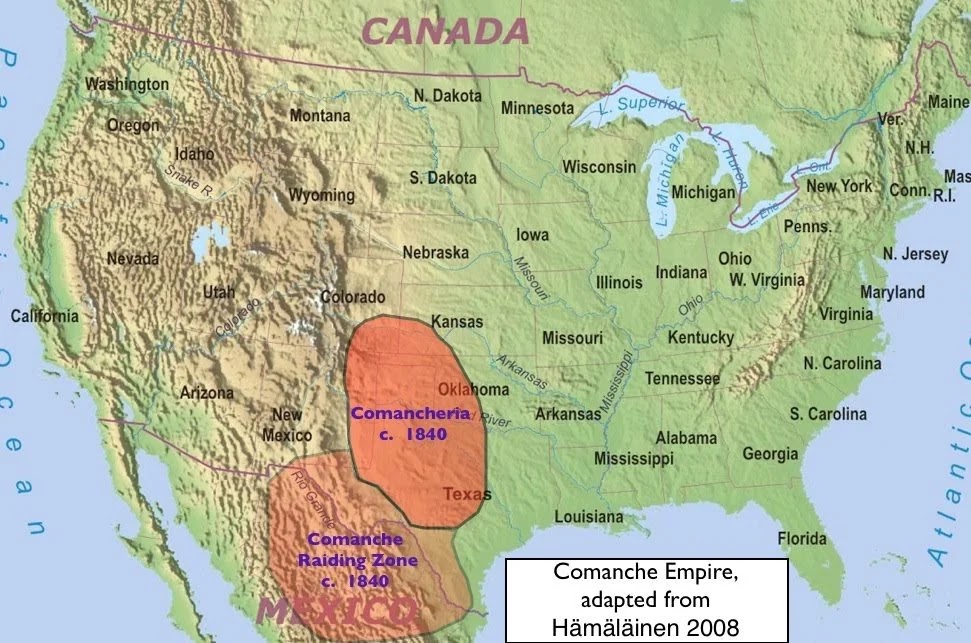
To the south of the Lakotas, there was another indigenous empire--the Comanches.


                                                                  The Comanche Empire

The Comanches expanded their empire by attacking the Spanish, Mexican, and white settlers and also other Indian tribes such as the Lipan Apaches.  Eventually, what the Spanish called Comancheria encompassed forty thousand Comanches living on a quarter million miles of land, making it the largest indigenous territory in North America.  In 1846 and 1847, the Comanches even sent thousands of soldiers deep into Mexico--attacking the city of Queretaro, only 135 miles north of Mexico City (Hamalainen 2008; 2022: 409-29).


THE EVOLUTIONARY ECOLOGY OF POWER

As Pekka Hamalainen has observed, Darwinian science allows us to explain the evolutionary ecology of Lakota and Comanche power that came from harnessing the stored energy from the Sun in horses, bison, domesticated plants, and human slave labor (Hamalainen 2022: 12-15, 249-58, 421-23).  (I have pursued a similar line of thought in writing about the Big History of photosynthesis and the cosmic evolution of complexity as measured by energy rate density.)

The modern domesticated horse (Equus ferus caballus) is a subspecies of the wild horse (Equus ferus).  The wild horse evolved over 45 million years ago.  Humans began domesticating horses around 4,000 BCE.  There were horses in North America until around 10,000 years ago, when they went extinct there.  They were reintroduced into North America by the European colonists.  When they arrived in the North American West early in the eighteenth century through a trade chain from Spanish New Mexico, the Native Americans in the west entered a new technological age.

Previously, the Indians had domesticated the dog.  But the domesticated horse was a bigger and stronger dog and a better energy converter.  Horses transformed the Sun's energy stored through photosynthesis in the biomass of the continental grasslands into immediately available muscle power, which the Indians could harness for hunting bison and waging war on their enemies.

The grasses on the North American Great Plains coevolved with large grazers like the bison.  And the bison were good at converting the energy stored in the grasses into an animal body that was a source of meat, bones, and hides for Indian hunters.  As they became more dependent on the bison meat as a source of protein, the hunters reduced their gathering of plants.  They developed trade relations with Indian farmers so that they could trade bison meat and hides for corn (maize), squash, and beans, which the farmers had genetically modified through domestication.

In this dependence on domesticated horses, the Lakota and Comanche empires belong to the deep history--over 2,000 years--of how warhorses became essential to the building and sustaining of great empires--from the Persian Empire of Cyrus to the Mongol Empires of Genghis Khan and Timur (Chaffetz 2024).

Many Indian tribes--including the Lakota and Comanche--also used Indian slaves as like domesticated animals, which was another way of harnessing the energy of the Sun stored in the muscle power of the slaves that could be put to useful work.


THE SURVIVAL OF THE AMERICAN INDIANS IN A LOCKEAN LIBERAL SOCIETY

By the 1880s, the U.S. Army had defeated the American Indian warriors.  This was beneficial for the Indians insofar as it ended the intertribal warfare and indigenous imperial conquest that had run through thousands of years of Indian history in North America.  But this benefit brought with it the cost of surrendering the Indians to American imperial conquest, and this subjugation made them vulnerable to violence and oppression.  Over the past 50 years, some historians have even spoken of the Americans as committing "genocide" against the Indians, so that Native American life was essentially extinguished --perhaps finally, as Dee Brown argued (in Bury My Heart at Wounded Knee)--with the U.S. Cavalry's 1890 massacre of more than 150 Sioux at Wounded Knee.

But recently, some scholars of American Indian history--including American Indian scholars like David Treuer (in his Heartbeat of Wounded Knee)--have complained that this story of the "dead Indian" denies or demeans the vibrant life of American Indians in America today.  The story of American Indian genocide is refuted by the simple fact of the stunning demographic growth and diversity of American Indian lives today.  As many as 5 million Americans identify themselves as American Indians today, which probably exceeds the population of Indians in North America in 1800.  Over the past 50 years, the average income of American Indians has been rising, and the poverty rate has dropped.  Indian-owned businesses have been growing.  The number of college-educated Indians has increased.  The youthful reservation population has been growing.  But most Indians live in urban areas.  Many move back and forth between a reservation and the city.  Indians are actively engaged in preserving Indian cultural traditions, including American Indian religious practices and beliefs.  In the 135 years since Wounded Knee, the Indians have not only survived, but they have even lived flourishing lives

As Treuer indicates, there are two reasons for this.  The first is that while the Indians' violent resistance to conquest was defeated in battle by the U.S. Army, their nonviolent resistance to oppressive subjugation has succeeded in securing their rights as American citizens to life and liberty.  This illustrates what I have argued about the importance of Lockean nonviolent resistance to oppression, which explains what John Adams meant when he said that America's Revolution of Independence was achieved "in the minds of the people" in the resistance movement from 1660 to 1775, long before any blood was shed at Lexington.

The second reason why American Indians have been able to live good lives as Indians in America is that a Lockean pluralist society allows for a culturally diverse social order in which one can live as both an American and an Indian.

Treuer conveys both of these points in this passage:
While Wounded Knee was the last major armed conflict between Indian tribes and the U.S. government, there have been many battles since 1890: battles fought by Indian parents to keep their children, and by the children far away at boarding schools to remember and keep their families and, by extension, their tribes, close to their hearts; battles of Indian leaders to defeat allotment and other destructive legislation; battles of activists to make good on the promises their leaders couldn't or wouldn't honor; battles of millions of present-day Indians to be Indian and modern at the same time.  We are, in a sense, the children and grandchildren and great-grandchildren of those hundreds who survived Wounded Knee and who did what was necessary to survive, at first, and then--bit by bit--to thrive (453).

When he speaks of the battle of Indians "to be Indian and modern at the same time," what he calls "modern" is what I call--in my convoluted professorial language--Lockean liberal symbolic niche construction, which is based on Adam Smith's principle of "allowing every man to pursue his own interest his own way, upon the liberal plan of equality, liberty, and justice."  

In other words, American Indians have discovered that they can be citizens in America's bourgeois pluralist society while preserving their Indian tribal identity.  This shows the evolution of Indigenous peoples through cultural adaptation so that they can live and live well as American Indians.

In 1877, the Nez Perce under Chief Joseph surrendered to General Nelson Miles in northern Montana.  Two years later, Chief Joseph gave a speech in Washington, D.C., which was directed to the government and to the general American public.  Treuer quotes the entire speech, which includes this passage:

I know that my race must change.  We can not hold our own with the white men as we are.  We only ask an even chance to live as other men live.  We ask to be recognized as men.  We ask that the same law shall work alike on all men.  If the Indian breaks the law, punish him by the law.  If the white man breaks the law, punish him also.

Let me be a free man--free to travel, free to stop, free to work, free to trade where I choose, free to choose my own teachers, free to follow the religion of my fathers, free to think and talk and act for myself--and I will obey every law, or submit to the penalty.

That's the American Indian's Declaration of Independence. 


REFERENCES

Ablasky, Gregory. 2019. "Species of Sovereignty: Native Nationhood, the United States, and International Law, 1783-1795." The Journal of American History 106: 591-613.

Bulkley, John. 1725. An Enquiry into the Right of the Aboriginal Natives to the Land in America.  In Mark Goldie, ed., The Reception of Locke's Politics, vol. 6: Wealth, Property, and Commerce, 1696-1832, 191-223.  London: Pickering & Chatto, 1999.

Cave, Alfred A. 1999. "The Delaware Prophet Neolin: A Reappraisal." Ethnohistory 46 (Spring): 265-290.

Chacon, Richard J., and Ruben G. Mendoza, eds. 2007. North American Indigenous Warfare and Ritual Violence.  Tucson: University of Arizona Press.

Chaffetz, David. 2024. Raiders, Rulers, and Traders: The Horse and the Rise of Empires. New York: Norton.

Hamalainen, Pekka. 2008. The Comanche Empire. New Haven, CT: Yale University Press.

Hamalainen, Pekka. 2019. Lakota America: A New History of Indigenous Power. New Haven, CT: Yale University Press.

Hamalainen, Pekka. 2022. Indigenous Continent: The Epic Contest for North America. New York: Liveright Publishing.

Herring, Joseph B. 1985. "Kenekuk, the Kickapoo Prophet: Acculturation Without Assimilation."  American Indian Quarterly 9 (Summer): 295-307.

Herring, Joseph B. 1988. Kenekuk, The Kickapoo Prophet.  Lawrence, KS: University Press of Kansas.

Kammen, Michael G., ed. 1966. "Virginia at the Close of the Seventeenth Century: An Appraisal by James Blair and John Locke." The Virginia Magazine of History and Biography 74: 141-169.

Locke, John. 1988. Two Treatises of Government. Ed. Peter Laslett. Cambridge, UK: Cambridge University Press.

Mohammedi, Sara. 2002. "The Interpretation of Christianity by American Indian Prophets." Indigenous Nations Studies Journal 3 (Fall): 71-88.

Seed, Patricia. 1995. Ceremonies of Possession in Europe's Conquest of the New World, 1492-1640. Cambridge, UK: Cambridge University Press.

Shain, Barry, ed. 2014. The Declaration of Independence in Historical Context. Indianapolis, IN: Liberty Fund.

Treuer, David. 2019. The Heartbeat of Wounded Knee: Native America from 1890 to the Present. New York: Riverhead Books.

Tully, John. 1993. "Rediscovering America: The Two Treatises and Aboriginal Rights." In An Approach to Political Philosophy. Cambridge: Cambridge University Press.

de Vattel, Emer. 2008. The Law of Nations. Indianapolis: Liberty Fund.

Weddle, Kevin J. 2021. The Compleat Victory: Saratoga and the American Revolution. New York: Oxford University Press.

Wharton, Samuel. 1781. Plain Facts: Being an Examination Into the Rights of the Indian Nations of America, to Their Respective Countries. Philadelphia; R. Aitken.

Williams, Roger. 2019. A Key into the Language of America. Eds. Dawn Dove, Sandra Robinson, Loren Spears, Dorothy Herman Papp, and Kathleen J. Bragdon. The Tomaquag Museum Edition. Yardley, PA: Westholme.