Showing posts sorted by date for query Scruton atheistic religiosity. Sort by relevance Show all posts

Saturday, April 11, 2026

Love, Death, and Redemption: The Atheistic Religiosity of Roger Scruton and Wagner's "Tristan and Isolde"


On December 3, 2019, Viktor Orban presented the Hungarian Order of Merit to Roger Scruton in London.  Scruton would die five weeks later from lung cancer.

In his speech honoring Scruton, Orban praised him for his work in the 1980s aiding the anti-communist underground in Central and Eastern Europe, which included Hungary.  Orban concluded the speech by saying: "He was and is a loyal friend of the freedom-loving Hungarians, who knows that this freedom relies on nation states and Christian civilization."

To identify Scruton as a supporter of "Christian civilization" is disturbing to those of us who have argued that Scruton belonged to a Kantian conservative tradition of atheistic religiosity.  Atheistic religiosity is for those who want the "magic of religious feeling" as an expression of the human mind's "religious instinct," but without having to believe in the real existence of God independent of the human mind.  They don't believe in the literal truth of Christianity or any other religion.  And yet they want to have a sense of the sacred that comes from religious emotions, but without the need to believe any religious doctrines.  They believe that God is dead, but they also believe that human beings need to satisfy their religious longings for transcendence and redemption if they are to escape the nihilism that comes from the death of God.

I suspect that many, if not most, of the conservatives who promote "Christian civilization"--including Orban--are really Christian atheists who believe a Christian culture supports the moral and political order of a nation, but without believing in the truth of Christian doctrines.  The flimsiness of this fake Christianity explains why Orban's promotion of Hungary as a Christian nation has failed to stop the decline of Christianity in Hungary.

I have been prompted to think more about this while reading Scruton's interpretation of Richard Wagner's Tristan und Isolde in Death Devoted Heart: Sex and the Sacred in Wagner's Tristan and Isolde (Oxford University Press, 2004).  I have been doing this in preparation for attending a concert performed by the Chicago Symphony Orchestra that includes the Prelude and Liebestod from Tristan and Isolde along with Richard Strauss's Four Last Songs.


REDEMPTION IN TRISTAN AND ISOLDE

Let's start with a brief synopsis of the story as Wagner tells it.

Set in the Celtic Middle Ages, the opera begins with Tristan, a knight of Cornwall, escorting Isolde, the daughter of the King of Ireland, to Cornwall where she is to marry King Marke, Tristan's uncle.  During the journey, Isolde is filled with rage and resentment towards Tristan for killing her fiancĂ©, Morold, in battle.  Despite her anger, when Tristan stares into her eyes--which is marked musically by Wagner's "Look" motive--she is drawn to him, and their complex relationship unfolds throughout the opera.

Act 1.  Isolde, furious at her fate, wishes for revenge against Tristan.  She recalls how she had speared his life when he was wounded and disguised as Tantris.  As they approach Cornwall, she demands that Tristan drink a cup of atonement with her.  However, Brangane, Isolde's maid, secretly substitutes the poison with a love potion, causing both Tristan and Isolde to fall deeply in love with one another.

Act 2.  The love between Tristan and Isolde deepens, but they are caught in a web of duty and betrayal.  Tristan is torn between his loyalty to King Marke and his love for Isolde.  Their secret affair is discovered, leading to a confrontation that highlights the tragic nature of their love.  The act culminates in a passionate duet where they express their longing and despair.

Act 3.  The final act sees Tristan wounded in battle and longing for Isolde.  He dies in her arms, and Isolde, overwhelmed by grief, follows him into death.  The opera concludes with Isolde's poignant Liebestod (love-death) where she transcends the physical world, symbolizing the idea that true love can only be fully realized in death.

I will pass over the details of Scruton's meticulous interpretation of this opera and jump to his conclusions. 

Scruton argued that Wagner's agenda as an artist was "nothing less than the redemption of humankind," which he accomplished in Tristan and Isolde.  According to Scruton, Wagner saw that the yearning for redemption was a religious yearning, an expression of the religious instinct that is universal to human beings, and that it could be fulfilled only in "otherworldly renunciation."  But Wagner "set out to discover a redemption that needs no god to accomplish it," because he would "make man his own redeemer" (3).  He would show "what redemption could mean, when detached from every promise of a life after death" (14).

Wagner himself once described Tristan and Isolde as a story of "endless yearning, longing, the bliss and wretchedness of love; world, power, fame, honor, chivalry, loyalty, and friendship all blown away like an insubstantial dream; one thing alone left living--longing, longing unquenchable, a yearning, a hunger, a languishing forever renewing itself; one sole redemption--death, surcease, a sleep without awakening" (29).

Thus could Wagner's opera stir religious feelings of redemption in his audience without requiring any belief in religious doctrines (like the existence of God and the eternal afterlife).  In this way, Scruton insisted, Wagner proved "that religion could live again in art and did not need God for its survival," and "that man can become holy to himself with no help from the gods" (190, 196).

But I would say that at best what Wagner proved is that his operatic art could induce a fake emotion of religious redemption that could not really redeem human beings.  After all, how can human beings be redeemed through "otherworldly renunciation" if they believe that there is no "otherworld" beyond this world?


THREE POSITIONS ON REDEMPTION

The fake redemption of atheistic religiosity is only one of at least three possible positions that musical artists can take on redemption.  

A second position is the real redemption that can come through a musical composition like Bach's Saint Matthew's Passion or Handel's Messiah, which induce religious emotions of redemption but also teach religious doctrines of redemption by eternal salvation.  The members of the audience who are not Christian believers can feel the power of those religious emotions.  But the Christian believers in the audience can also understand the promise of their redemption because they know that their Redeemer really exists, and He will raise them from the dead to eternal life in Heaven.

A third position that a musical artist can take on redemption is that there is no need for redemption from life because life--even with its suffering, vulnerability, and mortality--is inherently good.  And for that reason, we can calmly accept the end of life in death as the completion of our life's journey.  That position is artistically conveyed in Richard Strauss's Four Last Songs.

In 1948, Strauss was 84 and composing his last music before his death the next year.  His Four Last Songs were for soprano and orchestra.  He wrote to Kirsten Flagstad to express his wish that she would be the soprano for the world premiere of these songs.  And indeed the premiere occurred in London in 1950, after his death, sung by Flagstad with the Philharmonia Orchestra conducted by Wilhelm Furtwangler.  (Remarkably, Flagstad had sang as Isolde at Covenant Garden, London, in 1936.)

As he composed this music for a soprano, Strauss probably heard the voice of his wife Pauline de Anha, who had sung as a professional soprano.

The lyrics for the four songs are poems.  The first three by Herman Hesse, the fourth by Joseph Eichendorff.

In the first, Fruhling ("Spring"), the soprano's voice rises up as she dreams of trees and sky, and the flute evokes birdsong.

In the second, "September," there is an allegorical passage from life to death.  The first stanza reads:

The garden is mourning,

the rain sinks coolly into the flowers.

Summer shudders

as it meets its end.

It ends with Summer closing "its large eyes grown weary."

In the third song, Beim Schlafengehen ("While going to sleep"), the soprano yearns to forget all thoughts in sleep.  The first stanza reads:

Now that the day has made me so tired,

my dearest longings shall 

be accepted kindly by the starry night

like a weary child.

In the final song, Im Abendrot ("In the twilight"), we hear about an old couple at the end of life.  It begins with an orchestral depiction of sunset, with two trilling flutes representing a pair of larks ascending into the sky (the souls of the old couple).  We can imagine that here Strauss was thinking of his long and happy marriage with Pauline de Anha, who would die in 1950 only eight months after his death.  Here in this song, they are contemplating the end of life together.

The light fades as the song unfolds, and then the soprano asks, in the last line, Ist dies etwa Tod? ("Is this perhaps death?") 

The orchestra then whispers the "transfiguration" theme from Strauss's Death and Transfiguration, which he had written 60 years before.  Strauss is saying goodbye by wistfully suggesting that he has come full circle from his early life to his end.

Although "transfiguration" might suggest the need for redemption, the tone and meaning of Strauss's Four Last Songs are very different from Wagner's Tristan and Isolde.  Strauss's songs convey not an unquenchable longing for redemption from life (like that of Tristan and Isolde) but a serene completion of life in the old couple's calm acceptance of their inevitable ending of their lives together: "Is this perhaps death?"

Saturday, April 04, 2026

The Fall of Orban's "Illiberal Democracy." Fukuyama Was Right.


        Viktor Orban with J. D. Vance and Rod Dreher in Washington, D.C., November 2025


                                                                        Peter Magyar


"It's nice to have a strong man running your country."  That's what Donald Trump once said about Viktor Orban, the Prime Minister of Hungary.  One indication of his political strength is that he has been Prime Minister since 2010, which makes him the longest serving Prime Minister in Europe.

But that could be ended by the parliamentary elections coming up on April 12, because polling shows that Peter Magyar is leading Orban in the race to become the next Prime Minister.  Magyar is a former Orban loyalist in Orban's Fidesz party who now leads the opposition party Tisza.

If Orban loses, that would signal the collapse of the international right-wing movement for populist nationalism because Orban's illiberal regime in Hungary has been the model for that movement.  That explains why Trump and Vance have endorsed Orban for reelection, and why Vance has been visiting Hungary to support Orban.  There are reports that Vance will appear with Orban at a campaign rally in Budapest a few days before the election.  Trump and Vance are desperately worried that Orban's defeat would be a crushing blow to the international MAGA movement.

But Magyar's victory would be just the final nail in the coffin for Orban's regime, which has been in decline for years now.  There are at least three signs of that decline.  Orban's policies for strengthening Hungary's families have failed to raise the female fertility rate.  Orban's promotion of a "Christian Hungary" has failed to revive Hungarian Christianity.  And, finally, huge numbers of Hungarians have been voting with their feet against Orban's regime by emigrating to Western European countries that offer them a better life than what they can have in Hungary.  The fact that these emigrants are going to those European nations that rank high on the Human Freedom Index confirms the argument of Francis Fukuyama that most human beings today regard the liberal social order that secures human freedom as the best regime.


THE ILLIBERAL STATE

As a young student and lawyer, Orban was originally a liberal anti-communist.  In 1988, he was one of the founders of the Alliance of Young Democrats (with the acronym FIDESZ), which challenged the Hungarian Young Communist League.  In 1989, Fidesz became a political party that supported the overthrow of the communist regime in 1990.

In 1989, Orban studied at Oxford University on a research fellowship funded by George Soros, the Hungarian-born philanthropist whom Orban now denounces as the conspiratorial funder of liberal causes in Eastern Europe.

In 1990, he left Oxford early so that he could return to Hungary to run in the first post-communist parliamentary elections.  He was elected a Member of Parliament, and he became a leader in Fidesz.

In 1994, after Fidesz lost the parliamentary elections badly, Orban decided that if he was to have any chance of becoming Prime Minister, he would have to move Fidesz away from its center-liberal position and towards the sort of right-wing populism that had propelled Silvio Berlusconi to become prime minister of Italy (Higgins 2025; Szelenyi 2022).  He was willing to change his political principles if he thought that would help him win votes and gain political power.  And, indeed, he became prime minister in 1998.  But he lost the general election in 2002.

In 2010, Orban returned as prime minister, and this time, he wanted to make sure that he would remain in power for many years.  He began silencing or taking over media outlets that he considered hostile to Fidesz.  He had the government fund an elaborate propaganda apparatus serving Fidesz.  He wrote a new constitution that would make it difficult for his opponents to win control of the parliament.  He removed the civil service protection for many government employees, and replaced them with his loyalists. He also took control of the courts so that he could appoint judges loyal to him.  

All of this supported what Steven Levitsky and Lucan Way (2002, 2010) have called "competitive authoritarianism."  Somewhere between a fully authoritarian regime and a fully democratic regime, a competitive authoritarian regime has multiparty elections, but they are not completely free and fair, because the incumbent's abuse of power tilts the electoral playing field against the opposition, and basic civil liberties are restricted to make it hard for the opposition to challenge the ruling party.

Under competitive authoritarianism, opposition forces can compete seriously for power.  And, occasionally, the opposition can win an election, and the incumbents lose.  But this regime is still not fully democratic, because the ruling party uses its power over the government to attack opponents and co-opt critics.

These three regime types are distinguished by the kind of countervailance--power checking power--that they allow.  A fully authoritarian regime allows little or no countervailance.  A fully democratic regime allows strong countervailance.  A competitive authoritarian regime allows weak countervailance.

In a speech in 2014 that attracted attention around the world, Orban explained that "the new state that we are constructing in Hungary is an illiberal state."  He said that this would break away from the principles of liberal democracy that had dominated the global regime (including Hungary) from 1990 to 2010.  Beginning with the global financial crisis of 2008, he argued, it had become clear that the Western liberal social, economic, and political order based on the principle of individual freedom had failed.  This created an opening for newly emerging global powers based on illiberal nationalism--nations like Singapore, China, India, Russia, and Turkey.

Previously, Orban observed, the liberal states in Western Europe had been organized around the liberal principle of individual freedom: "With regard to the relationship between two people, the starting point of the liberal organization of society is based on the idea that we have the right to do anything that does not infringe on the freedom of the other party."  Here Orban paraphrased the definition of freedom adopted by John Locke--freedom as not being constrained or coerced by others, so long as one does not infringe on the same freedom for others (see Locke, Second Treatise, para. 57).

Notably, Orban did not completely reject this liberal principle of freedom.  But he did insist that this would not be the central organizing principle of the illiberal state.

What is happening in Hungary today can accordingly be interpreted by stating that the prevailing political leadership has today attempted to ensure that people's personal work and interests, which must be acknowledged, are closely linked to the life of the community and the nation, and that this relationship is preserved and reinforced.  In other words, the Hungarian nation is not simply a group of individuals but a community that must be organized, reinforced and in fact constructed.  And so in this sense, the new state that we are constructing in Hungary is an illiberal state, a non-liberal state.  It does not reject the fundamental principles of liberalism such as freedom, and I could list a few more, but it does not make this ideology the central element of state organization, but instead includes a different, special, national approach.

So Orban's illiberal state would secure some individual freedom, but there must also be a "national approach," because "the Hungarian nation is not simply a group of individuals but a community."  Here you see why the conservative communitarian critics of liberal individualism--like Patrick DeneenRoger Scruton, and Rod Dreher--have all made their pilgrimages to Budapest to honor Orban and receive his praises for their promotion of Orbanism in the United States and the UK (Szelenyi 2022).  Dreher moved to Budapest in 2022 so that he could be a part of Orban's propaganda operation--particularly, the Danube Institute, a state-backed think tank for disseminating Orban's ideology (Worth 2026).

I should say, however, that the Danube Institute does show some commitment to the liberal principle of open debate and freedom of thought.  Their mission statement includes this passage:

Our primary audience is the universe of centre-right intellectuals, political leaders, and public-spirited citizens. But we will also engage our counterparts on the democratic center-left in vigorous and principled public debate on as many occasions as possible and appropriate. We hope to draw upon the best minds of our day across national boundaries in international forums.

A recent example of their commitment to the liberal principle of intellectual freedom and debate is their event debating the question "Is Liberalism a Threat to Religious Liberty?"  One of the invited participants was Andrew Koppelman, a law professor at Northwestern University, who is best known for his philosophic and legal arguments for gay rights.  His response to the proposed question was to suggest that this was a weird question, because since religious liberty originated as a principle of Lockean liberalism, to suggest that liberalism could threaten religious liberty was nonsensical.

If you peruse the website of the Danube Institute, you can see their concern for thinking through all of the themes of Orban's illiberal state, two of the most prominent being Christianity and family life.


DECLINING CHRISTIANITY

In 2018, Orban declared that Hungary must be a "Christian democracy," and "a Christian democracy cannot be liberal" (Orban 2018).  A Christian democracy cannot be liberal because "it gives priority to Christian culture" over all other cultures, and therefore it denies the liberal principle of multiculturalism.

But Orban was vague about what exactly he meant by "Christian culture."  Most confusing was his claim that in affirming the importance of Christian culture, he was not affirming any Christian doctrines of faith.

Christian democracy is not about defending religious articles of faith--in this case Christian religious articles of faith.  Neither states nor governments have competence on questions of damnation or salvation.  Christian democratic politics means that the ways of life springing from Christian culture must be protected.  Our duty is not to defend the articles of faith, but the forms of being that have grown from them.  These include human dignity, the family, and the nation--because Christianity does not seek to attain universality through the abolition of nations, but through the preservation of nations.  Other forms which must be protected and strengthened include our faith communities.  This--and not the protection of religious articles of faith--is the duty of Christian democracy.

Orban's statement is incoherent.  On the one hand, he says that a Christian democracy must be illiberal.  On the other hand, he says that a Christian democracy must not enforce any religious articles of faith and must secure the freedom of all "faith communities," which sounds like the liberal principle of religious liberty and toleration.  

Christian democracy would be truly illiberal if it meant some form of Christian integralism or theocracy (like medieval Catholicism or 17th century Massachusetts Bay Colony).  But clearly Orban does not want that.  If he doesn't want the state to enforce any religious doctrines, that sounds like liberal democracy.  Indeed, Rod Dreher has said that authentic Christianity "can't exist if liberal democracy goes away" (Worth 2026, 36).  And as Koppelman pointed out, when the Danube Institute defends religious liberty, they're defending a fundamental principle of Lockean liberalism.

Moreover, if Christianity supports "the preservation of nations," as Orban says, does that mean the preservation of nations with diverse religious traditions?  Europe has some predominantly Muslim countries--such as Albania, Bosnia and Herzegovina, Kosovo, and Turkey--and in some cases, these Islamic traditions go back to the Middle Ages.  So it would seem that Orban's nationalism would have to allow for Islamic nationalism.  But then Orban's Christian democracy has been interpreted by many of his supporters as a defense of Christian Europe against Islam.

Another problem here is that by insisting that the state must not enforce any religious doctrines, Orban implies that religious freedom should include freedom of thought for atheists.  The fundamental religious doctrine of monotheism is "I believe in God the Father Almighty, Creator of Heaven and Earth" (the Apostle's Creed), and if Orban does not think the state can enforce belief in that doctrine, then he must think that atheists are free from persecution.

So in saying that Christian democracy supports Christian culture but not Christian doctrines, Orban implicitly endorses the kind of atheistic religiosity promoted by conservatives like Roger Scruton, who want to enjoy the religious feelings that sacralize a national culture but without the religious belief in the real existence of God outside the human mind.  (The vacuousness of ritualized Christian culture without Christian belief was manifest three years ago in the coronation of King Charles III as the Christian King of Great Britain.)

But in the long run, believing in the importance of Christian culture without believing in the truth of Christian doctrines fails to slow the decline of that Christian culture.  We can see that in Orban's Hungary.

According to the Hungarian Central Statistical Office, the majority of Hungarians do not identify themselves as religious.  In the census of 2022, 42.5% identified themselves as Christians, 1.3% as non-Christian religious believers, 16.1% as not religious, and 40.1% refused to answer.  Since it's unlikely that religious believers would refuse to answer the question, those who did refuse are probably not religious.  That means, then, that 56.2% of Hungarians do not identify themselves as religious.  And since most of the houses of worship in Hungary reportedly have few people attending, we can assume that most of those who identify themselves as religious are not devout believers.

If creating a Christian democracy in Hungary means that at least a majority of Hungarians are serious Christians, then Orban has failed to achieve that.

But that doesn't mean that Christianity cannot rebound in Hungary.  The number of Catholics and Reformed Protestants has dropped by about one half in 20 years.  But Hungary's fastest growing Christian church is the Hungarian Faith Church, which is a charismatic Pentecostal form of Christianity.  With its headquarters in Budapest, it has over 150,000 members, of which over 70,000 are in Hungary.  In a nation of 9.8 million people, those are impressive numbers when you consider that this church was founded as recently as 1979 by seven Hungarians.  Notably, Orban's son Gaspar Orban converted in 2014 to the Faith Church, and he has even become a minister in the church who claims to have received revelations from God and witnessed miraculous healings.

As I have argued, Christianity originated as a charismatic or Pentecostal form of religion rooted in animistic shamanism.  Animism was the first religion, and shamans were its first practitioners.  The religious experience of animistic shamanism is the natural seed in the human mind from which all subsequent religions have evolved.

The defining feature of Pentecostal doctrine is the teaching that all true Christians can be filled with the Holy Spirit, and the most prominent gifts of the Holy Spirit include healing, praying, prophesying, and preaching through speaking in tongues.  Here we see, once again, Christians becoming shamans who, through extraordinary states of ecstasy, engage with divine entities and provide services like healing and divination.


                              A Fresco of the Pentecostal Dove, Symbolizing the Holy Spirit

As long as we have liberal social orders with religious liberty, we will have free markets in religion that will allow the more charismatic Pentecostal religions to gain a growing share of the market because they appeal to the natural human desire for religious transcendence in making contact with the spiritual world through shamanic practices.  Pentecostalism is the fastest growing religious movement in the world, with over 600 million adherents worldwide.  So while Christianity in general might be in decline today in Hungary and elsewhere, we can expect a continuing revival of charismatic Christianity.


DECLINING FAMILIES

One reason why Christian culture is so important for Orban is that he sees it as supporting the traditional family with lots of children.  And that's important because families having and rearing many children resolves what Orban has said (in a 2017 speech) is "the greatest existential question for European civilization"--Will the drastic decline in Europe's population continue until there are hardly any Europeans left?

In that 2017 speech, Orban lamented that the population of Hungary had declined from 10,709,000 in 1980 to 9,799,000 in 2017, so that in less than 40 years, Hungary had lost almost a million people, which was more than all the casualties that Hungary sustained in World War II.

Orban announced that "Making Families Strong Again" would be the motto for the Hungarian government's family policies directed to raising the birth rate.  He explained:

It is important to highlight that the restoration of natural reproduction is a national cause; and it is not just one national cause among many, but the national cause.  And it is also a European cause: not just one European cause among many, but the European cause.  The goal of the Government of Hungary is to raise our birth rate to 2.1 per cent by 2030, which would be a replacement rate for our society.  At present, this figure stands at 1.5 per cent.

The technical term for the birth rate is the "total fertility rate" (TFR), which is a measure of an imaginary woman who passes through her reproductive life subject to all the age-specific fertility rates for the ages 15-49 that were recorded for a given population in a given year.  So this rate is the number of children a woman would have if she was subject to prevailing fertility rates at all ages from a single given year, and if she survived throughout all her childbearing years. 

If there were no mortality until the end of a woman's childbearing years, the replacement level of TFR would be around 2.0.  The replacement fertility rate is close to this for most industrialized countries.  For the global average, the TFR at replacement is about 2.33.  Here "replacement" means maintaining the present level of population into the future.

The drop in fertility rates that has occurred in most of the wealthier nations over the past hundred years has been called "the demographic transition" by demographers.  In the most developed societies today, the rich and powerful tend to have low fertility rates, and it's the lower class people who have higher fertility rates.  So as societies become wealthier, the total fertility rate for the whole society tends to drop, and over the past 70 years, it has dropped below replacement levels.

I have argued that one can explain this in Darwinian terms through the "embodied capital theory of human life history."  In the developed societies, the economic and social success of children depends ever more on their acquired technical skills and educational training, so that as adults they can compete for jobs that require special talents and knowledge. Consequently, rearing successful children in such societies requires that parents make increasingly costlier investments in the education of their children.  And as the cost of children has thus increased, the quantity of children demanded by parents has decreased, because parents now express their natural desire for parenting successful children by investing more resources in fewer children, thereby choosing quality over quantity in their children.

Moreover, for human beings to be able to invest so much in their children, they must first invest time and energy in their own education and career development and in the search for suitable mates.  Consequently, successful people in modern developed societies must often delay their marriage and having children, and thus the average ages for getting married and having the first child have risen.  When women do this, they sometimes reach the end of their reproductive years, and so produce fewer children than they would have desired.  It's likely that one reason for the total fertility rate falling below replacement levels is that couples who desire two or three children delay marriage and reproduction for so long that the women reach the end of their physiological fertility sooner than they had expected.  Then couples must rely on fertility treatments or adoption to satisfy their parental desires.

Orban has been trying to reverse this tendency to lower fertility through governmental policies that promote marriage and large families.  Hungary has a large per-child tax deduction that gets progressively larger with the second and third child.  Mothers of two or more children are exempt from paying income taxes for the rest of their lives.  Women with three or more children can have all of their student loan debt cancelled.  Families with home mortgages can have a large portion of that debt paid by the government in proportion to the number of their children.  The government has built or renovated infant day care centers around the country, and day care costs are heavily subsidized by the government.  The government has also built "family-friendly" infrastructure in the cities, such as beautiful playgrounds and parks, where parents can take their children to play.

But as of now, it appears that all of these pro-family policies have failed to raise the fertility rate.  In 2011, when Orban first became prime minister, Hungary had Europe's lowest TFR at 1.23.  By 2021, it had risen to 1.61.  But in 2025, it was back down to 1.27--essentially, the same all-time low as in 2011.

It is possible that policies designed to incentivize having more children may have had the opposite effect.  For example, providing tax exemptions for mothers of two children might provide a work incentive for those mothers.  European women are career-minded, and giving them tax exemptions could be reinforcing the idea that they should be earning more money, which directs the mother to invest more time and energy in her career rather than in her children.

When it comes to housing, Hungary's policy of subsidizing mortgages could be increasing the demand for housing but not the supply, which creates bidding wars that make homes less affordable.

Now let's consider how Hungary compares with the United States with respect to population growth and the fertility rate.  Unlike Hungary, the population of the U.S. has been growing steadily for over a hundred years.  According to the U.S. Census Bureau, the population of the U.S. has grown every year since 1900, except for one year during the Spanish flu epidemic, growing at an average of 0.85% per year since 2000.  As of today, the population of the U.S. is 342,415,867, which makes it the third largest national population in the world, behind only India and China.

This is surprising since the TFR for the U.S. is only 1.79, which is substantially higher than Hungary's 1.23, but it's still below the replacement level of 2.1.  What explains the growing population despite the below-replacement TFR is immigration.  Consider these calculations for the U.S. from the U.S. Census Bureau:
One birth every 9 seconds

One death every 10 seconds

One international migrant (net) every 97 seconds

Net gain of one person every 45 seconds

This shows that the mistake make by Orban's Hungary has been in limiting immigration into Hungary.  If Hungary had allowed more freedom of movement of immigrants into Hungary, comparable to that allowed by the U.S., Hungary could have had an increasing population.

Now, of course, if Trump's policies for closing the U.S. borders and deporting immigrants continues, this could reverse the century-long trend towards increasing population and bring about the sort of depopulation crisis that has afflicted Hungary.

This supports my argument for open borders and freedom of movement.


DECLINING FREEDOM LEADS TO DECLINING POPULATION

I have pointed to two causes of Hungary's declining population--low fertility rates and low rates of immigration into Hungary.  But there's a third cause: the emigration of Hungarians out of Hungary.

According to Hungary's Central Statistical Office, a total of 367,515 Hungarians have officially left the country during the 15 years that Orban's Fidesz government has been in power.  This is actually an underestimation because foreign statistics often record nearly twice as many new arrivals from Hungary as Hungarian authorities do departures.  Another reason for this being an underestimation is that many Hungarians living abroad retain a Hungarian address.  Adjusting for these factors, there could be as many as 640,000 Hungarian emigrants who have left the country.  Notably, most of these emigrants are aged 25-49 years old--the prime age for people who could contribute to the economic and social life of Hungary.

What's most interesting about these emigrants is that prefer to emigrate to countries that rank high on the Human Freedom Index.  This should not be surprising if one recognizes, as I have argued, that countries ranking high in freedom tend to provide the best conditions for people to live good lives because they have wider opportunities for freely pursuing their happiness.

Here are the five most popular destinations for Hungarian emigrants, with their Human Freedom Index ranking in parentheses: Austria (22), Germany (17), UK (19), Netherlands (9), and Switzerland (1).

By comparison, Hungary ranks 67th out of 165 countries.  Previously, Hungary ranked much higher at 26th in 2009 the year before Orban's Fidesz came to power.  Hungary's rankings have dropped steadily during Orban's time as prime minister.

So Hungarians are voting with their feet against Orban's illiberalism and for freedom secured in a liberal social order.  Declining freedom thus leads to declining population.


LIBERAL DEMOCRACY AT THE END OF HISTORY?

This failure of Orban's illiberal Christian democracy confirms Francis Fukuyama's famous argument in 1989 for "the end of history," in which human beings show their natural desire for the freedom--both economic and personal freedom--that comes from liberal democracy.

Actually, the appeal of the liberal principle of individual freedom is so powerful that even Orban cannot reject it completely.  As we've seen, Orban accepts the importance of securing that Lockean liberal conception of freedom in any good regime, although this cannot be the central organizing principle of his "illiberal state."  Consequently, Orban's "illiberal state" is not absolutely illiberal.  Someone like Rod Dreher (2023) can even defend Orban as the "guardian of liberal freedoms"!

We can see this in Hungary's rankings in the Human Freedom Index.  Under the rule of Orban's Fidesz party from 2010 to the present, Hungary's freedom ranking has fallen from 26th to 67th out of 165 countries.  But notice that a 67th ranking puts Hungary well above the world average.  Most countries rank lower.  Here are some examples of the lower ranking countries:  Mexico (91), Indonesia (92), India (110), Kuwait (113), China (149), Russia (152), and Iran (164).

If you look at how Hungary ranks in the various categories of personal freedom and economic freedom, where 10 is the highest possible score, you will see that Hungary ranks low in "rule of law" (4.9), "expression and information" (5.4), and "size of government" (6.1).  But Hungary ranks high in "freedom of movement" (9.9), "security and safety" (9.6), and "freedom in relationships" (8.8).

Thus, Orban's illiberal democracy is really very liberal, but not liberal enough for those Hungarians who have voted with their feet against Orban by leaving the country, and for those who will vote against him in the coming election.


REFERENCES

Dreher, Rod. 2023. "Orban: Guardian of Liberal Freedoms." The Critic, November.

Higgins, Andrew. 2025. "Viktor Orban's 'Propaganda State' Is Starting to Show Cracks." New York Times, October 12.

Levitsky, Steven, and Lucan Way. 2002. "The Rise of Competitive Authoritarianism." Journal of Democracy 13 (April): 51-65.

Levitsky, Steven, and Lucan Way. 2010. Competitive Authoritarianism: Hybrid Regimes After the Cold War. Cambridge: Cambridge University Press.

Orban, Viktor. 2014. "Speech at the 25th Balvanyos Summer Free University." July 26. Tusnadfurdo (Baile Tusnad), Romania.

Orban, Viktor. 2017. "Speech at the 2nd Budapest Demographic Forum."  May 25.

Orban, Viktor. 2018. "Speech at the 29th Balvanyos Summer Free University." July 28.

Sunday, July 06, 2025

Conservatism and Religion: Moots, Koons, and the Problem of Multiple Orthodoxies

The Darwinian conservatism of the permanent things recognizes that the desire for religious transcendence is one of the twenty natural desires of our evolved human nature.  And since the good is the desirable, we can judge the goodness of a social order by how well it secures the conditions for human beings to pursue the satisfaction of those natural desires, including the natural desire for religious transcendence.

As I have indicated in previous posts, the Catholic Integralists say that a Catholic Integralist regime is the best social order because it enforces belief in the one true religion in a Catholic confessional state and thus satisfies the natural desire for religious understanding.  But they are mistaken because they fail to see that the evolved natural desire for religious transcendence is pluralistic in that human beings will always disagree in what they believe to be the true religious experience of the transcendent world.  And there has never been a divine revelation of the religious truth clear enough to bring religious believers to agreement.  Surveying the entire history of Christianity, Wikipedia has lists of over 50 schisms and over 40 heresies.  Whatever the Holy Spirit might have whispered to popes, bishops, and priests has not been clearly heard by others.

The evolutionary science of religious pluralism supports John Locke's liberal theology of Christianity--that since "everyone is orthodox to himself," and "every Church is orthodox to itself," there is no set of universal doctrines binding on all Christians, except perhaps the belief that Jesus is the Messiah; and therefore, there is no one orthodoxy strictly speaking that can be properly enforced by government.  

For this reason, a Lockean liberal social order that secures religious liberty and religious toleration is the best regime for promoting the pluralistic pursuit of religious happiness.  It does this by allowing the cultural evolution of religion in a free marketplace of religion, so that churches compete for customers, and those churches that best satisfy the desire for religious experience increase their share of the market. 

And yet metaphysical conservatives must scorn this Lockean liberal understanding of religious liberty and toleration because they believe that a conservative form of religion requires the legal enforcement of the traditional orthodoxy of the one true church.  The fundamental problem with this position is that it denies the reality of religious pluralism and mistakenly assumes that all believers can agree in identifying the one truly orthodox church.

This problem was evident at the Kirk Center conference panel on "Conservatism and Religion."  Glenn Moots (Northwood University) argued that for American and British conservatives Protestantism must be the only truly orthodox tradition.  But then he was followed by Robert Koons (University of Texas-Austin) who argued that the Catholic Church was the only truly orthodox church for conservatives, and the Protestant Reformation was the source of the three great errors that led to modernity--antipathy to medieval scholasticism, radical intellectual individualism, and radical secular egalitarianism (the "priesthood of all believers").  

There was no discussion between Moots and Koons on the panel.  So there was no attempt to resolve the obvious contradiction between their arguments.  

But from listening to their presentations and reading their texts, I could see suggestions of where they might find some common ground.  Koons conceded that it was possible to be a conservative Protestant who would deny the three errors of the Protestant Reformation: specifically, Koons identified the magisterial Protestants (Lutherans, Anglicans, and Presbyterians) as Protestants who could reject the three errors.  At the same time, Moots spoke in favor of the magisterial Protestants, as opposed to the Pietistic and evangelical Protestants.

But then Koons and Moots did not explain how it is possible to have more than one magisterium.  Isn't the magisterium by definition the authoritative Christian orthodoxy of the one true Church?  Indeed, the Oxford English Dictionary defines "magisterium" as "the teaching function of the Roman Catholic Church."

Neither did Koons and Moots explain whether or how multiple magisteria can coexist peacefully.  As traditionally understood, the magisterium of the Catholic Church requires the Church to enlist the help of governmental authorities in persecuting heretics, which includes all Protestants.  At the same time, the magisterial Protestant reformers wanted to persecute all Protestant dissenters and Catholics as heretics.  Do Koons and Moots agree with this magisterial rejection of religious liberty?

Would Koons say that the Vatican II statement on religious liberty in Dignitatis humanae is heretical, and therefore that the post-Vatican II Catholic Church is heretical?  Actually, some traditionalist Catholics say exactly that.  For example, Michael Davies (in The Second Vatican Council and Religious Liberty [1992]) argues that the Catholic Church fell into heresy at Vatican II when it was corrupted by the influence of the "Americanist" heresy promoted by Father John Courtney Murray, S.J.  Would Koons agree? 

Are Koons and Moots saying that a conservative view of religion requires the legal enforcement of one church's orthodoxy over another's?  Are they committed, therefore, to perpetual religious warfare?  If not, then don't they have to endorse religious liberty and toleration as the best response to the fact of religious pluralism--to the fact that "every church is orthodox to itself"?  In that case, they would have to accept a Darwinian conservatism that secures the freedom of individuals to pursue the satisfaction of their natural desire for religious transcendence.

And, finally, to reiterate a point I made in a previous post, it was baffling to me that while both Koons and Moots praised Scruton for his conservative understanding of religion, they were silent about Scruton's atheism.  Scruton's atheistic religiosity is most evident in his writing about Richard Wagner: religion is an "elaborate fiction," because the gods exist only in human imagination, but in Wagner's imaginative art, the gods symbolize truthfully the spiritual needs of our human psychology.  Our deepest spiritual need is redemption from a world that has no meaning.  And Scruton believes that Wagner's Ring cycle satisfies our human longing for redemption.  The incoherent self-deception of such atheistic religiosity is ultimately self-defeating.  How can a fake religiosity satisfy our religious longings when we know it's fake?

Is this the dark side of conservatism and religion--that many of the conservatives who are most emphatic about the human need for religion are actually atheists?


Monday, June 30, 2025

Conservatives (Still) Need Charles Darwin. Responding to the Kirk Center's Conference on Russell Kirk and Roger Scruton

Conservatives need Charles Darwin.

That was the first sentence of my article in the November 2000 issue of First Things.  I argued that conservatives need Darwin because a Darwinian science of human nature supports conservatives in their realist view of human imperfectability and their commitment to ordered liberty as rooted in nature, custom, and prudence.  In his response to my article in the same issue of the journal, Michael Behe (a biologist known for his advocacy of "intelligent design theory" as an alternative to Darwinian science) complained: "I'm sorry to be blunt, but the notion that Darwinism supports conservatism is absurd."

I elaborated my argument in my book Darwinian Conservatism (2005), and in a second edition of that book with eight critical responses and my replies (2009).  In the fall 2010 issue of The Intercollegiate Review, I wrote about "Darwinian Conservatism Versus Metaphysical Conservatism."  I have defended that article against three critics in a post (here).

Over this weekend, I have been thinking about this debate as I pondered the presentations at a conference in Grand Rapids sponsored by the Russell Kirk Center for Cultural Renewal: "Prospects for Anglo-American Conservatism in the Tradition of Russell Kirk and Roger Scruton."  Although neither Kirk nor Scruton ever moved toward anything like Darwinian conservatism, I see nothing in their defense of traditionalist conservatism that would refute my argument for Darwinian conservatism.  Previously, I have written about some of my points of agreement and disagreement with Kirk and Scruton.  Here I will respond to some of the presentations at the conference.


THE METAPHYSICAL CONSERVATISM OF CHRISTIAN PLATONISM

James Matthew Wilson (University of St. Thomas, Houston) spoke about "The Conservative Defense of Christian Platonism" in Edmund Burke's Reflections on the French Revolution and in the writings of Roger Scruton.  He saw both Burke and Scruton as trying to preserve the Christian-Platonic tradition of Christendom that had dominated Western Civilization until it was overturned by the French Revolution.  While praising both of them for what they tried to do, Wilson thought their undertakings were weakened by their drawing on modern thought that subverted Christian-Platonist thought.  Burke appealed to the sentimentalism of the Scottish Enlightenment when he invoked those "natural feelings" and "moral sentiments" that show "the natural sense of right and wrong" and "the moral constitution of the heart" as the foundation of moral experience.  Scruton appealed to Immanuel Kant's Idealism as teaching that while the Ideas of Reason, God, Freedom, and Immortality cannot be proven true by pure reason, we must act "as if" they were true as a necessity of practical reason: these are conscious fictions of the mind.

I believe that Wilson was drawing material from his book The Vision of the Soul: Truth, Goodness, and Beauty in the Western Tradition (2017).  But since I have not read that book, I might not have rightly understood his presentation.

As I have argued in some previous posts, Plato's moral cosmology--particularly in the Republic, the Timaeus, the Parmenides, and The Laws--is so implausible as to be ridiculous, and it's not even clear that Plato or Plato's Socrates meant us to take this seriously.  I have suggested that while Plato might have thought that a teleological cosmology of divinely intelligent design could be a salutary belief for many people, it could not be a rational account of the cosmos for natural philosophers.  Aristotle suggested this in observing that such cosmic myths were little more than traditional folk tales (On the Heavens, 270b1-25, 283b26-284b5, 291b24-292a20, 298b6-299a2; The Movement of Animals, 699b12-31; Metaphysics, 1050b20-25, 1074b1-14).  But perhaps Wilson in his book has answered my objections.

Although much of Burke's Reflections seems to defend a Christian Platonic metaphysics, Wilson observed, this is in tension with Burke's empiricist ethics of moral sentiments that shows the influence of the Scottish Enlightenment.  As I indicated in my Intercollegiate Review article, I agree with this reading of Burke's Reflections, because I see there a tension between the metaphysical conservatism of Burke's moral cosmology of eternal right and wrong and the evolutionary conservatism of his moral anthropology of the moral sentiments.

But unlike Wilson, I don't see Burke's sentimentalism as weakening his argument for Christian Platonism.  In fact, Burke wrote his Reflections as a refutation of Reverend Richard Price's Christian Platonism.  Price contended that moral knowledge was a purely rational activity of the mind in grasping the eternal and immutable metaphysical truths of God's mind, and that the French Revolution was the historical fulfillment of those eternal truths.  Against Price's metaphysical morality, Burke rightly appealed to the natural moral sentiments as the empirical foundation of moral experience.  Later, Darwin adopted this moral sentimentalism as part of his evolutionary account of morality, which was then elaborated by evolutionary psychologists like Edward Westermarck and Darwinian conservatives like James Q. Wilson.

By contrast, James Matthew Wilson scorned moral sentimentalism as mere emotionalism, in which morality is reduced to emotive expressions without any rational apprehension of the human good.  But this ignores the fact that the moral sentimentalism of the Scottish Enlightenment--particularly in the work of Hume and Smith--was a reflective sentimentalism.   As I have indicated, the Scottish sentimentalists did not argue for enslaving reason to emotion, because they actually argued for moral autonomy as the activity of the whole human mind (reason and emotion), in which the mind can reflect rationally on itself and thus refine its emotional responses to the world by judging those responses as reasonable or unreasonable.  We can reflect on whether our moral sentiments are contradictory or consistent, whether they rest on true or false judgments about the world, and whether they promote or impede our happiness. 


SCRUTON'S CONSERVATISM OF RELIGIOUS ATHEISM

Wilson also criticized Scruton for embracing Kant's Idealism because this modern Idealism contradicts the premodern Idealism of Christian Platonism.  While Kant's ideas are fictional creations of the human mind that do not correspond to any objective reality in the world, Plato's ideas are meant to be intellectual perceptions of what exists in objective reality independently of the human mind.  

As I said earlier, I am not persuaded that Plato believed his Eternal Ideas to be anything more than a noble lie.  After all, in Plato's Parmenides, Plato has Parmenides refute Socrates' theory of the Forms, and Socrates cannot defend his theory against the criticisms; and in fact, nowhere in the Platonic dialogues does anyone satisfactorily reply to the criticisms.

I do agree with Wilson, however, that Scruton does not really affirm the objective truth of Christian Platonist metaphysics, because for Scruton this religious metaphysics is only a fictional creation of the human mind to satisfy a human longing for the divine.  As I have said previously, Scruton makes this clear in his praise for the atheistic religiosity of Richard Wagner's operatic art in the Ring cycle.  Scruton thinks that Wagner saw the "bleak truth" that "we are here on earth without an explanation and that if there is meaning, we ourselves must supply it." "The core religious phenomenon, Wagner believed, is not the idea of God, but the sense of the sacred. . . . religion contains deep truths about the human psyche; but these truths become conscious only in art, which captures them in symbols.  Religion conceals its legacy of truth within a doctrine.  Art reveals that truth through symbols."  In other words, "Wagner sees his art as expressing and completing our religious emotions.  Art shows the believable moral realities behind the unbelievable metaphysics."  Religion is an "elaborate fiction," because the gods exist only in human imagination, but in Wagner's imaginative art, the gods symbolize truthfully the spiritual needs of our human psychology.  Our deepest spiritual need is redemption from a world that has no meaning.  And Scruton believes that Wagner's Ring cycle satisfies our human longing for redemption. 

The incoherent self-deception of such atheistic religiosity is ultimately self-defeating.  How can a fake religiosity satisfy our religious longings when we know it's fake?

Darwinian conservatism offers a better account of the religious longings of the human animal.  As I have argued previously, Darwin was a zetetic philosophic scientist who recognized that the natural desire for religious transcendence was part of evolved human nature; and while Darwin himself took the side of reason in the reason/revelation debate, he knew that reason could not refute revelation.  He knew that the "mystery of the origin of all things is insoluble by us."  In the search for ultimate explanation, the philosophic scientist must assume that nature is the uncaused cause of everything; and yet he cannot refute the claim of the religious believer that God is the uncaused cause of nature.  Darwin conceded this in accepting the principle of dual causality, which recognizes natural evolution as the "secondary cause" of everything, while admitting that behind or above nature there might be a Divine First Cause.  Thus, Darwin saw that he had to remain open to the possibility of theistic evolution:  God does not have to miraculously intervene in nature to specially create every species, because God can choose to act through natural evolution to carry out his creative plan.

This supports a conservative view of religion.  The Darwinian scientist respects religious belief in revelation as satisfying the evolved natural desire for religious transcendence.  But the Darwinian scientist must also insist that since neither side in the reason/revelation debate can refute the other, and since the disagreement among believers in their interpretations of revelation make it impossible to identify the one true religion, the best regime must secure the freedom of thought and speech that promotes the reason/revelation debate and respects religious pluralism.


To be continued . . .

Monday, May 08, 2023

The Conservative Nihilism of Roger Scruton's Atheistic Religiosity: A Response to Daniel Mahoney

I have argued that there is a Kantian conservative tradition of atheistic religiosity expressed in people like Roger Scruton and Leon Kass, which resembles the Dionysian religiosity of Friedrich Nietzsche.  Atheistic religiosity is for those who want the "magic of religious feeling" as an expression of the human mind's "religious instinct," but without having to believe in the real existence of God independent of the human mind.  They don't believe in the literal truth of Christianity or any other religion.  And yet they want to have a sense of the sacred that comes from religious emotions, but without the need to believe any religious doctrines.  They believe that God is dead, but they also believe that human beings need to satisfy their religious longings for transcendence and redemption if they are to escape the nihilism that they fear comes from the death of God.

In the April issue of First Things, Carl Trueman offered a similar interpretation of Scruton's religious longings.  Although Trueman saw that religious themes became prominent in Scruton's later work, he wondered "whether Scruton believed in God or whether he simply believed that God was a good idea."  He asked, "was Scruton's God a theological reality or an anthropological one?"  He observed: "I fear that Scruton is too faithful a student of Kant to engage with the deeper metaphysical claims that, say, Christianity makes.  Throughout his work . . . it is always the experiential reality of the sense of the sacred and the good things that flow from it that he addresses.  But is that really enough?"  He also observed: "Scruton is vulnerable to the criticism that the place he ascribes to the religious instinct simply supports his own cultural and political tastes, granting them a veneer of authority.  Is his thinking thus a castle--albeit a magnificent and beautiful castle--floating precariously in mid-air?  Or, more controversially, is it a conservative expression of nihilism, with values likely to devalue themselves over time through lack of any solid, transcendent foundation?"  Thus did Trueman point to what I have identified as Scruton's atheistic religiosity--affirming the anthropological need for God without affirming the theological reality of God's existence.

In the June/July issue of First Things, there is a letter from Daniel J. Mahoney disputing Trueman's interpretation of Scruton.  He writes:  "Even after Scruton left his 'apprenticeship in atheism,' as he once called it, he never became or wished to become a theologian or a metaphysician.  His approach remained eminently phenomenological, defending those intimations of the transcendent that come to sight in the 'life world' of lived experience and mutual moral accountability.  Trueman suggests that this approach, eschewing traditional metaphysics, likely veils the 'conservative expression of nihilism,' defending a 'religious instinct' that ultimately points to nothing beyond itself."

Trueman cannot be right about this, Mahoney insists, because "Scruton was the sworn enemy of every form of nihilism."  He cites an essay by Mark Dooley ("Roger Scruton Was No Atheist") as proving that Scruton was not an atheist.

The first problem with Mahoney's argument is that he fails to see that the most fervent critics of atheistic nihilism are themselves nihilists who turn to atheistic religiosity in their attempt to escape what they fear to be the degrading consequences of nihilism.  The preeminent example of this is Nietzsche.  Even as he announced that "God is dead," he lamented the debasing effects that this would have on human beings who would no longer be elevated by transcendent longings for the divine.  To avoid this, he professed his faith in the religion of Dionysus that would allow him to be the most pious of those who do not believe in God.

The second problem with Mahoney's argument is that he concedes Trueman's point that Scruton's God is a subjective projection of the human mind's longing that has no objective reality.  Notice that Mahoney admits that Scruton's religion was purely "phenomenological"--rooted in human "lived experience"--but with no foundation in theological or metaphysical truth.  So, even though we know that God is dead, we need to feel that He is alive; and that emotional need is satisfied by Scruton's atheistic religiosity.

It should also be noted that in the essay by Dooley cited by Mahoney, Dooley never says that Scruton believed in the real existence of God independently of the human mind.  Dooley's point is that Scruton scorned the "evangelical atheists" like Richard Dawkins and Christopher Hitchens.  Attacking evangelical atheists is exactly what one should expect of a religious atheist.

Sunday, February 12, 2023

The Bourgeois Liberalism of Paul Kingsnorth's Wild Christianity


"There's money in mysticism."

That's what Sally said to me when I asked her about her business selling meditation lessons in Zen Buddhism.  We were both students at the University of Chicago in the 1970s, and we met at a student party in a crowded apartment in Hyde Park.  Although the tuition was low compared to tuition today at Chicago, we were all so poor that we were always looking for income to pay our expenses.  Some of us were envious of Sally's success as a spiritual entrepreneur in marketing her Buddhism to other students.

I thought about Sally a few days ago when I read Paul Kingsnorth's essay in the March 2023 issue of First Things--"A Wild Christianity."  Kingsnorth is a novelist, poet, and essayist living in Ireland.

Kingsnorth says he is returning to the "wild Christianity" or "cave Christianity" of the ancient Christian ascetics; and in doing that, he says he is rebelling against the degrading materialist culture of modern secular liberalism.  But a careful reading of this and other essays by Kingsnorth will show that in his longing for Christian spirituality, he is not so much rebelling against bourgeois liberalism as expressing it.  

Like Sally, Kingsnorth is a spiritual entrepreneur who sells his Christian writing to consumers who long for the experience of a Christian transcendence of the world.  There is nothing wrong with that, because it shows that the bourgeois virtues of a liberal society include the Christian virtues of faith, hope, and charity.  The natural desire for religious transcendence is part of evolved human nature that will be manifested in a liberal social order where human beings go to the free marketplace of religion to choose among the competing religious traditions in finding the one that is most satisfying to them.

There is something wrong, however, in Kingsnorth's refusal to see that far from working against liberal culture, he is working within it, because he depends on the religious liberty in the pursuit of spirituality that is secured by a liberal social order to live a happy and profitable life as a writer of spiritual literature.  

His talent for engaging writing is evident from the very beginning of his First Things essay:

"Through the mouth of the cave, I watched the storm front move in from the east.  I could already her the approaching thunder; the low bank of cloud was gray with it.  I was perched on a low ledge inside the cave, which was just long enough to accommodate a human body laid prone.  I had filled the place with candles, which guttered and danced in the wind that was rising now with the coming storm."

"The storm broke in an instant, and then everything was roaring.  Great nails of rain hammered down on the hazels, and the rumbles of thunder were replaced by an explosion right above me.  The dimming evening sky was suddenly ripped from horizon to horizon by a great sheet of white lightning.  More rain.  More thunder.  More electricity.  It roared on and then, eventually, it roared past.  Ten minutes later, the rain had slowed, but the pause in hostilities was only temporary.  I could see another front approaching over the mountains."

"Four hours it went on.  A night of storm and screaming skies.  In the end, everything was black but for the light the candle flames threw on the weeping walls of the limestone cave, and irregular explosions of light, which would suddenly imprint on my retinas a white cave mouth like an opening to heaven or hell.  The roof of the cave was dripping now.  Outside there was nothing to be sseen unless the lightning came down, seeking the ground like a long-lost brother.  No ruined church, no well, no spring, no wood:  Everything that had surrounded me during the day had been swallowed by the Atlantic winter."

"This was how I spent the eve of my fiftieth birthday."

He explains that his stormy night in this cave was his attempt to relive the experience of the sixth-century Irish Saint Colman Mac Duagh, who is said to have lived a monastic solitary life in this cave for seven years.  Here's a picture of the cave in the Burren, a region on the west coast of Ireland:


In a previous essay for First Things--"The Cross and the Machine" (June 2021)--Kingsnorth recounted his spiritual journey that eventually led to this night in St. Colman's cave.   As a child, he had no interest in religion because it seemed to be irrelevant to his life.  Then, as a teenager, he became an atheist.  But he often visited empty churches.  And he often walked and camped in the mountains of England and Wales, where he felt the wondrous mystery of the natural world.  He thus became an animist or pantheist, and this pantheistic religion of nature was then expressed in his environmentalist activism, which included chaining himself to construction equipment to stop building projects.

Then he saw that there was a deeper issue here: the ecological crisis arose from the refusal of the liberal way of life to accept any limits to human action on the world, and this was a crisis of culture that was also a crisis of spirit.  He saw that every culture is built around a spiritual core that looks to a divinely transcendent reality that limits human action.  Without that spiritual core, no culture can survive.

He saw that every culture might need to look to one of the great spiritual traditions to provide some understanding of a transcendent reality beyond the world.  He chose Zen Buddhism.  On his fortieth birthday, he went on a week-long Zen retreat.  But then over the next five years, he saw that Zen Buddhism would not satisfy him, because he needed to worship, but he did not know what it was that he could rightly worship.

He decided that since he had a reverence for nature, he could worship God in nature.  That led him to become a priest of the witch gods: he joined a Wiccan coven.  Wicca is a modern pagan religion developed in the first half of the twentieth century, in which all Wiccans are priests or priestesses of two gods--the Great Goddess and the Horned God--who are two aspects of a greater pantheistic deity.  Kingsnorth observes: "My coven used to do its rituals in the woods under the full moon.  It was fun, and it made things happen.  I discovered that magic is real.  It works.  Who it works for is another question."

But he still had a vague sense that there was a void inside of him, and that the Wiccan stuff was just play-acting.  Then, he began to dream of Jesus speaking to him.  And, finally, he had an ecstatic experience: "Suddenly, I could see how everyone in the room was connected to everyone else, and I could see what was going on inside them and inside myself.  I was overcome with a huge and inexplicable love, a great wave of empathy, for everyone and everything.  It kept coming and coming until I had to swagger out of the room and sit down in the corridor outside.  Everything was unchanged, and everything was new, and I knew what had happened and who had done it, and I knew that it was too late.  I had just become a Christian."  He explains: "In the end, though, I didn't become a Christian because I could argue myself into it.  I became a Christian because I knew, suddenly, that it was true."  In January of 2021, he joined the Romanian Orthodox Church and was baptized in the River Shannon.

But notice that while now he knows that Christianity is true, previously he knew that pantheism was true, that Zen Buddhism was true, and that Wicca was true.  How is what he knows now to be true any better than what he previously thought he knew to be true?  He doesn't explain.  And yet perhaps his account of his reliving the monastic experience of St. Colman in the cave can show us how his experience of Christian truth rises above his experience of pantheistic truth, Buddhist truth, or Wiccan truth.

Kingsnorth says he was drawn to Colman because from a young age he was obsessed by hermits and mystics like Tolkein's Gandalf.  "Maybe this sort of thing is in my blood, or maybe I just read too many fantasy novels."  Above all, he loves the story of strange men who retreat to the wilds to find wisdom and God.  And so, he loves the story of Colman:

"Colman lived in his cave, it is said, for seven years.  He drank water from the spring, ate hazelnuts and berries from the forest, and wandered the 'pathless woods' praying.  He built a small oratory church, of which no traces remain, though a later stone ruin stands on the same site. . . ."

. . .

"My favorite story about Colman concerns his wild companions.  The saint, the legends tell us, somehow befriended a cockerel, a mouse, and a fly, and trained them to help him out.  The cockerel's job was to crow when he needed to get up in the morning to pray.  The mouse's role was to step in if Colman didn't feel like getting out of bed:  It would nibble his ear until he roused himself.  As for the fly, Colman trained it to walk along the lines of his Bible in the dim light, so he could follow it as he read.  A new stained glass church window in the nearby town of Gort portrays the saint with his three animal companions rather sweetly."

Notice that Kingsnorth identifies this "story" as based on "legends."  Actually, everything he says about Colman comes from a short biography posted on the St. Colman.com website.  The source for this website biography is a book by Father Jerome Fahey--The History and Antiquities of the Diocese of Kilmacduagh (Dublin: M. H. Gill and Son, 1893)--which can be found online.  I don't see any evidence that Kingsnorth has read the book.  When Fahey tells the story about the cock, the mouse, and the fly, he warns his reader: "It should be remembered that those eminent writers who reproduce those legends never professed to do more than carefully reproduce what they found in ancient writings, without at all holding themselves responsible for their credibility" (60).  Fahey repeatedly makes remarks like this: "some of our medieval writers have added some incredible marvels of the usual legendary character" (62).

So, is Kingsnorth presenting this story of Colman as historically true?  Or does he see it as only a legend that might have little credibility?  He certainly makes no effort to persuade his readers that this story is historically accurate, as if this does not matter to him.

Consider this last paragraph of his essay:

"There is a wild-haired man in the desert clad in camel skin.  He is the start of things.  He lives on honey and insects and he calls us to prepare for the coming of one who will baptize not with water but with fire.  God, he says, will come in human form.  He will be born in a cave, he will walk on the water and battle in the desert and when he comes to the city it will kill him.  But that will not be the end of the story.  We can't write the ending to this story.  We can only trace the lines on the page in the dim light of the cave mouth.  We can only wait patiently for the storm to come over and for the lightning to come down, and illuminate everything."

So, now, Kingsnorth presents the stories of John the Baptist and Jesus as if they are at the same level as the stories of Colman in the cave.  If the stories of Colman are legends, are these New Testament stories also only legends?

If so, then Jesus exists as a character in a good fictional story, but he does not really exist.  If this is what Kingsnorth is suggesting, then he is still an atheist, as he was as a teenager, but now he's a religious atheist.  He is promoting the same atheistic religiosity that I have identified in people like Friedrich Nietzsche, Roger Scruton, Leon Kass, and Jordan Peterson.

If this is so, then Kingsnorth shows us that there is a global market for atheistic spirituality.  Kingsnorth's global marketing of his writing seems at odds with his vehement scorn for global capitalism and modern technology.  His first novel--The Wake--was published through internet crowdfunding.  Film rights to this novel were then sold to a global group of investors led by the actor Mark Ryland and the former president of HBO Films Colin Callender.

If you go to Kingsnorth's website, you will see how he markets his books and his blog to generate revenue.  A subscription to his "Abbey of Misrule" blog costs 50 Euros a year (about $53 USD).  In his use of internet marketing and in other respects, Kingsnorth has a lot in common with Rod Dreher.  This past week, Dreher was in Ireland to interview Kingsnorth for Dreher's new book on "reinchantment" movements around the world.


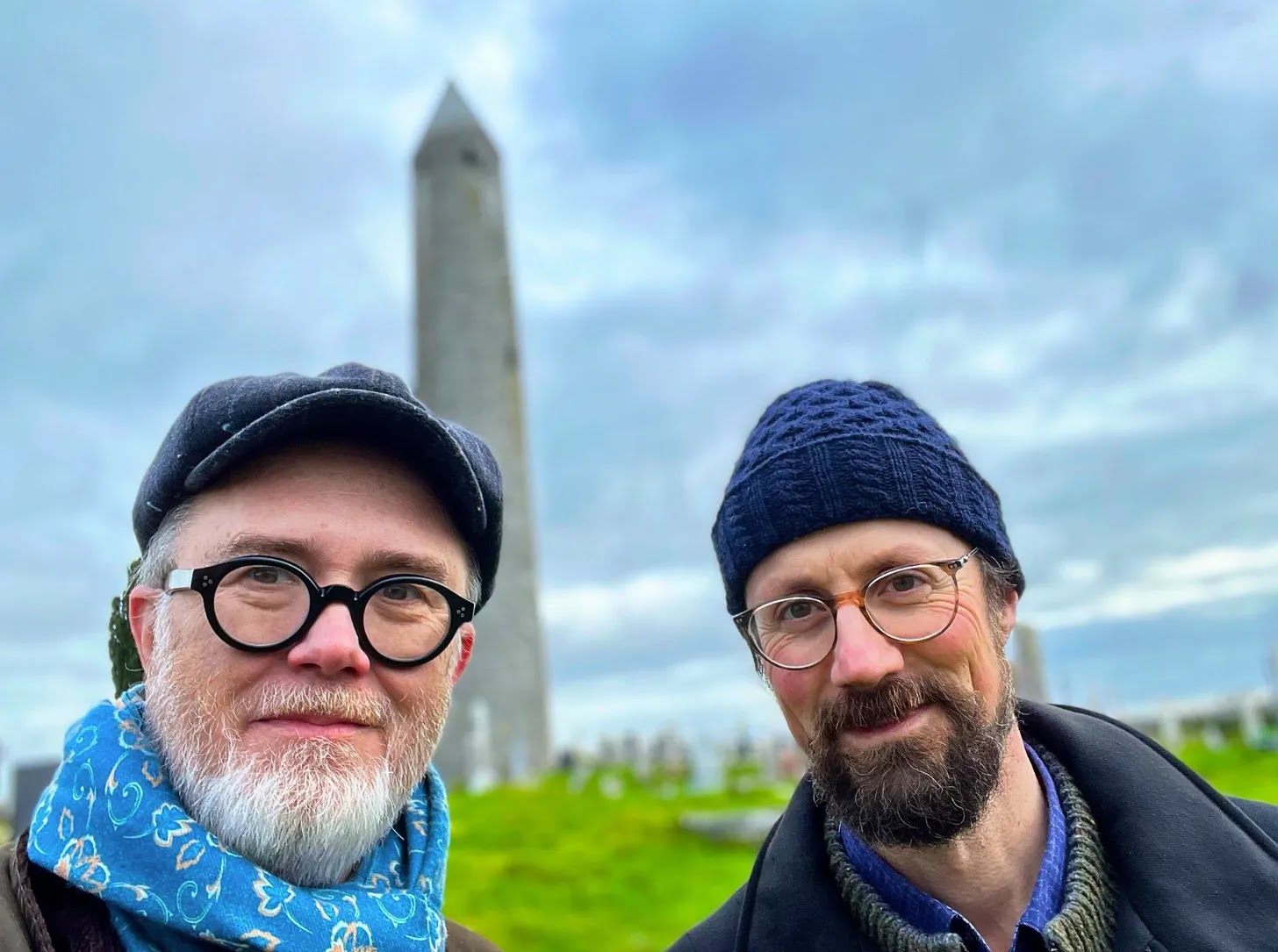
                Rod Dreyer and Paul Kingsnorth, Near the St. Colman Tower in County Clare


Just as Dreher argues for the "Benedict Option," in which religious believers form small local communities with their own schools, churches, and social groups of families to live out their religious faith, Kingsnorth recommends that people build voluntary associations of religious families and groups at the local level.  

Notice that both Kingsnorth and Dreher are incoherent in that while they profess to reject liberalism, they actually embrace the fundamental principles of liberalism--such as voluntarism and religious liberty--and they reject the illiberalism of theocratic regimes that would coercively enforce religious belief.  As I have indicated in previous posts, they share this incoherence (both affirming and denying liberalism) with Patrick Deneen.

When I went to Dreher's Substack website, I discovered that to read his blog, I would have to subscribe for $50 a year.  I then received this email message from Dreher:

Hey friend, if you’d like to receive the Daily Dreher, um, daily, please subscribe. It’s only five dollars per month (25 cents per day), or fifty dollars per year. Come on, it’ll be fun. Peel me a grape! French me a fry!

Why is it different from my blog? For one thing, it’s a spiritual exercise for me. On my TAC blog, I chronicle the Continuing Crisis. Here, I write in a much quieter and more reflective mode, trying to train my eye to perceive the beauty, the goodness, and the meaning in the world — reasons to hope. On this blog, I attempt to discover the truth of Auden’s lines: “Life remains a blessing/Although you cannot bless.”

I write more candidly and personally about religion here. Also, about books, ideas, travel, and food — but always striving to do so in a “what’s good about the world” sense. Crazy, innit? I hope you will join me. I also feature reader letters. Let’s make this a collective venture. We’re all trying to figure out how to “stagger onward rejoicing” (Auden again), so let’s help each other.

Thanks,

Rod.


Notice that for every 2,000 subscribers, this brings in a cool $100,000 of yearly revenue.  And it's only 25 cents per day!


This reminds us of Sally's wisdom: There's money in mysticism.