Traditionalist conservatives and classical liberals need Charles Darwin. They need him because a Darwinian science of human nature supports Burkean conservatives and Lockean liberals in their realist view of human imperfectibility, and in their commitment to ordered liberty as rooted in natural desires, cultural traditions, and prudential judgments. Arnhart's email address is larnhart1@niu.edu.
I have a chapter on Leon Kass's thought in a book recently published by Rowman & Littlefield--Thinking Through Science and Technology: Philosophy, Religion, and Politics in an Engineered World, edited by Glen Miller, Helena Mateus Jeronimo, and Qin Zhu. The title of this book plays off the title of Carl Mitcham's Thinking Through Technology: The Path Between Engineering and Philosophy (University of Chicago Press, 1994). Many of the authors in this new book have collaborated with or been engaged with Mitcham in his life-long philosophic study of modern science, technology, and engineering. I worked with Mitcham when he was the Editor-In-Chief of the four-volume Encyclopedia of Science, Technology, and Ethics (Macmillan Reference, Thompson Gale, 2005). I was one of the three associate editors for that book.
Anyone who wants to think philosophically about science and technology will want to read this book. Unfortunately, it's an expensive book--$155 ($127 at Amazon). But you do get a lot for your money, because it's a big book of 582 pages with 27 chapters divided into five parts: "Philosophy and Technology," "Philosophy and Engineering," "Religion, Science, and Technology," "Science and Technology Studies," and "Science and Technology Policy." Many of the authors are the most prominent people in the field--such as Albert Borgmann, Andrew Feenberg, Carl Mitcham, and Daniel Sarewitz.
Most of the authors are scornful of modern science and technology as having a morally and intellectually degrading influence on human life. In that respect, I am out of place in this book, because I regard the Baconian project for science and technology as morally and intellectually defensible. This is manifest in some of my articles for the Encyclopeda of Science, Technology, and Ethics--such as "Francis Bacon," "Biotech Ethics," and "Evolutionary Ethics."
Most of the material in my chapter ("Bioethics, Philosophy, and Religious Wisdom: A Critical Assessment of Leon Kass's Thought") comes from my many blog posts on Kass over the past 15 years--in particular, "Atheistic Religiosity in Leon Kass's Reading of the Bible" (December 28, 2021), "Leon Kass's Bioethics in Darwinian Liberal Education" (January 12, 2022), and "Leon Kass's Mistaken View of Science" (November 21, 2018).
In their "Introduction" to the book, the editors summarize my chapter in two sentences: "Larry Arnhart submits Leon Kass's historical progression of philosophical, religious, and scientific beliefs to the test, assessing their coherence and how they influenced his views on human nature, human dignity, and the appropriate limits of biotechnology. While Kass advocated for 'a richer bioethics' informed by classics in the Western tradition to discern those limits, Arnhart instead argues for a Darwinian science of human nature as part of liberal education" (7).
That second sentence is inaccurate. Far from rejecting Kass's "richer bioethics," I argue that it should be part of my proposed Darwinian liberal education. My main criticism of Kass is that while what I am defending resembles what Kass proposed in Toward a More Natural Science in 1985, Kass later scorned the Darwinian naturalistic ethics of this first book, beginning with the publication in 2002 of his essay "The Permanent Limitations of Biology." Part of this move away from his earlier scientific naturalism is Kass's atheistic religiosity in his books on the Hebrew Bible. But then, to add to the confusion, Kass returned to his earlier naturalistic ethics in his work with the President's Council on Bioethics (2001-2005), particularly in the Council's Beyond Therapy report.
I have argued that there is a Kantian conservative tradition of atheistic religiosity expressed in people like Roger Scruton and Leon Kass, which resembles the Dionysian religiosity of Friedrich Nietzsche. Atheistic religiosity is for those who want the "magic of religious feeling" as an expression of the human mind's "religious instinct," but without having to believe in the real existence of God independent of the human mind. They don't believe in the literal truth of Christianity or any other religion. And yet they want to have a sense of the sacred that comes from religious emotions, but without the need to believe any religious doctrines. They believe that God is dead, but they also believe that human beings need to satisfy their religious longings for transcendence and redemption if they are to escape the nihilism that they fear comes from the death of God.
In the April issue of First Things, Carl Trueman offered a similar interpretation of Scruton's religious longings. Although Trueman saw that religious themes became prominent in Scruton's later work, he wondered "whether Scruton believed in God or whether he simply believed that God was a good idea." He asked, "was Scruton's God a theological reality or an anthropological one?" He observed: "I fear that Scruton is too faithful a student of Kant to engage with the deeper metaphysical claims that, say, Christianity makes. Throughout his work . . . it is always the experiential reality of the sense of the sacred and the good things that flow from it that he addresses. But is that really enough?" He also observed: "Scruton is vulnerable to the criticism that the place he ascribes to the religious instinct simply supports his own cultural and political tastes, granting them a veneer of authority. Is his thinking thus a castle--albeit a magnificent and beautiful castle--floating precariously in mid-air? Or, more controversially, is it a conservative expression of nihilism, with values likely to devalue themselves over time through lack of any solid, transcendent foundation?" Thus did Trueman point to what I have identified as Scruton's atheistic religiosity--affirming the anthropological need for God without affirming the theological reality of God's existence.
In the June/July issue of First Things, there is a letter from Daniel J. Mahoney disputing Trueman's interpretation of Scruton. He writes: "Even after Scruton left his 'apprenticeship in atheism,' as he once called it, he never became or wished to become a theologian or a metaphysician. His approach remained eminently phenomenological, defending those intimations of the transcendent that come to sight in the 'life world' of lived experience and mutual moral accountability. Trueman suggests that this approach, eschewing traditional metaphysics, likely veils the 'conservative expression of nihilism,' defending a 'religious instinct' that ultimately points to nothing beyond itself."
Trueman cannot be right about this, Mahoney insists, because "Scruton was the sworn enemy of every form of nihilism." He cites an essay by Mark Dooley ("Roger Scruton Was No Atheist") as proving that Scruton was not an atheist.
The first problem with Mahoney's argument is that he fails to see that the most fervent critics of atheistic nihilism are themselves nihilists who turn to atheistic religiosity in their attempt to escape what they fear to be the degrading consequences of nihilism. The preeminent example of this is Nietzsche. Even as he announced that "God is dead," he lamented the debasing effects that this would have on human beings who would no longer be elevated by transcendent longings for the divine. To avoid this, he professed his faith in the religion of Dionysus that would allow him to be the most pious of those who do not believe in God.
The second problem with Mahoney's argument is that he concedes Trueman's point that Scruton's God is a subjective projection of the human mind's longing that has no objective reality. Notice that Mahoney admits that Scruton's religion was purely "phenomenological"--rooted in human "lived experience"--but with no foundation in theological or metaphysical truth. So, even though we know that God is dead, we need to feel that He is alive; and that emotional need is satisfied by Scruton's atheistic religiosity.
It should also be noted that in the essay by Dooley cited by Mahoney, Dooley never says that Scruton believed in the real existence of God independently of the human mind. Dooley's point is that Scruton scorned the "evangelical atheists" like Richard Dawkins and Christopher Hitchens. Attacking evangelical atheists is exactly what one should expect of a religious atheist.
That's what Sally said to me when I asked her about her business selling meditation lessons in Zen Buddhism. We were both students at the University of Chicago in the 1970s, and we met at a student party in a crowded apartment in Hyde Park. Although the tuition was low compared to tuition today at Chicago, we were all so poor that we were always looking for income to pay our expenses. Some of us were envious of Sally's success as a spiritual entrepreneur in marketing her Buddhism to other students.
I thought about Sally a few days ago when I read Paul Kingsnorth's essay in the March 2023 issue of First Things--"A Wild Christianity." Kingsnorth is a novelist, poet, and essayist living in Ireland.
Kingsnorth says he is returning to the "wild Christianity" or "cave Christianity" of the ancient Christian ascetics; and in doing that, he says he is rebelling against the degrading materialist culture of modern secular liberalism. But a careful reading of this and other essays by Kingsnorth will show that in his longing for Christian spirituality, he is not so much rebelling against bourgeois liberalism as expressing it.
Like Sally, Kingsnorth is a spiritual entrepreneur who sells his Christian writing to consumers who long for the experience of a Christian transcendence of the world. There is nothing wrong with that, because it shows that the bourgeois virtues of a liberal society include the Christian virtues of faith, hope, and charity. The natural desire for religious transcendence is part of evolved human nature that will be manifested in a liberal social order where human beings go to the free marketplace of religion to choose among the competing religious traditions in finding the one that is most satisfying to them.
There is something wrong, however, in Kingsnorth's refusal to see that far from working against liberal culture, he is working within it, because he depends on the religious liberty in the pursuit of spirituality that is secured by a liberal social order to live a happy and profitable life as a writer of spiritual literature.
His talent for engaging writing is evident from the very beginning of his First Things essay:
"Through the mouth of the cave, I watched the storm front move in from the east. I could already her the approaching thunder; the low bank of cloud was gray with it. I was perched on a low ledge inside the cave, which was just long enough to accommodate a human body laid prone. I had filled the place with candles, which guttered and danced in the wind that was rising now with the coming storm."
"The storm broke in an instant, and then everything was roaring. Great nails of rain hammered down on the hazels, and the rumbles of thunder were replaced by an explosion right above me. The dimming evening sky was suddenly ripped from horizon to horizon by a great sheet of white lightning. More rain. More thunder. More electricity. It roared on and then, eventually, it roared past. Ten minutes later, the rain had slowed, but the pause in hostilities was only temporary. I could see another front approaching over the mountains."
"Four hours it went on. A night of storm and screaming skies. In the end, everything was black but for the light the candle flames threw on the weeping walls of the limestone cave, and irregular explosions of light, which would suddenly imprint on my retinas a white cave mouth like an opening to heaven or hell. The roof of the cave was dripping now. Outside there was nothing to be sseen unless the lightning came down, seeking the ground like a long-lost brother. No ruined church, no well, no spring, no wood: Everything that had surrounded me during the day had been swallowed by the Atlantic winter."
"This was how I spent the eve of my fiftieth birthday."
He explains that his stormy night in this cave was his attempt to relive the experience of the sixth-century Irish Saint Colman Mac Duagh, who is said to have lived a monastic solitary life in this cave for seven years. Here's a picture of the cave in the Burren, a region on the west coast of Ireland:
In a previous essay for First Things--"The Cross and the Machine" (June 2021)--Kingsnorth recounted his spiritual journey that eventually led to this night in St. Colman's cave. As a child, he had no interest in religion because it seemed to be irrelevant to his life. Then, as a teenager, he became an atheist. But he often visited empty churches. And he often walked and camped in the mountains of England and Wales, where he felt the wondrous mystery of the natural world. He thus became an animist or pantheist, and this pantheistic religion of nature was then expressed in his environmentalist activism, which included chaining himself to construction equipment to stop building projects.
Then he saw that there was a deeper issue here: the ecological crisis arose from the refusal of the liberal way of life to accept any limits to human action on the world, and this was a crisis of culture that was also a crisis of spirit. He saw that every culture is built around a spiritual core that looks to a divinely transcendent reality that limits human action. Without that spiritual core, no culture can survive.
He saw that every culture might need to look to one of the great spiritual traditions to provide some understanding of a transcendent reality beyond the world. He chose Zen Buddhism. On his fortieth birthday, he went on a week-long Zen retreat. But then over the next five years, he saw that Zen Buddhism would not satisfy him, because he needed to worship, but he did not know what it was that he could rightly worship.
He decided that since he had a reverence for nature, he could worship God in nature. That led him to become a priest of the witch gods: he joined a Wiccan coven. Wicca is a modern pagan religion developed in the first half of the twentieth century, in which all Wiccans are priests or priestesses of two gods--the Great Goddess and the Horned God--who are two aspects of a greater pantheistic deity. Kingsnorth observes: "My coven used to do its rituals in the woods under the full moon. It was fun, and it made things happen. I discovered that magic is real. It works. Who it works for is another question."
But he still had a vague sense that there was a void inside of him, and that the Wiccan stuff was just play-acting. Then, he began to dream of Jesus speaking to him. And, finally, he had an ecstatic experience: "Suddenly, I could see how everyone in the room was connected to everyone else, and I could see what was going on inside them and inside myself. I was overcome with a huge and inexplicable love, a great wave of empathy, for everyone and everything. It kept coming and coming until I had to swagger out of the room and sit down in the corridor outside. Everything was unchanged, and everything was new, and I knew what had happened and who had done it, and I knew that it was too late. I had just become a Christian." He explains: "In the end, though, I didn't become a Christian because I could argue myself into it. I became a Christian because I knew, suddenly, that it was true." In January of 2021, he joined the Romanian Orthodox Church and was baptized in the River Shannon.
But notice that while now he knows that Christianity is true, previously he knew that pantheism was true, that Zen Buddhism was true, and that Wicca was true. How is what he knows now to be true any better than what he previously thought he knew to be true? He doesn't explain. And yet perhaps his account of his reliving the monastic experience of St. Colman in the cave can show us how his experience of Christian truth rises above his experience of pantheistic truth, Buddhist truth, or Wiccan truth.
Kingsnorth says he was drawn to Colman because from a young age he was obsessed by hermits and mystics like Tolkein's Gandalf. "Maybe this sort of thing is in my blood, or maybe I just read too many fantasy novels." Above all, he loves the story of strange men who retreat to the wilds to find wisdom and God. And so, he loves the story of Colman:
"Colman lived in his cave, it is said, for seven years. He drank water from the spring, ate hazelnuts and berries from the forest, and wandered the 'pathless woods' praying. He built a small oratory church, of which no traces remain, though a later stone ruin stands on the same site. . . ."
. . .
"My favorite story about Colman concerns his wild companions. The saint, the legends tell us, somehow befriended a cockerel, a mouse, and a fly, and trained them to help him out. The cockerel's job was to crow when he needed to get up in the morning to pray. The mouse's role was to step in if Colman didn't feel like getting out of bed: It would nibble his ear until he roused himself. As for the fly, Colman trained it to walk along the lines of his Bible in the dim light, so he could follow it as he read. A new stained glass church window in the nearby town of Gort portrays the saint with his three animal companions rather sweetly."
Notice that Kingsnorth identifies this "story" as based on "legends." Actually, everything he says about Colman comes from a short biography posted on the St. Colman.com website. The source for this website biography is a book by Father Jerome Fahey--The History and Antiquities of the Diocese of Kilmacduagh (Dublin: M. H. Gill and Son, 1893)--which can be found online. I don't see any evidence that Kingsnorth has read the book. When Fahey tells the story about the cock, the mouse, and the fly, he warns his reader: "It should be remembered that those eminent writers who reproduce those legends never professed to do more than carefully reproduce what they found in ancient writings, without at all holding themselves responsible for their credibility" (60). Fahey repeatedly makes remarks like this: "some of our medieval writers have added some incredible marvels of the usual legendary character" (62).
So, is Kingsnorth presenting this story of Colman as historically true? Or does he see it as only a legend that might have little credibility? He certainly makes no effort to persuade his readers that this story is historically accurate, as if this does not matter to him.
Consider this last paragraph of his essay:
"There is a wild-haired man in the desert clad in camel skin. He is the start of things. He lives on honey and insects and he calls us to prepare for the coming of one who will baptize not with water but with fire. God, he says, will come in human form. He will be born in a cave, he will walk on the water and battle in the desert and when he comes to the city it will kill him. But that will not be the end of the story. We can't write the ending to this story. We can only trace the lines on the page in the dim light of the cave mouth. We can only wait patiently for the storm to come over and for the lightning to come down, and illuminate everything."
So, now, Kingsnorth presents the stories of John the Baptist and Jesus as if they are at the same level as the stories of Colman in the cave. If the stories of Colman are legends, are these New Testament stories also only legends?
If so, then Jesus exists as a character in a good fictional story, but he does not really exist. If this is what Kingsnorth is suggesting, then he is still an atheist, as he was as a teenager, but now he's a religious atheist. He is promoting the same atheistic religiosity that I have identified in people like Friedrich Nietzsche, Roger Scruton, Leon Kass, and Jordan Peterson.
If this is so, then Kingsnorth shows us that there is a global market for atheistic spirituality. Kingsnorth's global marketing of his writing seems at odds with his vehement scorn for global capitalism and modern technology. His first novel--The Wake--was published through internet crowdfunding. Film rights to this novel were then sold to a global group of investors led by the actor Mark Ryland and the former president of HBO Films Colin Callender.
If you go to Kingsnorth's website, you will see how he markets his books and his blog to generate revenue. A subscription to his "Abbey of Misrule" blog costs 50 Euros a year (about $53 USD). In his use of internet marketing and in other respects, Kingsnorth has a lot in common with Rod Dreher. This past week, Dreher was in Ireland to interview Kingsnorth for Dreher's new book on "reinchantment" movements around the world.
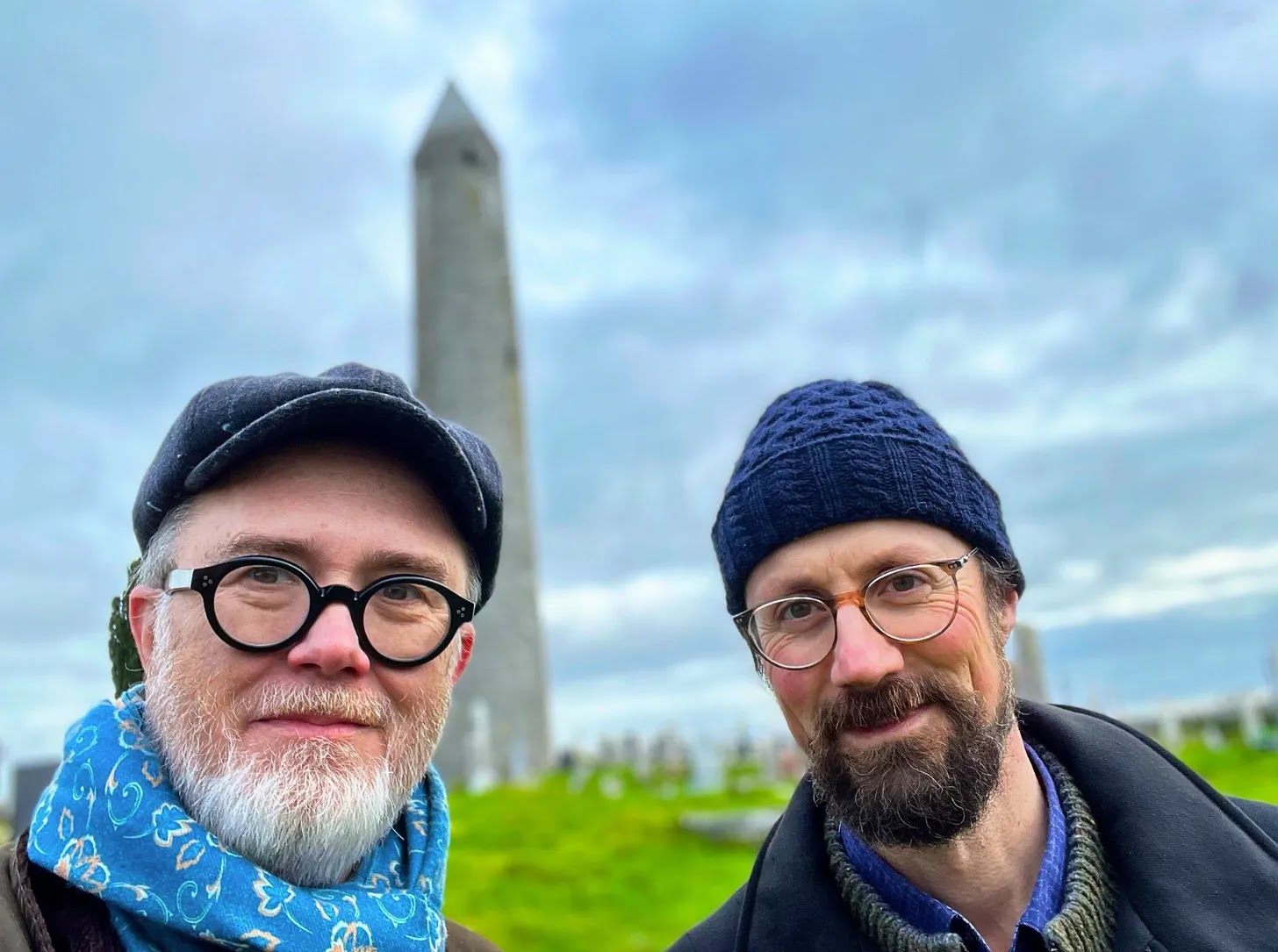
Rod Dreyer and Paul Kingsnorth, Near the St. Colman Tower in County Clare
Just as Dreher argues for the "Benedict Option," in which religious believers form small local communities with their own schools, churches, and social groups of families to live out their religious faith, Kingsnorth recommends that people build voluntary associations of religious families and groups at the local level.
Notice that both Kingsnorth and Dreher are incoherent in that while they profess to reject liberalism, they actually embrace the fundamental principles of liberalism--such as voluntarism and religious liberty--and they reject the illiberalism of theocratic regimes that would coercively enforce religious belief. As I have indicated in previous posts, they share this incoherence (both affirming and denying liberalism) with Patrick Deneen.
When I went to Dreher's Substack website, I discovered that to read his blog, I would have to subscribe for $50 a year. I then received this email message from Dreher:
Hey friend, if you’d like to receive the Daily Dreher, um, daily, please subscribe. It’s only five dollars per month (25 cents per day), or fifty dollars per year. Come on, it’ll be fun. Peel me a grape! French me a fry!
Why is it different from my blog? For one thing, it’s a spiritual exercise for me. On my TAC blog, I chronicle the Continuing Crisis. Here, I write in a much quieter and more reflective mode, trying to train my eye to perceive the beauty, the goodness, and the meaning in the world — reasons to hope. On this blog, I attempt to discover the truth of Auden’s lines: “Life remains a blessing/Although you cannot bless.”
I write more candidly and personally about religion here. Also, about books, ideas, travel, and food — but always striving to do so in a “what’s good about the world” sense. Crazy, innit? I hope you will join me. I also feature reader letters. Let’s make this a collective venture. We’re all trying to figure out how to “stagger onward rejoicing” (Auden again), so let’s help each other.
Thanks,
Rod.
Notice that for every 2,000 subscribers, this brings in a cool $100,000 of yearly revenue. And it's only 25 cents per day!
This reminds us of Sally's wisdom: There's money in mysticism.
Kass’s richer “more natural science” of his early writings supports a
richer public bioethics as part of a Darwinian liberal education that unifies
all intellectual disciplines—the natural sciences, the social sciences, and the
humanities—within the unifying framework of Darwinian evolutionary
science.The aim of liberal education is
to probe all the fields of intellectual inquiry to understand how the complex
interaction of natural propensities, cultural traditions, and individual
choices shapes the course of human experience within the cosmic order of
nature.Darwinian science provides a
general conceptual framework for such liberal learning grounded in the
scientific study of the evolution of life within the evolution of the universe
(Arnhart 2006).
Kass’s primary
contribution to this Darwinian liberal education has been in developing what he
has called “a richer bioethics, one that recognizes and tries to do justice to
the deep issues of our humanity raised by the age of biotechnology” (Kass
2005:221).Kass agrees with the argument
of John Evans that the public bioethical debate has become too “thin,” and that
it needs to become “thicker” (Evans 2002).Kass’s “richer” bioethics is what Evans would call a “thicker”
bioethics.For bioethics to become
richer or thicker, it must become part of a Darwinian liberal education, which
became clear in the work of the President’s Council as led by Kass (Briggle
2010).
Evans uses the metaphor
of thick and thin to distinguish the substantive rationality of the
bioethical debate from the late 1960s to the early 1970s and the formal rationality
that came to dominate bioethics beginning in the late 1970s.In the earlier period, the substantive rationality
of the debates over biotechnology required that people argue about whether some
technology such as human genetic engineering was consistent with ultimate
values or ends, which required that people argue about those ultimate
ends.So, for example, a scientist
promoting human genetic engineering might argue that this was the best means
for achieving the ultimate end of human control of nature and human nature, so
that human beings could engineer the perfection of their species by eliminating
genetic defects and pursuing genetic enhancements.But then a theologian might argue that this
was “playing God,” in that man was trying to become his own self-creator and
thus take the place of God the Creator, in violation of God’s ends.There would then be a debate over which
ultimate end should be higher—striving for a human God-like power over nature
for human self-perfection or a humble and reverent acceptance of a God-given
human nature with all its imperfections.Since many conflicting ends could be considered in such debates,
reaching agreement on which end should predominate was difficult if not
impossible, so that the debates could become endless.In this way, the substantive rationality of
these debates was thick.
By contrast, beginning
in the late 1970s, bioethics became dominated by professional
bioethicists—typically, academic philosophers and lawyers—who developed
bioethics as a specialized field of study promoting an argumentation of formal
rationality.According to this view, any
biotechnological means that maximized ends was ethical; and the ends were
predetermined by consensus of the experts to be limited in number.The ends were eventually reduced to four
principles: personal autonomy (informed consent), beneficence (benefits greater
than costs), nonmaleficence (avoiding harm), and justice (fair distribution of
benefits, costs, and risks) (Beauchamp and Childress 2001).It was assumed that these were universal ends
to which all human beings could agree.All other ends for which there was no universal agreement were excluded
from the bioethical debates.Once they had
agreed to their four ends, bioethicists would only debate about calculating the
best means to these four ends; and they saw no need to debate about ends other
than these four.In this way, the formal
rationality of their debates was thin.
Kass’s thicker or
richer bioethics accepts the four principles adopted by the professional
bioethicists—autonomy, beneficence, nonmaleficence, and justice.But in his writings and in his work with the
President’s Council, Kass has shown that a deep deliberation about bioethical
issues must consider many important moral ends beyond these four principles;
and because these many moral ends often conflict with one another, different
people will come to different conclusions about how to weigh these ends.The moral deliberation about these ends will
often not reach consensus.
For example, consider
the debate over whether parents should be free to use stimulant drugs—such as
Ritalin (methylphenidate) or Adderall (amphetamine)—to modify the behavior of
children who are inattentive, impulsive, or hyperactive.For thin bioethics, there might be only two
principles for this debate—autonomy and nonmaleficence.Are parents exercising their autonomy in
giving these drugs to their children?Are these drugs safe for the children?If the answer to both questions is yes, then we should allow parents to
use these psychotropic drugs in helping them to rear their children.
But for the thick
bioethics of the Beyond Therapy report, some important moral
considerations have been passed over in silence.For example, one crucial part of parental
rearing of children is the moral education of children through shaping their
moral character so that they are capable of self-control and behaving
appropriately in society.Will
behavior-modifying drugs interfere with this moral education?Will this teach children that good behavior
is caused by chemistry, and that the responsibility for their conduct belongs
not to themselves but to their pills?Will this diminish their sense of moral agency? (President’s Council
2003a:87-92). The thin bioethics of the
professional bioethicists does not ask such questions.
Furthermore, while thin
bioethics requires only a narrowly specialized training—learning the four moral
ends and how biotechnological means can maximize those ends—thick bioethics
requires a broadly interdisciplinary liberal education that integrates the
natural sciences, the social sciences, and the humanities in seeking wisdom
about the conditions for a flourishing human life and how biotechnology might
impede or promote that human flourishing.That liberal education is best pursued, Kass believes, through reading
and discussing the Great Books of the Western intellectual tradition.One can see that in the anthology of 92
selected texts published by the President’s Council—Being Human: Readings
from the President’s Council on Bioethics.The authors of the texts include scientists (such as Edward O. Wilson,
Richard Feynman, and James Watson), physicians (such as Hippocrates and Richard
Selzer), philosophers (such as Plato, Aristotle, Lucretius, and Thomas Hobbes),
poets (such as Homer, Shakespeare, and Walt Whitman), and novelists (such as
Leo Tolstoy, George Eliot, and Willa Cather) (President’s Council 2003b).
In its devotion to a
bioethics rooted in liberal education, the President’s Council was different
from the other five general federal bioethics commissions preceding it.Those other commissions were concerned mostly
with developing specific public policy proposals.By contrast, the Kass Council made few policy
proposals.Kass has admitted that the
Council has had “no demonstrable effect” on “specific policy issues.”He conducted the Council’s meetings and
supervised the Council’s reports to promote seminar-like discussions that
allowed open debate about the moral and intellectual questions raised by
bioethical disputes without ever reaching consensus.He said that Beyond Therapy was “a
purely educational work, with no policy recommendations.”He explained that his primary goal was
educational: he hoped that the published discussions and reports of the Council
would be adopted as readings for college seminar courses on bioethics or for
groups of ordinary citizens who wanted to discuss deep questions about the
implications of biotechnology for human life (Kass 2005:229, 240-41, 244-47).
We can see here that
Kass’s educational goal is to revive the tradition of liberal education as a
unification of all knowledge in the quest for wisdom about the meaning of our
humanity, of our human nature within the natural order of the whole.That unity of knowledge requires a unifying
framework of thought.There is today
only one plausible source for such a common ground of knowledge, and that is
Darwinian evolutionary science.
Although Kass does not
explicitly affirm this idea of a Darwinian liberal education, he does at least
implicitly suggest it in some of his early writings and in some of the reports
of the President’s Council.For example,
as we have seen, the Council’s report Beyond Therapy is organized around
natural human desires—“desires for longer life, stronger bodies, sharper minds,
better performance, happier souls, better children” (Kass 2005:235).These natural desires are the “essential
sources of concern” that set the standards for any moral assessment of
biotechnology.They constitute “what is
naturally human,” “what is naturally and dignifiedly human.”They are “naturally given” to us as inherent
in our human nature.If we seek the
source of this gift, we find that our natural desires are “wondrous products of
evolutionary selection,” because “the human body and mind” are “highly complex
and delicately balanced as a result of eons of gradual and exacting evolution”
(President’s Council 2003a:286-87).
This unification of
knowledge founded on evolutionary science suggests something like what Edward
O. Wilson called “consilience” (Wilson 1998).Wilson argued that the natural human desire to understand the world as
an orderly whole was a quest for the fundamental unity of all knowledge.This longing for a comprehensive knowledge of
the whole began with ancient philosophers such as Thales and Aristotle.It was renewed by the Enlightenment of the
seventeenth and eighteenth centuries.Now, Wilson claimed, the progress in modern science has created the
realistic prospect for satisfying this ancient longing by developing a web of
causal explanations that would combine all the intellectual disciplines.Crucial to this unification of knowledge is
its foundation in evolutionary biology as explaining the nature of human beings
and their place in the natural whole, including the evolution of the universe
from the Big Bang to the present, which some historians now call Big History
(Christian 2004; Christian, Brown, and Benjamin 2014).Darwinian liberal education must encompass
all of this.
THE NATURAL LIMITS OF BIOTECHNOLOGY
One objection to this pursuit of a Darwinian liberal education that
studies an evolved human nature is that this assumes the stability of that
human nature, even though we know now that biotechnology is giving us the power
to change and even abolish that human nature.After all, isn’t Kass’s bioethics driven by his fear that biotechnology
can lead to what C. S. Lewis called “the abolition of man”?
The problem with this
objection, however, is that it shows how the power of biotechnology for
changing human nature has been exaggerated (Arnhart 2003).The most fervent advocates of biotechnology
welcome the prospect of using it to transform our nature to make us
superhuman.The most fervent critics of
biotechnology warn us that its power for transforming our nature will seduce us
into a Faustian bargain that will dehumanize us.Both sides agree that biotechnology is
leading us to a “posthuman future” (Fukuyama 2002).
This is a mistake.It ignores how evolution has shaped the
adaptive complexity of our human nature—our bodies, our brains, and our
desires—in ways that resist technological manipulation.A Darwinian view of human nature—one truer to
the facts of human biology and human experience—reveals the limits of
biotechnology, so that we can reject both the redemptive hopes of its optimistic
advocates and the apocalyptic fears of its pessimistic critics.
Biotechnology will be
limited both in its technical means and in its moral ends.It will be limited in its technical means
because complex behavioral traits are rooted in the intricate interplay of many
genes, which interact with developmental contingencies and unique life
histories to form brains that respond flexibly to changing circumstances.Consequently, precise technological
manipulation of human nature to enhance desirable traits while avoiding
undesirable side effects will be very difficult if not impossible.Biotechnology will also be limited in its
moral ends because the motivation for biotechnological manipulations will come
from the same natural desires that have always characterized human nature.
In Beyond Therapy,
Kass and his Council recognized both these natural limits on
biotechnology.For example, they noted
the technical limits to any attempt to use genetic engineering to design
“better children”: “Growing recognition of the complexity of gene interactions,
the importance of epigenetic and other environmental influences on gene
expression, and the impact of stochastic events is producing a strong challenge
to strict genetic determinism.Straightforward genetic engineering of better children may prove
impossible, not only in practice but even in principle.”Consequently, “genetically engineered
‘designer babies’ are not in the offing” (President’s Council 2003a:38, 276).They also recognized that biotechnology would
be limited in its moral ends as set by the natural desires of evolved human
nature, including those desires around which the whole discussion in Beyond
Therapy is organized.
CONCLUSION
I have identified three problems in Leon Kass’s “richer
bioethics.”He contradicts himself when
he shifts back and forth between his appeal to natural reason and his appeal to
supernatural revelation—Athens and Jerusalem.His attempt to develop a biblical bioethics fails because he Bible lacks
the moral authority, the moral clarity, and the moral reliability required for
settling debates over biotechnology.In
claiming that all modern science is blinded by a crudely reductionistic,
mechanistic, and antiteleological understanding of nature, he fails to
recognize how modern science sees the emergent complexity and teleological
structure of life.
Kass could avoid these
problems by renewing his project for a “more natural science” in his early
writings.This expansive conception of
modern science would support a Darwinian liberal education that could help us
to think deeply and act morally in our modern world as shaped by modern science
and technology.
More broadly, Darwinian
liberal education can help us understand our human place in nature.We are neither mindless machines nor
disembodied spirits.We are
animals.As animals, we display the
animate powers of nature for movement, desire, and awareness.We move to satisfy our desires in the light
of our awareness of the world.We are a
unique kind of animal, but our distinctively human traits—such as symbolic
speech, practical deliberation, and conceptual thought—are emergent
elaborations of powers shared in some form with other animals.Our powers for habituation and learning allow
us to alter our natural environments, but even these powers are emergent extensions
of the behavioral flexibility shown by other animals.So even if the natural world was not made for
us, we were made for it, because we are adapted to live in it.We have not been thrown into nature from some
place far away.We come from nature.It is our home.
REFERENCES
Arnhart, Larry. 2003. “Human Nature Is Here to Stay.” The New
Atlantis, Number 2 (Summer): 65-78.
Arnhart, Larry. 2006. “Darwinian Liberal Education.”Academic Questions 19 (Fall):6-18.
Beauchamp, Tom L., and James F. Childress. 2001. Principles of
Bioethics. 5th edition. New York: Oxford University Press.
Christian, David. 2004. Maps of Time: An Introduction to Big
History. Berkeley: University of Chicago Press.
Christian, David, Cynthia Stokes Brown, and Craig Benjamin. 2014. Big
History: Between Nothing and Everything. New York: McGraw-Hill.
Evans, John H. 2002. Playing God? Human Genetic Engineering and the
Rationalization of Public Bioethical Debate.Chicago: University of Chicago Press.
Briggle, Adam. 2010. A Rich Bioethics: Public Policy,
Biotechnology, and the Kass Council. Notre Dame, IN: University of Notre
Dame Press.
Fukuyama, Francis. 2002. Our Posthuman Future: Consequences of the
Biotechnology Revolution. New York: Farrar, Straus, and Giroux.
Kass, Leon. 2005. “Reflections on Public Bioethics: A View from the
Trenches.” Kennedy Institute of Ethics Journal 15:221-50.
President’s Council on Bioethics. 2003a. Beyond Therapy:
Biotechnology and the Pursuit of Happiness. Washington, DC: President’s
Council on Bioethics.
President’s Council on Bioethics. 2003b. Being Human: Readings from
the President’s Council on Bioethics. Washington, DC: President’s Council
on Bioethics.
Wilson, Edward O. 1998. Consilience: The Unity of Knowledge.
New York: Knopf.
Does modern
science and technology give us greater understanding of and greater
power over the world?Or should we
recognize the limits of scientific knowledge? Do we need to search for a wisdom that is beyond science? And should we worry that modern science and technology give us no wise moral guidance for their proper uses, and thus we have no way to prevent the dehumanizing effects of scientific technology?Does philosophy or religion give us the wise moral guidance that we need?For example, can we develop a philosophic or
religious bioethics that can guide us in regulating biotechnology so that it
promotes human dignity rather than human degradation?
Leon Kass has devoted his life to pondering these questions.“I esteem scientific discovery, and I
treasure medical advance,” Kass told the Chicago Tribune.“But it’s very clear that the powers we are
now acquiring to alter the human body and mind also pose a certain threat to
the long-term future of the things that make us human" (Manier and Grossman 2001).He has argued that we need a bioethics rooted
in a wise understanding of nature and human nature that teaches us the requirements
for a worthy human life, so that we can defend those conditions of human
dignity against the threat of dehumanization by modern science and the
technological manipulation of nature. He has shown how we can find that humanizing
wisdom by reading the “great books” of philosophy, literature, and religion.He has done that through his published
writings, his work as chair of the President’s Council on Bioethics
(2001-2005), and through his influence on other scholars (such as those who write for the journal The New Atlantis).
His
argument is weakened, however, by four problems. First, his argument is ambiguous in that while he
recognizes that the appeal to unaided natural reason is opposed to the
appeal to any supernatural revelation, which he identifies as the choice between Athens and Jerusalem, he shifts back and forth
between these two opposing positions; and he never resolves the contradiction.
Second, while his philosophical defense of an Aristotelian
and Darwinian ethical naturalism is plausible, his religious defense of biblical
revelation is self-contradictory and self-deceptive in promoting an atheistic
religiosity. That was suggested in his first biblical book The Beginning of Wisdom: Reading Genesis (2003), and it has become clear in his new book Founding God's Nation: Reading Exodus (2021).
The third problem is that while Kass tries to interpret the Bible as providing religious reasons for
limiting biotechnology, the Bible cannot resolve our debates over biotechnology, because we cannot agree on the moral authority, the moral clarity, or the moral
reliability of the Bible.
The fourth problem is that his
account of the limitations of modern scientific knowledge assumes an
implausible caricature of modern science as a crudely reductionistic and mechanistic
view of nature.
I have written a book chapter on the third problem--"The Bible and Biotechnology" (2009). Richard Sherlock (2009) has written a good reply to my paper. I have written some posts on the fourth problem here, here, and here.
In this post, I will consider the first two problems.
ATHENS OR JERUSALEM?
The ambiguity of Kass's position in the reason/revelation debate was evident in how different readers saw conflicting messages in Kass's Genesis book. Richard Sherlock (a Christian believer) thought the book showed that Kass was "a person of faith" (Sherlock 2005). Alan Jacobs (also a Christian believer) said that despite Kass's claim that his book was "addressed to believers and nonbelievers alike," this was not really a book for believers like himself, and so nonbelievers would be more comfortable with Kass's "philosophic reading" of the Bible. Kass summarized his interpretation of Genesis in one sentence: "The book of Genesis is mainly concerned with this question: is it possible to find, institute, and preserve a way of life that accords with man's true standing in the world and that serves to perfect his godlike possibilities?" (Kass 2003: 661). Jacobs responded: "It seems to me that not a single significant word in this sentence accords with what the book of Genesis is about. Genesis, and the culture from which it emerges, doesn't seem to me to give a damn about our 'true standing in the world' and our 'godlike possibilities'; rather, as far as I can tell, it is about God and what He has done, and is doing, to repair what His rebellious and arrogant creatures have broken: our relations with ourselves, with one another, with the creation, and with God Himself" (Jacobs 2003).
While Sherlock puts Kass on the side of Jerusalem, and Jacobs puts him on the side of Athens, Hayyim Angel (an Orthodox rabbi) places him somewhere in between the two poles. He says that Kass shows "an unorthodox step toward revelation" or "a step toward a faith commitment" (Angel 2012: 61, 70).
So why did readers find mixed messages in Kass's Genesis book? For Sherlock's identification of Kass as "a man of faith," the crucial passage was this:
"The reader may well wonder how these studies have affected my own outlook on life, morals, and religion. I wish I could give a definitive answer; but I am still in the middle of my journey. There are truths that I think I have discovered only with the Bible's help, and I know that my sympathies have shifted toward the biblical pole of the age-old tension between Athens and Jerusalem. I am no longer confident of the sufficiency of unaided human reason. I find congenial the moral sensibilities and demands of the Torah, though I must confess that my practice is still wanting. And I am frankly filled with wonder at the fact that I have been led to this spiritual point, God knows how" (2003: xiv).
This is what Sherlock saw as Kass's profession of faith. But notice that Kass speaks only of his "sympathies" and "moral sensibilities" as shifting towards the biblical pole. He does not say that he believes in the existence of God or in the Bible as His revelation. Notice also that Kass says "my practice is still wanting"--he is not a practicing believer. A few pages earlier, he says that he is not "religiously observant" (xii). He also makes it clear that he does not believe any of the theological doctrines of orthodox biblical religion. He says that he has deliberately avoided "any specific doctrine" (2017:35). For example, he denies the doctrines of the immortality of the soul in an afterlife with rewards for the saved in Heaven and punishments for the lost in Hell (2017:21).
Why then did Kass's "sympathies" shift towards the Hebrew Bible? In his new Exodus book, Kass says that after the birth of his first child, he and his wife joined a Conservative synagogue in 1967. He says they were "preparing ourselves to offer our children an experience of Jewish tradition that they could later embrace or reject as they wished. Better, we thought, to be something rather than nothing, and our something was nothing to be ashamed of" (x-xi). But notice that he does not say that this "experience of Jewish tradition" led him to become a pious Jewish believer. He can be a member of a Conservative synagogue without being "religiously observant."
For Conservative Judaism, the authority of Jewish law and tradition derives more from an evolving popular agreement than from any divine revelation of theological doctrines. Moreover, most Conservative Jews are not religiously observant.
And yet, Angel is a leader of Orthodox Judaism--a rabbi and biblical scholar--who says that Kass's "greatest moment" in the Genesis book is this passage: "If we allow ourselves to travel its narrative journey, the book may reward our openness and gain our trust. Who knows, we may even learn who (or Who) is speaking to us, and why" (17). Angel says this shows how a secularized reading of the Torah can lead to "a step toward a faith commitment" (70). Perhaps. But Kass has never explicitly affirmed a "faith commitment," and Angel offers no evidence that he has.
On the contrary, Kass says that he does not read the Bible in the manner of "those fundamentalist Protestants and Orthodox Jews who approach the text piously and who study it reverently" (2003:2). Instead of that, he will offer a "philosophic reading" of the Bible--reading it in the same way he reads Homer's Iliad, Plato's Republic or Aristotle's Nicomachean Ethics (2003:1).
Amazingly, he admits that this contradicts what he says about the opposition of reason and revelation, Athens and Jerusalem. "The Bible, I freely acknowledge, is not a work of philosophy, ordinarily understood. Neither its manner nor its manifest purposes are philosophical. Indeed, there is even good reason for saying that they are antiphilosophical, and deliberately so. Religion and piety are one thing, philosophy and inquiry another. The latter seek wisdom looking to nature and relying on unaided human reason; the former offer wisdom based on divine revelation and relying on prophecy. There is, I readily admit, a reason to be suspicious of a philosophical approach to the Bible" (2003:3).
Therefore, sometimes Kass stresses the tension between reason and revelation, which forces us to choose one side or the other. But at other times, he suggests overcoming this tension by finding some middle ground between the two. That middle ground must be nature. But to say that, Kass must contradict himself because he says repeatedly that the philosopher's appeal to nature contradicts the pious man's appeal to revelation.
By "nature" I mean the idea of the regular order of the observable world as knowable by human reason. As Kass indicates, the Hebrew Bible has no word for "nature," and this has been noted by some people who believe the very idea of nature is absent from the Bible. If everything is created by God, then we might think that everything exists not by any regular order but only by the contingent will of God. If there is no natural order in things, then philosophy or science as the inquiry into the causal regularity of the universe is futile. The only true wisdom would be unquestioning obedience to the arbitrary contingencies of God's inscrutable will.
Kass admits: "we run the risk of distorting the biblical teaching by referring anachronistically to the Bible's view of 'nature,' or indeed by using the term at all in this volume. Nevertheless, we shall do so, albeit nervously, in order to bring our study of the biblical text into conversation with other wisdom-seeking activities. We shall, no doubt, have later occasions to visit this question of nature. For now, let the reader beware" (2003:44). Actually, he never does "visit this question of nature" in the Bible later in his book. Consequently, he never resolves this fundamental contradiction in both affirming and denying the opposition between natural reason and divine revelation.
The only way for Kass to resolve this contradiction would be for him to admit that he was mistaken in turning away from the Aristotelian and Darwinian naturalism of his Towards a More Natural Science (1985) and moving towards biblical revelation. If he were to do this, he could still read the Bible for whatever philosophical wisdom it might contain; but he would have to correct the Bible to conform to a philosophical conception of natural morality and natural understanding.
THE ATHEISTIC RELIGIOSITY OF THE DIVINE PRESENCE
In his new book on Exodus, Kass says while he has "no single epiphany to report" from his years of reading the Bible, he can say that reading Exodus has had a profound effect on him, especially in recent years. "I have lived with the book and allowed it to work on me. . . . And it has changed me" (2021:xiii). The biggest change has come from his reading of the last third of Exodus, which is devoted to the construction of the portable Tabernacle that the people of Israel will carry with them as they wander for forty years in the Sinai desert.
Kass has seen that the ritual enactments in the Tabernacle "speak to the human soul's deep longings for transcendence and that--quite mysteriously--can bring a numinous Presence into the daily lives of ordinary human beings" (2021:xv). "Having witnessed the Tabernacle's raising," Kass says, "I try to imagine it occupied, myself among the assembled," and thus "we bear collective witness to His awesome Presence":
"When performing the prescribed rituals or raising our voices in worship and song, we may on occasion be lifted up to otherworldly states of feeling and awareness, sensing for a moment that attachment to God is the core and peak of existence. Could this be what is meant by knowing His Spirit and feeling His Presence?" (2021:604)
This does sound like a religious conversion, in which Kass has actually felt the Divine Presence. Does this suggest that Kass can now affirm the real existence of the biblical God, because by living with the final chapters of Exodus and imagining himself performing the rituals in the Tabernacle, he has felt the Presence of God?
Well, not exactly. If you study carefully what Kass says about the meaning of the Divine Presence in the Tabernacle, I think you will see he's teaching what I call atheistic religiosity--religious feelings of transcendence, of being in touch with God, but without believing any religious doctrines about the real existence of God. God "exists" only in the minds and actions of people who feel awe and reverence in their experience of a transcendent Dionysian frenzy elicited by religious ceremony. (I have also identified atheistic religiosity in the work of Friedrich Nietzsche, Roger Scruton, and Jordan Peterson.)
God requires daily sacrifices in the Tabernacle. At the beginning and end of each day, a young lamb is to be burned on the Altar (Exodus 29:38-42). These sacrifices are imitations of a human meal, but the meal is for God. Why? Kass explains: "Surely He has no ordinary need for nourishment. Are the offerings then solely for our sake, to remind us daily--when we rise up and when we lie down--of what we owe for our existence, given us not for our merit but as an act of grace? Are the offerings of gratitude intended to introduce a similar gracious disposition into our souls" (2021:499). Yes. But Kass sees more here than that:
"The sacrifices are not only for the human beings; they are important also for Him. Strange though it is to say, the Lord needs the sacrifices, not to eat, but analogously to our need for food: in order to live in our world. He 'needs' for human beings to recognize His presence in order to be Himself fully present in His world. The purpose of the daily sacrifices, He comes close to saying, is to keep the association alive: [if] you bring the daily sacrifices to the door of the Tent of Meeting before the Lord, [then] 'I will meet with you and speak unto you there.' If there are no sacrifices, there can be no meeting. The Lord will go into eclipse--not as an act of will or as punishment to us, but as an unavoidable consequence of being ignored. If God's Presence is unnoticed, unknown, or unacknowledged, He is not Present. Not to be known is, in a very real sense, to cease to be. I-Will-Be-What-I-Will-Be depends on His creatures for 'Being-What-He-Is.'" (2021:500)
Therefore, God exists only in the religious thoughts and actions of the human beings who know or acknowledge Him. If He were not recognized by those who believe in Him, He would "go into eclipse"--He would "cease to be."
Kass thinks this point is made more explicit when God says that He needs the ritual sacrifices in the Tabernacle "that I might dwell among them" (Exodus 29:43-46). This states the "ultimate purpose" of God and the purpose of the whole Torah (2021:500-503, 598, 603). When God dwells in the religious life of Israel, there is a mutual benefit: it benefits Israel that they come to know God, and it benefits God to exist as part of Israel's life forever. If Israel were to stop worshiping God, then God would be dead. As Kass says, "The Lord God of Israel needs the recognition of His children for His living Presence in the world" (689).
Kass draws a similar conclusion from his reading of the first chapter of Genesis, particularly Genesis 1:27: "And God created the human being in His image, in the image of God He created him, male and female He created them." Kass sees this verse as important because it provides the biblical basis for seeing man as the most godlike of the animals, and thus supporting the moral equality of all human beings as equal in their human dignity. He also sees this equal human dignity as the fundamental principle for religious bioethics, which claims that we ought to prohibit any biotechnological alteration of the human body or mind that would violate that equal human dignity.
How can Kass interpret the creation story in Genesis 1 so that it shows us that this is a truth, even a self-evident truth--that God created human beings in His image? Kass states his interpretation first in his Genesis book and then repeats it in almost the same words in other writings (2003:36-40; 2017:310-314; 2021:591-593).
I need to quote some of this at length:
"To see how man might be godlike, we look at the text to see what God is like. In the course of recounting His creation, Genesis 1 introduces us to God's activities and powers: (1) God speaks, commands, names, blesses, and hallows; (2) God makes, and makes freely; (3) God looks at and beholds the world; (4) God is concerned with the goodness and or perfection of things; (5) God addresses solicitously other living creatures and provides for their sustenance."
"In short: God exercises speech and reason, freedom in doing and making, and the powers of contemplation, judgment, and care."
"Doubters may wonder whether this is truly the case about God--after all, it is only on biblical authority that we regard God as possessing these powers and activities. But it is indubitably clear--even to atheists--that we human beings have them, and that they lift us above the plane of a merely animal existence. Human beings, alone among the creatures, speak, plan, create, contemplate, and judge. Human beings, alone among the creatures, can articular a future goal and use that articulation to guide them in bringing it into being by their own purposive conduct. Human beings, alone among the creatures, can think about the whole, marvel at its many-splendored forms and articulated order, wonder about its beginning, and feel awe in beholding its grandeur and in pondering the mystery of its source."
"These self-evident truths do not rest on biblical authority. Rather, the biblical text enables us to confirm them by an act of self-reflection. Our reading of this text, addressable and intelligible only to us human beings, and our responses to it, possible only to us human beings, provide all the proof we need to confirm the text's assertion of our special being. Reading Genesis 1 performatively demonstrates the truth of its claims about the superior ontological standing of the human. This is no anthropocentric prejudice, but cosmological truth. And nothing we shall ever learn about how we came to be this way could ever make it false." (2003:37-38).
We thus confirm the truth of Genesis 1 "by an act of self-reflection," because in reading the text we are "holding up a mirror in which we see reflected our special standing in the world." Another way of putting this, Kass observes, is that "not until there are human beings does the universe become conscious of itself--a remarkable achievement that should surely inspire awe and wonder, even in atheists" (2017:313).
Notice how Kass says that the teaching of Genesis 1 should be clear "even to atheists," and it should "inspire awe and wonder, even in atheists"--atheists like Kass? Doesn't Kass here suggest that God's mental powers exist only as an anthropomorphic projection or mirror of human mental powers?
Doesn't Kass express the same idea in his Exodus book in saying that God needs to dwell in the minds of His believers who acknowledge Him, because without that human acknowledgement, God would "in a very real sense . . . cease to be"?
That's what I call atheistic religiosity--the idea that human beings have a natural longing for God that can be satisfied through religious feelings, but without any doctrinal faith in God's existence, because God does not exist outside of those human religious feelings.
The problem with Kass's atheistic religiosity is that it's incoherent self-deception. It's incoherent in trying to both affirm and deny the existence of God. It's self-deception because it's a fake religiosity that doesn't work if we know its fake.
The atheistic religiosity of Kass's reading of the Bible also fails to sustain a religious bioethics. That became evident in Kass's chairing of the President's Council on Bioethics. Kass never introduced Bible-reading into the Council's meetings (Arnhart 2005; Briggle 2010). And in Beyond Therapy: Biotechnology and the Pursuit of Happiness (2003)--perhaps the best of the Council's reports--there are no references to the Bible and only a few vague references to "souls with longings for the eternal" (200, 206, 288, 299).
In a section of the report that considers the "appreciation of the giftedness of life," it is said that "although it is in part a religious sensibility, its resonance reaches beyond religion." There is no attempt to identify God as the giver of life. Instead, nature and human nature are identified as "the naturally given," which has arisen as "wondrous products of evolutionary selection" (287-290).
The report appeals repeatedly to a purely naturalistic ethics rooted in human nature and the natural human pursuit of happiness as the complete and comprehensive satisfaction of natural human desires--Athens rather than Jerusalem (205, 235, 260, 265, 270).
REFERENCES
Angel, Hayyim. 2012. "An Unorthodox Step Toward Revelation: Leon Kass on Genesis Revisited." Tradition: A Journal of Orthodox Jewish Thought 45 (4): 61-70.
Arnhart, Larry. 2005. "President's Council on Bioethics." In Encyclopedia of Science, Technology, and Ethics, edited by Carl Mitcham, 1482-86. New York: Macmillan Reference.
Arnhart, Larry. 2009. "The Bible and Biotechnology." In Sean D. Sutton, ed., Biotechnology: Our Future as Human Beings and Citizens, 123-157. Albany, NY: State University of New York Press.
Briggle, Adam. 2010. A Rich Bioethics: Public Policy, Biotechnology, and the Kass Council. Notre Dame, Indiana: University of Notre Dame Press.
Jacobs, Alan. 2003. "Leon Kass and the Genesis of Wisdom." First Things (June).
Kass, Leon. 1985. Toward a More Natural Science: Biology and Human Affairs. New York: The Free Press.
Kass, Leon. 2003. The Beginning of Wisdom: Reading Genesis. New York: The Free Press.
Kass, Leon. 2017. Leading a Worthy Life: Finding Meaning in Modern Times. New York: Encounter Books.
Kass, Leon. 2021. Founding God's Nation: Reading Genesis. New Haven, CT: Yale University Press.
Manier, Jeremy, and Ron Grossman. 2001. "Bush's Guardian of Bioethics." The Chicago Tribune.
The President's Council on Bioethics. 2003. Beyond Therapy: Biotechnology and the Pursuit of Happiness. Washington, DC: President's Council on Bioethics.
Sherlock, Richard. 2005. "Jerusalem and Athens." Modern Age 47 (1) (Winter).
Sherlock, Richard. 2009. "A Transcendent Vision: Theology and Human Transformation." In Sean D. Sutton, ed., Biotechnology: Our Future as Human Beings and Citizens, 159-188. Albany, NY: State University of New York Press.
This is a video of my lecture for a conference on "Science, Human Nature, and Public Policy," April 4-6, sponsored by the Center for Political and Economic Thought at Saint Vincent College in Latrobe, Pennsylvania. All of the lectures can be found on YouTube.
I was especially happy to visit Saint Vincent for the first time because one of the best of my former Ph.D. students--Jason Jividen--has been teaching there for some years. This also gave me the chance to pay homage to those famous residents of Latrobe--Arnold Palmer and Fred Rogers--and also to sneer while driving past The Trump House (Google it).
With nine speakers delivering lectures on a wide range of topics, it was sometimes hard to see the thematic coherence of the conference. But by the second day, I began to see some recurrent themes; and when the last speaker--Melissa Moschella--spoke in favor of "animalism," I saw the question of animalism as one common theme in many of the lectures, although Moschella was the only speaker who used the term.
Animalism is the term used by some contemporary philosophers over the past thirty years for a seemingly simple idea: We are animals. We are, each of us, an animal of a certain kind, the kind that is called Homo sapiens. In contrast to those dualists who assert that we are not just animals but persons, and that our personal identity transcends our animal bodies, animalists assert that every human person is a human animal. We are self-aware thinking beings with a first-person perspective on the world--each of us can say "I"--but this personal experience of subjective self-consciousness and decision making arises from the psychological properties of the human animal. Not every human animal is a human person, because a human fetus is an animal, but it lacks the subjective self-awareness of a person; and a human animal that falls into a persistent vegetative state without any capacity for self-conscious thought is no longer a person. Moreover, the death of the human animal body brings the death of the human mind or soul, so there is no personal immortality separated from an animal body.
One might imagine, however, that there could be personal immortality if dead animal bodies could be resurrected in such a way as to sustain personal minds. The resurrection of Jesus shows this. Christian theologians like Thomas Aquinas have speculated on what this resurrected human animal body would be like. (I have written about this here, here, and here.)
Animalism does not necessarily deny the possibility of persons that are not animals, because we might imagine a capacity for personal experience that does not depend on animal bodies--such as angels, deities, or robots.
A good presentation of animalism is Stephen Blatti's article on "Animalism" (2014) in the online Stanford Encyclopedia of Philosophy and his coedited book (with Paul Snowden)--Animalism: New Essays on Persons, Animals, and Identity (2016). As Blatti indicates, many of the objections to animalism depend on imaginative thought experiments--as is often the case with analytic philosophers--that supposedly show how human persons could be separated from their animal bodies. So, imagine, for example, that we could transplant a person's brain or head from one body to another, and imagine that the thoughts and memories of that self-conscious person could then be attached to a new animal body, and the old animal body could be destroyed. Does this show that the human person is not identical to any particular animal body?
But there's no proof here that such a transplant could be successful--that a brain could be severed from its body without destroying personal identity. Moreover, this ignores the fact that a brain is itself an embodied animal organism; and so a mind that depends on a brain is not fully disembodied.
There is at least one rare human condition, however, that does seem to deny the animalist's claim that each of us is identical to a particular human animal--a rare type of conjoined twinning called dicephalus--in which twins are conjoined below the neck, so that we see two distinct heads on one body, with two brains supporting two distinct mental lives. This looks like two persons with only one animal body.
Conjoined Twins Abby and Britany Hensel at Their Wedding
Abby and Britany look like two separate persons sharing one animal body. So does this show that personal identity is not animal? While Abby and Britany are clearly sharing one body, other conjoined twins--like the famous "Siamese twins" Chang and Eng Bunker--have two bodies joined by only a small belt of flesh at the waist. Conjoined twins thus raise deep questions about the anatomical biology of human nature (Dreger 2004; Quigley 2003).
Actually, although it happens rarely, lots of nonhuman animals have been born with two heads--including cats, cattle, snakes, turtles, and more. So does this show that their personality is separated from their animality?
Stephan Blatti (2007) argues that dicephalic twins are a "borderline case" of the human animal--with more than one but less than two complete animals. This need not be seen as a counterexample to the animalist's claim that each of us is identical to a human animal.
Here I will follow this question of animalism as it came up in the nine lectures at the Saint Vincent conference.
Blombos Cave or Bethlelem? Science, Theology, and Human Nature
Christopher Baglow, the University of Notre Dame
Baglow is the Director of the Science and Religion Initiative at Notre Dame. His lecture was to answer one question: What do science and faith teach us about human origins and human nature?
Some scientists would point us back to Blombos Cave on the southeast coast of South Africa, where archaeologists have found evidence of behavioral changes among Middle Stone Age human ancestors dating to 100,000 to 70,000 years ago.
Engraved Ochre found in Blombos Cave
Although it's hard to interpret its meaning, the abstract patterns of engraving on ochre look like the oldest evidence of symbolic artifice. This capacity for symbolic abstraction has been identified by some evolutionary scientists as the distinctive human difference: human beings are animals, but they have naturally evolved from primate ancestors to be the human kind of animal that is capable of symbolic culture, which makes possible human art, science, philosophy, and religion. (I have written about the uniqueness of human symbolic culture here.)
Baglow asked: Is this Adam? If these ancient human ancestors in Blombos Cave were the first truly human beings, because of their capacity for symbolic thought, Jews, Christians, and Muslims might say that they correspond to Adam and Eve of the Genesis story of Creation. The problem, of course, is that the scientists studying the artifacts at Blombos Cave do not see any evidence there for God's creation of Adam and Eve in God's image.
But then, some evolutionary psychologists who are also Christians (like Justin Barrett) would say that what we see here is the natural emergence of Homo religiosus--the first animal capable of believing in and longing for God through symbolic thought. A theistic evolutionist could say that God used a natural evolutionary process to create human beings in His Image. (Some of my posts on these points are here , here, and here.)
Baglow gave us a manifestation of this evolved human capacity for religious symbolism by giving us a Christian theological interpretation of human nature as fulfilled in Jesus Christ: to become fully human is to be open to Christ as both fully human and fully divine--as Adam was before the fall into sin, as the embodied image of God.
As he did this, he also affirmed Thomas Aquinas's animalism--Aquinas's Aristotelian insistence that human beings really are animals, even if animals of a special human kind, and that the human mind or soul is an activity of the human animal.
Baglow did not speak about the contradiction in Aquinas's account of how the soul arises in human biology--claiming that this arises through a fully natural embryological process, but then also claiming that this requires a miraculous infusion of soul by God. I wrote about this in my paper for this conference, and in a post here.
Why Intelligent Design Is Not A Good Way to Challenge the Hegemony of Naturalism in Public Life: A Thomistic Corrective
Francis Beckwith, Baylor University
Beckwith is a professor of philosophy at Baylor. Originally, he was hired at Baylor to be the Director of the J. M. Dawson Institute of Church-State Studies. Members of the Dawson family signed a letter to the President of Baylor protesting that since Beckwith was a Fellow of the Discovery Institute--the leading organization promoting Intelligent Design Theory--he was opposed to J. M. Dawson's idea of separating church and state, because he was advocating the teaching of ID as science in public schools, which was an unconstitutional violation of the separation of church and state. They asked that he be terminated. When he was denied tenure at Baylor, he appealed the decision and won.
It stirred great interest, therefore, when Beckwith openly rejected ID in a series of blog posts at the Biologos website, which promotes theistic evolution. He argued that he had never fully embraced ID, although he had defended the constitutionality of teaching ID in high school biology classes. He explained that the Catholic theology of Thomas Aquinas had persuaded him that ID was theologically mistaken: ID assumes that natural causes compete with divine action, because divine action requires a miraculous break in the natural order of causes. In fact, God can act through the secondary causes of nature--including natural evolution--that depend ultimately on God as First Cause. William Dembski and Michael Behe imply that God is not First Cause, because divine intelligent design is separated from nature and chance. In affirming that God acts through nature and chance, Beckwith has adopted theistic evolution as opposed to ID.
In his lecture at Saint Vincent, Beckwith repeated these points, which are some of the same points that I have made against ID (here and here).
Apparently, Beckwith would agree with those theistic evolutionists who think that God could have created human beings in His Image through the natural evolution of animal species, which would support animalism. He did not indicate, however, whether this would explain the evolution of the soul in the brain through the emergent evolution of the primate brain, which has been my argument (here). Nor did he indicate how his theistic evolution would allow for those miracles necessary for Christian faith--such as the Resurrection and Second Coming of Christ.
Science and Slavery in Lincoln's "Lecture on Discovery and Inventions"
Diana Schaub, Loyola University, Maryland
A professor of political science, Schaub offered an interpretation of Abraham Lincoln's "Lecture on Discovery and Inventions." Lincoln's account of human history as a progressive advance through technological inventions and discoveries--such as language, writing, the printing press, the discovery of America, and the steam engine--sounds a lot like Francis Bacon's project for progress through the human mastery of nature.
But as someone influenced by Leon Kass and other conservative critics of modern science and technology, Schaub wanted to read Lincoln as rejecting Baconian science. She did this by indicating that at least some of the inventions mentioned by Lincoln--such as "the invention of the negro" at the start of the trans-Atlantic slave trade--are morally harmful. Therefore, she concluded, Lincoln teaches us that technological progress is not necessarily moral progress, and he hints that God will punish us for our immoral inventions like slavery.
Her argument was unpersuasive, because she played down the general Baconian tone of moral and intellectual progress in Lincoln's lecture. She ignored the fact that while this lecture has more Biblical references than any other speech by Lincoln, Lincoln uses the Bible as an anthropological history, and he ignores or mocks the Bible's religious teaching. So, for example, here is how Lincoln begins the lecture:
"All creation is a mine, and every man, a miner."
"The whole earth, and all within it, upon it, and round about it, including himself, in his physical, moral, and intellectual nature, and his susceptibilities, are the infinitely various 'leads' from which, man, from the first, was to dig out his destiny."
"In the beginning, the mine was unopened, and the miner stood naked, and knowledgeless, upon it."
Notice that "in the beginning," there is no divine creation of man, and man depends totally on himself "to dig out his destiny" without any guidance from God.
Considering the themes of this conference, it was surprising that Schaub said nothing about Lincoln's acceptance of the idea of evolution--as developed by Robert Chambers--and nothing about the many ideas that Lincoln shared with Darwin. I have written about this here, here, and here.
In his "Lecture on Discoveries and Inventions," his "Address to the Wisconsin State Agricultural Society," and in his meeting with some American Indian chiefs, Lincoln laid out his conception of evolution as moving through three stages of human society--from foraging societies to agrarian societies to societies based on commercial exchange and free labor (Arnhart 1985, 2012; Miller 2001). Like Darwin, Lincoln believed that human beings were unique in the animal world because of the human capacity for symbolic speech, which allowed for collective learning in the artful domination of nature for the material, moral, and intellectual improvement of human life. Originally, all human beings lived by foraging, a way of life still manifested in Lincoln's day among some of the Native American Indians. The invention of agriculture supported human civilization as an advance beyond the savage life of foragers. But, despite the progress in civilization in agrarian states, such states were founded on slavery and other forms of coerced labor, so that rulers lived by exploiting peasant labor. Lincoln saw that the Industrial Revolution based on commercial exchange and free labor was bringing a new revolution in human cultural evolution that promised the physical, moral, and intellectual liberation of labor. He saw the abolition of slavery as a crucial move toward this new state of society, which would bring a "new birth of freedom" to which all human beings would have a fair chance in the "race of life." Schaub said almost nothing about this Lincolnian vision of human cultural evolution.
On the Margin: Out of the Mainstream in Liberal Societies
Amy Wax, the University of Pennsylvania Law School
In the fall of 2017, Amy Wax, a professor at Penn Law School, started an intense debate at her school and around the country in response to her op-ed article in the Philadelphia Inquirer entitled "Paying the Price for Breakdown of the Country's Bourgeois Culture." She attributed many of the social ills in the United States today to the failure to enforce the bourgeois norms of conduct that prevailed in the United States up to the early 1960s. "All cultures are not equal," she declared. This was enough to provoke the charge that she was a white racist elitist! This then became part of the general debate over whether the liberal principle of freedom of speech and thought should include freedom for cultural conservatives to speak in favor of social norms that support the moral condemnation of those groups that reject those norms.
Wax's lecture was an extension of what she had said in her article and in her responses to her critics. She began by agreeing with Alexis de Tocqueville about the mania for equality in America. While she accepted the justice of equality of opportunity as fundamental for any good liberal social order, she worried that equality of opportunity was being replaced by equality of outcomes, so that every group of people demands recognition for its identity and freedom from any stigmatizing disapproval.
Every healthy society requires norms of good conduct, she observed, and the enforcement of those norms will inevitably create social ranking of people into higher and lower classes. Thus, in a bourgeois liberal society, those who exhibit (or at least profess) the bourgeois norms will be respected, and those who don't will not. Of course, a liberal society must show some tolerance for deviant behavior, but tolerance is not endorsement, and so we will allow some deviance but only within bounds and with moral disapproval.
In her defense of the need for bourgeois culture in a liberal society, Wax could have deepened her argument by rooting it in a science of human nature that explains the evolution of bourgeois liberalism as symbolic niche construction. She came close to doing that in her references to some of Charles Murray's reasoning in The Bell Curve and Coming Apart, in which he shows how the bourgeois virtues satisfy the natural desires of our evolved human nature. I have written about these points here, here, here, and here.
In her article for the Inquirer, but not in her lecture, Wax made clear her agreement with Murray that the breakdown of bourgeois culture was limited to a few groups of people--some working-class whites and some inner-city blacks--and that the upper classes and upper-middle classes were still practicing the bourgeois virtues. She wrote in her article: "Among those who currently follow the old precepts, regardless of their level of education or affluence, the homicide rate is tiny, opioid addiction is rare, and poverty rates are low."
Wax should emphasize more than she does that except for a few groups, the indicators of social disorder that rose in the late 1960s and 1970s have dropped dramatically in recent decades. For example, in her article, she says that "homicidal violence plagues inner cities." But she doesn't note that homicide rates have been dropping since the 1980s. Here are the deaths by homicide per 100,000 resident population in the United States: 5.1 in 1950, 10.4 in 1980, and 5.1 in 2014. So homicide has fallen to the levels of the 1950s. Consider also the divorce rate in the U.S. measured as divorces per 1,000 people: 4.3 in 1946, 2.2 in 1957, 5.3 in 1980, and 2.8 in 2010. So after peaking in 1980, the divorce rate has dropped almost to the level of 1957, and it's actually lower than in 1946.
Moreover, some groups of Americans--such as African-Americans and women--are much better off today than they were in the 1950s. In her article, Wax says that "male working-age labor-force participation is at Depression-era lows." That is true, but it is also true that women's working-age labor-force participation is higher than it has ever been. She says that "many college students lack basic skills, and high school students rank below those from two dozen other countries." But this ignores the fact that there has been a stunning increase in educational achievement for many Americans, and particularly women. Here are the percentages of the population with 4 years or more of college education: 5.2 percent for women and 7.3 percent for men in 1950, 6.7 percent for women and 11.4 percent for men in 1962, 35.3 percent for women and 34.6 percent for men in 2018.
Contrary to the assertions of recent critics of liberalism (like Patrick Deneen and Rod Dreher), these and other social indicators prove that bourgeois liberalism has succeeded in improving the lives of most human beings who live in liberal social orders.
Schools, Religion, and the New Science: "Education and the State" Revisited
Catherine Pakaluk, The Catholic University of America
Thomas Aquinas claims that like other animals whose offspring require parental care, human parents are naturally inclined by instinct to care for their children by providing for their existence, their nourishment, and their education. And thus parental care of children is part of natural law.
Throughout most of human history, parents have been responsible for the education of children. But beginning in the 19th century, in Europe and North America, there arose the first state-sponsored and compulsory mass education systems. For the first time, parents were compelled to send their children to government schools for five to ten years with a prescribed curriculum (usually reading, writing, and arithmetic) and licensed teachers. For the past 150 years, this has been a great experiment that has sparked a debate over its successes and failures.
Pakaluk is a professor of economics in the Business School at Catholic University of America who studies the economics of education and religion. She is a critic of compulsory state education who thinks that parents should have the freedom to supervise the education of their children either through home-schooling or through choosing the school where they will send their children.
In her lecture, she elaborated her argument as a reconsideration of E. G. West's book Education and the State, which was first published in 1965. West's book was a critical study of the history of public schooling in Great Britain, beginning with the Elementary Education Act of 1870 (also called Forster's Education Act), which set the framework for the schooling of all children between the ages of 5 and 12. Eventually, this became a system of compulsory education with a curriculum prescribed by government. The main argument for this system was that parents could not be trusted to educate their children voluntarily. But West claimed that in 1870 most children were already being educated by their parents through voluntary schools supported by churches and private philanthropy. Moreover, he argued that private voluntary schooling is probably better for children. West then proposed a voucher system to replace the system of compulsory government schooling.
Pakaluk endorsed West's argument and brought it up to date by pointing out that there was little empirical evidence to support the success of public education and a lot of evidence that private voluntary schooling supervised by parents was better for educating children. Furthermore, she emphasized the importance of religious education, which is not provided in public schools.
Implicitly, Pakaluk was recommending a return to Aquinas's natural law view of parents as the natural educators of their children.
The Gold Standard Family: How Science Tells Us Marriage Still Matters in the Twenty-First Century and What Public Policy Can Do To Strengthen It
W. Bradford Wilcox, the University of Virginia
Brad Wilcox is a professor of sociology and Director of the National Marriage Project at the University of Virginia. His lecture was a summary of the social science research showing that the "gold standard family"--two married parents committed to one another in a stable household--is the best family for the couple and for the children.
Why Marriage Matters: Jonathan Rauch Interviews Amy Wax, Brad Wilcox, and Elizabeth Marquardt
Wilcox spoke against two "myths" about marriage. The first is the "soulmate myth"--the idea that people today marry only for a personally satisfying romance, and so they should divorce as soon as the romance fades. The second is the "kids will be okay myth"--the idea that as long as the kids are loved, it does not matter if their parents are unmarried.
In fact, Wilcox argued, the children are more likely to flourish if their parents are in a "gold standard marriage," where husband and wife are married and committed to fidelity and a stable household. Divorce elevates the risk of harm to the children. But even worse than divorce is cohabitation, where there are two adults in the household, but they're unmarried. In some ways, Wilcox claimed, the kids whose parents are divorced are the lucky ones! The kids of a single mom are much better off than the kids of a mom who have a live-in boyfriend. The risk of child abuse and neglect is elevated in cohabitation.
We should keep in mind, however, as Wilcox indicated, is that the superiority of the gold standard family for children as compared with other family structures is only a difference in the degree of risk on average. Most children turn out fine regardless of the structure of the family. But still the gold standard family is more likely to favor good outcomes for the children.
The gold standard marriage is also good for men and women even when they have no children, as indicated by the evidence presented by Linda Waite and Maggie Gallagher (in The Case for Marriage) showing that married people are both physically and mentally healthier than unmarried people. This indicates that conjugal bonding is a natural good of marriage even without the natural good of parental care.
Wilcox offered some recommendations for public policies that might promote marriage--such as, for example, changing the tax laws to favor marriage. But his policy proposals seemed weak. And he suggested that the best support for marriage comes not from government but from culture--from socially supported norms that teach people that monogamous marriages built around couples permanently and faithfully committed to one another is good for everyone.
In the question and answer period, Wilcox was asked about the social science research on same-sex marriage. He said that there was some evidence on both sides of the debate over same-sex marriage, but there wasn't enough evidence to resolve the debate. Same-sex marriage has only recently be legalized, and so, he observed, we will need at least 10 years to see how this experiment plays out. This supported my argument in my lecture that, indeed, we will need more experience with same-sex marriage before we have enough evidence to see whether same-sex marriage can succeed.
It's noteworthy that in the video above, Wilcox was interviewed by Jonathan Rauch, one of the leading gay men promoting same-sex marriage, and the interview was sponsored by the Institute for American Values, which was founded by David Blankenhorn. Blankenhorn was once a leading opponent of same-sex marriage, but then he changed his mind when he decided that if marriage is good, it's good for both straights and gays. I have written about this here.
In my lecture, I pointed out that the best proponents of same-sex marriage--like Rauch and John Corvino--agree with Wilcox about the "gold standard family" being the ideal. They agree that this is the best kind of family for both adults and children. But then they ask: When this ideal is unattainable, what's the best we can do? They argue that same-sex marriages can at least approximate heterosexual marriages in satisfying the two natural ends of marriage--conjugal bonding and parental care. Once we have more experience with legalized same-sex marriages, we will have enough evidence to decide whether this is true or not.
Gender Trouble, Marriage Trouble?
Mark Regnerus, the University of Texas at Austin
I have written about Regnerus's research on comparing gay and lesbian parenting with heterosexual parenting in some recent posts. In this lecture, he spoke about his present research involving a world survey of how Christian young adults around the world view marriage. He is interviewing hundreds of young churchgoers in seven different countries.
What he sees is that like other young adults today, these young Christians have moved away from the traditional "foundation model" of marriage to a new "capstone model." Traditionally, many young adults have seen marriage as a "foundation" for their life: they would marry at a young age--before their mid-20s--so that they and their spouses could work together in building a good life, which meant that they would start out relatively poor, but with the expectation that they would accumulate resources and become economically and socially successful over time. Now, many young adults see marriage as a "capstone" of their life: they don't want to start a marriage in poverty, and so they delay getting marriage until they have successful careers, and then they can be comfortable in marriage. This is part of the explanation for the decline in marriage rates and the delay in getting married.
Another part of the traditional foundation model of marriage was the expectation that marriage would be organized as a division of labor, with the wife working more as a housekeeper and mother and the husband working more outside the home as the breadwinner. The new view of marriage is that both spouses should have careers outside the home, so that the wife contributes as much to the household income as the husband.
This new view assumes "gender flexibility": instead of the traditional division of labor based on men and women having different gender roles, now men and women become interchangeable. But, then, Regnerus suggested, it's not clear that men and women need one another, and so marriage becomes less important to them. One can see here the theme in much of Regnerus's research--that modern views of human equality lead to the breakdown of the traditional family that was organized around traditional gender roles for men and women.
One of the traditional gender norms for marriage was that the share of household income earned by the husband should be greater than that of the wife, because the husband should be the primary breadwinner, and the wife the primary housekeeper. But now as women have increased their participation in the labor force in many societies, wives can contribute more to household income, and sometimes the wife's income can exceed the husband's.
Regnerus suggested that this departure from traditional gender norms has created trouble for marriage, as indicated by the research of some economists (Bertrand et al. 2015) studying the causes and consequences of relative income within households. They showed that in the United States, the distribution of the share of household income earned by the wife drops dramatically once it exceeds one-half. That is to say, it seems that many couples feel an aversion to the wife earning more than the husband. Indeed, as the economists indicate, some surveys show about 38 percent of U.S. respondents agreeing with the statement that "if a woman earns more money than her husband, it's almost certain to cause problems."
The economists offer some evidence indicating that some of the decline in marriage rates comes from women earning more than men, because men and women don't want to marry if the man would earn less than the woman. The economists also show that in households where the wife earns more than her husband, the wife does more housework than the husband, as if she's trying to restore traditional identity norms. And where the wife has the potential to earn more than her husband, she might choose to earn less than her potential. The economists also indicated that in households where the wife earns more than the husband, there is a higher likelihood of divorce.
Do we see here one of the natural sex differences in the human animal--that men tend to have a stronger drive for dominance than do women, so that husbands need to take pride in their earning more income than their wives? Does a successful marriage depend on husbands and wives taking different roles that conform to natural sex differences? Regnerus seemed to be saying yes. And yet he did not ask about whether there was any scientific explanation for this sex differences. He did not consider the possibility that evolutionary psychology might explain these differences--that, for example, in the ancestral environments of ancient human foragers, the reproductive fitness of women would have been increased, on average, by mating with men willing and able to provide resources for the women and their offspring, and consequently natural selection would favor women finding men with resources more attractive (see Trivers 1972; Buss 2016).
But notice that the majority of the respondents in that survey did not agree with the idea that a woman earning more than her husband will cause problems for the marriage. The economists report that those answering in this way tend to be more highly educated than those endorsing traditional gender roles. And as Charles Murray and others have noted, the more highly educated people tend to have more stable households and lower divorce rates. Does this suggest that a modern education can promote sexual equality in gender roles?
The Darwinian and Thomistic Natural Law of Justice Kennedy's Same-Sex Marriage Opinion
Larry Arnhart, Northern Illinois University
Having written some recent posts about my paper for this conference, I don't need to add much here about my lecture, which was a brief summary of my paper.
If we agree with Aquinas that the natural law of marriage supports two natural ends for the human animal--conjugal bonding and parental care--and if same-sex marriage can achieve those same natural ends for homosexual couples without harming children or weakening heterosexual marriage, then there is a natural law argument for same-sex marriage. But even in making this argument, I observed, one can concede that the stable marriage of husband and wife caring for their biological children is still the "gold standard family," and that same-sex marriage can be justified only as some approximation or likeness to that ideal.
When I finished my lecture, about a third of all the people in the room raised their hands to ask a question. This started a lively discussion. I was surprised by the friendly tone. Even though it was obvious that most of the audience disagreed with my position, I had the impression that many people found my arguments persuasive, even if not convincing.
This confirms my sense that most of the Christian conservatives who have opposed same-sex marriage are now conceding that they have lost the debate, because their own arguments for the goodness of marriage support the conclusion that marriage is good for homosexuals as well as heterosexuals.
The only undecided question is how many homosexuals will choose to marry, and how many will establish stable households. It is possible that most homosexuals will have no interest in marriage, and most of those who do marry will have no interest in caring for children.
Trapped in the Wrong Body? Dualism, Transgender Identity Claims, and the False Hope of Gender Reassignment Therapies
Melissa Moschella, The Catholic University of America
A popular explanation of transgender people is that they feel "trapped in the wrong body." These people have a personal gender identity that conflicts with the biological sexual identity of their bodies, and so they might seek hormonal and surgical treatment to change the sexual identity of their bodies to conform to their gender identity. It has now become a standard medical treatment for "gender dysphoria" to provide procedures for changing one's sex to coincide with one's preferred gender, so that men can become women, and women can become men.
Speaking as a professor of philosophy, Melissa Moschella argued against this "wrong body" narrative as based on a false dualist view of human nature that should be rejected in favor of an animalist view. Dualism is false because the body is intrinsic to our personal identity. Animalism rightly sees that our personal sexual identity as male or female is rooted in the biological identity of our body. We are our animal bodies. And therefore men are those with male bodies, and women are those with female bodies. It's impossible to change one's biological sex, because biological sex is impressed on our body and brain early in fetal and neonatal life.
Gender dysphoria, she argued, is not a medical problem requiring physiological or surgical treatment but a psychological problem requiring psychiatric counseling. Those with gender dysphoria are suffering from the mental delusion that their mental sexual identity differs from the sexual identity of their body. So doctors who try to help them undergo a biological sex change are not curing them but rather supporting their delusional disorder. This explains why although patients often feel better initially after sex-change procedures, later on they often become depressed, anxious, and suicidal.
Moschella made a comparison with anorexia. The cure for anorexia is not liposuction, although the patient might initially feel better, because the problem is not obesity but the psychological delusion of being too obese.
Moschella also pointed out the incoherence in the "wrong body" idea. It is said that a person's gender identity is in the mind not in the body. But then it is said that the sex of the body must be changed to be in harmony with the true gender identity of the person, which concedes that the sex of the body really is essential for sexual identity.
Moschella seemed to be agreeing with Dr. Paul McHugh at Johns Hopkins University Hospital, who was responsible for shutting down the sex-change treatment program that had once been supervised by Dr. John Money. Money was the one who invented the idea of "gender identity" as different from "sex identity," with the thought that "gender" is a mental or social construction that need not conform to biological nature. This has supported the claim that while animals have "sex," only humans have "gender." Moschella's animalism seems to deny the gender/sex dichotomy started by Money.
It should be said, however, that biological nature does sometimes throw up anomalous cases that cannot be clearly identified as male or female--the most obvious case being those who are born as true hermaphrodites, who combine male and female traits. In response to a question about such cases of intersexuality, Moschella conceded that these cases show a biological disorder creating confusion about biological sex identity, but gender dysphoria is not an intersexual anomaly of nature like this.
For Moschella to sustain this claim, she would have to refute the "developmental mismatch" theory of gender dysphoria. According to this theory, in utero the sexual differentiation of the genitals occurs separately and earlier than the sexual differentiation of the brain, so that it is possible for the sexual identity of the body to differ from the sexual identity of the brain (Bao and Swaab 2011; Williams 2018). This is not a dualist theory that denies animalism, because both the body and the brain are biological realities of the human animal. As far as I can tell, the evidence for this developmental mismatch theory is disputed. But Moschella would need to at least respond to this line of reasoning.
My argument here is that the central tendency of animal biology is to distinguish the sexual identity of males and females as determined by their complementarity for reproduction. But while this holds "for the most part," there are exceptional cases in nature where the bipolarity of male and female becomes confused.
I have written a series of posts on sexual identity, hermaphroditism, and transgenderism here, here, and here.
As you can see, I left Latrobe pondering many questions about the nature of the human animal and what it might mean for public policy. (I am still struggling to get that image of The Trump House out of my head!)
Arnhart, Larry. 2012. "Biopolitical Science." In James E. Fleming and Sanford Levinson, eds., Evolution and Morality, 221-265. New York: New York University Press.
Bao, Ai-Min, and Dick F. Swaab. 2011. "Sexual Differentiation of the Human Brain: Relation to Gender Identity, Sexual Orientation, and Neuropsychiatric Disorders." Frontiers in Neuroendocrinology 32 (April): 214-226.
Bertrand, Marianne, Emir Kamenica, and Jessica Pan. 2015. "Gender Identity and Relative Income Within Households." The Quarterly Journal of Economics 130: 571-614.
Blatti, Stephan. 2014. "Animalism." The Stanford Encyclopedia of Philosophy.
Blatti, Stephan, and Paul Snowden, eds. 2016. Animalism: New Essays on Persons, Animals, and Identity. Oxford: Oxford University Press.
Buss, David. 2016. The Evolution of Desire: Strategies of Human Mating. Revised and updated edition. New York: Basic Books.
Dreger, Alice Domurat. 2004. One of Us: Conjoined Twins and the Future of Normal. Cambridge, MA: Harvard University Press.
Miller, Eugene. 2001. "Democratic Statecraft and Technological Advance: Abraham Lincoln's Reflections on 'Discoveries and Inventions,'" Review of Politics 63: 485-515.
Quigley, Christine. 2003. Conjoined Twins: An Historical, Biological, and Ethical Issues Encyclopedia. Jefferson, NC: McFarland.
Trivers, Robert. 1972. "Parental Investment and Sexual Selection." In Bernard Campbell, ed., Sexual Selection and The Descent of Man, 1871-1971, pp. 136-79. Chicago: Aldine.
West, E. G. 2010. Education and the State. Revised edition. Indianapolis: Liberty Fund.
Williams, Shawna. 2018. "Are the Brains of Transgender People Different from Those of Cisgender People?" The Scientist (March).