The afternoon session for June 24 began with a lecture by Robin Dunbar on "The Social Animal in Evolutionary Perspective."
Dunbar is a Professor of Evolutionary Psychology at Oxford University. He is best known as a proponent of the "social brain hypothesis"--the idea that the evolutionary expansion of the human neocortex was an adaptation for navigating the complex world of social relationships. He has argued that there is a cognitive limit to the number of individuals with whom any one person can maintain stable relationships--roughly 150, which has become known as the "Dunbar number." His explanation for this is that human beings evolved mostly for life in small hunter-gatherer bands of 100-200 individuals.
He began his lecture by mentioning an obvious objection to his theory--hasn't modern communications technology (such as the Internet) expanded our social world well beyond the local band or village of our ancestral past?
His answer was that his research into the world of "Facebook" shows that the number of true "friends" that one can have is 150-200. Although some individuals might have been "friended" by hundreds of people, the actual traffic on these "Facebook" pages is limited to a smaller group. On "Facebook," all "friends" are not the same. He argued that this confirms his theory that human social groups all have mean sizes of 100-200.
Dunbar quoted from Aristotle's Nicomachean Ethics about how true friendship is possible only with a few people.
He then projected a slide with "The Expanding Circles" of social relationships--circles of increasing size but decreasing intensity. At the center of the circles is "ego," because one's care for oneself comes first, and then one extends care to a few others to whom one feels some attachment--particularly, family and friends. The attachment to family can be strong even when you don't see them very often. But the attachment to friends weakens when you don't see them.
He argued that primate social relationships depend on both emotional and cognitive capacities. One can see the emotional component in the activation of endorphins in humans that comes from light stroking. The cognitive component is manifest in the human experience of "mind reading"--imagining what other people are thinking or what they might think in various circumstances. These emotional and cognitive capacities set the limits of group size.
He explained his research showing that friendship depends on shared traits--such as similarities in language, education, worldview, and sense of humor. When such friendship is established, we are more likely to behave altruistically towards our friends.
The general message from all of this is that face-to-face relationships in small groups are essential for a healthy social life.
Dunbar concluded by warning that as the modern world becomes more global, so that we find ourselves in global networks of relationships with strangers whom we cannot know by face-to-face exchanges, we are likely to become more and more disengaged from social life, because we are evolved for bonding in small groups based on personal ties.
In my lecture at the conference, I reminded the audience of Dunbar's "Expanding Circles" diagram, and I noted that this is exactly the image that Adam Smith uses in The Theory of Moral Sentiments to explain the expanding circles of human attachments with care for oneself at the center. Moreover, Smith saw this as a biological adaptation for the social bonding of mammalian animals like human beings.
I also indicated that Dunbar's evolutionary account of human sociality explains some of those desires on my list of 20 natural desires--including familial bonding, friendship, and social status.
I argued that this "social brain" conception supports the liberal idea that social order arises largely as a spontaneous or unintended order in civil society. This sustains Hayek's insight that we have evolved for life in small foraging bands based on familial bonds and personal relationships of exchange.
I am not persuaded, however, by Hayek's claim that a modern extended society based on impersonal, abstract relationships requires a Freudian repression of our social instincts for life in small foraging groups. The atavistic yearning to return to those primordial groups explains the appeal of socialism, Hayek thought, and the widespread discontent with the impersonality of modern market relationships.
Dunbar and other evolutionary psychologists seem to agree with Hayek about this, when they warn about feelings of disengagement in the modern world, because that world is "mismatched" for our Stone Age minds that are adapted for life in small foraging bands.
Doesn't Dunbar's research actually show that even in the modern world of global exchange, we naturally break up into small groups in which we satisfy our innate social instincts for face-to-face personal relationships? A liberal society can have hundreds of millions of members who cannot know one another personally. But the freedom of a liberal civil society allows people to organize their social lives in a multiplicity of natural and voluntary associations.
Moreover, doesn't Hayek exaggerate the abstractness and impersonality of modern exchange relationships? Yes, of course, when I go to my local grocery store, I have no personal contact with all of the people around the world who might have contributed something to the goods in the store. But I can have personal contact with the people in that store, and if I am disappointed by their service, they will lose my trust.
When I travelled to the Galapagos Islands and other places in South America, my wife and I dealt with many strangers through the Internet in planning our trip. But the success of the individuals who dealt with us--travel agents, travel guides, hotel employees, and so on--depends on maintaining their reputations for good service. In touring the Galapagos Islands on a tourist yacht, my wife and I developed personal relationships with the crew of the ship and our fellow tourists. Our satisfaction was reflected in the tips we gave the crew members and in the recommendations that we will give to family and friends about the trustworthiness of the people who served us. We will go to the Internet and write a testimonial to the good service we received. People that do business on the Internet rely on this. Thus it is that our world of global exchange is broken up into small groups of people who build personal relationships of trust, and who punish those who prove untrustworthy.
The Internet has created a phenomenon that we might call "Reputation.com," which is actually the name of a business that provides the service of monitoring one's reputation on the Internet and correcting any harmful misrepresentations. Here we see a modern manifestation of our evolved propensity for cooperation based on "indirect reciprocity"--judging people by their reputation for being trustworthy or untrustworthy.
We should also remember that despite the efficiency of global electronic communication today, business people everyday are investing their time and money in travelling around the world for business meetings, because they instinctively sense that there is no substitute for the personal relationships that come from face-to-face interactions.
The size and complexity of our human neocortex make this possible.
Tuesday, July 16, 2013


The MPS in the Galapagos (3): The Neurobiology of Liberty
Jaoquin Fuster lectured on "The Neurobiology of Liberty".
He is one of the leading neuroscientists in the world today. He has taught at UCLA, where he is now a Professor of Psychiatry and Biobehavioral Sciences in the Semel Institute for Neuroscience and Human Behavior. His publications include Cortex and Mind (Oxford University Press, 2005) and The Prefrontal Cortex (4th ed., Academic Press, 2008). His lecture summarized some ideas that are elaborated in his new book--The Neuroscience of Freedom and Creativity: Our Predictive Brain (to be published in September by Cambridge University Press).
Fuster began with a quotation from Friedrich Hayek: "Without a theory, the facts are silent." In The Sensory Order (1952), Hayek presented a theory of perception as arising from networks of neuronal connections that he called "maps." Now, Fuster argued, Hayek's theory of cognition as emerging from interactive networks of cortical neurons has been confirmed by facts--by empirical research in neuroscience--that were not available to Hayek when he wrote his book. Hayek's profound insights in that book have not received the recognition they deserve, Fuster observed. When the book was first published, it was overshadowed by Donald Hebb's The Organization of Behavior, which postulated some of the same ideas about the network model of the brain that Hayek had developed.
One might wonder whether there could be any connection between Hayek's neurological psychology and his promotion of the classical liberal principle of liberty. Fuster suggested such a connection by arguing that neuroscience shows us that the prefrontal cortex of the human brain provides human beings with freedom of choice and with the ability to organize societies that institutionalize liberty.
Fuster pointed out that the evolutionary history of the prefrontal cortex shows ever increasing size and connectivity in mammalian species, culminating in the human prefrontal cortex, which is almost one third of the entire human brain. The large size and complexity of the human prefrontal cortex creates a uniquely human capacity for deliberate reflection and freedom of choice.
 Prefrontal Cortex in Four Mammalian Species
I was pleased by Fuster's lecture, because of the clarity and vigor in his presentation of his deep understanding of the human brain, and because what he said provided an expert's confirmation for what I have claimed as to the neurobiological basis for human freedom and classical liberal thought (see Darwinian Natural Right, 83-87, 223-30; and Darwinian Conservatism, 109-111).
Only human beings have a soul, which gives them a moral and intellectual freedom that other animals do not have. This soul is an emergent product of the evolution of the primate brain once it passed over a critical threshold of size and complexity in the neocortex, particularly in the frontal lobes. Larger and more complex frontal lobes give animals the capacity for voluntary action, in the sense that they can learn to alter their behavior in adaptive ways. In human evolution, the growth in the size and complexity of the frontal lobes passed over a critical threshold allow human beings to use words and images to compare alternative courses of action through mental trial and error. Consequently, human beings are capable not just of voluntary action but of deliberate choice, by which they self-consciously choose present courses of action in the light of past experiences and future expectations to conform to some general plan of life.
I was also impressed by what Fuster said about how our cortical free choices are constrained, on the one hand, by the instinctive memory of our species and, on the other hand, by the cultural memory of our society. This seemed to confirm what I have argued about the neurobiology of self-ownership, property, and mammalian sociality as supporting classical liberal thought (see pp. 36-43 of my MPS paper, "The Evolution of Darwinian Liberalism").
Some posts on related topics can be found here and here.
He is one of the leading neuroscientists in the world today. He has taught at UCLA, where he is now a Professor of Psychiatry and Biobehavioral Sciences in the Semel Institute for Neuroscience and Human Behavior. His publications include Cortex and Mind (Oxford University Press, 2005) and The Prefrontal Cortex (4th ed., Academic Press, 2008). His lecture summarized some ideas that are elaborated in his new book--The Neuroscience of Freedom and Creativity: Our Predictive Brain (to be published in September by Cambridge University Press).
Fuster began with a quotation from Friedrich Hayek: "Without a theory, the facts are silent." In The Sensory Order (1952), Hayek presented a theory of perception as arising from networks of neuronal connections that he called "maps." Now, Fuster argued, Hayek's theory of cognition as emerging from interactive networks of cortical neurons has been confirmed by facts--by empirical research in neuroscience--that were not available to Hayek when he wrote his book. Hayek's profound insights in that book have not received the recognition they deserve, Fuster observed. When the book was first published, it was overshadowed by Donald Hebb's The Organization of Behavior, which postulated some of the same ideas about the network model of the brain that Hayek had developed.
One might wonder whether there could be any connection between Hayek's neurological psychology and his promotion of the classical liberal principle of liberty. Fuster suggested such a connection by arguing that neuroscience shows us that the prefrontal cortex of the human brain provides human beings with freedom of choice and with the ability to organize societies that institutionalize liberty.
Fuster pointed out that the evolutionary history of the prefrontal cortex shows ever increasing size and connectivity in mammalian species, culminating in the human prefrontal cortex, which is almost one third of the entire human brain. The large size and complexity of the human prefrontal cortex creates a uniquely human capacity for deliberate reflection and freedom of choice.

I was pleased by Fuster's lecture, because of the clarity and vigor in his presentation of his deep understanding of the human brain, and because what he said provided an expert's confirmation for what I have claimed as to the neurobiological basis for human freedom and classical liberal thought (see Darwinian Natural Right, 83-87, 223-30; and Darwinian Conservatism, 109-111).
Only human beings have a soul, which gives them a moral and intellectual freedom that other animals do not have. This soul is an emergent product of the evolution of the primate brain once it passed over a critical threshold of size and complexity in the neocortex, particularly in the frontal lobes. Larger and more complex frontal lobes give animals the capacity for voluntary action, in the sense that they can learn to alter their behavior in adaptive ways. In human evolution, the growth in the size and complexity of the frontal lobes passed over a critical threshold allow human beings to use words and images to compare alternative courses of action through mental trial and error. Consequently, human beings are capable not just of voluntary action but of deliberate choice, by which they self-consciously choose present courses of action in the light of past experiences and future expectations to conform to some general plan of life.
I was also impressed by what Fuster said about how our cortical free choices are constrained, on the one hand, by the instinctive memory of our species and, on the other hand, by the cultural memory of our society. This seemed to confirm what I have argued about the neurobiology of self-ownership, property, and mammalian sociality as supporting classical liberal thought (see pp. 36-43 of my MPS paper, "The Evolution of Darwinian Liberalism").
Some posts on related topics can be found here and here.
Monday, July 15, 2013
The MPS in the Galapagos (2): Human Cultural Evolution
June 24
Most of the sessions of the conference were organized as pairs of lectures with opposing points of view, followed by discussion. Since most of the lectures were based on texts that can be found online at the website for the conference, I will minimize my summaries of the lectures and concentrate on offering commentary and questions.
The first session was on cultural evolution, with Rob Boyd presenting a Darwinian view of cultural evolution and Maurice Bloch questioning the adequacy of such a Darwinian view.
BOYD ON CULTURAL EVOLUTION
Boyd is retired from the Anthropology Department at UCLA. He is one of the leading scholars of the evolutionary psychology of human culture. He is the co-author with Peter Richerson of Culture and the Evolutionary Process (1985), The Origin and Evolution of Cultures (2005), and Not by Genes Alone: How Culture Transformed Human Evolution (2005).
Boyd lectured on "How Culture Transformed Human Evolution." His PowerPoint presentation is available online. His lecture briefly stated some of the main ideas that are elaborated in Not by Genes Alone.
The most fundamental idea of that book is that "the theoretical and empirical tools designed by evolutionary biologists to study genes are well suited to describing cultural evolution given suitable modification" (242). The three conditions that Darwin set for adaptation by natural selection apply not just to genes but also to cultural traditions and groups: variation, inheritance, and selection in the struggle for existence (206).
In Not by Genes Alone, Richerson and Boyd point out that while much of Darwin's Descent of Man was a study of cultural evolution as the inheritance of acquired variation, Darwin's theory was often identified as purely biological and therefore not applicable to the social sciences. Richerson and Boyd choose to revive Darwin's social science: "we follow Darwin's path not taken. Beginning with psychologist Donald T. Campbell's work in the 1960s, we, and a few compatriots, have sought to give cultural evolution its due weight without divorcing culture from biology" (17).
It's surprising that Richerson and Boyd seem to be unaware of Hayek's studies of Darwinian cultural evolution, which show the influence of people like Donald Campbell, suggesting that Richerson and Boyd belong to the same intellectual tradition as Hayek (see, for example, Hayek's "Three Sources of Human Values" in Law, Legislation, and Liberty, volume 3, 153-76). Boyd's lecture at the MPS conference would have been an appropriate occasion for him to reflect on the connections between his work on Darwinian cultural evolution and Hayek's. But Boyd chose not to do that. (Actually, Boyd and Richerson have written a Hayekian account of liberal evolution in "The Evolution of Free Enterprise Values," in Paul Zak, ed., Moral Markets [Princeton University Press, 2008], 107-41.)
Boyd began by noting that human beings are exceptionally good at adapting to a wide range of environments, which has made them the dominant animal on earth. It is common for evolutionary theorists to explain this as a consequence of the fact that human beings are smarter than other animals, because they have evolved to live in "the cognitive niche" (as Steve Pinker has called it).
Boyd argued that this cannot be the whole explanation, because more important than individual intelligence is the fact that we learn as populations and not just as individuals. Most animals extract information about their environments as individuals. While other animals do show some cultural learning, it is not very extensive, and there is little accumulation of cultural knowledge. The human ability for cumulative cultural learning is what has made human beings the dominant animal. (This is a Hayekian theme!)
Boyd illustrated this by showing how survival in the arctic was difficult for European explorers who did not have all the cultural knowledge of the native American Inuit. Being very smart as individuals does not allow us to adapt to diverse environments without the culturally inherited knowledge that local populations build up over many generations.
To benefit from cultural learning, we must ignore individual reason and copy others, Boyd explained. We must do stuff just because other people are doing it.
Natural selection favors this, because it supports a system of cultural inheritance as enhancing survival and reproduction. This cultural evolution does not override our human biology, Boyd argued, because it is actually part of our biology.
I am mostly persuaded by Boyd's position. But to be fully persuaded, I would need some clarification of a few points. In my paper for the conference ("The Evolution of Darwinian Liberalism"), I argue for two main ideas. First, a Darwinian account of human social evolution must move through three levels of human experience, so that human nature constrains but does not determine human culture and human judgment, and human nature and human culture jointly constrain but do not determine human judgment. Second, this Darwinian account supports classical liberalism by showing how the free or open society as the most desirable society emerges from the spontaneous orders of human nature and human culture and the deliberate order of human judgment.
Boyd's argument for the importance of cultural evolution sustains the first idea by indicating how human social experience depends on a complex interaction of genetically transmitted information and culturally transmitted information. Proponents of a "blank slate" psychology of cultural constructionism are wrong in ignoring how social learning is constrained by our genetically innate nature. And yet proponents of evolutionary psychology (like Cosmides and Tooby) are wrong in ignoring the necessity for cultural learning in shaping evolved human adaptations. Contrary to evolutionary psychology's assumption that our evolved mental modules could support a hunting-gathering way of life, Boyd points out, modern humans could not survive in a hunting-gathering environment without the culturally learned knowledge of a hunting-gathering society (see Not by Genes Alone, 12, 44-48, 159). Despite the presence of Cosmides and Tooby, this debate did not come up at the MPS conference.
Up to this point, I agree with Boyd. But I suspect there might be two points of disagreement in that Boyd leaves little room for individual judgment in social life, and he seems committed to a fact/value dichotomy that denies that science can support moral or political arguments.
Consider the following passage from Not by Genes Alone:
Notice that while Boyd acknowledges that our "individual decision-making" can influence our own evolution, he also insists that we are "the prisoners of the culture and genes we inherit." If we are totally imprisoned by our nature and our culture, then how can our individual decisions have any influence? Is Boyd teaching genetic and cultural determinism? Wouldn't it be better to say that our nature and our culture constrain but do not determine our individual choices? After all, isn't this implied in what Boyd says about how we can use our understanding of social evolution to improve the process? Indeed, in Not by Genes Alone, Boyd speaks about the "deliberate evolution of new social institutions" and how "cultural and genetic processes are integrated in the brain" (234-35).
Talking about improving the evolutionary process implies a moral judgment that some forms of social order are better than others. But at the MPS conference, Boyd said that as a value-free scientist, he could not make value judgments, because of the dichotomy between facts and values.
In the above passage, doesn't he implicitly make value judgments based on the values of "human happiness and human misery"? In one of the footnotes to this passage, Boyd cites Robert Edgerton's Sick Societies: Challenging the Myth of Primitive Harmony (1992). Edgerton presents an anthropological survey of primitive societies to support his conclusion that "all societies are sick, but some are sicker than others." He argues that our evolved human nature gives us certain natural needs and desires, and that we can judge cultures by how well or how poorly they satisfy those natural desires--such as the desires for life, health, sexual mating, parental care, familial bonding, and social status. Those cultures that fail to satisfy these natural desires can be judged to be "maladaptive" in promoting human misery rather than human happiness (14, 34, 44-45, 57, 73, 83, 101-104, 136-59, 171, 206). Edgerton's list of natural desires corresponds rather closely to my list of 20 natural desires as rooted in our evolved human nature.
Does Boyd agree? Or would he say that his value-free science cannot recognize any evolved natural desires as standards for moral judgment? If so, then how can he recognize "the sources of human happiness and human misery"?
Boyd suggests that his Darwinian science of social evolution allows him to see that "property-rights institutions" and "open political systems" can move evolution "in largely desirable directions" and towards "desirable innovations." (In a footnote, he cites Douglass North and Robert Thomas's The Rise of the Western World: A New Economic History, which shows how property rights and the rule of law fostered the economic development of modern liberal regimes.) Does this point towards a Hayekian free society as the most "desirable" social order? (This is suggested in Boyd and Richerson's Moral Markets chapter.)
BLOCH ON THE "SOCIAL IMAGINARY" OF "TRANSCENDENTAL ROLES"
Maurice Bloch's lecture on "Why Religion is Nothing Special But is Central" showed both agreement and disagreement with Boyd's account of Darwinian cultural evolution. Bloch's paper can be found online.
Bloch is a prominent British anthropologist at the London School of Economics. His primary sites for field research have been in Madagascar. He has been much influenced by French Marxist ideas, and he has written about the influence of Marxism in anthropology. He has also written about the relationship between anthropology and cognitive psychology. The ideas in his lecture are elaborated in a new book to be published this month: In and Out of Each Other's Bodies: Theories of Mind, Evolution, Truth, and the Nature of the Social (Paradigm Publishers).
Bloch agreed with Boyd in seeing human nature and human culture as shaped by a Darwinian evolutionary process and in seeing human cultural learning as uniquely human. But while Boyd accepted the evolutionary explanation of religion advanced by cognitive scientists like Pascal Boyer, Bloch argued that religious belief manifested a uniquely human capacity for imagining other worlds rooted in a humanly unique neurological adaptation.
Bloch distinguished between the "transactional social" that other primates share with human beings and the "transcendental social" that is uniquely human. Among primates (like chimpanzees), there is an order of social positions that depends on "the predictable achievements of the individual." For example, an individual chimp holds the position of alpha male only as long as he can carry out the functions of the alpha role in transactions with other individuals. While human beings show this same transactional social ordering, they also show a transcendental social ordering based on "essentialized transcendental roles" that is uniquely human.
Children show this in their pretend play. They might pretend to be a teacher teaching teddy bears. They have thus separated "the teacher" as an imagined role from Mrs. Smith the teacher. They understand the social role of "teacher" as an essentialized transcendent reality that goes beyond individuals and their achievements. This imagined social role seems to transcend time. (This sounds like John Searle's account of how "institutional facts" arise from human agreement.)
Religious imagination expresses this same imaginative capacity, Bloch argued. So, for example, the tribe's ancestors can be part of this time-transcending imaginative network. There is nothing bizarre about believing in ancestors as immortal, because this is exactly the same as believing in any social role as having a time-transcending reality. Religion is not special. Rather, it is typical of the human capacity for imagining social roles as transcendent.
But, then, in one passage of his paper, Bloch says that "an elder can be replaced in his transcendental role through revolutionary manipulation." Doesn't this contradict what Bloch has said about how a transcendental role never depends on the "predictable achievements of the individual"?
This is a crucial point for the social evolution of liberalism. Traditionally, moral and political authority has depended on claims of transcendent cosmological order such as "divine right." Liberalism challenged such claims as illusory mystification to secure the rule of exploitative elites. Liberalism grounds social order in a moral anthropology rather than a moral cosmology. Would Bloch say that this contradicts the human need for "essentialized transcendental roles"?
Some posts on related topics can be found here, here, here, and here.
Most of the sessions of the conference were organized as pairs of lectures with opposing points of view, followed by discussion. Since most of the lectures were based on texts that can be found online at the website for the conference, I will minimize my summaries of the lectures and concentrate on offering commentary and questions.
The first session was on cultural evolution, with Rob Boyd presenting a Darwinian view of cultural evolution and Maurice Bloch questioning the adequacy of such a Darwinian view.
BOYD ON CULTURAL EVOLUTION
Boyd is retired from the Anthropology Department at UCLA. He is one of the leading scholars of the evolutionary psychology of human culture. He is the co-author with Peter Richerson of Culture and the Evolutionary Process (1985), The Origin and Evolution of Cultures (2005), and Not by Genes Alone: How Culture Transformed Human Evolution (2005).
Boyd lectured on "How Culture Transformed Human Evolution." His PowerPoint presentation is available online. His lecture briefly stated some of the main ideas that are elaborated in Not by Genes Alone.
The most fundamental idea of that book is that "the theoretical and empirical tools designed by evolutionary biologists to study genes are well suited to describing cultural evolution given suitable modification" (242). The three conditions that Darwin set for adaptation by natural selection apply not just to genes but also to cultural traditions and groups: variation, inheritance, and selection in the struggle for existence (206).
In Not by Genes Alone, Richerson and Boyd point out that while much of Darwin's Descent of Man was a study of cultural evolution as the inheritance of acquired variation, Darwin's theory was often identified as purely biological and therefore not applicable to the social sciences. Richerson and Boyd choose to revive Darwin's social science: "we follow Darwin's path not taken. Beginning with psychologist Donald T. Campbell's work in the 1960s, we, and a few compatriots, have sought to give cultural evolution its due weight without divorcing culture from biology" (17).
It's surprising that Richerson and Boyd seem to be unaware of Hayek's studies of Darwinian cultural evolution, which show the influence of people like Donald Campbell, suggesting that Richerson and Boyd belong to the same intellectual tradition as Hayek (see, for example, Hayek's "Three Sources of Human Values" in Law, Legislation, and Liberty, volume 3, 153-76). Boyd's lecture at the MPS conference would have been an appropriate occasion for him to reflect on the connections between his work on Darwinian cultural evolution and Hayek's. But Boyd chose not to do that. (Actually, Boyd and Richerson have written a Hayekian account of liberal evolution in "The Evolution of Free Enterprise Values," in Paul Zak, ed., Moral Markets [Princeton University Press, 2008], 107-41.)
Boyd began by noting that human beings are exceptionally good at adapting to a wide range of environments, which has made them the dominant animal on earth. It is common for evolutionary theorists to explain this as a consequence of the fact that human beings are smarter than other animals, because they have evolved to live in "the cognitive niche" (as Steve Pinker has called it).
Boyd argued that this cannot be the whole explanation, because more important than individual intelligence is the fact that we learn as populations and not just as individuals. Most animals extract information about their environments as individuals. While other animals do show some cultural learning, it is not very extensive, and there is little accumulation of cultural knowledge. The human ability for cumulative cultural learning is what has made human beings the dominant animal. (This is a Hayekian theme!)
Boyd illustrated this by showing how survival in the arctic was difficult for European explorers who did not have all the cultural knowledge of the native American Inuit. Being very smart as individuals does not allow us to adapt to diverse environments without the culturally inherited knowledge that local populations build up over many generations.
To benefit from cultural learning, we must ignore individual reason and copy others, Boyd explained. We must do stuff just because other people are doing it.
Natural selection favors this, because it supports a system of cultural inheritance as enhancing survival and reproduction. This cultural evolution does not override our human biology, Boyd argued, because it is actually part of our biology.
I am mostly persuaded by Boyd's position. But to be fully persuaded, I would need some clarification of a few points. In my paper for the conference ("The Evolution of Darwinian Liberalism"), I argue for two main ideas. First, a Darwinian account of human social evolution must move through three levels of human experience, so that human nature constrains but does not determine human culture and human judgment, and human nature and human culture jointly constrain but do not determine human judgment. Second, this Darwinian account supports classical liberalism by showing how the free or open society as the most desirable society emerges from the spontaneous orders of human nature and human culture and the deliberate order of human judgment.
Boyd's argument for the importance of cultural evolution sustains the first idea by indicating how human social experience depends on a complex interaction of genetically transmitted information and culturally transmitted information. Proponents of a "blank slate" psychology of cultural constructionism are wrong in ignoring how social learning is constrained by our genetically innate nature. And yet proponents of evolutionary psychology (like Cosmides and Tooby) are wrong in ignoring the necessity for cultural learning in shaping evolved human adaptations. Contrary to evolutionary psychology's assumption that our evolved mental modules could support a hunting-gathering way of life, Boyd points out, modern humans could not survive in a hunting-gathering environment without the culturally learned knowledge of a hunting-gathering society (see Not by Genes Alone, 12, 44-48, 159). Despite the presence of Cosmides and Tooby, this debate did not come up at the MPS conference.
Up to this point, I agree with Boyd. But I suspect there might be two points of disagreement in that Boyd leaves little room for individual judgment in social life, and he seems committed to a fact/value dichotomy that denies that science can support moral or political arguments.
Consider the following passage from Not by Genes Alone:
"The sources of human happiness and human misery are evolutionary. Take social institutions as an example. Some simple societies lack effective systems of dispute resolution, whereas others have quite effective ones. Levels of trust, happiness, and satisfaction with life differ greatly within western European countries, quite independently of per-capita wealth. People evidently find some sets of social institutions more congenial than others. Since individual decision-making and collective decision-making institutions act as forces in cultural evolution, we may be said to affect our own evolution. However, we are also the prisoners of the culture and genes we inherit.
"Aggregating individual decisions to make collective ones is a formidable problem in theory and in practice. . . . Low-trust societies controlled by authoritarian institutions look much the same no matter their origins. The modern evolution of technology shows that the rate of evolution can be enormously accelerated, in largely desirable directions, if things such as property-rights institutions are favorable. The evolution of social institutions is the tougher nut to crack, but the capacity of open political systems to build the interpersonal trust that in turn serves as the basis for desirable innovations in social arrangements is fairly impressive. No doubt, if we understood the nature of social evolution better, we could improve the process" (249-50).
Notice that while Boyd acknowledges that our "individual decision-making" can influence our own evolution, he also insists that we are "the prisoners of the culture and genes we inherit." If we are totally imprisoned by our nature and our culture, then how can our individual decisions have any influence? Is Boyd teaching genetic and cultural determinism? Wouldn't it be better to say that our nature and our culture constrain but do not determine our individual choices? After all, isn't this implied in what Boyd says about how we can use our understanding of social evolution to improve the process? Indeed, in Not by Genes Alone, Boyd speaks about the "deliberate evolution of new social institutions" and how "cultural and genetic processes are integrated in the brain" (234-35).
Talking about improving the evolutionary process implies a moral judgment that some forms of social order are better than others. But at the MPS conference, Boyd said that as a value-free scientist, he could not make value judgments, because of the dichotomy between facts and values.
In the above passage, doesn't he implicitly make value judgments based on the values of "human happiness and human misery"? In one of the footnotes to this passage, Boyd cites Robert Edgerton's Sick Societies: Challenging the Myth of Primitive Harmony (1992). Edgerton presents an anthropological survey of primitive societies to support his conclusion that "all societies are sick, but some are sicker than others." He argues that our evolved human nature gives us certain natural needs and desires, and that we can judge cultures by how well or how poorly they satisfy those natural desires--such as the desires for life, health, sexual mating, parental care, familial bonding, and social status. Those cultures that fail to satisfy these natural desires can be judged to be "maladaptive" in promoting human misery rather than human happiness (14, 34, 44-45, 57, 73, 83, 101-104, 136-59, 171, 206). Edgerton's list of natural desires corresponds rather closely to my list of 20 natural desires as rooted in our evolved human nature.
Does Boyd agree? Or would he say that his value-free science cannot recognize any evolved natural desires as standards for moral judgment? If so, then how can he recognize "the sources of human happiness and human misery"?
Boyd suggests that his Darwinian science of social evolution allows him to see that "property-rights institutions" and "open political systems" can move evolution "in largely desirable directions" and towards "desirable innovations." (In a footnote, he cites Douglass North and Robert Thomas's The Rise of the Western World: A New Economic History, which shows how property rights and the rule of law fostered the economic development of modern liberal regimes.) Does this point towards a Hayekian free society as the most "desirable" social order? (This is suggested in Boyd and Richerson's Moral Markets chapter.)
BLOCH ON THE "SOCIAL IMAGINARY" OF "TRANSCENDENTAL ROLES"
Maurice Bloch's lecture on "Why Religion is Nothing Special But is Central" showed both agreement and disagreement with Boyd's account of Darwinian cultural evolution. Bloch's paper can be found online.
Bloch is a prominent British anthropologist at the London School of Economics. His primary sites for field research have been in Madagascar. He has been much influenced by French Marxist ideas, and he has written about the influence of Marxism in anthropology. He has also written about the relationship between anthropology and cognitive psychology. The ideas in his lecture are elaborated in a new book to be published this month: In and Out of Each Other's Bodies: Theories of Mind, Evolution, Truth, and the Nature of the Social (Paradigm Publishers).
Bloch agreed with Boyd in seeing human nature and human culture as shaped by a Darwinian evolutionary process and in seeing human cultural learning as uniquely human. But while Boyd accepted the evolutionary explanation of religion advanced by cognitive scientists like Pascal Boyer, Bloch argued that religious belief manifested a uniquely human capacity for imagining other worlds rooted in a humanly unique neurological adaptation.
Bloch distinguished between the "transactional social" that other primates share with human beings and the "transcendental social" that is uniquely human. Among primates (like chimpanzees), there is an order of social positions that depends on "the predictable achievements of the individual." For example, an individual chimp holds the position of alpha male only as long as he can carry out the functions of the alpha role in transactions with other individuals. While human beings show this same transactional social ordering, they also show a transcendental social ordering based on "essentialized transcendental roles" that is uniquely human.
Children show this in their pretend play. They might pretend to be a teacher teaching teddy bears. They have thus separated "the teacher" as an imagined role from Mrs. Smith the teacher. They understand the social role of "teacher" as an essentialized transcendent reality that goes beyond individuals and their achievements. This imagined social role seems to transcend time. (This sounds like John Searle's account of how "institutional facts" arise from human agreement.)
Religious imagination expresses this same imaginative capacity, Bloch argued. So, for example, the tribe's ancestors can be part of this time-transcending imaginative network. There is nothing bizarre about believing in ancestors as immortal, because this is exactly the same as believing in any social role as having a time-transcending reality. Religion is not special. Rather, it is typical of the human capacity for imagining social roles as transcendent.
But, then, in one passage of his paper, Bloch says that "an elder can be replaced in his transcendental role through revolutionary manipulation." Doesn't this contradict what Bloch has said about how a transcendental role never depends on the "predictable achievements of the individual"?
This is a crucial point for the social evolution of liberalism. Traditionally, moral and political authority has depended on claims of transcendent cosmological order such as "divine right." Liberalism challenged such claims as illusory mystification to secure the rule of exploitative elites. Liberalism grounds social order in a moral anthropology rather than a moral cosmology. Would Bloch say that this contradicts the human need for "essentialized transcendental roles"?
Some posts on related topics can be found here, here, here, and here.
Sunday, July 14, 2013
The Mont Pelerin Society in the Galapagos
The Mont Pelerin Society was founded in 1947 by Friedrich Hayek as an organization for promoting classical liberal thought. For a long time, it seemed to be defending a lost cause. But by the 1970s, many of its members became prominent in an apparent revival of classical liberalism. The awarding of the Nobel Prize in Economics to Hayek in 1974 and to Milton Friedman in 1976 was one indication of this. The collapse of the Marxist socialist regimes in 1989 was said by some commentators to be a vindication of Hayek's argument that socialism must fail.
Although the MPS has been dominated by economists, Hayek had always wanted this organization to be a meeting place for people from many intellectual disciplines, because he thought the argument for a free society was not just economic, but also moral and political. Moreover, Hayek himself saw the free society as the product of spontaneous evolution, and he embraced an evolutionary view of social order that applied biological reasoning to social thought. In recent years, many classical liberal thinkers have applied new ideas from sociobiology and evolutionary psychology in explaining the spontaneous order of a free society as conforming to evolved human nature.
It is understandable, therefore, that the MPS held a special week-long meeting (June 23-28) on "Evolution, the Human Sciences, and Liberty" in the Galapagos Islands, with the sponsorship of the Universidad San Francisco de Quito (USFQ). The meeting was held at the branch campus of the University in the Galapagos, in Puerto Baquerizo Moreno on the island of San Cristobal. Most of the lectures and discussions were at the Charles Darwin Convention Center in the city.
I will be commenting on all the lectures in a series of posts. Copies of most of the lectures can be found on the MPS website.
June 23
The conference opened at the Charles Darwin Convention Center with a greeting from the Mayor of Puerto Baquerizo Moreno, which is the provincial capital of the Galapagos.
I was impressed by the large mural painting (signed by David Basantes) that covers the entire back wall of the stage of the Convention Center. It's clearly a depiction of God's creation of the Galapagos. On the extreme right end of the painting, one sees what looks like the wreck of Noah's Ark, with a Galapagos iguana falling out of it. On the left and middle part of the painting, there are two giant hands breaking through the sky. One hand is clinching a line that is pulling up a fish. The other hand is delivering bags full of Galapagos animals. A blue-footed booby has walked out of it, and a giant tortoise is tearing his way out of the bag. Near the middle, there is a vague outline of two naked human figures emerging out of a cloud formation, suggesting the creation of human beings. Next to the human figures is an erupting volcano, perhaps suggesting that God can use natural processes for his creative purposes.


I was surprised that none of the speakers mentioned this painting. When I lectured two days later, I drew attention to it as suggesting the question of whether Darwinian evolution could be compatible with the Creation story of the Bible.
Carlos Montufar of USFQ spoke about the remarkable history of the University. It was founded in 1988 as the first private university devoted to a liberal arts education in South America. And it is now regarded as one of the very best universities in all of Latin America. Its campus on San Cristobal is the location for its Galapagos Institute for the Arts and Sciences, which has hosted three major conferences on evolution in 2005, 2009, and 2013.
Diego Quiroga of USFQ lectured on "Darwin and the Galapagos," providing a general view of Darwin's time in the Galapagos (September 15 to October 20, 1835) as part of his long trip around the world on the Beagle (December 27, 1831, to October 2, 1836).
Deepak Lal of UCLA, a former President of the Mont Pelerin Society, gave the welcoming address for the beginning of the conference. He spoke about Hayek's vision of the MPS as a scholarly society dedicated to a free society of liberalism, but without being propagandistic. Hayek rejected the common separation between the natural sciences and the social sciences, and he pursued a life-long interest in social evolution. He wanted the MPS to be an interdisciplinary academy that would not be narrowly economic. Lal saw this as providing the justification for this MPS conference.
The first lecture of the conference was by David Kohn, speaking on "The Scottish Enlightenment, Malthus, and Darwin's Theory of Evolution." (Remarkably, Kohn delivered his lecture by telephone, because he had fallen and injured himself earlier in the day.)
Kohn is a professor emeritus of the history of science at Drew University. He has been an editor with the Darwin Correspondence Project at Cambridge University, and he was a co-editor of Charles Darwin's Notebooks, 1836-1842 (Cornell University Press, 1987).
In recent years, Kohn has been studying the influence of John Henslow's botany on Darwin, and some of this work was published in his fascinating article "What Henslow Taught Darwin" in Nature, 436 (4 August, 2005): 643-45. Although Henslow accepted the creationist idea that species can vary only within limits, he emphasized variation in a way that prepared Darwin's mind to see how difficult it was to distinguish varieties and species. As one might expect, then, Kohn's lecture stressed the importance of Darwin's botanical studies in the Galapagos in showing variation across the islands.
Kohn gave the audience a meticulous examination of how Darwin's notebooks show his slow steps towards his theory of evolution after his return to England. Kohn emphasized the influence on Darwin of the idea of an "economy of nature," which came from the application of economic thinking to the history of life. For example, from Henri Milne Edwards, Darwin learned that the division of labor could be seen as a major law of the economy of nature.
Later in the week, Leda Cosmides suggested another connection between economics and evolution. She observed that one good way to teach school children the idea of Hayekian markets as spontaneous orders would be to connect this to what they might have learned about protecting ecosystems from human interference: markets as spontaneous ecosystems need to be protected from the disruption of governmental attempts at planning. Indeed, one might think here of how the very ideas of "ecology" and "ecosystems" borrow from economics.
Kohn traced the evidence for the influence of Thomas Malthus on Darwin's development of his theory of evolution. As I have indicated in a previous post ("James Mackintosh & Darwin's Evolutionary Theory of Morality," June 6), I agree with this, and yet given the topic for this MPS conference--human social evolution--I think Kohn should have given more attention to the influence on Darwin of James Mackintosh as a moral and political philosopher. Mackintosh was to Darwin's theory of moral evolution what Malthus was to Darwin's theory of organic evolution.
Darwin's Voyage of the Beagle and his Notebooks make it clear that Darwin was struggling with two controversial topics--the natural evolution of species and the natural evolution of human society and morality. Although both were controversial, the second was more controversial than the first.
This remains true today. Many people who accept Darwin's general theory of evolution in The Origin of Species are reluctant to accept his theory of human social evolution in The Descent of Man. One could see this at the MPS conference. I could not detect among the speakers or the audience any resistance to the idea of organic evolution. But I could detect some uneasiness about the idea of human social evolution. In fact, as I indicated in my lecture, even many proponents of evolutionary psychology today assume a fact/value dichotomy in which human morality is understood as transcending evolutionary science.
Saturday, July 13, 2013
An Evolutionary Tour of the Galapagos (6): Can We See Evolution in the Beak of the Finch?
June 22
From Genovesa, we navigated overnight to North Seymour Island, where we hiked in the morning before ending our tour on the Cormorant and leaving for the Baltra airport.
From North Seymour, we could see the small island of Daphne Major, which is also easily seen when one flies into or out of the Baltra airport. This bleak-looking island has become world famous as the main site for the research of Peter and Rosemary Grant in studying "Darwin's finches."
Almost every high school and college textbook in general biology refers to this research as proof for Darwin's theory of evolution, because it seems that the Grants have actually observed evolution in action. But does this really prove the evolution of new species by natural selection?
 Peter and Rosemary Grant
 Daphne Major
 The 14 Species of Galapagos Finches
 The Adaptive Radiation of Finches in Beak Morphology
In touring the Galapagos, I occasionally asked members of my tour group whether they believed we were seeing proof for Darwin's theory of evolution. They were puzzled by my question, because it seemed obvious to them that yes, of course, life on the Galapagos demonstrates Darwinian evolution beyond any doubt. One person who is a public school biology teacher responded: "Haven't you read The Beak of the Finch?" Jonathan Weiner's book The Beak of the Finch: A Story of Evolution in Our Time is a popular survey of the Grants' studies of the finches, and it received the Pulitzer Prize for General Non-Fiction in 1995. The powerful impact of this research is conveyed in the subtitle--"evolution in our time"--that is, the thought that we can actually see Darwinian evolution occurring among Darwin's finches, and therefore evolution is not just a speculative theory but an observable fact.
And yet a careful reading of Weiner's book suggests an ambiguity in the story of the finches' evolution. He writes: "It is one thing to demonstrate, as the Grants have done, that natural selection leads to evolution. It is another and much more complicated thing to demonstrate precisely how this evolution leads to new species; and despite the title of his greatest book, Darwin himself never spells out the details" (128). Weiner indicates that while many readers will accept the evolution by natural selection of "slight individual differences," they will find it hard to see how this kind of evolution--"as an editor of beaks and bodies"--can create completely new species.
The fundamental ambiguity in the research of the Grants on the finches is that while it clearly shows microevolution within a species, it is not at all clear that it shows the macroevolution of a new species from an ancestral species. Even some of the most enthusiastic supporters of Darwinian science see this problem in the finch research. In Darwin in Galapagos, Thalia Grant and Greg Estes provide a favorable survey of the research conducted by the Grants, and yet they observe: "They have not shown speciation (no one has), but they have shown evolution" (151). In other words, the Grants have shown evolutionary change within a species, but they have not shown macroevolutionary speciation--the evolution from one species to another. (Thalia Grant has some intimate knowledge of this research, because the Grants are her parents, and she has worked with them in the Galapagos.)
Biologist Kathleen Donohue has edited an anthology of all the major writing on the evolution of the finches--Darwin's Finches: Readings in the Evolution of a Scientific Paradigm (University of Chicago Press, 2011). Although she generally accepts the conclusions that the Grants have drawn from their research, she observes: "The tenuous link between adaptive microevolution and macroevolution remains one of the greatest challenges in the field of evolutionary biology" (353).
As I have indicated in some previous posts, creationists and intelligent design theorists can accept the finch research of the Grants as showing how evolution by natural selection can create microevolutionary change within a species--such as changes in the size and shape of finch beaks in response to changing ecological conditions. But they can still argue that this does not support a Darwinian explanation for the origin of species. For example, intelligent design proponent Jonathan Wells concedes that there is "good evidence that natural selection can produce limited modifications within existing species such as Darwin's finches" (Icons of Evolution, 245). But these "limited modifications within existing species" do not show any evolutionary emergence of new species. If so, then one can accept the research of the Grants while still believing that the creation of species (or of "kinds") requires a Creator or Intelligent Designer.
I am persuaded that the research of the Grants makes a plausible case for the adaptive radiation of Darwin's finches as a product of Darwinian macroevolution, particularly when one considers that the alternative theories--the theory of special creation and intelligent design theory--offer no testable hypotheses about exactly when, where, and how the Creator or Intelligent Designer brought new species into being. But the plausibility of the Darwinian case falls short of absolute demonstration, because the Grants have not directly observed the evolution of new species, although they have directly observed evolutionary change within species.
Thus the Grants are in the same situation as Darwin himself, who admitted in The Origin of Species that while he thought he had made a persuasive argument for the evolutionary origin of species, he had not demonstrated it, because there remained many "difficulties" for his theory (to which he devoted five of the fifteen chapters of his book).
As far as I know, the Grants have never explicitly responded to this challenge. But they do implicitly recognize the problem in their book How and Why Species Multiply: The Radiation of Darwin's Finches (Princeton University Press, 2008), which is a general survey of all of their research.
The Grants began their study of Darwin's finches on Daphne Major in 1973, and they continued that study for 34 years. They see themselves as extending the work of David Lack, who died in 1973 just as they were beginning their work. In 1947, Lack published Darwin's Finches, based on his field research in the Galapagos and analysis of specimens in museums.
Contrary to a popular legend, Darwin's theory of evolution did not come to him suddenly when he studied the finches during his time in the Galapagos, because it was only after he returned to England that he began to suspect that the different species of finches on the Galapagos might show an evolutionary adaptation by natural selection to the diverse environmental conditions of the islands. Lack confirmed that this was the case by arguing that the Galapagos finches showed an adaptive radiation from a common mainland ancestor. Individual finches that were better adapted to the diverse conditions of life in the different islands would be more likely to survive and reproduce, and thus some varieties of the birds would be favored by natural selection, and eventually these varieties could diverge so greatly as to become new species. When different species competed with one another on the same island, this competition could create even greater divergence through character displacement, so that, for example, different species might evolve different shapes and sizes in their beaks as adaptations for feeding on different kinds of food.
Lack showed how this illustrated the three principles of Darwin's theory--variation, inheritance, and selection. There is variation in the morphology of finch beaks. This variation is heritable, because the beaks of offspring tend to resemble the beaks of their parents. And, finally, this heritable variation is subject to selection insofar as it confers some advantage or disadvantage in the struggle for life. Lack's view of the evolution of the finches was then adopted by biology textbooks as the standard example of Darwinian evolution.
Although they disagree with Lack on some points, the Grants have supported his general account of finch evolution with their own meticulous research. On Daphne Major, they captured each individual finch, measured its weight and beak morphology, and then banded it for identification. They could then identify individual variations, compare offspring and parents to determine inheritance, and see the consequences for survival and reproduction in the changing circumstances of the island to determine natural selection.
In 1977, the Grants saw the consequences of a severe drought on Daphne Major. 85% of the medium ground finches (Geospiza fortis) died. Normally, these birds feed on small and soft seeds, but when the supply of these seeds was depleted by the drought, the birds were forced to try to feed on large and hard seeds, which can be cracked only by large birds with large beaks. Consequently, the smaller birds with smaller beaks died at a high rate, the larger birds with larger beaks were more likely to survive, and by 1978, the average body size and average beak size of this population of finches had increased. "Natural selection had occurred," the Grants concluded (53). By extrapolation, they reasoned, if such droughts occurred at least once a decade for at least 200 years, this could produce a new species of finch.
But, then, in 1983, the heavy rainfall of an El Nino event promoted the growth of plants with small seeds, which favored the survival of smaller birds with smaller beaks. As a result, the average body size and beak size of the birds declined. "The direction of evolution had been reversed," the Grants concluded (55). But if this evolution is fluctuating in opposite directions, it's hard to see how this could lead to the evolution of new species.
In 2004, this story of evolution became even more complicated. 2004 was another year of severe drought, and consequently the numbers of medium ground finches declined even more than they did in the drought of 1977. But in contrast to 1977, the evolutionary effect of the drought of 2004 was to decrease the average beak size of the medium ground finches after this drought.
To explain this change in selection pressures, the Grants argue that the finches in 2004 were showing "character displacement," in which closely related species living close together must diverge in their foraging behavior to avoid interspecific competition. In 1982, a breeding population of large ground finches (Geospiza magnirostris) was established by two females and three males. Large ground finches and medium ground finches compete for the same seeds. By 2004, this competition had become intense, because the population of large ground finches had grown to 150, while the population of medium ground finches was 235. The drought severely reduced the numbers of both species, and the medium ground finches with large beaks were more likely to die, because they were competing with the large ground finches for the same seeds (68-74).
So, once again, we see microevolutionary changes within a species, but we still don't see any macroevolutionary emergence of new species.
The research of the Grants also illustrates the unpredictable complexity of evolutionary biology that arises from historical contingency. In 1978, the Grants could interpret the consequences of the drought of 1977 as an event of natural selection. But this post-hoc explanation did not allow them to precisely predict the consequences of future droughts. They could not predict the arrival of 5 large ground finches in 1982, which would lead to a growing population of large ground finches on Daphne Major, which would then so change the ecological circumstances that a drought in 2004 would have an evolutionary effect on the medium ground finches opposite to that of the drought of 1977.
Evolutionary science is a historical science, and the Grants are historians of the finch populations on Daphne Major. Like all historians, they can explain the past, but they cannot make precise predictions about the future, because of the irreducible complexity and unpredictable uncertainty of historically contingent events.
The evolutionary history of the finches that the Grants have observed on Daphne Major includes cultural history. Reproductive isolation is a crucial element of their two-sentence definition of species: "Species comprise one or more populations whose members are capable of interbreeding with little or no fitness loss. They are reproductively isolated from all other populations, either because there is no interbreeding, or because any interbreeding is rare and usually results in relatively unfit (or no) offspring being produced" (119). This reproductive isolation can have cultural rather than genetic causes, and this is true for the finches. Female finches choose their mates based on the songs sung by the males that identify them as members of the species. Unlike beak morphology, the songs are transmitted not by genetic coding but by cultural learning: males imprint on the songs they hear sung by their fathers or other males between day 10 and day 40 after hatching. The songs as sung by mature males are shaped by sexual selection in that they must be attractive to females and effective in repelling male competitors. There is individual variation in these songs, and in one case, the Grants observed that a single immigrant male large ground finch introduced a new song, and since he was a productive breeder, this song increased in frequency (87). Here then individual variation can lead to changes in cultural history that determine the patterns of breeding that set the boundaries for species. Thus, the evolutionary history of natural selection and sexual selection is not only genetic but also cultural.
Consequently, evolutionary science must include cultural evolution as well as genetic evolution. And, indeed, gene-cultural coevolution has become one of the most vibrant areas of evolutionary theory today. The importance of cultural evolution was recognized by Darwin, particularly in his Descent of Man, in which he explained the evolution of human morality as the joint product of social instincts, cultural learning, and individual judgments.
But even if human culture is open to evolutionary explanation, we might still wonder whether Darwinian evolutionary science can fully explain every feature of human nature. Can it explain the human soul? Or does the soul require a religious understanding that is beyond natural science?
Although David Lack thought evolutionary science could fully explain the finches of the Galapagos, he thought any full explanation of human beings required religious beliefs that transcended science. In a book published in1957--Evolutionary Theory and Christian Belief--he argued that it was possible to be a theistic evolutionist, accepting both the scientific truth of evolution and the religious truth of Christianity. To take such a position, we must see, on the one hand, that the story of Creation in the book of Genesis is "poetic imagery" that is not meant to be a scientific account of origins, and that God could have allowed Darwinian evolution to govern the history of life without any need for miraculous interventions to create new species. But we must also see, on the other hand, that "science has not accounted for morality, truth, beauty, individual responsibility or self-awareness" (36-37, 72, 77, 111-14). "It seems inconceivable . . . that a soul could be evolved by natural selection," and so the human soul must be understood through religious belief (89). Lack thus joined a long tradition of theistic evolutionists--from Asa Gray to C.S. Lewis to Francis Collins.
This question of whether evolutionary science can fully explain human life--including our moral, political, and religious experience--was one of the central questions for the Mont Pelerin Society conference on "Evolution, the Human Sciences, and Liberty" on the Galapagos island of San Cristobal. In my next series of blog posts, I will give my account of the conference.
Some posts on related topics can be found here, here, here, here, here, and here.
A POSTSCRIPT
After reading this blog post, Peter Grant sent me a copy of the following paper: Peter Grant and Rosemary Grant, "The Secondary Contact Phase of Allopatric Speciation in Darwin's Finches," Proceedings of the National Academy of Science 106 (December 1, 2009): 20141-20148.
Here are a few excerpts from that paper, beginning with the abstract.
This appears to be close to observing actual speciation, although it also seems unlikely to persist. Here the Grants are reaffirming what they say at the end of How and Why Species Multiply: although the speciation of Darwin's finches depends on a combination of behavioral, ecological, geographical, and genetic factors, "behavior plays the key role in birds like Darwin's finches inasmuch as the origin of new species is the origin of barriers to interbreeding, and those barriers are created by behavior" (164-65). Remarkably, these behavioral barriers to interbreeding are not genetic but cultural, because they are based on the cultural learning of song. This does not come through in the textbook reports of the Grants' finch research.
From Genovesa, we navigated overnight to North Seymour Island, where we hiked in the morning before ending our tour on the Cormorant and leaving for the Baltra airport.
From North Seymour, we could see the small island of Daphne Major, which is also easily seen when one flies into or out of the Baltra airport. This bleak-looking island has become world famous as the main site for the research of Peter and Rosemary Grant in studying "Darwin's finches."
Almost every high school and college textbook in general biology refers to this research as proof for Darwin's theory of evolution, because it seems that the Grants have actually observed evolution in action. But does this really prove the evolution of new species by natural selection?


In touring the Galapagos, I occasionally asked members of my tour group whether they believed we were seeing proof for Darwin's theory of evolution. They were puzzled by my question, because it seemed obvious to them that yes, of course, life on the Galapagos demonstrates Darwinian evolution beyond any doubt. One person who is a public school biology teacher responded: "Haven't you read The Beak of the Finch?" Jonathan Weiner's book The Beak of the Finch: A Story of Evolution in Our Time is a popular survey of the Grants' studies of the finches, and it received the Pulitzer Prize for General Non-Fiction in 1995. The powerful impact of this research is conveyed in the subtitle--"evolution in our time"--that is, the thought that we can actually see Darwinian evolution occurring among Darwin's finches, and therefore evolution is not just a speculative theory but an observable fact.
And yet a careful reading of Weiner's book suggests an ambiguity in the story of the finches' evolution. He writes: "It is one thing to demonstrate, as the Grants have done, that natural selection leads to evolution. It is another and much more complicated thing to demonstrate precisely how this evolution leads to new species; and despite the title of his greatest book, Darwin himself never spells out the details" (128). Weiner indicates that while many readers will accept the evolution by natural selection of "slight individual differences," they will find it hard to see how this kind of evolution--"as an editor of beaks and bodies"--can create completely new species.
The fundamental ambiguity in the research of the Grants on the finches is that while it clearly shows microevolution within a species, it is not at all clear that it shows the macroevolution of a new species from an ancestral species. Even some of the most enthusiastic supporters of Darwinian science see this problem in the finch research. In Darwin in Galapagos, Thalia Grant and Greg Estes provide a favorable survey of the research conducted by the Grants, and yet they observe: "They have not shown speciation (no one has), but they have shown evolution" (151). In other words, the Grants have shown evolutionary change within a species, but they have not shown macroevolutionary speciation--the evolution from one species to another. (Thalia Grant has some intimate knowledge of this research, because the Grants are her parents, and she has worked with them in the Galapagos.)
Biologist Kathleen Donohue has edited an anthology of all the major writing on the evolution of the finches--Darwin's Finches: Readings in the Evolution of a Scientific Paradigm (University of Chicago Press, 2011). Although she generally accepts the conclusions that the Grants have drawn from their research, she observes: "The tenuous link between adaptive microevolution and macroevolution remains one of the greatest challenges in the field of evolutionary biology" (353).
As I have indicated in some previous posts, creationists and intelligent design theorists can accept the finch research of the Grants as showing how evolution by natural selection can create microevolutionary change within a species--such as changes in the size and shape of finch beaks in response to changing ecological conditions. But they can still argue that this does not support a Darwinian explanation for the origin of species. For example, intelligent design proponent Jonathan Wells concedes that there is "good evidence that natural selection can produce limited modifications within existing species such as Darwin's finches" (Icons of Evolution, 245). But these "limited modifications within existing species" do not show any evolutionary emergence of new species. If so, then one can accept the research of the Grants while still believing that the creation of species (or of "kinds") requires a Creator or Intelligent Designer.
I am persuaded that the research of the Grants makes a plausible case for the adaptive radiation of Darwin's finches as a product of Darwinian macroevolution, particularly when one considers that the alternative theories--the theory of special creation and intelligent design theory--offer no testable hypotheses about exactly when, where, and how the Creator or Intelligent Designer brought new species into being. But the plausibility of the Darwinian case falls short of absolute demonstration, because the Grants have not directly observed the evolution of new species, although they have directly observed evolutionary change within species.
Thus the Grants are in the same situation as Darwin himself, who admitted in The Origin of Species that while he thought he had made a persuasive argument for the evolutionary origin of species, he had not demonstrated it, because there remained many "difficulties" for his theory (to which he devoted five of the fifteen chapters of his book).
As far as I know, the Grants have never explicitly responded to this challenge. But they do implicitly recognize the problem in their book How and Why Species Multiply: The Radiation of Darwin's Finches (Princeton University Press, 2008), which is a general survey of all of their research.
The Grants began their study of Darwin's finches on Daphne Major in 1973, and they continued that study for 34 years. They see themselves as extending the work of David Lack, who died in 1973 just as they were beginning their work. In 1947, Lack published Darwin's Finches, based on his field research in the Galapagos and analysis of specimens in museums.
Contrary to a popular legend, Darwin's theory of evolution did not come to him suddenly when he studied the finches during his time in the Galapagos, because it was only after he returned to England that he began to suspect that the different species of finches on the Galapagos might show an evolutionary adaptation by natural selection to the diverse environmental conditions of the islands. Lack confirmed that this was the case by arguing that the Galapagos finches showed an adaptive radiation from a common mainland ancestor. Individual finches that were better adapted to the diverse conditions of life in the different islands would be more likely to survive and reproduce, and thus some varieties of the birds would be favored by natural selection, and eventually these varieties could diverge so greatly as to become new species. When different species competed with one another on the same island, this competition could create even greater divergence through character displacement, so that, for example, different species might evolve different shapes and sizes in their beaks as adaptations for feeding on different kinds of food.
Lack showed how this illustrated the three principles of Darwin's theory--variation, inheritance, and selection. There is variation in the morphology of finch beaks. This variation is heritable, because the beaks of offspring tend to resemble the beaks of their parents. And, finally, this heritable variation is subject to selection insofar as it confers some advantage or disadvantage in the struggle for life. Lack's view of the evolution of the finches was then adopted by biology textbooks as the standard example of Darwinian evolution.
Although they disagree with Lack on some points, the Grants have supported his general account of finch evolution with their own meticulous research. On Daphne Major, they captured each individual finch, measured its weight and beak morphology, and then banded it for identification. They could then identify individual variations, compare offspring and parents to determine inheritance, and see the consequences for survival and reproduction in the changing circumstances of the island to determine natural selection.
In 1977, the Grants saw the consequences of a severe drought on Daphne Major. 85% of the medium ground finches (Geospiza fortis) died. Normally, these birds feed on small and soft seeds, but when the supply of these seeds was depleted by the drought, the birds were forced to try to feed on large and hard seeds, which can be cracked only by large birds with large beaks. Consequently, the smaller birds with smaller beaks died at a high rate, the larger birds with larger beaks were more likely to survive, and by 1978, the average body size and average beak size of this population of finches had increased. "Natural selection had occurred," the Grants concluded (53). By extrapolation, they reasoned, if such droughts occurred at least once a decade for at least 200 years, this could produce a new species of finch.
But, then, in 1983, the heavy rainfall of an El Nino event promoted the growth of plants with small seeds, which favored the survival of smaller birds with smaller beaks. As a result, the average body size and beak size of the birds declined. "The direction of evolution had been reversed," the Grants concluded (55). But if this evolution is fluctuating in opposite directions, it's hard to see how this could lead to the evolution of new species.
In 2004, this story of evolution became even more complicated. 2004 was another year of severe drought, and consequently the numbers of medium ground finches declined even more than they did in the drought of 1977. But in contrast to 1977, the evolutionary effect of the drought of 2004 was to decrease the average beak size of the medium ground finches after this drought.
To explain this change in selection pressures, the Grants argue that the finches in 2004 were showing "character displacement," in which closely related species living close together must diverge in their foraging behavior to avoid interspecific competition. In 1982, a breeding population of large ground finches (Geospiza magnirostris) was established by two females and three males. Large ground finches and medium ground finches compete for the same seeds. By 2004, this competition had become intense, because the population of large ground finches had grown to 150, while the population of medium ground finches was 235. The drought severely reduced the numbers of both species, and the medium ground finches with large beaks were more likely to die, because they were competing with the large ground finches for the same seeds (68-74).
So, once again, we see microevolutionary changes within a species, but we still don't see any macroevolutionary emergence of new species.
The research of the Grants also illustrates the unpredictable complexity of evolutionary biology that arises from historical contingency. In 1978, the Grants could interpret the consequences of the drought of 1977 as an event of natural selection. But this post-hoc explanation did not allow them to precisely predict the consequences of future droughts. They could not predict the arrival of 5 large ground finches in 1982, which would lead to a growing population of large ground finches on Daphne Major, which would then so change the ecological circumstances that a drought in 2004 would have an evolutionary effect on the medium ground finches opposite to that of the drought of 1977.
Evolutionary science is a historical science, and the Grants are historians of the finch populations on Daphne Major. Like all historians, they can explain the past, but they cannot make precise predictions about the future, because of the irreducible complexity and unpredictable uncertainty of historically contingent events.
The evolutionary history of the finches that the Grants have observed on Daphne Major includes cultural history. Reproductive isolation is a crucial element of their two-sentence definition of species: "Species comprise one or more populations whose members are capable of interbreeding with little or no fitness loss. They are reproductively isolated from all other populations, either because there is no interbreeding, or because any interbreeding is rare and usually results in relatively unfit (or no) offspring being produced" (119). This reproductive isolation can have cultural rather than genetic causes, and this is true for the finches. Female finches choose their mates based on the songs sung by the males that identify them as members of the species. Unlike beak morphology, the songs are transmitted not by genetic coding but by cultural learning: males imprint on the songs they hear sung by their fathers or other males between day 10 and day 40 after hatching. The songs as sung by mature males are shaped by sexual selection in that they must be attractive to females and effective in repelling male competitors. There is individual variation in these songs, and in one case, the Grants observed that a single immigrant male large ground finch introduced a new song, and since he was a productive breeder, this song increased in frequency (87). Here then individual variation can lead to changes in cultural history that determine the patterns of breeding that set the boundaries for species. Thus, the evolutionary history of natural selection and sexual selection is not only genetic but also cultural.
Consequently, evolutionary science must include cultural evolution as well as genetic evolution. And, indeed, gene-cultural coevolution has become one of the most vibrant areas of evolutionary theory today. The importance of cultural evolution was recognized by Darwin, particularly in his Descent of Man, in which he explained the evolution of human morality as the joint product of social instincts, cultural learning, and individual judgments.
But even if human culture is open to evolutionary explanation, we might still wonder whether Darwinian evolutionary science can fully explain every feature of human nature. Can it explain the human soul? Or does the soul require a religious understanding that is beyond natural science?
Although David Lack thought evolutionary science could fully explain the finches of the Galapagos, he thought any full explanation of human beings required religious beliefs that transcended science. In a book published in1957--Evolutionary Theory and Christian Belief--he argued that it was possible to be a theistic evolutionist, accepting both the scientific truth of evolution and the religious truth of Christianity. To take such a position, we must see, on the one hand, that the story of Creation in the book of Genesis is "poetic imagery" that is not meant to be a scientific account of origins, and that God could have allowed Darwinian evolution to govern the history of life without any need for miraculous interventions to create new species. But we must also see, on the other hand, that "science has not accounted for morality, truth, beauty, individual responsibility or self-awareness" (36-37, 72, 77, 111-14). "It seems inconceivable . . . that a soul could be evolved by natural selection," and so the human soul must be understood through religious belief (89). Lack thus joined a long tradition of theistic evolutionists--from Asa Gray to C.S. Lewis to Francis Collins.
This question of whether evolutionary science can fully explain human life--including our moral, political, and religious experience--was one of the central questions for the Mont Pelerin Society conference on "Evolution, the Human Sciences, and Liberty" on the Galapagos island of San Cristobal. In my next series of blog posts, I will give my account of the conference.
Some posts on related topics can be found here, here, here, here, here, and here.
A POSTSCRIPT
After reading this blog post, Peter Grant sent me a copy of the following paper: Peter Grant and Rosemary Grant, "The Secondary Contact Phase of Allopatric Speciation in Darwin's Finches," Proceedings of the National Academy of Science 106 (December 1, 2009): 20141-20148.
Here are a few excerpts from that paper, beginning with the abstract.
"Speciation, the process by which two species form from one, involves the development of reproductive isolation of two divergent lineages. Here, we report the establishment and persistence of a reproductively isolated population of Darwin's finches on the small Galapagos island of Daphne Major in the secondary contact phase of speciation. In 1981, an immigrant medium ground finch (Geospiza fortis) arrived on the island. It was unusually large, especially in beak width, sang an unusual song, and carried some Geospiza scandens alleles. We followed the fate of this individual and its descendants for seven generations over a period of 28 years. In the fourth generation, after a severe drought, the lineage was reduced to a single brother and sister, who bred with each other. From then on this lineage, inheriting unusual song, morphology, and a uniquely homozygous marker allele, was reproductively isolated, because their own descendants bred with each other and with no other member of the resident G. fortis population. These observations agree with some expectations of an ecological theory of speciation in that a barrier to interbreeding arises as a correlated effect of adaptive divergence in morphology. However, the important, culturally transmitted, song component of the barrier appears to have arisen by chance through an initial imperfect copying of local song by the immigrant. The study reveals additional stochastic elements of speciation, in which divergence is initiated in allopatry; immigration to a new area of a single male hybrid and initial breeding with a rare hybrid female."
". . . it is too early to tell whether reproductive isolation is transitory or likely to be enduring. The odds would seem to be against long-term persistence of the immigrant lineage as a reproductively isolated population. First, numbers are small and stochastic fluctuations in population size may result in extinction. Second, the new populations might run the risk of competitive exclusion from G. fortis and/or G. magnirostris if the food environment changed. Third, it might disappear through interbreeding with G. fortis and/or G. scandens, an example of reproductive absorption of one species by another, initiated perhaps by extra-pair mating or misimprinted song. Fourth, it might suffer from inbreeding depression."
This appears to be close to observing actual speciation, although it also seems unlikely to persist. Here the Grants are reaffirming what they say at the end of How and Why Species Multiply: although the speciation of Darwin's finches depends on a combination of behavioral, ecological, geographical, and genetic factors, "behavior plays the key role in birds like Darwin's finches inasmuch as the origin of new species is the origin of barriers to interbreeding, and those barriers are created by behavior" (164-65). Remarkably, these behavioral barriers to interbreeding are not genetic but cultural, because they are based on the cultural learning of song. This does not come through in the textbook reports of the Grants' finch research.
Wednesday, July 10, 2013
An Evolutionary Tour of the Galapagos (5): Sibilicide Among the Boobies
June 20
Overnight, the Cormorant navigated to Marchena, which is one of the most isolated islands and one rarely visited by tour boats.
We hiked over Black Beach. The beach is black because it's composed of volcanic ash. The large pieces of driftwood on the beach that have floated in from hundreds of miles away suggest how the islands could have been originally settled by animals floating on wood from the South American mainland.
Reptiles could have survived such a long trip without water better than mammals, which could explain why there are no large land mammals on the Galapagos, and why the reptiles are dominant.
There are marine iguanas here, as there are on all the main islands. They are the only marine lizards in the world. They live largely on land, but they feed almost entirely on red and green algae. They can remain submerged for over 10 minutes.
Here's a video of marine iguanas feeding.


On Marchena, there are no land iguanas or tortoises, which feed on cacti. Consequently, as Carlos pointed out to us, the species of cactus on this island grows low to the ground, because it does not need a high stalk to protect itself from iguanas and tortoises eating it. Opuntia helleri is a low-growing species that grows only in Marchena and other northern islands that have never had a tortoise or land iguana population.
 Opuntia helleri
 Opuntia echios, Found on Santa Cruz
June 21
Having navigated overnight to the island of Genovesa, the Cormorant anchored in Darwin Bay, which is an almost perfectly circular bay created when a crater collapsed into the sea.

In the morning, we hiked a trail where we were surrounded by thousands of breeding sites for nazca boobies, who make their nests on the ground, and red-footed boobies, who make their nests in trees. The third species--the blue-footed boobies--is the most famous of the three.
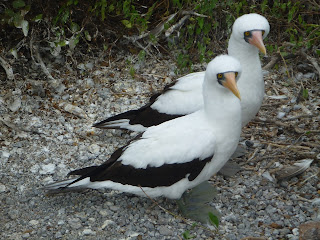 Nazca Boobies
 Red-Footed Booby
 Blue-Footed Booby
 Mating Dance of the Blue-Footed Boobies
The Nazca Booby is a species endemic to Galapagos--that is, it is found nowhere else in the world. The Blue-footed Booby and the Red-footed Booby are endemic subspecies that are found only in Galapagos, but other closely related members of the species are found elsewhere in the world.
They all feed by plunge diving for fish. Although they breed close to one another, they avoid competition in fishing by not fishing close to one another. Blue-footed boobies fish close to shore. Nazca boobies fish farther out to sea within the islands. Red-footed boobies fish even farther out in the open ocean outside the islands.
Although he did not use the terms, Carlos often appealed to what Darwinian biologists call "competitive exclusion" and "niche differentiation." Where similar species compete for the same food resources, either one will drive out the other, or they will coexist when the species differentiate their niches so that resources are divided between them. The boobies can coexist and avoid competing for fish by fishing in different spots and thus carving out distinct niches. So while natural selection is driven by competition between species, natural selection can also favor species finding ways to avoid directly competing with one another for scarce resources.
People are amused by the clownish look of the mating dance of the blue-footed boobies. Indeed, the name "booby" is derived from the Spanish word bobo--a fool or a clown. Here's a video of the mating dance.
Despite their clownish appearance, the reproductive and parenting strategies of the boobies are deadly serious. As Carlos explained to us, the supply of food determines how many offspring they can rear. Blue-footed boobies lay up to three eggs that are incubated by both parents for up to 42 days. If the food supply runs short, the young can eat their siblings. Nazca boobies can lay up to two eggs, but they cannot rear more than one offspring. Laying two eggs seems to be insurance if one of the eggs is bad. If both eggs hatch, one sibling will kill the other. Biological studies have shown that the killers tend to be innately more aggressive, with higher levels of testosterone. Oddly, those young that are born without siblings have been observed attacking the young of other birds, as though their instinct for sibilicide needs to be satisfied. Some pictures of Nazca booby sibilicide can be found here.
Some of the people in my tour group had spoken previously about how "cute" the boobies were, but then they were disturbed by these Darwinian explanations about their need for siblicide and cannibalism as reproductive strategies. This illustrates the point that Darwin made in his debate with Frances Cobbe--that evolutionary science reveals a world that is without moral design, and thus there is no cosmic grounding for right and wrong. Those with Platonic longings for a moral cosmology conclude from this that Darwinism is nihilism, because they cannot accept the moral anthropology of Darwinian science--that human morality arises from evolved human nature without any cosmic normativity to support it. Here is where Darwinian science continues the tradition of Lucretian liberalism as revived by David Hume and Adam Smith, which forces us to consider the possibility that Friedrich Nietzsche was right in claiming that we could properly "describe the entire phenomenon of morality as animal."
The Darwinian evolution of family conflict, including siblicide, in birds and other animals has been explained by behavioral ecologist Douglas Mock. See Mock, More than Kin and Less than Kind: The Evolution of Family Strife (Harvard University Press, 2006), and Mock and Geoffrey A. Parker, The Evolution of Sibling Rivalry (Oxford University Press, 1997). See also Douglas Mock, Hugh Drummond, and Christopher H. Stinson, "Avian Siblicide," American Scientist, 78 (1990): 438-49, which can be found online. For some evidence that hormonal changes in Nazca boobies promote the aggression of dominant, first-hatched chicks against subordinate, second-hatched chicks, see Elisa Tarlow, Martin Wikelski, and David Anderson, "Hormonal Correlates of Siblicide in Galapagos Nazca Boobies," Hormones & Behavior 40 (2001): 14-20, available online.
Some posts on related themes can be found here and here.
Overnight, the Cormorant navigated to Marchena, which is one of the most isolated islands and one rarely visited by tour boats.
We hiked over Black Beach. The beach is black because it's composed of volcanic ash. The large pieces of driftwood on the beach that have floated in from hundreds of miles away suggest how the islands could have been originally settled by animals floating on wood from the South American mainland.
Reptiles could have survived such a long trip without water better than mammals, which could explain why there are no large land mammals on the Galapagos, and why the reptiles are dominant.
There are marine iguanas here, as there are on all the main islands. They are the only marine lizards in the world. They live largely on land, but they feed almost entirely on red and green algae. They can remain submerged for over 10 minutes.
Here's a video of marine iguanas feeding.


On Marchena, there are no land iguanas or tortoises, which feed on cacti. Consequently, as Carlos pointed out to us, the species of cactus on this island grows low to the ground, because it does not need a high stalk to protect itself from iguanas and tortoises eating it. Opuntia helleri is a low-growing species that grows only in Marchena and other northern islands that have never had a tortoise or land iguana population.


June 21
Having navigated overnight to the island of Genovesa, the Cormorant anchored in Darwin Bay, which is an almost perfectly circular bay created when a crater collapsed into the sea.


In the morning, we hiked a trail where we were surrounded by thousands of breeding sites for nazca boobies, who make their nests on the ground, and red-footed boobies, who make their nests in trees. The third species--the blue-footed boobies--is the most famous of the three.


The Nazca Booby is a species endemic to Galapagos--that is, it is found nowhere else in the world. The Blue-footed Booby and the Red-footed Booby are endemic subspecies that are found only in Galapagos, but other closely related members of the species are found elsewhere in the world.
They all feed by plunge diving for fish. Although they breed close to one another, they avoid competition in fishing by not fishing close to one another. Blue-footed boobies fish close to shore. Nazca boobies fish farther out to sea within the islands. Red-footed boobies fish even farther out in the open ocean outside the islands.
Although he did not use the terms, Carlos often appealed to what Darwinian biologists call "competitive exclusion" and "niche differentiation." Where similar species compete for the same food resources, either one will drive out the other, or they will coexist when the species differentiate their niches so that resources are divided between them. The boobies can coexist and avoid competing for fish by fishing in different spots and thus carving out distinct niches. So while natural selection is driven by competition between species, natural selection can also favor species finding ways to avoid directly competing with one another for scarce resources.
People are amused by the clownish look of the mating dance of the blue-footed boobies. Indeed, the name "booby" is derived from the Spanish word bobo--a fool or a clown. Here's a video of the mating dance.
Despite their clownish appearance, the reproductive and parenting strategies of the boobies are deadly serious. As Carlos explained to us, the supply of food determines how many offspring they can rear. Blue-footed boobies lay up to three eggs that are incubated by both parents for up to 42 days. If the food supply runs short, the young can eat their siblings. Nazca boobies can lay up to two eggs, but they cannot rear more than one offspring. Laying two eggs seems to be insurance if one of the eggs is bad. If both eggs hatch, one sibling will kill the other. Biological studies have shown that the killers tend to be innately more aggressive, with higher levels of testosterone. Oddly, those young that are born without siblings have been observed attacking the young of other birds, as though their instinct for sibilicide needs to be satisfied. Some pictures of Nazca booby sibilicide can be found here.
Some of the people in my tour group had spoken previously about how "cute" the boobies were, but then they were disturbed by these Darwinian explanations about their need for siblicide and cannibalism as reproductive strategies. This illustrates the point that Darwin made in his debate with Frances Cobbe--that evolutionary science reveals a world that is without moral design, and thus there is no cosmic grounding for right and wrong. Those with Platonic longings for a moral cosmology conclude from this that Darwinism is nihilism, because they cannot accept the moral anthropology of Darwinian science--that human morality arises from evolved human nature without any cosmic normativity to support it. Here is where Darwinian science continues the tradition of Lucretian liberalism as revived by David Hume and Adam Smith, which forces us to consider the possibility that Friedrich Nietzsche was right in claiming that we could properly "describe the entire phenomenon of morality as animal."
The Darwinian evolution of family conflict, including siblicide, in birds and other animals has been explained by behavioral ecologist Douglas Mock. See Mock, More than Kin and Less than Kind: The Evolution of Family Strife (Harvard University Press, 2006), and Mock and Geoffrey A. Parker, The Evolution of Sibling Rivalry (Oxford University Press, 1997). See also Douglas Mock, Hugh Drummond, and Christopher H. Stinson, "Avian Siblicide," American Scientist, 78 (1990): 438-49, which can be found online. For some evidence that hormonal changes in Nazca boobies promote the aggression of dominant, first-hatched chicks against subordinate, second-hatched chicks, see Elisa Tarlow, Martin Wikelski, and David Anderson, "Hormonal Correlates of Siblicide in Galapagos Nazca Boobies," Hormones & Behavior 40 (2001): 14-20, available online.
Some posts on related themes can be found here and here.
Tuesday, July 09, 2013
An Evolutionary Tour of the Galapagos (4): Love, Reproductive Fitness, and Transcendent Longings
June 18
We navigated to Fenandina and explored the Mangle Point area. In the afternoon, we went back to Isabella to hike around Urvina Bay.
Fernandina is one of the most pristine of the islands, with few introduced species.
Urvina Bay is a special site because one can see the consequences of geological uplift. In 1954, this area was raised by up to 10 meters. In 1994, it was raised by 90 cm. The evidence for this is everywhere--shells, sea urchin segments, and lots of coral heads--which shows the underwater origins of the land.

June 19
During the night, the Cormorant navigated to the Espinosa Point area of Fenandina, where we saw lots of sea lions, and Carlos explained their breeding behavior. The mature females must find suitable areas for breeding--such as a protected tidal pool where the young can swim safely until they are old enough to swim farther out in the sea. The sea lions are serial polyandrists. A dominant male will fight for dominance over the breeding territory, but the male's dominance is brief, often only a few weeks. The females then move on to a new breeding territory with a new dominant male.
We saw more flightless cormorants, and Carlos explained their courtship behavior, which includes the male presenting the female with pretty ornaments for the nests.
We also talked about the frigate birds, who inflate their red neck pouch for sexual display, which seems to be an example of sexual selection. Males with such inflated pouches cannot even feed themselves.


Repeatedly, Carlos brought up the courtship and breeding behavior of the animals we saw, and he explained it in Darwinian terms as evolved adaptations for reproduction. This fascinates us because we see how similar this is to our human behavior in courtship, conjugal bonding, and parental care, although the behavioral reproductive patterns differ for different animals in ways that are adaptive for them. This intimates to us that our deepest desires for loving and being loved might be explained scientifically as evolved strategies for reproductive fitness.
Of course, many people deny this Darwinian explanation of human behavior. As I have noted in some previous posts, existentialist conservatives like Peter Lawler argue that Darwinism is only partly true, because while it explains our animal sociality, it cannot explain our deepest existential longings for love and meaning in our lives and our fear of death. We cannot live with the Darwinian teaching that we are just very smart social mammals who live for a time and then die, in a universe that does not care for or about us. We are moved by transcendent longings for a universe in which we are the center of attention: It's all about me!
A tour of the Galapagos does not support such transcendental human narcissism. This is a world that evolved for millions of years without any human beings present. In fact, much of the charm of the Galapagos, as Darwin noted, is that since the animals did not evolve any instinctive fear of humans, they seem remarkably tame--we can move among them, and they do not hide or run away.
Galapagos is a world born out of volcanic fire, a world of great beauty, but also a world of suffering and death. It is a world indifferent to our human cares. But it is also a world that appeals to us: we care about this world, and we want to preserve and cultivate its biodiversity, because we find deep satisfaction in seeing it, studying it, and pondering how it illuminates the cosmic process of evolution that gave birth to us, and to our capacity for seeing, studying, and pondering the meaning of it all during the brief lives that we have on this Earth.
An Evolutionary Tour of the Galapagos (3): Flightless Cormorants and Creationism
June 17
Overnight, the Cormorant navigated to Punta Moreno, an area on the southwestern coast of Isabella. After hiking there in the morning, we sailed farther north to Elizabeth Bay on Isabella.
We saw lots of wildlife--pink flamingos, flightless cormorants, marine iguanas, penguins, sea turtles, and pelicans.
The Galapagos penguins are unique to the islands. It's remarkable to see a species of penguins at the Equator!
The flightless cormorants and marine iguanas are also unique to the Galapagos. The flightless cormorants are a remarkable example of evolutionary adaptation. They are only found in the northern and western areas of Isabella and in Fernandina.


Like all cormorants, the Galapagos cormorants dive deep in the sea for fish, eels, and octopus. But unlike all other cormorant species, the Galapagos cormorants have wings that they cannot use for flying. Notice how puny their wings are and how they have to spend long periods drying their wings. Why would God or the Intelligent Designer create birds with wings that serve no purpose? Doesn't this look like unintelligent design?
The evolutionary explanation is that when the flying cormorants came to the Galapagos, they found themselves in an environment in which they were not threatened by any major predators that would make flying advantageous for them. Consequently, natural selection might favor those birds with wings that were not well adapted for flying, and eventually the whole species would become flightless. This would be an example of the evolution of a new species, in which organs that once had a purpose evolve into vestigial organs with no purpose.
So how would the creationists explain this? Some would say that God simply chose to create flightless cormorants in the Galapagos and nowhere else for His own inscrutable reasons. But this is not very satisfying as an explanation, particularly if there is no explanation as to exactly where, when, how, and why the Creator did this. These creationists accept the idea of change within species (microevolution) but deny the idea of changing from one species to another (macroevolution).
And yet some creationists accept the evidence for the emergence by natural selection of new species--like the flightless cormorant. But then they argue that this actually supports creationism and not Darwinism. According to the first chapter of Genesis, God created all living beings "after their kind" (in the King James translation). But what is a "kind"? In Darwin's time, many creationists interpreted "kind" to mean "species" in the modern sense of Linnean taxonomy. If so, then the natural evolution of new species would contradict the creationist belief in the special creation of each species by God. But now some creationists--like those represented by "Creation Ministries International" and "Answers in Genesis"-- argue that Biblical "kinds" are general groups of similar animals that correspond to higher levels of taxonomy above the species level. So, for example, one "kind" of animal might be the "family" of canids, which includes different species--foxes, wolves, dogs, jackals, and coyotes. Part of the reasoning here is that Noah's Ark was not large enough to include two of each species, but it could have been large enough to include two of each "kind." Then, each "kind" could diversify by mutation and natural selection into many new species.
As you can see in the link to "Creation Ministries International," these creationists insist: "It can hardly be over-emphasized: natural selection is not evolution; indeed, natural selection was discovered by creationists before Darwin, and is now an important part of the biblical creation model." Their argument is that adaptation and natural selection occur when genes are removed from a population. But this is not Darwinian evolution, which would require new genetic information, which can only come by God's creative activity.
They argue that Darwinian evolution requires change from one kind to another. But creationism allows natural selection for adaptation to bring change within kinds. So, for example, flightless cormorants arose by natural selection as a new species of cormorant in the Galapagos. But still, the flightless cormorant is a cormorant; it is the same kind of animal as all other cormorants.
Consequently, these creationists have expanded the notion of "microevolution" to include the evolution of new species, which they affirm as compatible with the Biblical story of God's creation of "kinds." But they deny that there has been any Darwinian "macroevolution," understood as evolutionary change from one kind to another kind.
Aren't these creationists conceding a lot to Darwinian evolution by conceding that there has been a natural evolutionary emergence of new species without God's miraculous intervention?
Some of the intelligent design proponents go even further in their concessions to Darwinian evolution. For example, Michael Behe--the leading proponent of intelligent design theory among biologists--accepts as scientific fact that human beings evolved from ancient primate ancestors.
An Evolutionary Tour of the Galapagos (2): Invasive Species and Anthropocentric Morality
June 16
After an overnight navigation to the island of Isabella, the Cormorant was anchored at Puerto Villami, the only permanent settlement on the island. Although it is the largest of the Gallapagos Islands, Isabella is inhospitable to human settlement, because it has the ruggedness of one of the newer islands shaped by geologically recent volcanic activity. The Sierra Negra volcano erupted as recently as 2005, and it has the largest caldera in the Galapagos.
 Eruption of the Sierra Negra Volcano in 2005
Isabella is one of the four islands visited by Darwin, who went from San Cristobal (Chatham) to Floreana (Charles) to Isabella (Albermarle) to Santiago (James).
The geological history of the Galapagos Islands has made them a natural laboratory for the study of evolution. The islands lie about 600 miles from the mainland coast of Ecuador. The geological science of plate tectonics allows us to see that the islands lie at the meeting point of two submarine ridges--the Carnegie Ridge and the Cocos Ridge. This meeting point of the two ridges is known as the Galapagos Hot Spot because of its volcanic activity. The islands lie at the northern edge of the Nazca Plate, which is moving eastward at a rate of 2 cm per year. This movement is responsible for the building of the Andes mountain range--the longest mountain range in the world--and for the volcanic and earthquake activity through the western edge of South America. As the plate moves eastward, while the Hot Spot remains stationary, a series of volcanic islands are formed, and thus the western islands are newer than the eastern islands. The older islands in the east--like San Cristobal--have a longer history of erosion, which produces more vegetation and makes them more hospitable to human settlement. The newer islands in the west--like Isabella and Fernandina--are largely uninhabitable because of rugged lava landscapes.
Carlos told us a story of the Ecuadorian special forces military unit that decided to use one of the most rugged areas of lava for their training. They planned to march across it in a few days. But their boots were soon lacerated by the sharp lava, and they had to be rescued by helicopter.

Since lava is usually too porous to hold rainwater, the lack of freshwater makes the islands even more inhospitable to life. Carlos pointed out the lichen on the lava fields as being possibly the first form of life that would develop after the lava flows had cooled. More complex forms of life would have arrived by migration from the mainland, and then by evolution they would be adapted for the diverse environments of the islands.
We visited a tortoise breeding center run by the National Park Service not far from Puerto Villamil. When Darwin visited the islands in 1835, there were probably hundreds of thousands of giant tortoises. Today, the total population is estimated to be around 15,000 individuals. In the 19th century, many of the tortoises were taken onto whaling boats as a good source of food, because the tortoises could survive for many months without food or water. Today, the biggest threat to the tortoises are the black rats that eat tortoise eggs and young tortoises. That's why an artificial breeding program is necessary to preserve the tortoises. The black rats are identified as an "invasive" species introduced by human beings. Similarly, feral goats are another "invasive" species that threatens the tortoises by eating the vegetation that they feed on.


The National Park Service has eradicated the feral goats from some parts of the islands, and now there is a program for eradicating the black rats. As I have suggested in a previous post, this illustrates the evolutionary basis of morality as rooted in human desires. There is no cosmic standard by which we can say that giant tortoises are "better" or "higher" than black rats and goats. But if we take an interest in the tortoises, if we want to see them and study them, and if tourists come to the Galapagos to see them, then we can decide that the tortoises should be protected and the black rats and goats should be eradicated. Here we appeal not to some ecocentric or biocentric standard of value--as some "deep ecologists" have asserted--but to our anthropocentric desires. Strictly speaking, even the distinction between "native" or "endemic" species and "invasive" species is a human value judgment, because even the "native" species were originally "invaders" from the mainland. Our management of the distribution of life forms in the Galapagos Islands is an exercise in human niche construction, by which we construct the environment of the Galapagos to create a cognitive and aesthetic niche to satisfy our natural desires.
After an overnight navigation to the island of Isabella, the Cormorant was anchored at Puerto Villami, the only permanent settlement on the island. Although it is the largest of the Gallapagos Islands, Isabella is inhospitable to human settlement, because it has the ruggedness of one of the newer islands shaped by geologically recent volcanic activity. The Sierra Negra volcano erupted as recently as 2005, and it has the largest caldera in the Galapagos.
Isabella is one of the four islands visited by Darwin, who went from San Cristobal (Chatham) to Floreana (Charles) to Isabella (Albermarle) to Santiago (James).
The geological history of the Galapagos Islands has made them a natural laboratory for the study of evolution. The islands lie about 600 miles from the mainland coast of Ecuador. The geological science of plate tectonics allows us to see that the islands lie at the meeting point of two submarine ridges--the Carnegie Ridge and the Cocos Ridge. This meeting point of the two ridges is known as the Galapagos Hot Spot because of its volcanic activity. The islands lie at the northern edge of the Nazca Plate, which is moving eastward at a rate of 2 cm per year. This movement is responsible for the building of the Andes mountain range--the longest mountain range in the world--and for the volcanic and earthquake activity through the western edge of South America. As the plate moves eastward, while the Hot Spot remains stationary, a series of volcanic islands are formed, and thus the western islands are newer than the eastern islands. The older islands in the east--like San Cristobal--have a longer history of erosion, which produces more vegetation and makes them more hospitable to human settlement. The newer islands in the west--like Isabella and Fernandina--are largely uninhabitable because of rugged lava landscapes.
Carlos told us a story of the Ecuadorian special forces military unit that decided to use one of the most rugged areas of lava for their training. They planned to march across it in a few days. But their boots were soon lacerated by the sharp lava, and they had to be rescued by helicopter.

Since lava is usually too porous to hold rainwater, the lack of freshwater makes the islands even more inhospitable to life. Carlos pointed out the lichen on the lava fields as being possibly the first form of life that would develop after the lava flows had cooled. More complex forms of life would have arrived by migration from the mainland, and then by evolution they would be adapted for the diverse environments of the islands.
We visited a tortoise breeding center run by the National Park Service not far from Puerto Villamil. When Darwin visited the islands in 1835, there were probably hundreds of thousands of giant tortoises. Today, the total population is estimated to be around 15,000 individuals. In the 19th century, many of the tortoises were taken onto whaling boats as a good source of food, because the tortoises could survive for many months without food or water. Today, the biggest threat to the tortoises are the black rats that eat tortoise eggs and young tortoises. That's why an artificial breeding program is necessary to preserve the tortoises. The black rats are identified as an "invasive" species introduced by human beings. Similarly, feral goats are another "invasive" species that threatens the tortoises by eating the vegetation that they feed on.


The National Park Service has eradicated the feral goats from some parts of the islands, and now there is a program for eradicating the black rats. As I have suggested in a previous post, this illustrates the evolutionary basis of morality as rooted in human desires. There is no cosmic standard by which we can say that giant tortoises are "better" or "higher" than black rats and goats. But if we take an interest in the tortoises, if we want to see them and study them, and if tourists come to the Galapagos to see them, then we can decide that the tortoises should be protected and the black rats and goats should be eradicated. Here we appeal not to some ecocentric or biocentric standard of value--as some "deep ecologists" have asserted--but to our anthropocentric desires. Strictly speaking, even the distinction between "native" or "endemic" species and "invasive" species is a human value judgment, because even the "native" species were originally "invaders" from the mainland. Our management of the distribution of life forms in the Galapagos Islands is an exercise in human niche construction, by which we construct the environment of the Galapagos to create a cognitive and aesthetic niche to satisfy our natural desires.
Subscribe to:
Posts (Atom)